What can humans do that AI cannot?
The previous section was about what humans are losing, what they are afraid of, and what the leadership team has to do to honor that experience. That framing is necessary. It is also incomplete, because it can leave the impression that the human role in an AI-Native company is primarily defensive. It is not. What follows is the positive case for what humans bring, made as a strategic argument rather than as a sentimental one.
One influential strain of AI-Native discourse places humans at the edge of operations: machine intelligence at the center, people aligning it from the boundary, and the workforce becoming whatever automation has not yet absorbed. The Coinbase framing introduced in Section 2.2 points in this direction, and variants are appearing in other public commitments. It deserves direct scrutiny rather than automatic acceptance.
That framing can produce a strategic error. It treats work as monolithic and AI as a capability expanding toward its boundary. Work has multiple dimensions, and AI is differentially capable across them. Humans bring forms of value tied to task performance and also to embodiment, social participation, responsibility, and lived stakes. A company that protects and amplifies those forms may outperform one that treats people as residue. That is a strategic hypothesis to test in the operation, measured like any other.
I want to name what humans bring. Seven kinds of value, with the understanding that the list is not exhaustive and that the kinds overlap. They are organizing categories, open to additions.
The categories are not claims that a model can never produce a novel option, empathetic sentence, ethical analysis, or coherent story. Models already do all four. The distinction is where standing, participation, responsibility, and lived consequence enter the work. Performance can be generated. Authority and accountability still have to be placed, and a company that places them carelessly has made an operating-model decision whether it recognizes it or not.
Intellectual lineage. The argument has a serious philosophical history, though that history should not be treated as proof of permanent machine limits. Lucy Suchman's 1987 Plans and Situated Actions challenged the idea that human action is simply the execution of pre-formed plans, emphasizing how action is produced within unfolding situations. Hubert Dreyfus argued from phenomenology that expertise depends on embodiment, contextual involvement, and intuitive judgment that cannot be understood as rule-following alone. Hubert and Stuart Dreyfus also developed the influential five-stage skill-acquisition model: novice, advanced beginner, competent, proficient, expert. Modern AI differs substantially from the systems these authors examined, and some of Dreyfus's capability predictions have aged unevenly. Their durable contribution here is the question they force: what is lost when performance is abstracted from situation, body, relationship, and responsibility?
Suchman, Lucy A. (1987). Plans and Situated Actions: The Problem of Human-Machine Communication. Cambridge UP. / Dreyfus, Hubert L. (1972, updated 1992). What Computers Still Can't Do. MIT Press. / Dreyfus, H. L., and Dreyfus, S. E. (1986). Mind Over Machine.
What the research shows. A landmark field experiment by researchers affiliated with Harvard, BCG, MIT, Warwick, and Wharton studied 758 BCG consultants and described a jagged technological frontier. On selected tasks designed to fall inside the tested model's frontier, AI-assisted participants completed 12.2 percent more tasks, worked 25.1 percent faster, and produced outputs rated more than 40 percent higher in quality. On a selected task outside that frontier, AI-assisted participants were 19 percentage points less likely to reach the correct answer. The experiment does not map every task or establish a permanent human-machine boundary. It shows that capability can vary sharply across superficially similar work and that users may not know which side they are on. An operating model that assumes uniform capability will fail precisely where polished output disguises that boundary.
Dell'Acqua, F., McFowland, E., Mollick, E., Lifshitz-Assaf, H., Kellogg, K., et al. (2023). "Navigating the Jagged Technological Frontier." Harvard Business School Working Paper 24-013.
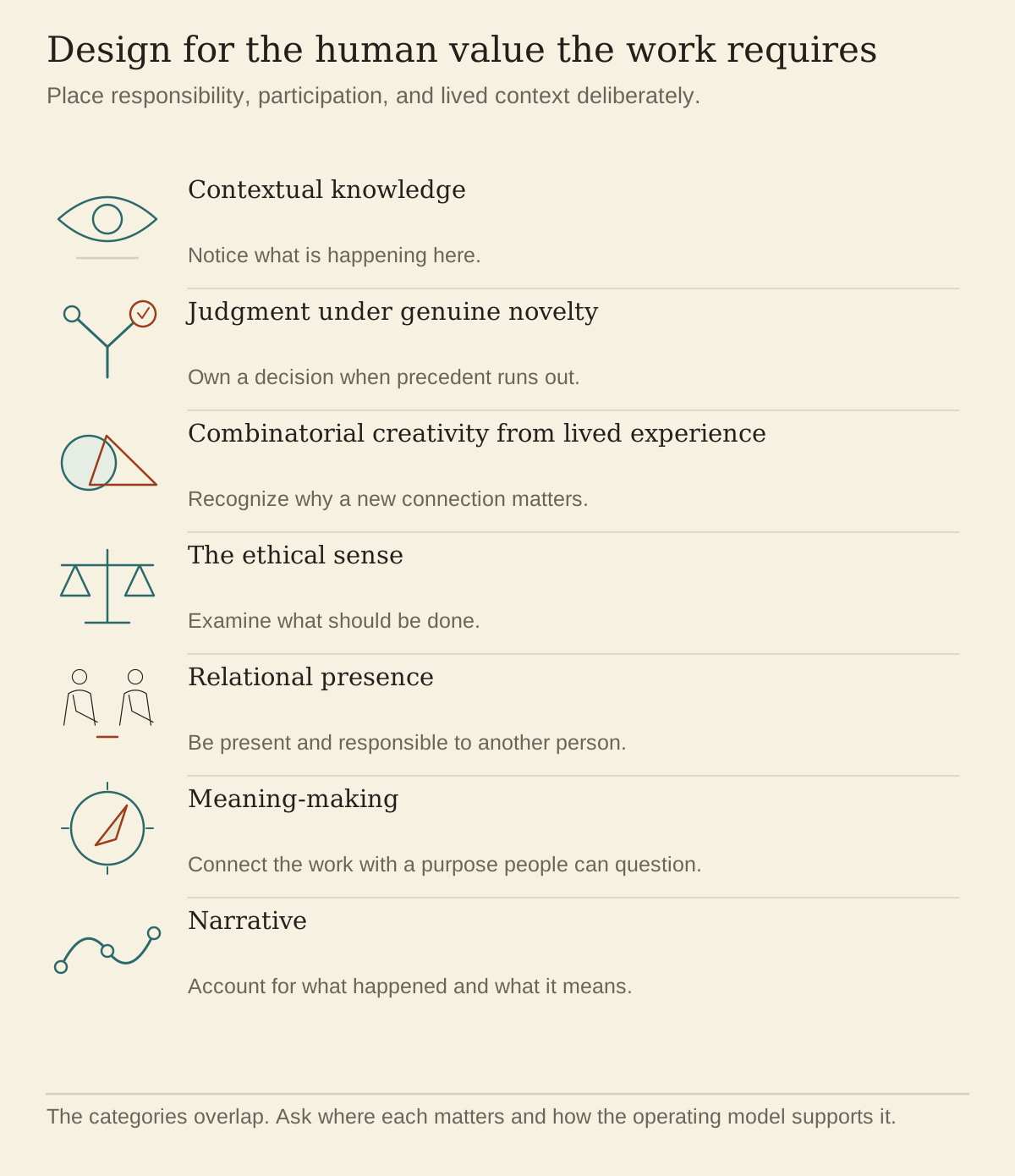
Contextual Knowledge
First, humans bring the lived sense of what is going on in this place, with these people, right now. AI can be given extensive multimodal and historical context, sometimes detecting patterns people miss. It still receives a representation selected by sensors, records, interfaces, and permissions. An experienced person participates in the situation. The supervisor hears that a machine has sounded slightly different for a week. The account manager senses a change in the customer's tone not captured by a transcript. The teacher notices that an engaged student is sitting differently today. Imagine a hospital nurse, three hours into a night shift, who pauses because a patient does not look right even though the monitor reads normally. She escalates. The cardiac event comes an hour later.
This kind of knowledge is accumulated calibration to a situation. People can misread it, and analytic systems can improve it. The distinctive value is that a person can integrate weak signals with lived context and take responsibility for escalating before the evidence is clean. Strong systems combine that situated judgment with measurements rather than forcing a choice between them.
Judgment Under Genuine Novelty
Second, humans bring accountable judgment in situations that have not happened before. Both humans and models draw on prior experience or learned patterns, and both can generate new combinations. When a situation has no close precedent, model output may still be useful, but its apparent coherence can outrun the evidence available to validate it.
The cases that matter most in many businesses include unprecedented customer situations, supply-chain disruptions without a close historical analog, competitive moves that require reframing the market, and crises in which the playbook does not apply. In these situations, capable humans can recognize novelty, suspend a default frame, draw across experience, consult others, and own a decision under uncertainty. AI can contribute options and analysis. It does not bear the institutional, legal, or moral consequences of choosing among them.
This kind of judgment is not the routine application of expertise. It is the higher-order capacity to recognize that the situation is novel, to suspend the default analytic frames, and to construct a response from first principles. The capacity is rare even among experienced workers. The capacity is, in my experience, what distinguishes the senior people whose judgment the company depends on from the senior people whose role can be substantially automated.
Combinatorial Creativity from Lived Experience
Third, humans bring creativity shaped by lived experience that no training corpus fully represents. Generative AI can produce surprising combinations and is not usefully dismissed as mere copy-and-paste. It is nevertheless conditioned by training, context, tools, and selection. A person who has spent thirty years in a domain brings a different body of combinatorial material: specific colleagues, industry shifts, failures, successes, bodily environments, and the felt consequences of each.
Many original ideas come from people who have crossed boundaries: the doctor who started as a physicist, the financial analyst who taught poetry, the product manager who spent five years in a plant. AI can support cross-domain reasoning. What the person adds is a lived understanding of why the combination matters, where the analogy breaks, and what consequences follow in practice. A system may reach the same combination.
The strategic implication is direct but not automatic. A company that hires across backgrounds and gives people real authority and space to contribute can access a wider range of frames and lived intersections. Demographic variety without inclusion does not guarantee creativity, and a homogeneous team can still produce excellent work. Diversity is more than compliance, however: under the right conditions it is an operational asset, and AI does not erase the value of who has actually lived which parts of the problem.
The Ethical Sense
Fourth, humans bring responsibility for what should be done rather than only analysis of what could be done. AI can discuss ethics, apply frameworks, and surface competing considerations. Current systems do not feel moral injury, belong to a community, or bear accountability. Humans can feel that a course is wrong before they can fully articulate why. That intuition can encode bias as easily as wisdom. It is still a signal that deserves examination when explicit frameworks fail to settle the case.
This matters operationally because most consequential business decisions have ethical dimensions, and the ethical dimensions often determine whether the decision works. A company can produce a perfectly legal action that the workforce knows is wrong, and the workforce will respond by disengaging from the company. A company can refuse a profitable action because the workforce will not participate in something they cannot defend, and the company will be better off for the refusal even though the analysis would have argued for the action.
Humans in the operating model remain the accountable source of this judgment. A leadership team that includes people willing and empowered to say "this is wrong, regardless of what the analysis says" adds protection no governance framework supplies alone. Human objection also needs evidence, due process, and challenge; conscience is not a license for unexamined preference. Companies that punish good-faith ethical objection weaken a capacity that is difficult to rebuild and may discover the loss through misconduct, scandal, or reputational damage.
Relational Presence
Fifth, humans bring the felt experience of being met by another person. AI can generate empathetic language, adapt its tone, and sometimes outperform a rushed human on measures of perceived warmth. It is not a person, and users do not always know when they are interacting with AI unless the system discloses it. The relevant distinction is not whether the words sound caring. It is whether a person is present, responsible, and capable of entering an ongoing reciprocal relationship.
The relational dimension matters in every situation where humans are doing something that depends on trust. The customer making a decision that involves real money. The employee navigating a difficult moment in their career. The patient receiving news that changes the trajectory of their life. The student trying to understand something that requires a teacher to read their face and adjust. In these situations, the presence of a real human, who is paying attention, who is responding to the specific person in front of them, who is bearing witness to what is happening, is doing work that AI does not do.
Automating every one of these interactions may look efficient in the quarter. In some low-stakes settings it may also improve access or consistency. In high-trust moments, undisclosed or poorly designed automation risks a later cost in alienation, error, or deteriorating trust. That risk should be measured rather than assumed away.
Meaning-Making
Sixth, humans construct and contest the frames that orient other people. A leader who articulates what the company is for in a way the workforce can carry through difficult quarters is doing more than generating language. The frame is an act of meaning-making backed, or contradicted, by the leader's history and choices. AI can help draft the words. It cannot supply the legitimacy the audience grants, or withholds, based on who says them and what that person has done.
Meaning-making is also what experienced workers do with newer ones. AI can explain procedures and offer interpretations. A mentor can connect how the work is done with why this community believes it matters, answer for the culture being transmitted, and allow the newer person to challenge it. Culture travels many ways, and human-to-human transmission is one of the ways it becomes reciprocal, passed back and forth between people.
Meaning-making is work. It can be selected for and it can be developed. Treating it as a soft skill rather than as a capacity the operating model depends on is how a company loses it without noticing.
Narrative
Seventh, humans place events in a story that makes them coherent. The events of a company do not arrive already assembled into one honest through-line. The workforce experiences them as connected because someone has done the work of interpreting what belongs together, what changed, and what it means. Narration is the human act of making the year's activities intelligible without pretending the story is the only possible one.
A workforce that has a coherent narrative about what the company is doing and why can absorb individual setbacks without losing momentum. A workforce that does not have a coherent narrative experiences setbacks as evidence that the company is failing, even when the setbacks are normal. The narrative is the difference. It is constructed by humans, primarily by leaders, drawing on their understanding of the company and their judgment about what to emphasize.
AI can summarize events and generate compelling narratives, including narratives tailored to a company's stated culture. What it cannot do on its own is possess the standing to decide which story the organization should live by or accept responsibility for what that story includes and excludes. Machines can produce prose. Narrative remains human work because people must authorize, contest, and live with the frame.
The Strategic Case Against the Humans at the Edge Framing
The seven kinds of value, taken together, make the strategic case. A company that designs around them can produce work competitors cannot replicate merely by buying the same AI tools. Contextual knowledge, judgment under novelty, lived creativity, ethical responsibility, relational presence, meaning-making, and narrative are parts of the operation whose value depends on more than generated task performance. Protecting and amplifying them can support durable advantage. Treating them as residue risks removing the conditions under which the work becomes trustworthy, distinctive, and worth doing.
The "humans at the edge" framing can lead operating models to underinvest in the seven. It can make headcount reduction look efficient while leaving quality, trust, learning, resilience, and exception handling unmeasured. Replacing experienced workers with less experienced workers supported by AI may work in some tasks and fail badly in others. The decision should follow evidence about where value resides, including evidence about what experience still contributes.
AI belongs in operations. The argument is for designing the operating model around the actual distribution of value, which puts AI at the center of some kinds of work and humans at the center of others. The Coinbase framing is correct for some kinds of work in some kinds of companies. It is wrong as a universal claim about where the intelligence sits and where the humans go. The right answer differs by archetype, by industry, by the specific value the company is trying to deliver. The wrong answer is the framing that assumes the question has been settled in favor of one position.
The next section addresses the cognitive posture that distinguishes workforces that produce the seven kinds of value over time from workforces that lose the capacity to produce them. The cognitive posture is one of the most consequential things a company can develop, and a leadership team can be deliberate about developing it.