What is the difference between using AI to think and letting AI do the thinking?
A team that was building a company inside the AI-Native question discovered, about a year into the work, that they had developed a habit they had not chosen. They were defaulting to Claude Code for technical decisions that they used to make by talking to each other. The shift had been gradual. Someone would have an idea about a feature. Instead of bringing it to a colleague, they would put it into the AI and see what the AI suggested. The AI was good. The suggestions were often useful. The colleague got skipped.
The team noticed the pattern when they realized they had not had a substantive conversation about an architectural decision in weeks. They had been making decisions. Those decisions had been informed by AI. Thinking they used to do together had been replaced, without anyone deciding it should be, by individual interactions with the AI followed by integration of whatever it said.
The team pulled back deliberately. They reinstated practices they had not realized they had lost. They started talking to each other again about substantive questions before going to AI in cases where shared judgment mattered. They used AI to deepen and sharpen their thinking rather than automatically substitute for discussion. In the team's assessment, the work improved, their thinking became more active, and the relationships recovered something that had been quietly dissolving.
I tell the story as a worked example of a distinction that runs through the entire AI-Native question: using AI for thinking versus using AI as thinking. From the outside the postures can look similar. The same person with the same tool may move between them even within one task. Over time, the pattern may compound. Active engagement exercises framing, evaluation, and judgment. Repeated delegation can reduce practice in whichever skills the person no longer performs. The outcome is a risk to monitor, and it varies by person and by use.
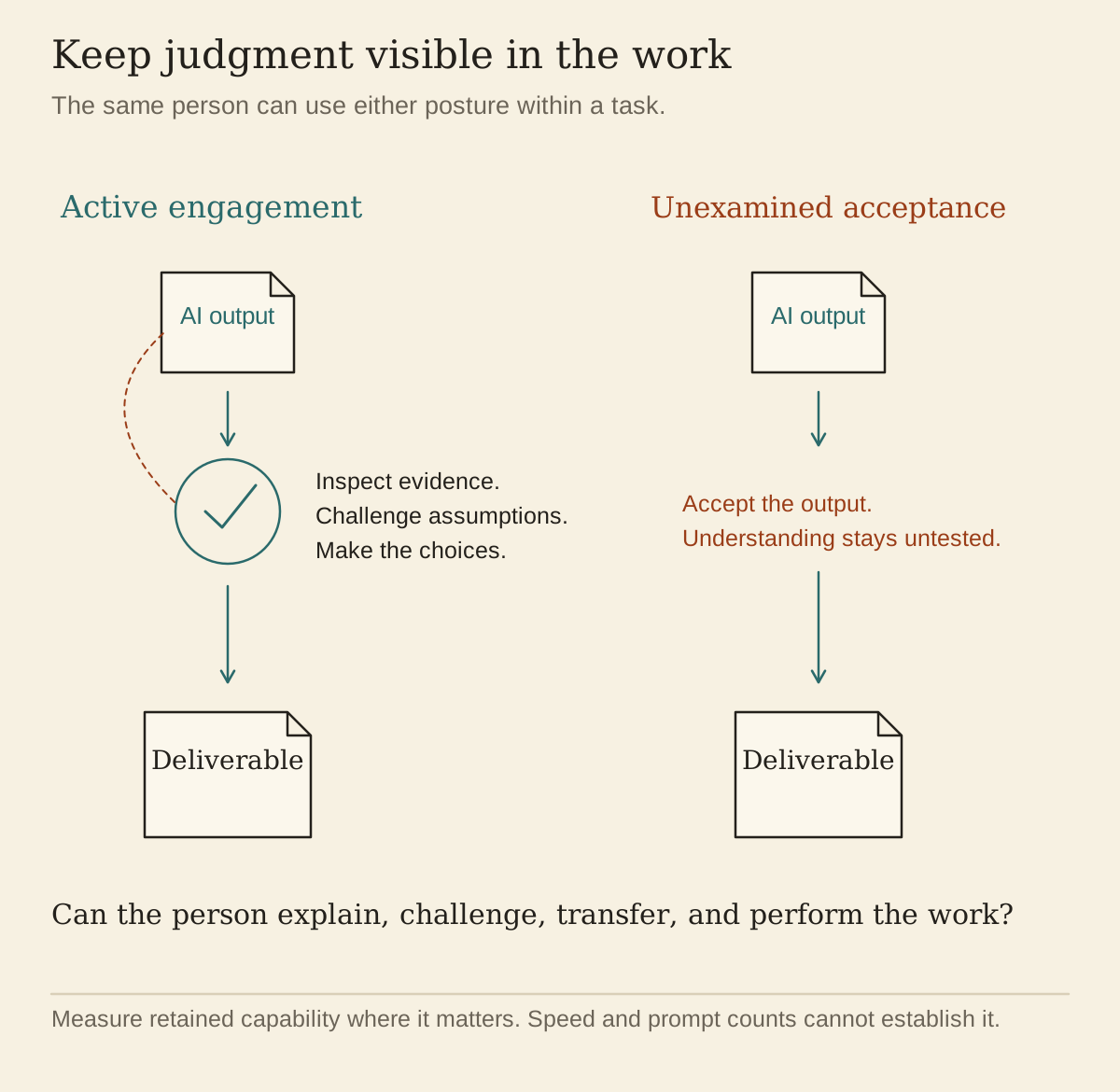
The Two Postures
Using AI for thinking means questioning its output, testing it against what you know, and deciding what to keep. The exchange should help you examine the problem more carefully.
AI as thinking is the posture in which the human treats the output as the thinking, full stop. The human prompts, the AI responds, and the human accepts and integrates mechanically. Framing a good task can itself require thought, and delegation is often rational. The risk arises when the person repeatedly offloads skills they still need to understand, supervise, or perform under exception. Those skills may weaken through disuse, and the weakness may remain hidden until the system fails or the context changes.
The first posture is more likely to exercise judgment. The second creates a risk of deskilling. Neither guarantees an outcome, because effects depend on the task, prior expertise, interface, incentives, and how performance is assessed. Companies that want sustainable capability should measure whether AI use leaves people better able to explain, challenge, transfer, and perform the work, a harder test than how quickly they submit it.
This is not a distinction between virtuous people who use little AI and careless people who use a lot. A person can delegate most of a routine task and remain fully capable of supervising it. Another can type every prompt personally while letting the model choose the frame, evidence, and conclusion. The better test is authorship in the deeper sense: who understood the problem, noticed what was missing, made the consequential choices, and can answer for the result when challenged. Tool-use metrics cannot tell you that.
The Research
The concern is not unique to AI. Research on cognitive offloading examines how people shift memory, calculation, navigation, and other work to external aids. Offloading is not inherently harmful: writing, calculators, and search can free attention for higher-order work. The developmental question is whether the learner still practices and understands the capacity an assignment is meant to build. An aid can support deeper engagement or bypass it, depending on the design and use.
Research on AI-specific cognitive offloading is still preliminary. Educators report cases in which students submit fluent work they cannot defend, transfer, or extend, but anecdote does not establish prevalence or long-term decline. Experimental work suggests that how AI is used matters: structured engagement can support reasoning, while answer substitution can reduce effort on the target skill. The field does not yet justify a single claim about what AI does to every learner.
The working-life evidence is earlier still. Automation research gives reason to watch for deskilling, automation bias, and the loss of expertise needed during exceptions. AI can also scaffold learning, expose workers to alternatives, and raise the level at which they practice. The distinction in this chapter is therefore a design hypothesis: posture, task, interface, and incentives shape whether offloading substitutes for capability or helps build it.
What the research shows. Two 2025 studies are suggestive and easy to overstate. Michael Gerlich's mixed-method study of 666 participants reported a strong negative correlation (r = -0.68) between reported AI-tool use and critical-thinking scores, with cognitive offloading as a proposed mediator. Its observational design cannot establish that AI use caused lower critical thinking; prior ability, education, age, task choice, and other factors may influence both. Kosmyna and colleagues assigned 54 adults to write essays using an LLM, search, or no external tool across the first three sessions; only 18 completed the crossover session. The preprint reported the weakest EEG connectivity in the LLM condition along with linguistic and recall differences. EEG connectivity during one writing task is not a direct measure of atrophy, intelligence, or long-term capability, and published critiques have raised design, reproducibility, and reporting concerns. The studies justify attention and better experiments, and stop short of showing brain decline.
Gerlich, M. (2025). "AI Tools in Society: Impacts on Cognitive Offloading and the Future of Critical Thinking." Societies 15(1):6. / Kosmyna, N., et al. (2025). MIT Media Lab. "Your Brain on ChatGPT" pre-print study.
The Slow-Feedback Problem
What makes this distinction operationally dangerous is the possibility of slow feedback. AI-assisted work can remain acceptable while unaided recall, first-principles production, or exception handling receives less practice. That does not prove meaningful decline after a year, and workers may notice or compensate in other ways. The risk is that a capability gap becomes visible only when tools are unavailable, output must be challenged, or an unfamiliar case requires the underlying skill. Rebuilding can then be slower and more expensive than preserving periodic practice would have been.
Slow feedback is hard to manage because immediate output metrics may reward offloading while revealing little about retained capability. Signals need not take years: explanation checks, transfer tasks, unaided samples, incident reviews, and simulation exercises can make them visible earlier. Without those checks, a company may attribute declining judgment or resilience to other causes because accumulated changes in how work is performed leave no single event to inspect.
The measurement has to begin with a capability the organization has decided it still needs. If engineers must repair a critical service without the generating system, test that. If analysts must recognize when a forecast violates the business, give them unfamiliar cases and ask for the diagnosis. If a profession requires independent judgment for licensure or safety, preserve the practice its standards demand. An abstract fear of cognitive decline produces generic training. A named capability, consequence, and test produce an operating decision.
A leadership team that takes this risk seriously will build practices that produce earlier signals. The practices are not exotic. I will name them next.
Watch for this. Deskilling can hide behind acceptable daily output. Watch for changes in work people still need to understand: the analyst who no longer forms a hypothesis without prompting, the strategist who stops challenging summaries, the engineer who cannot explain or repair generated code. Starting with a prompt or reviewing generated work is not itself evidence of decline. The signal is lost ability to explain, transfer, challenge, or perform when the situation requires it.
Eight Practices
Think first when prior judgment matters. Before going to AI on a question you should be able to frame independently, write down an initial position, assumptions, or uncertainties. Then use AI to test, refine, or challenge them. For unfamiliar discovery work, AI may reasonably come first; the requirement is active evaluation afterward. The purpose is to prevent the model's first frame from becoming yours by default.
Critique reflexively. Whenever AI produces something consequential, look deliberately for a weakness, missing alternative, or unsupported claim. The practice trains non-acceptance without requiring performative disagreement. Calibrated critique matters more than contrarianism; the goal is to detect real error.
Cross-check sources. Open and inspect sources supporting consequential claims, and sample-check lower-risk work according to an explicit standard. Verification is not always cheap, so effort should scale with consequence, novelty, and the cost of error. The habit is to treat a citation as a path to evidence rather than evidence by itself.
Disagree visibly. When you disagree with the AI's output, say so out loud in the prompt. The purpose is to make your own thinking visible to yourself, and to remind yourself that your judgment is the thing that matters. Manipulating the AI has nothing to do with it. The visibility of disagreement keeps the worker in the role of thinker rather than the role of accepter.
Hold AI-free practice. Some cognitive work benefits from periods without AI: unaided drafting, initial brainstorming, calculation, diagnosis, or reflection. Which activities matter depends on the capabilities the role must retain. Reserve enough practice to test and exercise those capabilities; do not make tool abstinence a ritual disconnected from the work.
Watch for default behavior. The slip into AI-as-thinking is not announced. It happens through accumulated small decisions, each of which would have looked reasonable in isolation. The discipline is to notice the pattern. The team that defaulted to Claude Code did not decide to default. They drifted. The watch for the drift is what allows the correction to happen before the capacities have eroded.
Teach others. Teaching another person requires you to organize knowledge, respond to misunderstanding, and discover what your explanation omitted. Explaining something to AI can also expose gaps, but a person contributes independent confusion, experience, and challenge. Teaching remains a powerful way to exercise understanding as AI takes on more work that once transferred knowledge through doing.
Reflect on use. At the end of a substantive piece of work, look at how you used AI. Where did the AI add value. Where did you do work that the AI could not have done. Where did you let the AI do work you should have done yourself. The reflection is what produces learning. Without it, the patterns repeat.
These eight form a checklist, but they should be adapted to consequence and role rather than enforced mechanically on every task. Practiced over time, they can support habits of active engagement. The practices are teachable and testable. Companies should evaluate whether they improve explanation, transfer, judgment, quality, and resilience rather than assume the checklist itself creates capability.
The organization has obligations here too. A worker cannot preserve deep practice while every incentive rewards speed, every deadline assumes maximum automation, and every AI-free exercise is treated as inefficiency. Teams need time to compare approaches, permission to question generated work, access to source material, and assignments that still develop judgment. Managers need to distinguish a temporary learning cost from poor performance. Otherwise the company will celebrate the output gain while quietly removing the conditions under which capability is built.
The Strategic Case at the Company Level
The strategic argument for caring about cognitive posture is that unexamined offloading can weaken the judgment and craft on which differentiated work depends. Shared models and similar prompts can also pull output toward common defaults. Neither outcome is inevitable, but both are plausible enough to manage.
A company whose workers routinely accept AI output without engagement risks convergence in structure, language, assumptions, and taste. Differentiation that came from worker judgment and craft may erode, making the work easier for competitors using similar systems to replicate.
A company whose workers use AI as an active thinking aid has a better chance of gaining speed and breadth while preserving distinctiveness. Judgment, taste, and craft can be exercised rather than displaced. Whether they actually strengthen should appear in work samples, transfer tests, customer response, and performance under novel conditions.
Over a five-to-ten-year planning horizon, these paths could produce substantial differences. One company may become efficient but generic; another may combine efficiency with distinctive output and resilient expertise. Markets do not reward distinctiveness automatically, and admired companies fail for many reasons. The claim here is narrower: retained human capability preserves strategic options that a deskilled workforce no longer has.
The next section addresses the positive aspiration. The up-leveling that becomes possible when the cognitive posture is right and the conditions support it.