What becomes possible when a worker has AI alongside them?
The cognitive posture from the previous section names what the worker has to do to avoid hollowing out. What follows names what becomes possible when the posture is right and the conditions support it. The possibility is up-leveling, and it is one of the most exciting and least well-understood prospects of the AI-Native era.
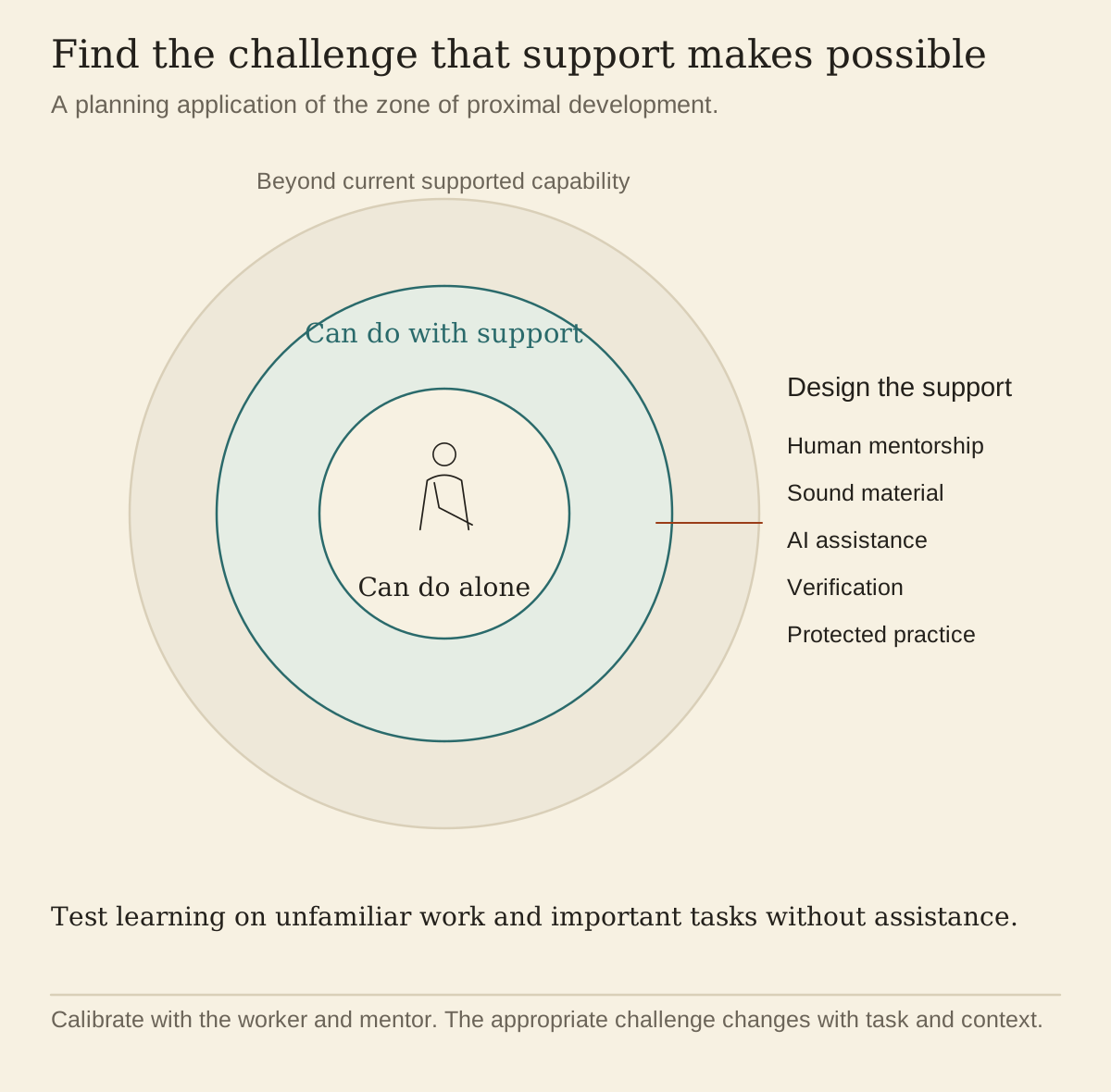
The simplest way to introduce up-leveling is through Vygotsky's concept of the zone of proximal development. That zone is the gap between what a learner can do alone and what they can do with help from a more capable other. Learning happens inside it. The learner who is supported through the zone, by a teacher, mentor, or capable peer, develops capacities that they did not have before. The learner who is left in the zone without support stays where they were. The learner who is given problems below the zone is bored. The learner who is given problems above the zone is overwhelmed. The zone is where development happens.
AI can sometimes serve as part of that scaffolding. It can explain a concept three ways, generate practice, question an assumption, and respond at the moment a learner gets stuck. But it is not Vygotsky's more capable other in the full human sense. It may be confidently wrong, it does not reliably know what the learner understands, and it cannot take responsibility for the learner's development. Used with sound material, verification, and human judgment, it can help a worker operate inside the zone more often. The implications are large, and they are still only partly realized in working life. I want to walk through the historical lineage, describe what up-leveled cognition can look like in practice, name the honest counterweights, and identify the conditions that make the outcome more likely.
The Historical Lineage of Cognitive Extensions
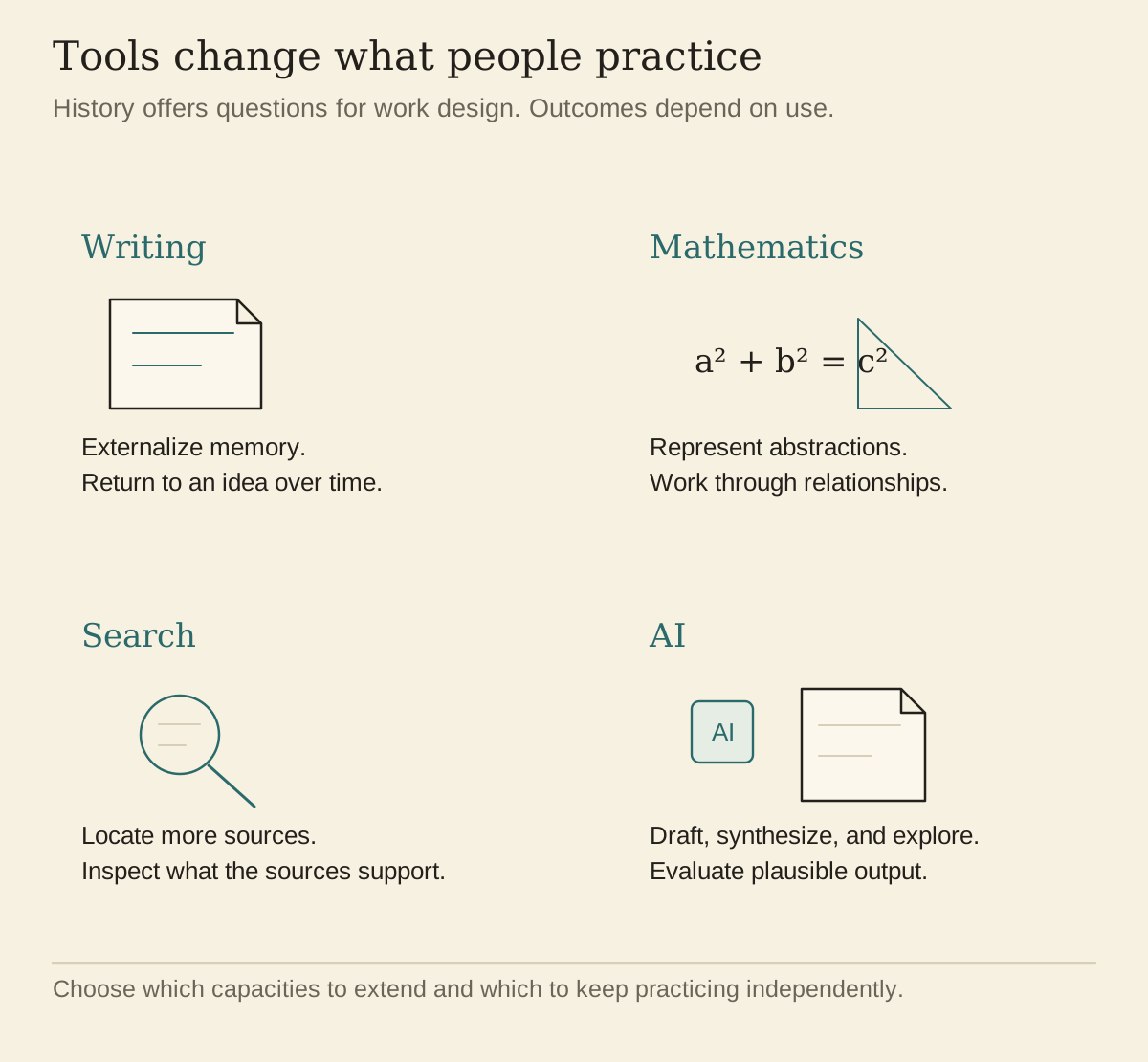
AI is not the first cognitive extension humans have invented. Writing was the first. Writing extended memory, allowing humans to hold thoughts outside their own heads, work on them over time, and pass them across generations. The invention transformed what was thinkable. Mathematics was another. Mathematical notation extended reasoning, allowing humans to manipulate abstractions that would have been impossible to hold in working memory. The invention enabled science, engineering, and the modern economy. Search was a more recent extension. Search engines extended recall, allowing humans to access vast amounts of information without having to internalize it. The invention transformed knowledge work.
Each extension provoked a familiar argument. Critics worried that writing would weaken memory, that calculators would displace mental arithmetic, and that search would replace the need to know things. Those concerns were real. The historical record still offers no clean law that every extension weakens the capacity it extends. Tools change what people practice. A capacity that is routinely offloaded may deteriorate; another may be strengthened by the same tool. The effect depends on the person, the task, the surrounding instruction, and whether the unassisted capacity is still exercised.
The extensions also enabled new capacities that the prior generation could not have imagined. Writing enabled accumulation of knowledge across generations that pre-literate cultures could not sustain. Mathematics enabled scientific reasoning that pre-mathematical cultures could not undertake. Search enabled synthesis across vastly more sources than any individual could have memorized.
AI belongs in this lineage, but it is not simply the next calculator. Generative systems can draft, synthesize, classify, translate, simulate perspectives, and produce plausible errors through the same interface. That breadth makes the extension unusually powerful and unusually easy to overtrust. Some unaugmented capacities may weaken where practice disappears. Others may grow when AI creates better practice, feedback, or access. A generation raised with AI will almost certainly do things its predecessors did not, and it may also need deliberate ways to retain capacities its tools make easy to neglect.
That history is useful because it calibrates without settling the argument. Anxiety has accompanied earlier cognitive tools, but resemblance is not proof that today's risks will resolve the same way. AI will change what people practice, what institutions reward, and eventually what competence means. The question is not whether cognition will change. It is which capacities we choose to extend, which we refuse to surrender, and whether those choices are made deliberately.
What Up-Leveled Cognition Looks Like
Picture one analyst on two Tuesdays, two years apart. On the first Tuesday she spends the morning pulling market data into a spreadsheet and the afternoon formatting the report. On the second Tuesday the pull and the formatting are finished before she sits down, and she spends the morning pushing back on three scenarios the AI drafted overnight and the afternoon on the phone with a plant manager, asking about a constraint the model could not see. Her business card reads the same.
Up-leveled cognition can hold wider problems. The worker who used to think about one project may be able to examine a portfolio. The analyst who focused on one market may be able to compare an industry. The expansion does not happen because AI magically enlarges working memory. It happens when the system can reliably externalize part of the search, organization, calculation, or comparison that used to consume attention. Wider scope also creates more ways to miss an error, so the worker needs methods for checking the whole as well as inspecting the parts.
Up-leveled cognition can work at higher levels of abstraction. The strategy meeting that was consumed by assembling tactics can spend more time examining frames. The architecture review can move from modules to systems without losing the module-level evidence. The medical consultation can consider a patient's life trajectory while licensed clinicians remain responsible for the diagnosis and care. The altitude shifts only when lower-level work is dependable enough to support it. Abstraction without contact with the underlying facts is not up-leveling. It is distance.
Up-leveled cognition can synthesize across domains. A specialist can use AI to locate vocabulary, surface candidate connections, and enter three or four adjacent fields faster than before. Access is not mastery. The worker still has to distinguish a deep connection from a linguistic resemblance and know when an actual expert is required. AI lowers the cost of crossing a disciplinary border; curiosity, discipline, and verification determine whether the crossing produces insight or confident tourism.
Up-leveled cognition asks better questions. The worker who used to ask questions that produced data is now asking questions that produce insight. The questions are different. They are framed differently. They expect more from themselves and more from the analytic system. The practice of asking better questions is itself a learned skill, and the AI supports the development of the skill by providing immediate feedback on what kinds of questions produce useful responses.
Up-leveled cognition can develop taste. Taste, in this context, is the sense of what good work looks and feels like in a domain: the senior analyst's standard for a credible market analysis, the designer's feel for a resolved interface, the engineer's recognition of an elegant solution. Taste develops through consequential experience, comparison, critique, and feedback on one's own attempts. AI can increase the volume and speed of examples and feedback. It can also flood the learner with polished mediocrity or reinforce its own conventions. Faster exposure develops taste only when the examples are good, the feedback is trustworthy, and a person capable of judging both remains in the loop.
Up-leveled cognition can integrate across longer time horizons. When AI handles some monitoring and comparison, a leader may recover attention for scenarios measured in years rather than quarters. Nothing about the tool forces that choice. The same systems can accelerate the weekly dashboard and make an organization more reactive than before. A longer horizon comes from governance and leadership; recovered bandwidth merely makes it possible.
Up-leveled cognition designs better experiments. The worker who used to be limited by the cost of trying things can now run many small experiments in parallel. The cost of testing has fallen. The value of being good at experimental design has risen. The worker who develops a practice of designing experiments that produce learning, in addition to producing immediate results, develops a capacity that compounds over years.
What the research shows. Brynjolfsson, Li, and Raymond studied the staggered introduction of a generative AI assistant among 5,172 customer-support agents at one Fortune 500 software company. In the peer-reviewed 2025 paper, access increased productivity, measured as issues resolved per hour, by fifteen percent on average. The gains were uneven. The lowest-skill group improved by thirty-six percent, while the highest-skill group showed no significant productivity gain; the most experienced and highest-skilled workers saw small speed gains and small declines in quality. Agents with two months of tenure and AI access performed as well as or better than agents with more than six months of tenure without it. The authors also found suggestive evidence of learning that persisted during brief system outages. This is important evidence that a well-fitted tool can diffuse some practices of stronger workers. It is one tool, one occupation, and one firm, and it generalizes only as far as that.
Brynjolfsson, E., Li, D., and Raymond, L. (2025). "Generative AI at Work." The Quarterly Journal of Economics, 140(2), 889–942.
The Honest Counterweights
Care is warranted here, because the aspiration is real and the outcome is not automatic. Many workers may not experience the up-leveling just described unless the work is designed to support it. The reasons are several, and worth naming so the aspiration does not become rhetorical.
Effort feels optional. The path of least resistance with AI is often to use it for immediate output rather than development. The worker who finishes existing work faster gets a strong signal that the tool is helpful. The worker who uses it to test and develop their own capacities receives a weaker, slower signal. Under deadline pressure, choosing the immediate gain is rational. Repeated without reflection, that choice may produce the wrong outcome over years.
The signals can be slow. Some workflow gains appear in days; durable changes in judgment and independent capability may take months or years of deliberate practice. That patience is not the kind most working environments support. Quarterly performance reviews reward output more readily than cognitive development. On the timescales the company usually measures, the worker who is developing may look much like the worker who is merely producing faster. The capacity to invest in development that does not pay off in the current period is scarce in workers and scarcer in the systems that evaluate them.
Up-leveling interacts with the baseline. Expertise helps a worker frame a problem, detect a bad answer, and recognize what matters. But the worker without that expertise does not have “nothing to extend.” The customer-support study above found the largest measured gains among less-experienced and lower-skilled workers because the system exposed them to practices they had not yet learned. Other tasks may favor experts who can direct and evaluate the tool. The distributional effect is therefore not fixed: AI can compress a performance gap, widen it, or shift it somewhere else. Tool quality, task design, access, training, and the value placed on the expertise used to build the system all matter.
Some cognition does not transfer cleanly. Not every capacity is equally amenable to AI extension. Some work is deeply embodied, relational, or bound to local experience. AI may still inform it, but information is not the same as practiced judgment. Up-leveling is asymmetric, and the asymmetries matter for how the operating model is designed.
Learning takes time. Some performance gains appear quickly; durable changes in knowledge, judgment, and independent capability require repeated practice and evidence that the learning transfers when the tool is absent. Two weeks may be enough to test a workflow and nowhere near enough to claim cognitive transformation. The relevant clock depends on the skill. Organizations need to measure progress over an appropriate interval rather than turn “brain plasticity” into a scientific-sounding promise.
This outcome is not automatic. We do not yet have evidence for what share of the workforce will achieve genuine cognitive up-leveling. Many workers will understandably use AI for productivity. Some will also develop; some may become dependent; some will do both in different tasks. The workers most likely to develop are those in environments that support practice, recognize learning, test unaided capability where it matters, and prize the long arc alongside the immediate quarter.
The honest counterweights are reasons the aspiration requires deliberate work to realize. None of them argues against it. The companies that build the conditions for up-leveling will produce more up-leveled workers than the companies that do not. The conditions are namable, and they follow. Each is a company decision, and the absence of any one quietly caps the outcome.
The Conditions That Produce Up-Leveling
Time and space. Up-leveling requires sustained engagement with work that is at the edge of what the worker can do. The engagement cannot happen in fifteen-minute slices between meetings. It requires blocks of time, in environments that support concentration, with the expectation that the time will produce learning rather than immediate output. A calendar scheduled to the minute is a decision against up-leveling, whether or not anyone made the decision deliberately.
Expectation of stretch. The work has to reach beyond routine without becoming unsafe or impossible. Too easy and development stalls. Too hard, and the worker may disengage or produce errors they cannot detect. Calibration is shared work: the manager sets consequential boundaries and understands the role; the worker reports where challenge becomes confusion; mentors and domain experts help test the result. AI can propose the next rung, but it should not be the sole judge of whether the rung is sound.
Mentorship. Up-leveling is often faster and more reliable when there is a more capable human who can support the worker through the zone. The mentor is a companion in the work rather than an instructor delivering content: someone who can recognize an unnamed difficulty through shared context and relationship, pose a challenge that matters in the actual work, and model the higher-altitude practice toward which the worker is reaching. Companies that maintain mentorship cultures, even as AI takes on more explicit knowledge transfer, preserve a developmental engine. Companies that let mentorship erode in the name of efficiency should not assume a tool will recreate it.
Protected modes of work. Some kinds of cognitive work benefit from not using AI at all. Section 5.4 named them in the practice of holding AI-free time, and the list is the same. Protecting these modes is a company decision as well as an individual discipline. Where a role still requires an unaugmented capacity, that capacity remains part of the foundation for supervising and extending the augmented work. A culture that automates everything in the name of efficiency can erode the foundation without anyone deciding to erode it.
AI as Socratic partner as well as answer machine. The way the AI is used matters. An answer can teach, and a question can mislead; the distinction is not absolute. But a system used only to supply finished output gives the worker fewer occasions to explain, retrieve, defend, and revise. A system asked to surface alternatives, challenge assumptions, request a rationale, and then show its own answer can create more of those occasions. Configuration, prompts, task design, and culture shape which posture predominates. The developmental posture has to be designed and tested deliberately.
The right measurements. Measures direct attention, sometimes usefully and sometimes perversely. Companies that reward only output volume and immediate quality should expect people to optimize for those outcomes. Capability development, contribution to others' learning, long-arc work quality, and unaided performance on critical tasks provide a fuller view. Those measures can also be gamed, so they should inform judgment rather than masquerade as a perfect score. Most performance systems were not designed for work divided among humans and AI. Redesigning them is part of redesigning the work.
The long arc. Durable up-leveling is an ongoing practice, often measured across years even when early gains appear quickly. The leadership team has to be willing to invest in development that does not produce visible returns in every quarter. That willingness is scarce. A leadership team that funds development only when it pays off inside the quarter gets quarter-to-quarter results, and the capacity that might have compounded over the longer cycle never gets built.
The Strategic Case
The strategic argument for taking up-leveling seriously is that the companies that develop up-leveled workforces will compound advantage in ways that the companies that do not develop them cannot match.
The up-leveled workforce produces distinctive work, because the workers' judgment, taste, and craft have been amplified by AI rather than replaced. The work is harder to replicate. The competitive advantage lives in the workforce.
The up-leveled workforce develops new capabilities that the company can deploy as new market opportunities arise. The flexibility is operational, because the workers are capable of being deployed against problems they have not seen before.
An up-leveled workforce may retain better. Development is one reason people stay, especially when the learning is portable and the work remains meaningful. It competes with pay, leadership, workload, opportunity, and life outside the company. The strategic case is not a guaranteed retention effect. It is that an environment worth learning in gives capable people one more substantial reason to remain.
The up-leveled workforce produces leaders. The workers who have developed deep capability are the workers who can take on larger responsibility. The leadership pipeline that the company depends on for the future is built through the practices of the present.
Over a five-to-ten-year horizon, the difference between a company that develops its workforce and one that uses AI only to extract more output could be substantial. The first has something capable of compounding: human judgment, stronger practice, reusable knowledge, and better tools reinforcing one another. The second may still post short-term gains, but it is spending the very capability it will later need. The AI investment matters. The more important investment is the system of people, practices, and technology that determines what the AI makes possible.
The next four sections of Stage 5 address the development side of this work. Passion as the source condition for up-leveling, and the brain's need for challenge underneath it. The hidden expertise that AI is going to surface. What must be unlearned for the AI-Native company to function. And the workforce that all of it produces, humans and agents together.