What makes someone care about their work, and what does their brain require of it?
Section 5.5 described the conditions under which up-leveling happens. Those conditions are real, and on their own they are not enough. Give a worker time and space, a manager who can spot the right stretch assignment, a culture that protects deep work, and measurement systems that reward development, and the up-leveling can still fail to arrive. All of it supports a process that has to start somewhere, and the somewhere is inside the worker. They have to be reaching for something. They have to care about getting better at this. Without that, you have inputs and no engine.
I want to name this plainly, because it gets discussed less than almost anything else that matters this much. Up-leveling runs partly on caring. Curiosity and a desire to improve make developmental uses of AI more likely. They do not operate alone. A worker can care deeply and still be trapped by workload, unsafe management, poor tools, illness, or responsibilities outside work. Another can begin with little attachment and discover interest through the work itself. Caring is an engine. Nobody should be graded on it. The company still has to build a road on which it can run.
The Brain Needs Challenge
Underneath the caring argument is a feature of human development that the corporate conversation often ignores. People can benefit from cognitive challenge: work near the edge of current skill can build competence, sustain attention, and create the satisfaction of progress. Too little challenge can produce boredom. Too much can produce stress, error, or withdrawal. The useful target is not permanent strain. It is meaningful demand matched with support, recovery, and agency.
Corporate conversation often treats cognitive content as a matter of personal preference. Preference does matter. People differ, routine can be satisfying, and no employer owns a worker's development or purpose. But work design is not neutral. A company deciding which tasks to automate also decides what people will practice for thousands of hours. It should examine whether the remaining work offers variety, judgment, learning, human contact, and a reasonable degree of control, and ask workers, rather than infer from a theory, what makes the work sustainable.
The “use it or lose it” hypothesis has a long history in research on cognitive aging. Studies associate sustained cognitive, social, and physical activity with better cognitive trajectories, and training can improve practiced abilities. The causal story is harder. People with stronger health and cognition may select more demanding activities; education, income, sleep, disease, exercise, isolation, and stress also shape the outcome. Practice is specific, and improvement on one task does not guarantee broad protection against decline. The honest reading is neither “challenge prevents aging” nor “activity makes no difference.” Engagement and capacity can reinforce each other inside a much larger system of health and circumstance.
Retirement research illustrates both the signal and the uncertainty. Longitudinal studies and natural-experiment methods often associate retirement with lower cognitive functioning or faster decline in some abilities, especially memory, but findings vary by cognitive domain, job, reason for retirement, and what replaces paid work. Retirement itself is not cognitive abandonment. Caregiving, volunteering, study, craft, exercise, and social life can all be demanding. Physical-health findings are similarly entangled with health-driven retirement, income, stress, movement, and social connection. The evidence supports one conclusion: losing a major source of structure and engagement may matter. Harm to the brain or body from leaving a job is unproven. Section 5.8 takes up what people lose when the work stops needing them.
A related literature examines purpose. People who report a stronger and more sustained sense of purpose often show better cognitive and health trajectories. These are important associations, and purpose may be one cause among several. Purpose can organize attention and behavior; health and social circumstance can also make purpose easier to sustain. Paid work is one possible source. Family, faith, community, art, service, learning, and care are others. A company can make work more worthy of care. It should not claim jurisdiction over the meaning of a person's life.
The implication for working life is narrower and more defensible. Work is one of the places where many adults encounter challenge, structure, social contact, and opportunities to build competence. Because it occupies so much time, its cognitive content deserves design attention. It is not irreplaceable, and it is not medicine. It is a consequential environment that employers have the power, and therefore the obligation, to shape with care.
The Welder
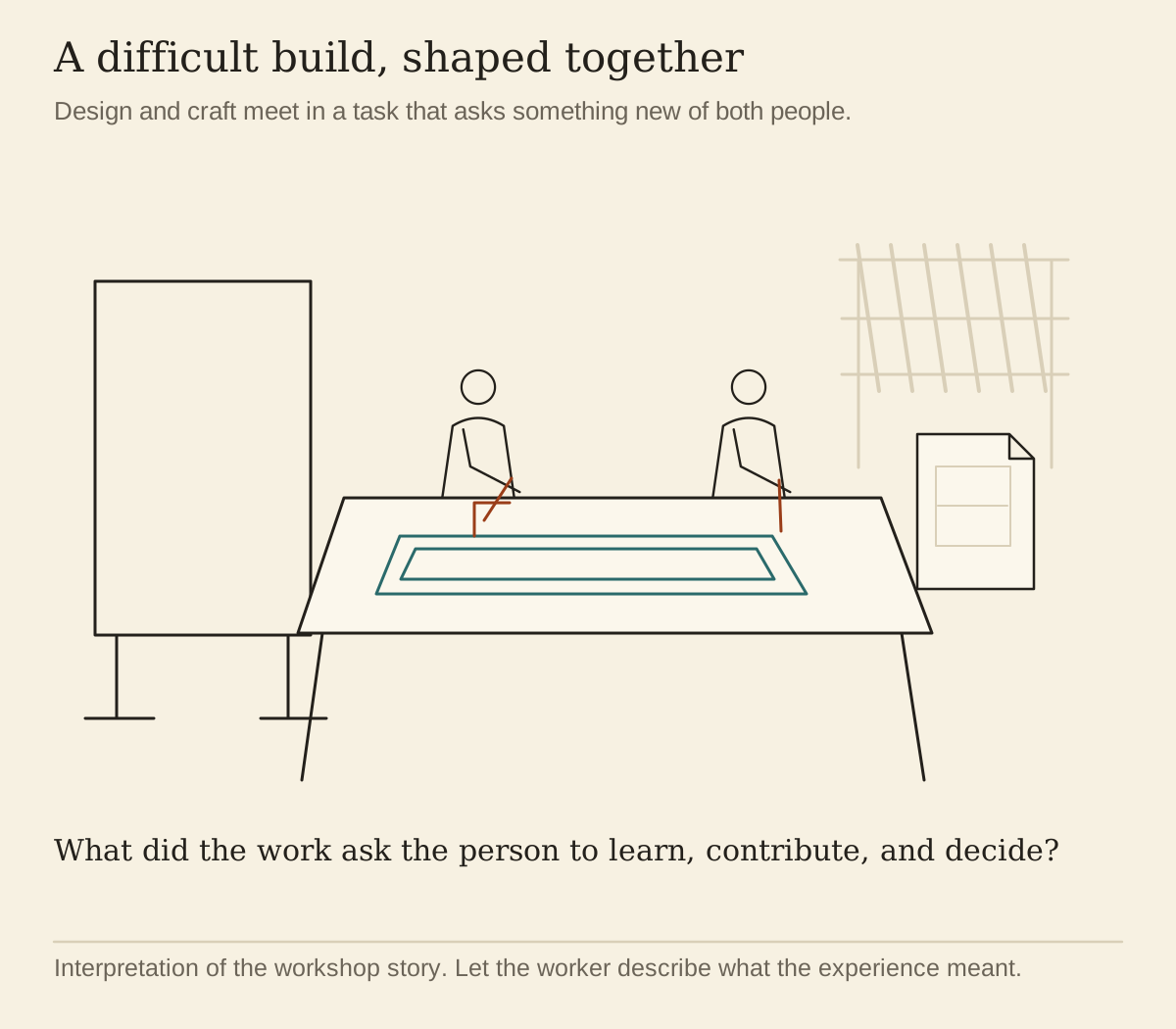
A worked example will help here, because the argument is otherwise abstract.
Years ago, I was designing and leading workshops for senior leaders. The workshops used physical artifacts. Large marker boards, custom-built, that could hold the kind of work the senior teams were doing. The boards had to be substantial. They had to be designed for the specific shape of the work. I needed someone who could build them.
I found a welder. He was a working welder. He had spent his career on metal. He was not in the workshop business. He had not designed anything like what I was describing. I had the design. He had the craft. For several weeks that January we worked side by side in his shop, a metal building with a concrete floor, a space heater in one corner, and steel stock racked along the back wall. He ran the welds and I held the pieces square, and when the grinder was going we gave up on talking and pointed. By the last week my drawings carried chalk dust and bootprints. The first set of boards stood finished by the door.
Years later, I ran into the welder again at the counter of a welding supply house, both of us waiting on orders. We caught up for a minute on the ordinary things. Unprompted, he said something I have not forgotten. He said: I want to thank you for including me in that work. You gave me the most challenging brain activity I have ever had in my life. And I loved it.
I was not expecting this. He had not described himself as someone who was reaching for cognitive challenge. He had said yes to a job and done it. What he had discovered, in the doing, was that the work had engaged him in a way that his regular welding work did not. The money was there. The relationship was there. His thanks went to the challenge itself.
He was, in the way of someone who does not usually talk about himself this way, telling the truth about what his brain had wanted, and what doing work that demanded that thing had given him. There was no request in it for a more interesting job, and none of the language of meaningful work or employee engagement. He had loved the challenge. The challenge had been a gift.
It was a gift in part because most of his work was nothing like it. Challenge was rare for him, the exception to the ordinary condition of his working life. A leadership team that hears this story should hold both halves. The welder was happier when he was being challenged. The welder was not being challenged most of the time. The two halves go together. The welder's gratitude is the measure of what most of his work had not been giving him.
Intellectual lineage. The welder story can be read through Edward Deci and Richard Ryan's Self-Determination Theory. The theory proposes three basic psychological needs: autonomy, the experience of volition; competence, the experience of effectiveness; and relatedness, the experience of connection and belonging. Research in workplaces links support for these needs with more autonomous motivation and a range of favorable outcomes, with meaningful variation across people and settings. Need satisfaction does not switch intrinsic motivation on, need frustration does not make motivation collapse in every case, and compensation still matters. The boards project appears to have supported all three: competence at the edge of his craft, autonomy in shaping the build, and relatedness through working side by side. That is my interpretation of why the experience stayed with him, drawn from one conversation. Csikszentmihalyi's work on flow overlaps with this account, but the theories describe related rather than identical phenomena.
Deci, E. L., and Ryan, R. M. (1985). Intrinsic Motivation and Self-Determination in Human Behavior. Plenum. / Ryan, R. M., and Deci, E. L. (2017). Self-Determination Theory. Guilford Press.
Two Kinds of Passion
Passion research offers a distinction every leadership team should know, because it separates the passion worth cultivating from the passion that burns people down. Robert Vallerand and his colleagues, across two decades of studies, distinguish harmonious passion from obsessive passion. Harmonious passion is caring the person controls. The work matters to them, they chose it freely, and it sits in balance with the rest of their life. Obsessive passion is caring that controls the person. The work has fused with their identity or their standing, they cannot put it down, and the caring produces rigidity and burnout alongside the effort.
The distinction matters because the social conditions around work can encourage more autonomous or more controlled forms of engagement. Real connection, recognition, autonomy, and membership may support harmonious passion. Recognition tied to self-worth, pressure without safety, and membership that has to be re-earned can feed obsessive patterns. They do not mechanically manufacture one form or the other; identity, personality, history, and life outside work matter too. A leadership team that demands visible engagement can easily reward obsessive behavior because it resembles commitment, until the costs appear.
The welder's account has the qualities associated with harmonious passion. He chose the work, it challenged him at the edge of his craft, and years later he described what it had added to his life. I cannot infer his inner state from a brief encounter. I can recognize the target: demanding work held in proportion to a whole life.
Intellectual lineage. The harmonious/obsessive distinction comes from Robert Vallerand's Dualistic Model of Passion, developed with colleagues at the Université du Québec à Montréal and studied across work, sport, education, and the arts. A 2015 meta-analysis synthesized 94 studies and found meaningfully different patterns of association: harmonious passion was generally linked with more adaptive wellbeing, motivation, and cognitive outcomes, while obsessive passion showed a more mixed and often maladaptive pattern. These are tendencies, and plenty of people break them. Autonomy-supportive environments can encourage autonomous internalization; controlling and contingent environments can encourage controlled internalization. The person and the environment both matter.
Vallerand, R. J., et al. (2003). "Les Passions de l'Âme: On Obsessive and Harmonious Passion." Journal of Personality and Social Psychology, 85(4), 756-767. / Vallerand, R. J. (2015). The Psychology of Passion: A Dualistic Model. Oxford University Press.
The Manager's Job Has Changed
The first implication is that AI changes the manager's role, although it does not erase what came before. Managers have always coordinated work, allocated resources, resolved blockers, developed people, exercised judgment, and represented the team in systems of power. Different organizations weighted those duties differently. AI can change that weighting and expose managers whose contribution was little more than moving information between meetings.
AI can draft plans and status reports, summarize communication, and surface candidate dependencies. Plans do not maintain themselves. A system cannot reliably decide that a reported status is true, that an unmentioned dependency matters, or that a team needs protection rather than another reminder. Coordination survives, but some of its clerical burden can shrink. The time released creates a choice about what management becomes.
One answer is engagement architecture. The manager learns enough about each worker to understand what they are trying to develop without demanding access to their private identity. They design assignments that connect business need with appropriate stretch, notice withdrawal without treating ordinary boundaries as disengagement, and address the conditions within the company's control. The goal is not to manufacture passion. It is to stop extinguishing it and make room for it to grow.
This is different work from administrative coordination, and often harder. Many management programs underweight work design, coaching, psychological safety, and the responsible use of AI. Companies need to select, train, support, and evaluate managers for the full role. “Retrain or replace” is too blunt when the organization itself promoted yesterday's behavior and still rewards it today. Change the system, give people a fair chance to grow, and make role decisions on evidence.
What Cultivates Passion
Intellectual lineage. What I am describing is related to what Mihaly Csikszentmihalyi called flow: deep absorption in an activity, often accompanied by concentration, a sense of control, and intrinsic reward. His account emphasizes conditions such as clear goals, timely feedback, and a workable match between challenge and skill. Later research has developed, tested, and debated how flow is defined and measured. Flow is not synonymous with caring, and it is not the only desirable way to work; collaboration, reflection, care, and routine competence may feel different. The overlap is still useful. Work is more likely to absorb people when they can understand the goal, perceive progress, and meet a challenge that is neither trivial nor crushing.
Csikszentmihalyi, Mihaly (1990). Flow: The Psychology of Optimal Experience. Harper & Row.
Passion is a strong word. I use it deliberately, and with care. I mean the more workable version rather than the romanticized version that requires every worker to be in love with their job. The worker genuinely cares about getting better at what they do. They see the work as connected to something they value. They bring their full attention to it. This kind of caring is more common than the romantic version, and it is the kind on which the AI-Native company depends.
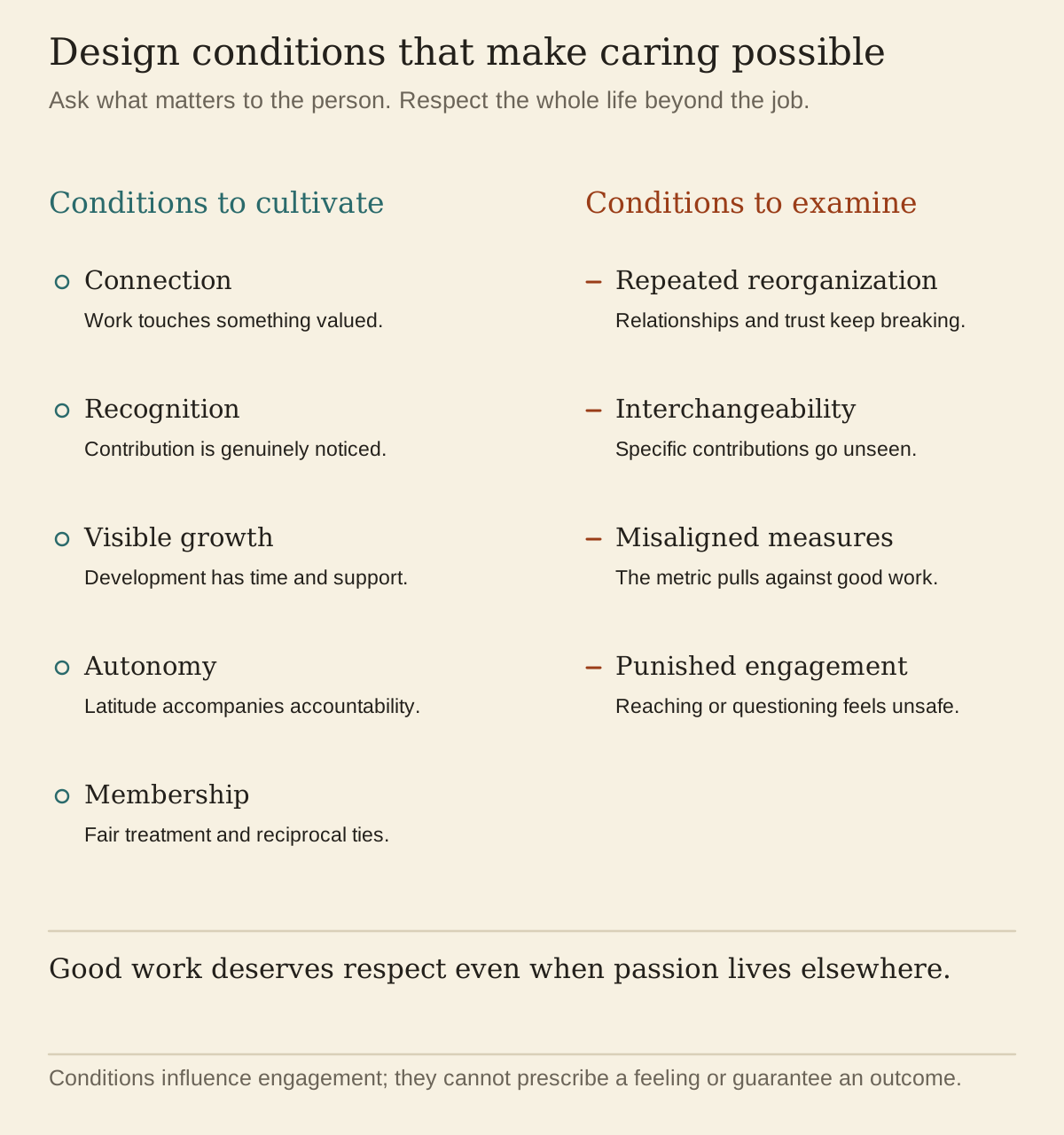
A handful of namable factors cultivate it.
The first is connection between the work and something that matters to the worker. Seeing how the work affects a customer, colleague, community, craft, or personal goal can provide a reason to persist through difficulty. Workers may have other reasons, including economic security, and those reasons deserve respect. The leadership team can make real consequences visible. It cannot fabricate meaning or decide on a worker's behalf what should matter.
The second is recognition of contribution. The worker who can see that what they do is noticed by people whose opinion they respect has a reason to care about the work. The recognition has to be real. Recognition theater, the kind that comes with a corporate certificate signed by a senior leader who does not know the recipient, is worse than no recognition because it tells the workforce that the company is not paying attention.
The third is growth as a visible trajectory. The worker who can see that they are getting better at the work, and that the company is invested in their getting better, has a reason to care. The growth has to be real, and the investment has to be visible. The companies that talk about development without investing in it produce the cynicism that destroys caring.
The fourth is autonomy within the work. The worker who has genuine latitude to make decisions about how the work gets done has more reason to care than the worker who is executing a script. The latitude has to come with the accountability that turns autonomy into ownership. Autonomy without accountability is neglect. Accountability without autonomy is coercion. The combination is the condition that produces caring.
The fifth is membership in something that matters. The worker who feels part of a team, craft, tradition, or mission has a reason to care that does not depend on individual outcomes. Membership is built over time through shared experience, fair treatment, and reciprocal obligation. Constant reorganization or repeated headcount reduction can fracture it. Sometimes restructuring is necessary. Treating the social cost as zero guarantees that the financial case is incomplete.
What Destroys Passion
The reverse list is equally important. It is worth reading slowly, because these practices are common and rarely recognized as destructive.
Constant reorganization can destroy passion. Workers hesitate to invest in relationships, systems, and missions they expect to lose. At some companies the org chart changes more often than the logo. A reorganization may have sound strategic logic, and avoiding one can also harm people. The mistake is treating the loss of trust, local knowledge, and membership as an externality rather than a cost to be anticipated and repaired.
Treating workers as fungible can destroy passion. A company needs roles, budgets, and headcount models; it also needs to remember that the people inside those abstractions are specific. Workers who repeatedly see contribution ignored and relationships treated as disposable have less reason to reciprocate commitment. The effect will not be identical in every person. The breach is still real.
Measuring the wrong things can destroy passion. Workers measured on outputs that do not correspond to what they believe good work requires can find themselves doing work they cannot defend to themselves. Measurement systems shape what gets done. Poorly chosen measures can train people away from the quality, judgment, or care the company still claims to value.
Punishing visible engagement can extinguish it unusually fast. The worker who reaches beyond their assigned scope, suggests a better way of doing the work, or flags a problem no one asked them to flag, and is punished for reaching, learns quickly that silence is safer. The lesson can generalize. The worker may stop reaching, and the company may later complain about the disengagement it helped produce. Much of this punishment is accidental, delivered through managers who feel threatened or systems that reward conformity. Intent changes the moral judgment; it does not erase the effect the worker experiences.
The Respected Place for Non-Passion-Driven Engagement
There is a version of this argument that produces an unhealthy expectation that every worker must be passionate, must be reaching, must be using AI to up-level themselves continuously. The expectation, taken seriously, produces a workforce in which workers feel they have to perform passion they do not feel, and the performance is more destructive than the absence of passion. The performed version is obsessive passion by another name. It costs the worker and returns nothing durable to the company.
I want to name the alternative. There is a respected place in an AI-Native company for the worker whose engagement is not passion-driven. The worker who is in their job for the paycheck, who does the work well, who goes home to a life that is centered elsewhere, who treats the company fairly and expects to be treated fairly in return. This worker is doing nothing wrong. They are doing a kind of work that has been honored in most cultures throughout history. The company that requires every worker to be passionate has confused itself about what it can ask of people.
The honest version of the argument is that up-leveling will be unevenly distributed, and we do not yet know the proportions. People will want different things in different seasons of life. The company benefits from supporting workers who are reaching and from treating workers who are not seeking continuous development as full members of the company. Both are doing real work. The company that hollows out the second category in favor of the first will discover that much of the work keeping the company running lived there.
What This Implies for AI-Native Work Design
The AI-Native company that takes the welder's experience seriously will design work differently than the AI-Native company that does not. The first company treats the cognitive content of work as a primary property, and designs it deliberately.
This is harder than it sounds because AI can remove both drudgery and development. Repetition sometimes builds fluency; difficulty sometimes comes from pointless friction. The temptation is to automate whatever looks hard without asking which part teaches the worker, reveals the state of the system, or keeps human judgment calibrated. The result can leave people with passive monitoring, fragmented exception handling, or responsibility for outcomes they no longer have enough contact with the work to understand.
The alternative is to design AI into the work so that human demand becomes more valuable. Volume alone is intensification. Routine steps may be automated while people frame goals, inspect evidence, handle exceptions, make accountable decisions, build relationships, and sometimes practice the underlying task without assistance. AI capabilities will continue to move, so “work the AI cannot do” is a brittle boundary. The durable boundary is work for which the organization chooses to require human authority, participation, or capability.
This is the up-leveling argument from Section 5.5, viewed from the angle of human flourishing rather than competitive advantage. The two angles converge on the same operating model.
Productivity Is Not the Whole Question
I want to push back, gently and directly, on a piece of the corporate vocabulary that is making this work harder.
Productivity is the word the corporate world has used for decades to describe the purpose of work. Productivity measures output per unit of input. More productivity is better. The vocabulary is so familiar that most leadership teams cannot easily think about work in any other terms.
The productivity vocabulary is insufficient for the AI-Native era because a ratio of output to input does not, by itself, reveal what the work is doing to workers or to future capability. A team can produce more this year while weakening apprenticeship, judgment, trust, or resilience. That does not prove cognitive loss, and the future cost may never materialize. It does mean that a quarterly productivity number is a snapshot rather than the whole trajectory.
A more useful frame is to ask what the work is producing in two places. First, what the work is producing for the company. Second, what the work is doing to the worker. The two have to be considered together, because the company that hollows out its workforce in pursuit of quarterly output will discover that the workforce it has produced cannot deliver the output it needs in the years that follow.
The leadership team that takes this frame seriously will measure workforce trajectory alongside output. Can people explain and perform critical work when the tool is unavailable. Are novices progressing. Are errors being caught earlier. Do workers report useful challenge, agency, and sustainable load. Is expertise being shared, credited, and renewed. No single measure answers whether people are becoming “sharper,” and surveillance can damage the very conditions being measured. Use capability tests, operational outcomes, voluntary and privacy-protected feedback, and informed human judgment together.
Why AI Amplifies Whatever Culture It Lands In
One last point about passion: AI can amplify important features of the culture that receives it. A culture that rewards curiosity and candor may use AI to test more ideas and expose weak reasoning. A culture that rewards speed and punishes dissent may use the same tool to produce more work with less challenge. Technology can also alter culture rather than merely reflect it. Same tool does not mean same implementation, incentives, data, authority, or output.
This is why the human work matters strategically as well as ethically. Returns from AI depend in part on earlier investments in expertise, trust, process, data, and management. A company that invested in its people has more capability for AI to extend. A company that treated people only as inputs may still obtain productivity gains, but it carries less trust and developmental capacity into the transition. Neither outcome is guaranteed; both are starting conditions leaders can see and change.
The leadership team thinking about the AI investment should also examine the human investment it postponed. The two interact. Tools shape the work people can do; people determine where the tools are trusted, challenged, and applied. The operating system has to hold both.
The Welder's Standard
A close for this section: what I have come to call the welder's standard.
The standard is the question that every leadership team designing an AI-Native operating system should be willing to be asked. If a worker in this company, years from now, ran into you at a baseball game, what would they say to you about the work they did here. Would they say, you gave me the most challenging brain activity I have ever had in my life, and I loved it. Would they say something quieter that meant approximately the same thing. Or would they say something else.
A leadership team that can answer this question with the welder's words has evidence that at least some work is good for the people doing it. It should also listen for different honorable answers: the work was fair; I became capable; my boundaries were respected; I supported my family; I belonged; I left with my health intact. No executive should answer for the workforce. The standard is an invitation to ask, and to be willing to hear what comes back.
The welder's standard is the counterpart to the operational rigor built across the previous sections. Both are necessary. Neither is sufficient on its own.
The next section turns to one of the more hopeful consequences of taking this argument seriously, which is the expansion of who gets to be skilled in a domain at all.