Who becomes skilled in a domain when AI lowers the barrier to entry?
Displacement is the dominant story about AI and work. Workers who used to be valuable are becoming less so. Workers who learned skills that took years to develop are watching those skills become less rare. The story is partly true. It is also incomplete, and the incompleteness is one of the more interesting things about the AI-Native era.
What that story misses is the other end of the skill distribution. Some people never got to explore domains for which they may have had real aptitude because a prerequisite, teaching method, cost, disability, credential, or early judgment closed the path. The aspiring doctor stopped by organic chemistry. The aspiring engineer stopped by calculus. The architect who could think spatially but could not draw to the expected standard. The would-be developer defeated by bad documentation and unhelpful error messages before building anything that mattered to them. Some filters protect the public or test knowledge the work genuinely requires. Others are rough proxies, and even necessary prerequisites can be taught or supported in better ways. The world has almost certainly lost potential expertise because it mistook the ability to pass a gate for the full ability to do the work beyond it.
AI can change the geometry of some of this filtering. It does not make every gate obsolete.
The Gatekeeping Skills Are Not the Work
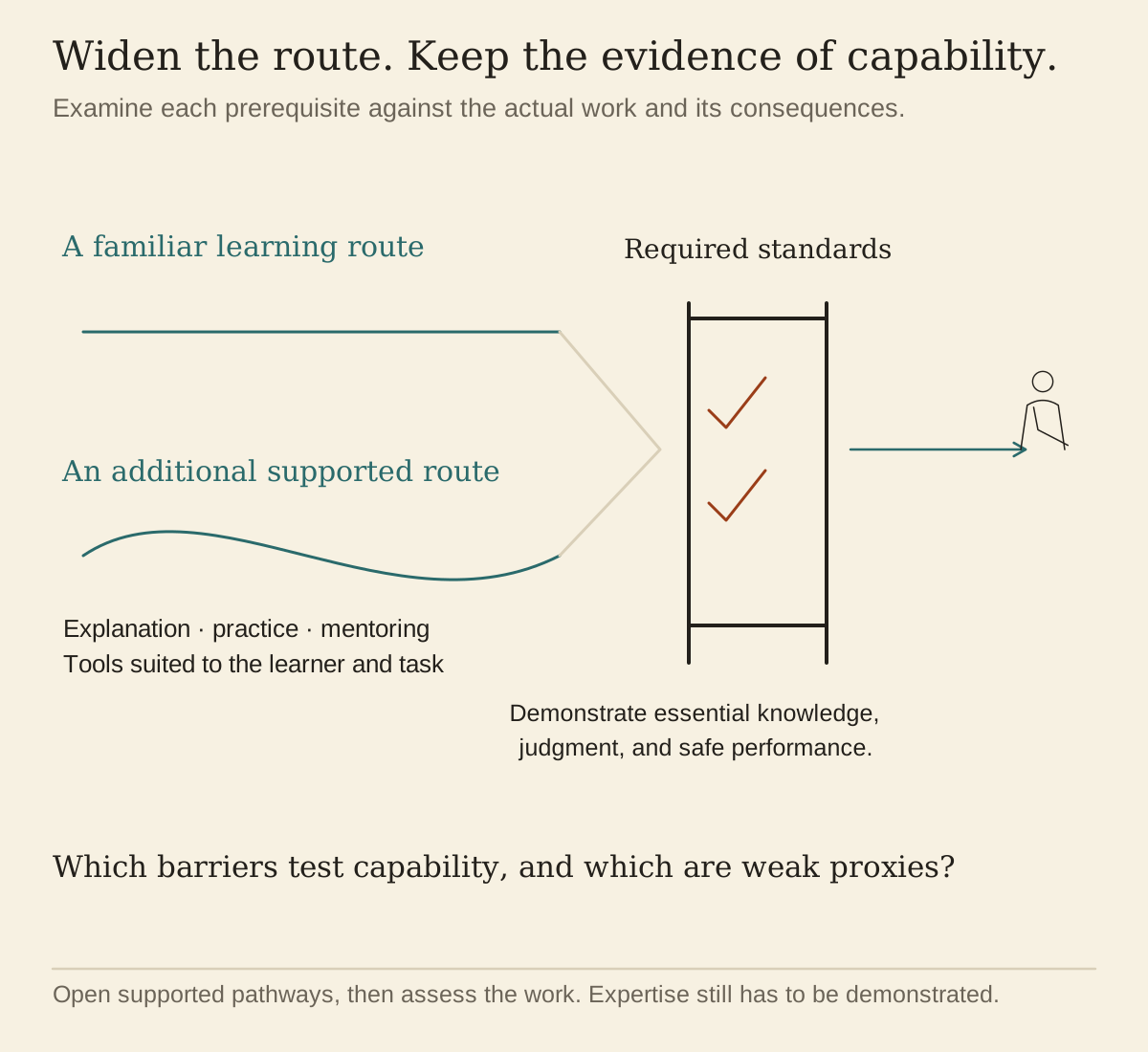
Notice first that a prerequisite is not always identical to the work it precedes. Educational and professional systems use prerequisites to establish foundations, ration limited places, make evaluation manageable, and protect the public. Some directly test essential capability. Some are historically convenient proxies. Many do both imperfectly. The important question is not whether a gate is frustrating. It is whether the capability it tests remains necessary, whether AI changes how that capability can be learned or exercised, and what evidence should replace the old test if the gate moves.
Engineering makes the distinction visible. Engineers design systems that solve real problems. The work involves mathematics alongside judgment about tradeoffs, communication with stakeholders, integration across domains, persistence through iteration, and responsibility for safety and failure. Mathematics is a tool and part of the professional foundation; in many branches, a person must understand it well enough to select a model, recognize a broken assumption, and know when an answer is physically impossible. AI can perform calculations, visualize relationships, explain abstractions, and provide practice. It may change how mathematical competence is developed and demonstrated. It does not make mathematical understanding irrelevant wherever the system's behavior depends on it.
A high school student who is told that they are not good at math, and who therefore should not consider engineering, is being filtered by the mathematical prerequisite. The filtering may or may not be accurate. Some students who fail the filter would also have failed at the work. Some students who fail the filter would have been extraordinary at the work if they had ever been allowed to get to it. The world has no way to tell which is which, because the filter happens before the work begins.
I have a son who experienced this filtering. He was told in high school that he was not good at math and that engineering was probably not for him. He has a passion for understanding how things work and fit together, one important engineering disposition, though not the whole profession. A judgment about his performance in one setting became a judgment about the path. AI does not answer whether he should be an engineer. It may give him a better way to find out: patient explanation, manipulable models, immediate practice, and multiple representations of the same concept. The mathematics does not disappear. The route into it becomes wider than one classroom, one pace, or one teacher's verdict.
The implication is that some people who could not cross an old gate may now be able to build the required capability and demonstrate it another way. The number is not zero, and it is not everyone. In some roles the threshold may fall because AI safely handles part of the task. In others the threshold should remain or even rise because AI output creates new verification demands. The geometry is changing, but it has to be redrawn task by task.
The Pattern Generalizes
The same pattern appears across domains, most visibly in software. Development used to require enough fluency in programming languages, error messages, tooling, and documentation to reach a working prototype. Those demands filtered out people who might have designed useful software. Now people can build applications by describing behavior in natural language and iterating with AI. Producing something that runs is real development, but it is not proof that the system is secure, maintainable, accessible, or correct. The barrier to creation has fallen faster than the burden of responsibility. That is expansion with a new obligation attached.
I am one of these people. I was not a programmer. My cofounder set me up with the right tools and the right environment. Visual Studio Code. Claude Code. The integration with version control. I started by asking the AI questions in natural language. I dabbled in editing what the AI produced. Over time, my sense of what was possible changed. I began saying, what if the application worked like this. I worked with the AI to bring it to life. The work compounded. What started as basic interactions evolved into something I would not have predicted I could do.
This story is not exotic. Versions of it are appearing in other domains: a medical researcher using AI to write and inspect bioinformatics code, a journalist entering data analysis with guided statistical support, a teacher turning classroom knowledge into usable curriculum materials. In each case, AI can lower an implementation barrier without conferring the neighboring profession's full expertise. The researcher still needs valid methods, the journalist still needs statistical judgment, and the teacher still needs evidence and quality control. The trajectories are visible. Their scale and long-term effect on the supply of expertise remain open empirical questions.
What the research shows. Wharton Human-AI Research and GBK Collective's 2025 enterprise survey included 801 U.S. business leaders at organizations with at least one thousand employees and $50 million in revenue. Among 372 vice presidents and C-suite leaders asked about hiring over the next two to five years, thirty-nine percent expected more entry-level or junior hiring, forty percent expected no change, and eighteen percent expected less. For interns, forty percent expected more and eighteen percent less. The result is more mixed, and more interesting, than a simple displacement story. It records leaders' expectations, which may differ from hiring outcomes, and it does not establish why they answered as they did. It suggests that many leaders can imagine AI creating opportunities for junior workers even while a meaningful minority expects contraction.
Wharton Human-AI Research and GBK Collective (2025). "Accountable Acceleration: Gen AI Fast-Tracks Into the Enterprise." Year Three Full Report, pp. 71–72.
The Same Gate, From the Other Side
Everything above is about people walking in. There is a second thing happening at the same gate, to the people already inside, and a section that tells only the first half is not being straight with them.
The person who spent twenty years becoming the one who knows was holding two things at once. They could do the work. Very few others could. Those arrived together and could feel like a single thing, though they were never identical. AI may separate them. Some parts of the capability can become easier to access, while other parts (judgment, accountability, tacit discrimination, and experience with failure) remain scarce. The expert's capability is not untouched, because the work itself is changing. The scarcity is not simply gone, because it moves.
That is a real loss and it deserves to be named as one. The skill is intact. What goes is the position, being the first person the room asks. Section 5.2 calls this the grief of expertise, and it sits first on that list because it is the one people carry quietly and almost never say out loud.
I am on both sides of it. I could not program, and now I can, which puts me among the people who came through the gate after it came down. I also spent a career building a practice around designing how teams do their hardest work, and the same force is arriving at that. Writing this section only from the optimistic end would be dishonest about where I am standing in it.
What I would say to the person holding the knowledge is this. One scarce thing was always knowing which of the things you know applies to the situation in front of you. AI affects that too, but it does not remove the need for grounded judgment or responsibility. A company that treats you only as a repository will be disappointed. You should have a say in how the work changes and receive credit for the knowledge you contribute.
The Bridge Question
One warm Friday night in July I found myself next to an electrician at a minor league baseball game, third row up the first-base line, his company's name stitched over the pocket of his polo. The home half of the second went three up, three down, and in the lull he asked what I did, and I told him I worked in AI. He had not used AI himself. He had not used ChatGPT. He had a clear sense of one of his pain points. He was given blueprints for new projects, and parsing the blueprints to produce accurate bids was slow work. The slowness affected which projects he could pursue. The slowness affected the economics of his business.
I explained, over the course of an inning or two, while the visitors changed pitchers and the grounds crew dragged the infield, that software could extract information from blueprints and help prepare a draft bid using his rules and examples. With careful implementation, evaluation, permissions, and review, a system could support more bids without pretending to know conditions the drawings did not show. He nodded at the right places, eyes on the field. He understood what I was saying. His mental model still ran on blueprints and spreadsheets. The bridge from where he was to a trustworthy AI-assisted workflow was not yet walkable. The intelligence to cross it was there. The bridge was not.
That bridge question is one of the most consequential in the AI-Native era. Across industries, many workers are sitting where the electrician sat. They have real expertise. They have specific problems that AI could help them solve. They do not yet have the bridge from their current practice to tools that would extend it. The bridge has to be built by someone. The question is who builds it, for whom, and to what standard.
The companies that take this seriously are building the bridges as part of their AI-Native operating models. They are not assuming that workers will figure out AI on their own. They are designing the entry points, the supports, the practice opportunities, and the trusted relationships that allow workers to cross from their existing expertise into the AI-augmented version of that expertise. The companies that do this well will have workforces that surface latent capability the company did not know it had. The companies that do not do this will have workforces in which only the workers who could build their own bridges, the workers who were already at the comfortable end of the digital divide, will participate in the AI-Native transformation. The workers at the other end of the divide will be left out, and the talent they could have contributed will not be recovered.
The Democratization Research
Research on AI-augmented work offers a narrower signal. In several studied tasks, including the customer-support setting in Section 5.5, less-experienced or lower-performing workers gained more than the strongest workers and performance dispersion narrowed. Other studies show a jagged frontier: assistance improves performance on some tasks and harms it on others, with effects shaped by baseline skill and how the tool is used. These studies concern people already doing or selected into the work. They do not show that people previously filtered out by a prerequisite possess hidden professional expertise, and they do not justify removing safety-critical qualifications.
The evidence is preliminary and uneven across domains. It is still strong enough to justify an experiment rather than a conclusion. A company can look for employees whose adjacent experience, aptitude, and interest have been missed; provide AI-supported learning and supervised practice; and evaluate them on real work against the same outcome and safety standards. The opportunity is access to a broader pool of potential capability. Whether it becomes expertise must be demonstrated.
What This Means for How Companies Hire and Develop
The hidden-expertise argument has direct implications for hiring, development, and the structure of who gets to do what kinds of work in an AI-Native company.
Hiring practices that rely reflexively on prerequisite filters may select for an outdated version of the work. The response is not to assume that someone who struggled with mathematics is therefore a strong engineering hire. It is to decompose the role: which knowledge remains essential, which task is now tool-assisted, which capability can be learned on the job, and which credential is legally or ethically nonnegotiable. Then evaluate candidates on relevant work, learning ability, judgment, and the foundations the role still requires.
Development practices that assume the only valid path is the one that worked in the pre-AI era will keep selecting for a workforce that resembles the pre-AI workforce. Some people who could benefit most from AI-supported development may be precisely those traditional pathways overlooked. The development system should be redesigned to find and support them without presuming that access alone has already produced expertise.
Role design that carries every old prerequisite forward without examination may constrain the company to a smaller workforce than it needs. Roles can sometimes be made accessible to a broader range of workers through better tools, training, apprenticeship, and division of responsibility while holding outcomes to the same or a higher standard. Accessibility and safety are joint design requirements. The payoff is potential capability that competitors may overlook; the proof is performance.
The Strategic Case
The strategic case for taking hidden capability seriously is that companies may find a labor pool competitors using inherited proxies cannot see. No evidence says a suitable pool exists in every role or company. The only responsible way to discover it is to open credible pathways, support people through them, and measure the resulting work.
Companies that build those systems may include an aspiring clinician who found a different path into health analysis while respecting the boundaries of licensure, a prospective engineer who learned mathematics through tools that finally made it legible, or the electrician at the baseball game using a carefully tested system to expand his bidding capacity. The potential may be there. The company's job is to build bridges that develop and test it, and to wait until the crossing before declaring expertise.
This is one of the genuinely optimistic threads in the AI-Native conversation. It deserves to be held carefully because optimism becomes dangerous when it erases standards or appropriates a profession's name. Hidden capability is real. AI can expand who gets a fair chance to develop skill. Expertise still has to be earned, demonstrated, maintained, and, where other people bear the risk, governed.
The next section sets this argument beside its hardest question: what happens to the people the work stops needing, and whether access to these tools raises ambition or leaves people exposed. The expansion of who can be skilled is the opportunity. What it does to the people already doing the work is the question.