What happens to a person when the work stops needing them?
Olivia Lipkin was the only writer at a San Francisco tech startup. She was twenty-five. ChatGPT came out in November 2022, and she did not think much of it. Then articles about using it began appearing on the company's Slack. Her assignments dwindled. Her managers began referring to her on Slack as "Olivia/ChatGPT." In April 2023 she was let go without an explanation. Later she found the messages in which her managers had discussed that the chatbot cost less than paying her.
Whenever people had brought up ChatGPT, she had felt insecure and anxious that it would replace her. "Now I actually had proof that it was true," she told The Washington Post, "that those anxieties were warranted and now I was actually out of a job because of AI." She took a job walking dogs.
The slash came before the layoff.
The same technology did something different to me. This field guide has a Guide you can talk with, a Listening Round that hears each person on a team privately, and a reader that walks you through the stages. I built them with agents. Section 5.7 told how I got here without being a programmer: my sense of what was possible changed, and the work compounded. I am more ambitious now than I was before these tools. I reach for ideas I would have set aside.
Two people, one technology. It made one of us interchangeable. It made the other more ambitious. This section is about the distance between those outcomes, who lands on which side, and how much of that a company decides.
What Mattering Is
The experience Lipkin lost has a name. In 1981 the sociologists Morris Rosenberg and B. C. McCullough described mattering as the sense that we are significant to other people: that they notice us, that we are important to them, and that they depend on us. They pointed to retirement as one of the transitions where that sense is most exposed.
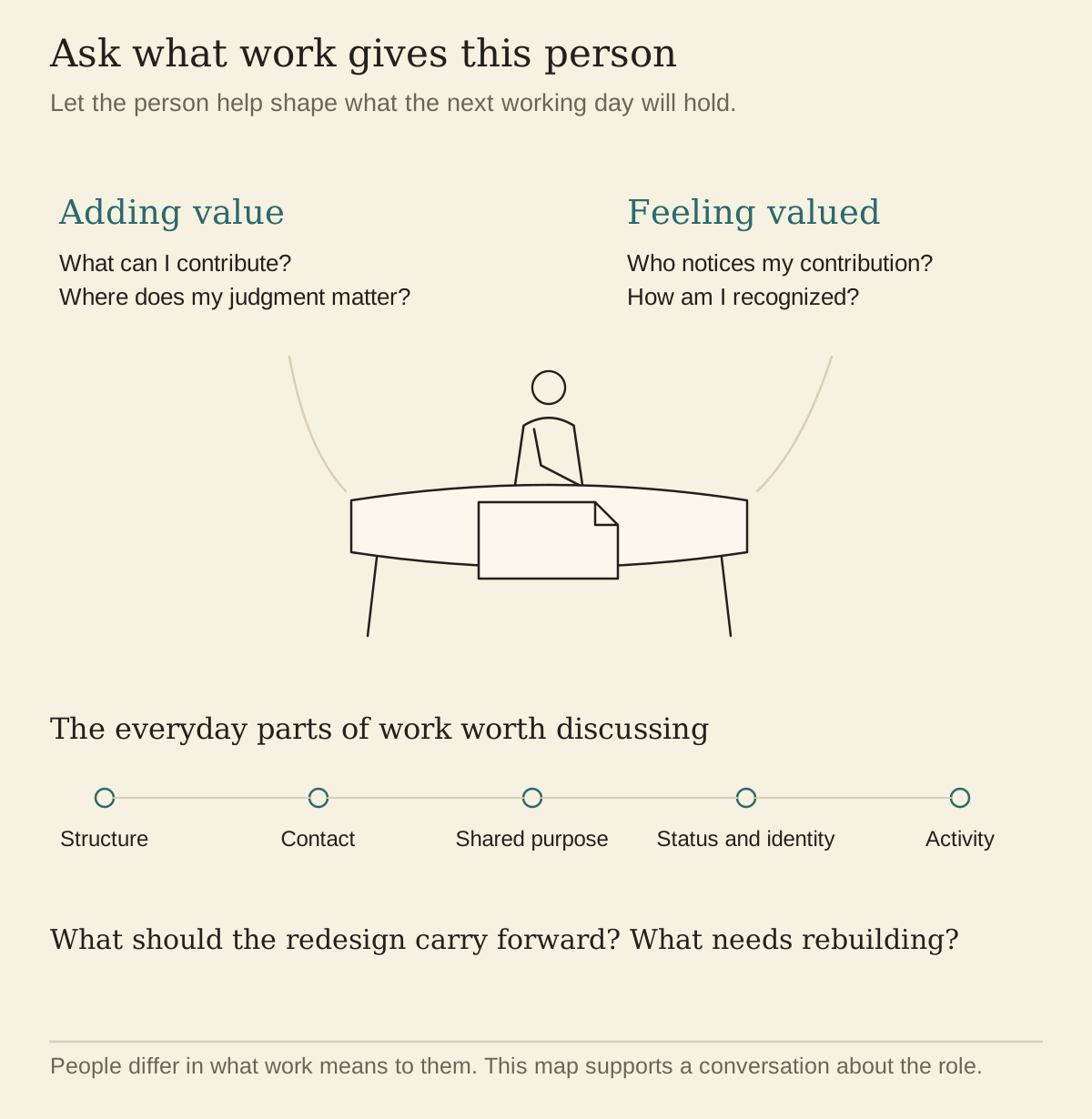
The psychologist Isaac Prilleltensky splits mattering into two halves: feeling valued and adding value. The first comes from being seen, recognized, and respected. The second comes from contributing something that makes a difference. Both run through work. A company decides what work people do, which shapes the second half, and how they are recognized for it, which shapes the first.
The idea has moved from the seminar room into policy. When the US Surgeon General published a framework for workplace mental health in 2022, it named five essentials, and one of them was Mattering at Work, grounded in dignity and meaning. A team of researchers that included Martin Seligman and Roy Baumeister built an Organizational Mattering Scale, with recognition and achievement as its two components, and found that it tracked with job satisfaction, promotion, and retention. Mattering can be measured at work. That means a leadership team can design it.
What Work Quietly Provides
Pay is the visible part of a job. Marie Jahoda, who began studying unemployment in an Austrian village in the 1930s, described the rest: a structure for the day, regular contact with people outside the family, a share in a collective purpose, status and identity, and regular activity. She called them the latent benefits of employment. People rarely notice them until they are gone.
Section 5.6 walked through the research on retirement and cognition and reached a careful conclusion: losing a major source of structure and engagement may matter. Mattering explains part of why. A retiree usually plans for the loss of a paycheck. Few plan for the loss of daily evidence that someone needs them.
In 2026, Stephanie Chan and colleagues reviewed what is known about people who live without paid work: the unemployed, retirees, financially dependent spouses, even lottery winners. Three things shaped whether losing work harmed wellbeing. The first was agency, meaning whether the exit was chosen. The second was whether people had other sources of the latent benefits work had provided. The third was the surrounding context, including cultural norms and the strength of safety nets.
That first finding reaches straight into the workplace. A redesign a person helped shape is a different event, psychologically, from one imposed on them.
The Ambition Argument
In September 2026, Ezra Klein interviewed Jensen Huang, the chief executive of Nvidia, and the two of them arrived at this question from opposite directions.
Huang argued that the usual arithmetic of automation leaves something out. Take the work, insert the automation, and the remaining work shrinks. He called that calculation flawed because it leaves out an input that cannot be measured in calories or joules: ambition. In his view, human ambition is the greatest force in the economy, and it will create more work than automation removes.
Klein pushed back. For a lot of people, he said, their relationship to work is powered by something other than the kind of ambition that led Huang to build Nvidia. Huang answered generously. Ambition, he said, can mean wanting "to make their children's lives better, to take care of their family, take care of their parents." Klein returned to the point later, from a more personal angle. He sleeps. He wants to spend time with his children in the morning. An AI agent working for him does neither. It just works.
Both men were right about something, and the exchange left a third position on the table.
Klein's Side: Drive Is Unevenly Distributed, and That Is Fine
Plenty of people want work that fits inside a whole life. They do it well, they go home, and they keep their ambition for their families, their faith, their communities, and the work they do outside a job. Section 5.6 makes a respected place for exactly this kind of engagement, and Section 6.3 notes that many people reserve identity for life outside work. A plan that assumes everyone will meet AI with an entrepreneur's appetite will misread most of the workforce.
Huang's own frame contains a second problem. He divides every job into its purpose and its tasks: radiologists still diagnose disease even when software reads the scans. He also granted the exception. Some jobs are their tasks. For a customer service agent on the phone, the call is the job. Automate the call and nothing remains above it. For that person, a more capable tool is exposure.
Ambition also fails as a safety net, for a reason inside Huang's own answer. When a person's ambition is taking care of their family, AI leaves the ambition intact and threatens the job they use to carry it out. The means are what is at risk.
The Other Side: Access Can Create Ambition
The reply nobody gave in that conversation is the one I live.
Some of what looks like a lack of ambition is a lack of means. People rarely aspire to what they cannot see a way to do. Albert Bandura spent decades showing that belief in one's own capability shapes the goals a person sets. People who believe they can do something reach further. Raise what someone can do, and you can raise their reach.
Section 5.7 makes the first half of this argument. AI lowers some of the gates that kept capable people out of a domain: the aspiring engineer stopped by calculus, the would-be developer defeated by bad documentation. The second half is the part that matters here. Once a gate opens, a person can start wanting things they had stopped wanting. My own ambition grew when the distance between an idea and a working version of it collapsed.
What Both Sides Share
Underneath both positions sits the same belief: I can do this. AI can push it in either direction, and the clearest evidence on which direction comes from how the work is done.
In a 2026 experiment, Elena Hayoung Lee and colleagues at the University of Southern California gave professionals writing tasks from their own jobs: press releases, short reports, delicate emails. Some worked without AI. Some copied what the AI produced. Some wrote a draft first and then used AI to refine it. The people who copied lost confidence in their own ability, felt less ownership of the result, and found the work less meaningful. The people who drafted first came out where the group without AI did, on all three. When everyone later did a similar task by hand, ownership recovered for the copiers. Their confidence and their sense of meaning stayed lower.
One more result belongs in front of every leadership team. Right after the task, the copiers were the most satisfied of the three groups. Once they went back to doing the work themselves, they were the least satisfied. Passive use feels good early and costs later. A dashboard that tracks adoption, and a pulse survey taken in the first month, would both report success.
The authors name a cause leaders should recognize. Telling employees to maximize their use of AI, they write, "may inadvertently encourage passive reliance."
My experience sits on the first side of that experiment. I direct the work, so the tools extend me. A person handed a mandate to use AI as much as possible, on work they do not control, gets the other result. Whether everyone wants more stays an open question. Part of the answer depends on design, and design belongs to the leadership team.
How AI Wears Mattering Down, and How It Builds It
Eva Selenko and colleagues offer a useful frame: whether AI strengthens or threatens a person's work identity depends on whether it complements their tasks, replaces them, or creates new ones. Sarah Bankins and Paul Formosa describe three paths of deployment: replacing tasks, tending the machine, and amplifying skills.
Tending the machine is the quiet one. Amber Yu, a freelance game illustrator in China, used to earn between $430 and $1,000 for a poster, and once spent a full week on one illustration of a woman in traditional dress performing a lion dance. After the gaming companies she worked for adopted image generators, she was offered work fixing their output, adjusting the lighting and correcting distorted bodies, at a tenth of her old rate. Timothy McKeon, a rare Irish-language translator, lost nearly 70 percent of his income as work from the European Union dried up. What remained was polishing machine translations, which in turn trained the software. "The more it learns, the more obsolete you become," he told CNN. "You're essentially expected to dig your own professional grave." He turns that work down.
This is what being unneeded feels like from the inside. The person may still have the work. Their judgment is no longer what the work asks of them.
The amplifying path runs the other way, and it is a design choice. The same tools can take the parts of a job that wore people down and leave them more of the judgment, the relationships, and the problems worth solving. Section 4.2 is where that choice gets made.
Eighteen Months Later
The book has so far followed people through the moment of change. Section 5.2 named the emotions present when the reckoning begins. Many people carry the loss well past that moment: the employee who kept the job while its center was handed to a system, the survivor of a restructuring, the specialist now reviewing output in a field they used to practice.
The evidence on what job loss and insecurity do is strong. A meta-analysis by Karsten Paul and Klaus Moser, drawing on more than three hundred studies, concluded that unemployment causes distress, beyond accompanying it. Prospective studies find that job insecurity predicts later depressive symptoms. In a study of ten Finnish towns, employees who kept their jobs through a major downsizing died of cardiovascular disease at roughly twice the rate of employees whose workplaces did not downsize, though the estimate is imprecise.
The evidence specific to AI is younger. In a three-wave study of employees in South Korea, Kim and colleagues found that AI adoption lowered psychological safety, which in turn raised depression, and that ethical leadership softened the effect. Researchers at the University of Florida have proposed a clinical construct, AI replacement dysfunction, describing persistent distress about obsolescence, loss of professional identity, and loss of purpose. It is a proposal, without standing as a diagnosis.
Leaders should diagnose no one. Section 5.9 warned against reading disengagement from age, skepticism, or slower adoption. What leaders can do is notice the conditions that produce distress, and make sure a path to qualified help exists that people trust enough to use.
What the Company Owns
Owning the consequences of your own decisions requires no authority over anyone's inner life. A company that redesigns work has made a decision with psychological consequences, and it owns those consequences the way it owns the decision. Standards bodies have reached the same place. ISO 45003 treats poorly managed change as a psychosocial hazard, and several Australian jurisdictions now enforce psychosocial risk management as a legal duty.
The obligations are concrete. Section 5.11 turns them into a working method for one function, and Section 9.3 covers how the organization runs the change over time.
Agency in the redesign. The people in a role help redesign it. Agency is the strongest protective factor in the research on losing work.
Honest timing. Uncertainty that leadership could have resolved is a harm leadership chose.
New ways to add value, designed into the role before the old ones are removed.
Recognition of the new contribution. When an agent did part of the work, recognition has to find the human part. Section 6.5 takes this up.
Psychological safety through the change, so people can say what is happening to them.
Sequence where ownership matters. Where a person's judgment is the point of the work, let them draft and let the agent refine.
Mattering measured across teams, and never used to rank individuals.
Where support crosses into clinical care, the company's role is to fund it and step back. A company can pay for a qualified clinician to support a team whose roles are changing. When it does, the clinician should tell everyone in advance who the client is, what the company will see, and where confidentiality ends, as the American Psychological Association's ethics code requires of psychologists working through organizations. Monitoring the wellbeing of individuals sits outside the line this book draws.
Why It Pays
The AI-Native operating model depends on people continuing to contribute what they know. Section 1.3 put it plainly: people who trust the purpose are more likely to contribute context, exceptions, and judgment beyond the minimum they can safely disclose. People who stop feeling they matter stop contributing. Prilleltensky identifies neglect and devaluation as primary drivers of burnout and turnover, and the Organizational Mattering Scale tracks with retention. The survivor costs show up as absence, departures, and health. A company that lets mattering erode pays for it in the knowledge its systems were supposed to capture.
What We Do Not Know
Whether access raises ambition across a whole workforce, or mostly for people who were already reaching, has not been measured. The experiments on active and passive use ran for minutes, on writing tasks. How long the erosion lasts in real jobs, and whether it reverses when the work is redesigned, are open questions. The honest position is that the direction depends partly on design, and the size of the effect is still unknown.
Nobody had to intend the slash for it to do its work. That is how mattering usually erodes: as a side effect of decisions made for other reasons. Side effects of a leadership decision belong to the leadership team.
The next section turns to what has to be unlearned for the AI-Native operating model to work at all. Mattering is what people stand to lose in the change. Unlearning is what they are asked to give up.
Bring this into the room. Split the leadership team, with people from the roles being redesigned in the room. Half argue Klein's side: drive is uneven, many people want work that fits a life, and a more capable tool is exposure for anyone whose job is its tasks. Half argue the other side: access creates ambition, and the right design lets the tools extend people. Next, build a mattering map together. For each role being redesigned, ask what the role gives the person today: the value they add, the recognition they receive, and the latent benefits of structure, contact, purpose, and status. Finally, ask what replaces each one after the change. The gaps on the map are the design work. Nobody votes on who won the argument.
Intellectual lineage. Mattering as a construct begins with Rosenberg and McCullough; Prilleltensky's two halves and the Organizational Mattering Scale carry it into work. Jahoda's latent benefits explain what a job provides beyond pay. Bandura's self-efficacy theory sits under both sides of the ambition argument, and Lee and colleagues show how the sequence of work moves it.
Rosenberg, M., and McCullough, B. C. (1981). Mattering: Inferred significance and mental health among adolescents. Research in Community and Mental Health, 2, 163–182. / Prilleltensky, I., and Prilleltensky, O. (2021). How People Matter: Why It Affects Health, Happiness, Love, Work, and Society. Cambridge University Press. / Office of the U.S. Surgeon General (2022). The U.S. Surgeon General's Framework for Workplace Mental Health and Well-Being. / Reece, A., Yaden, D., Kellerman, G., Robichaux, A., Goldstein, R., Schwartz, B., Seligman, M., and Baumeister, R. (2021). Mattering is an indicator of organizational health and employee success. The Journal of Positive Psychology, 16(2). / Jahoda, M. (1982). Employment and Unemployment: A Social-Psychological Analysis. Cambridge University Press. / Chan, S. C. Y., Bales, A., Hermann, K. L., and Gabriel, I. (2026). Work, Wellbeing, and Choice: Empirical Lessons for AI Futures. arXiv preprint 2609.11019. / Bandura, A. (1977). Self-efficacy: Toward a unifying theory of behavioral change. Psychological Review, 84, 191–215. / Lee, E. H., Yin, Y., Jia, N., and Wakslak, C. J. (2026). Relying on AI at work reduces self-efficacy, ownership, and meaning while active collaboration mitigates the effects. Scientific Reports, 16, 13583. / Selenko, E., Bankins, S., Shoss, M., Warburton, J., and Restubog, S. L. D. (2022). Artificial intelligence and the future of work: A functional-identity perspective. Current Directions in Psychological Science, 31(3), 272–279. / Bankins, S., and Formosa, P. (2023). The ethical implications of artificial intelligence (AI) for meaningful work. Journal of Business Ethics, 185, 725–740. / Paul, K. I., and Moser, K. (2009). Unemployment impairs mental health: Meta-analyses. Journal of Vocational Behavior, 74, 264–282. / Kim, T. J., and von dem Knesebeck, O. (2016). Perceived job insecurity, unemployment and depressive symptoms: A systematic review and meta-analysis of prospective observational studies. International Archives of Occupational and Environmental Health. / Vahtera, J., Kivimäki, M., and colleagues (2004). Organisational downsizing, sickness absence, and mortality: 10-town prospective cohort study. BMJ. / Kim, Kim, and Lee (2025). The dark side of artificial intelligence adoption: Linking artificial intelligence adoption to employee depression via psychological safety and ethical leadership. Humanities and Social Sciences Communications, 12, 704. / McNamara, S. N., and Thornton, J. E. (2025). Artificial intelligence replacement dysfunction (AIRD): A call to action for mental health professionals in an era of workforce displacement. Cureus. / ISO 45003:2021. Psychological health and safety at work. / American Psychological Association. Ethical Principles of Psychologists and Code of Conduct, Standard 3.11. / Verma, P., and De Vynck, G. (2023, June 2). ChatGPT took their jobs. Now they walk dogs and fix air conditioners. The Washington Post. / Zhou, V. (2023, April 11). AI is already taking video game illustrators' jobs in China. Rest of World. / CNN (2026, January 23). Like digging 'your own professional grave': The translators grappling with losing work to AI. / The Ezra Klein Show (2026, September 23). Jensen Huang vs. the A.I. Doomers. The New York Times.