What habits of mind no longer serve the AI-Native worker?
At a conference last year a panelist said, almost in passing, that anyone over forty working in or building a company around AI has to forget half of what they have learned and half of what they know. I heard the line as provocation, a figure of speech about habit with nothing to say about age. A career spent learning how work gets done leaves you holding hard-won judgment about the right sequence, the right amount of caution, and how long a thing takes. New compute and new interfaces are clearing some of the hurdles that shaped those judgments. Experience remains valuable. Some conclusions drawn from its old conditions now need to be tested again.
The line means that some things that used to work for you may work differently now. Timelines that used to take quarters can sometimes be compressed into weeks. Parts of workflows that had to be sequential can sometimes run in parallel. Hurdles that used to slow you down may be cleared with new compute and interfaces. Habits of mind that protected you in the pre-AI world (the carefulness, the staging, the defensive expertise, the long iteration cycles) are not all wrong in the AI-Native context. Some still serve you. Others may be slowing you down after the condition that justified them has changed.
Adopting new tools is part of becoming AI-Native. The rest is deliberately revising patterns built for conditions that may no longer hold. Revising is often harder than adding because it requires a person to separate the principle that made a practice wise from the mechanism through which it was expressed. The way you have been working may not be the way to keep working. That can be especially difficult when the old way helped produce real success. It can be equally difficult for a novice who has never seen why the old safeguard existed. Unlearning is not forgetting. It is updating without discarding the evidence that made the earlier lesson true.
The Specific Habits Worth Examining
I want to walk through several habits of work that deserve examination. The list is not exhaustive. It is meant to make the abstract argument concrete, so that a leadership team or an individual worker can see what I mean and can locate their own version of the pattern.
Long timelines. The pre-AI world ran on long cycles because the work took long to do. Strategic plans were quarterly or annual. Major projects took years. Software releases were measured in months. The long cycles produced patterns of work that depended on the cycles. Decisions could be deliberated over weeks. Drafts could be reviewed over days. Communication could be staged because the response was not needed immediately.
AI can compress some of those cycles. A first draft, code prototype, comparison, or synthesis that took weeks may take hours. Discovery, consultation, physical work, regulatory review, integration, and trust may not compress with it. Faster generation can even lengthen evaluation by multiplying the number of plausible options. The habit to unlearn is not deliberation. It is assigning every step the duration imposed by the slowest old step. Decide which latency has actually changed, then protect the time the consequence still requires. A late excellent decision can be useless. A fast unexamined decision can be worse.
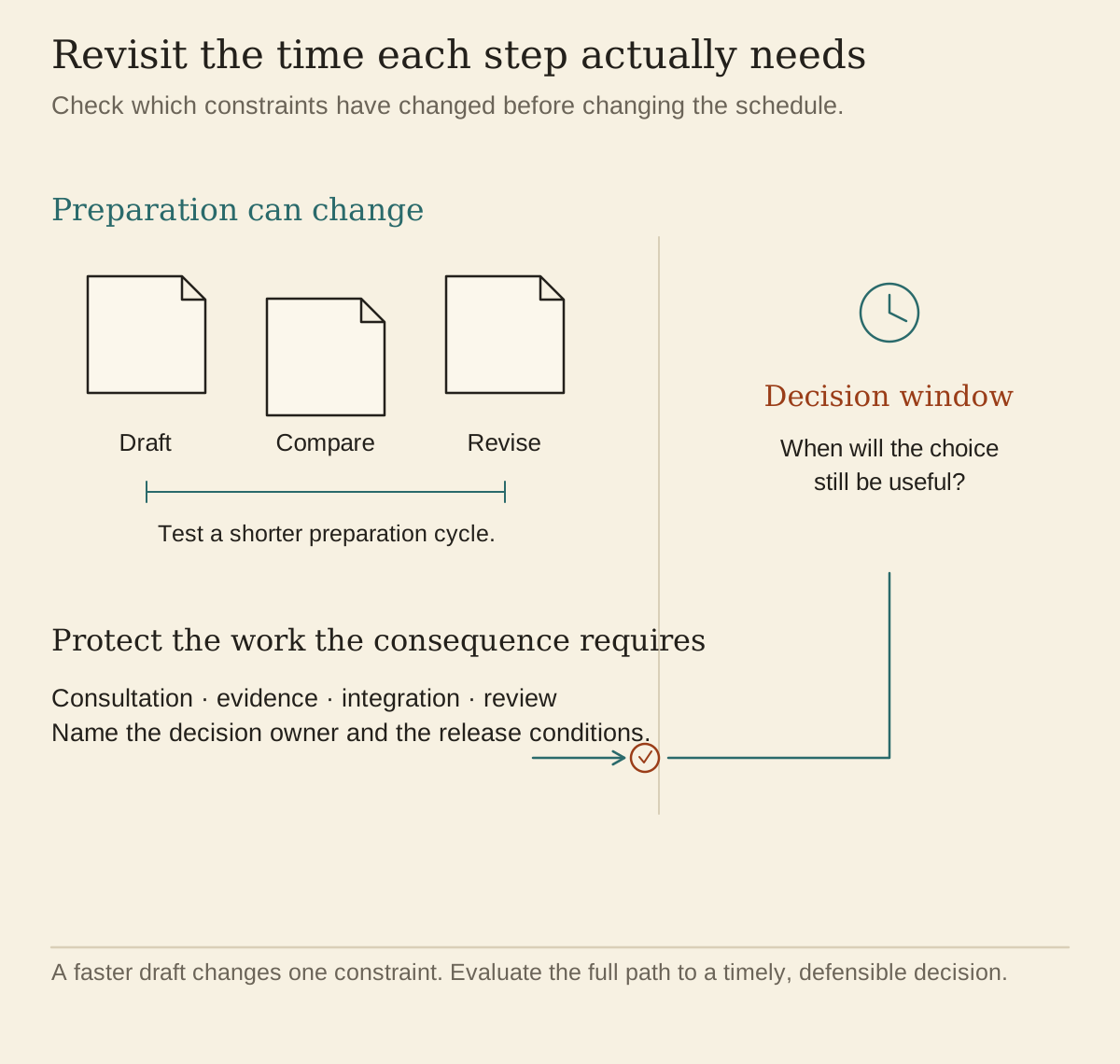
Sequential workflows. The pre-AI world depended on sequential work because parallel work required coordination overhead that often was not worth it. The analyst produced the analysis, then handed it to the strategist, who produced the strategy, then handed it to the planner, who produced the plan. Each handoff was a cost, and the costs accumulated. The sequence existed because the alternatives were worse.
AI allows more parallelism by lowering the cost of drafting, comparison, and synchronization. Analysis, strategy, and planning can sometimes begin together as hypotheses that inform one another. They cannot become independent fictions. Strategy still depends on what the analysis establishes, and a plan built against a discarded strategy must be reworked. The habit to unlearn is unnecessary waiting. Causal sequence still matters. Define the interfaces, assumptions, and points of convergence; run reversible work in parallel; and keep irreversible decisions behind the evidence they require. AI can support integration. It is not the substrate that guarantees it.
Defensive expertise. Many experienced workers learned, over their careers, to develop expertise as a defense. Knowing more than your colleagues made you valuable. Being the person others came to for a specific kind of judgment created a moat around your role. The expertise functioned simultaneously as competence and as protection. Sharing too much eroded the protection. Documenting your work too fully made you replaceable. The incentives produced behavior that was rational at the individual level and corrosive at the organizational level.
AI changes these incentives, but not in one direction. Expertise kept inaccessible cannot improve shared practice or the systems meant to support it. Expertise captured without consent, credit, context, or a credible employment covenant may train the mechanism used to eliminate the contributor's role. Calling reluctance “hoarding” turns an organizational trust problem into a worker defect. The company has to make contribution safer and more valuable than concealment: define purpose and access, recognize authorship, compensate unusual knowledge work, preserve challenge and advancement, and honor legal, contractual, privacy, and collective-bargaining boundaries.
Letting go of defensive expertise asks the worker to believe the company will still value judgment after the explicit knowledge has been shared. That trust is the covenant from Section 5.2, and the company has to earn it through conduct. A covenant does not guarantee participation, knowledge does not automatically become a graph, a graph does not automatically become capability, and capability does not automatically elevate the contributor's work. Each arrow requires design and proof. When the chain works, shared knowledge can improve tools and free experts for more consequential work. When it does not, the worker's caution may be entirely rational.
Status games. Most pre-AI organizations were structured around status games that workers learned to play. The hierarchy was visible. The signals of position were specific. The meetings were structured to display rank. The communication patterns reinforced who was senior to whom. The games were sometimes unhealthy. They were stable, and workers learned to play them with skill.
Some AI-Native companies flatten hierarchy; others centralize new power around models, data, infrastructure, and the people who control them. Less-senior workers can perform some tasks once reserved for seniors, but tool-assisted output is not identical to senior judgment. Old status signals may weaken while new ones form around access, fluency, visibility, and control of automated systems. The games change more reliably than they disappear.
Releasing this requires the worker to find new sources of standing. The standing that comes from doing work that is genuinely distinctive. The standing that comes from developing other workers. The standing that comes from being trustworthy in moments of ambiguity. These are real sources of standing in the AI-Native company. They differ from some of the sources rewarded in the pre-AI company. Workers who make the transition can find new ground. Workers who do not may keep spending energy on games whose prizes are disappearing.
The Discipline of Unlearning
Unlearning can be harder than learning. A new pattern can be added without threatening the old explanation of success. Revising the old pattern requires a person to notice that it held only under certain conditions. The pattern need not be erased. It can remain available for the conditions in which it still works. The demanding act is building a better rule for when to use which approach.
Unlearning is a practiced skill. People become better at it when they notice that a familiar practice has stopped producing its old result, investigate what changed, and test a replacement rather than merely redoubling effort. It is observable and teachable. Companies that reward revision, preserve psychological safety, and keep the results of experiments visible give the workforce a better chance of navigating transition.
The teaching is practical. The manager who notices that a worker is operating on a pre-AI pattern that no longer fits, and who works with the worker to examine the pattern, name what it was doing, and design a replacement, is teaching the discipline. The worker who learns from the manager learns to do it on their own, and then teaches others. The discipline propagates through the workforce as a culture, carried person to person.
Why This Is Hardest for the Most Accomplished
I want to name something uncomfortable. Unlearning can be especially hard for people who were highly accomplished under the old conditions: the senior partner whose practice was built on a particular judgment, the chief operating officer whose career was built on a particular execution discipline, the engineer whose reputation rests on a particular design approach. They have strong evidence that the patterns worked and real identity invested in them. They also possess the experience needed to distinguish a genuine change from recycled hype. The point is not that accomplished people have the most to forget. It is that their revision carries unusually high stakes and unusually high value.
The accomplished worker may see intellectually that the patterns of work are changing and still hesitate to release them. The resistance can be emotional, practical, and economic. The patterns are part of how the worker understands themselves, but they may also carry reputation, income, authority, and real protection against error. Revision can therefore feel like releasing a piece of identity built over decades while betting that the new conditions will hold.
The leadership teams that recognize this and design for it produce different outcomes than the leadership teams that do not. The recognition involves giving accomplished workers explicit permission to experiment with releasing patterns. It involves protecting the workers from the immediate consequences of the experiments, because the experiments will not all work. It involves modeling the release at the leadership level, so that the workers can see that the leaders are doing the same work they are asking of the workers. It involves time, because the release is not a switch.
Companies that do this well give experienced workers a credible reason and a fair opportunity to make the transition. Companies that do it poorly risk resignation, quiet withdrawal, or justified resistance to a badly designed change. A disengaged accomplished worker may still be in the building, but leaders should not diagnose that state from age, skepticism, or slower adoption. Examine contribution, invite dissent, test the new practice, and ask what the system is doing before deciding the person is the problem.
What Stays
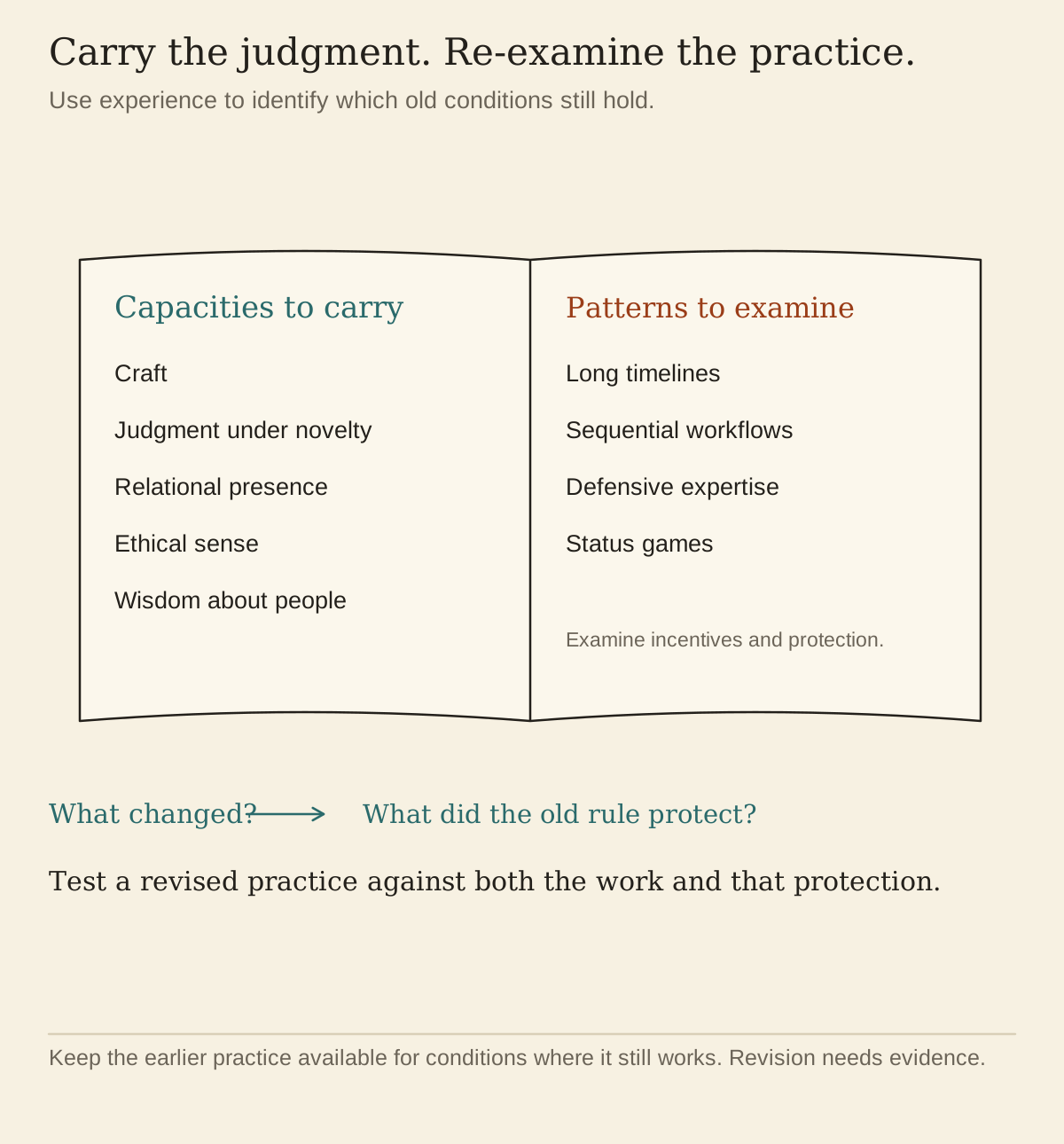
One thing to name before closing: what does not need to be unlearned. The conversation can imply that workers should release everything that worked for them. That is wrong. The seven kinds of human value from Section 5.3 remain important: judgment under genuine novelty, relational presence, ethical standing, contextual knowledge, and the rest. AI performance is uneven rather than cleanly divided between routine playbooks and uniquely human situations. As capability moves, these human capacities matter because organizations choose to place authority, responsibility, participation, and trust in people. No benchmark guarantees that machines will stay weak at them. Two capacities deserve emphasis because the unlearning conversation most often unsettles them.
Craft stays. A worker's developed sense of what good work looks like in a domain is one basis for evaluating AI output. Craft gives the collaboration standards, exceptions, and a memory of consequences. AI can amplify it and help novices begin to acquire it. Without craft or effective external checks, AI-mediated work may be polished yet shallow, technically broken yet persuasive, or occasionally better than the person expected. Fluency is not the same as quality.
Wisdom about people stays. Accumulated understanding of how individuals and groups behave, how trust is built and broken, how power moves, and how change lands is consequential human knowledge. AI can model patterns, recall cases, and offer interpretations; it does not participate in the relationship or carry legitimate authority to decide what should be done to people. Workers with this wisdom can be more valuable when the operating model makes room for it. The company still has to recognize and use it.
The unlearning is real and the unlearning has limits. The test is whether a revised practice fits the changed conditions while preserving the protection the old practice was built to provide. The companies that take both seriously, the release of the patterns that no longer fit and the preservation of the capacities that remain valuable, will produce workforces that can do the new work. The next section completes Stage 5 by asking what the workforce of an AI-Native company actually looks like, given everything the human work of this part has built so far.