What does an AI transition feel like from inside the workforce?
The leader who has begun their own practice is ready for the harder half. The picture the first four parts built, of what an AI-Native company looks like at the structural level, is incomplete. The structural work matters.
A major determinant of success is the work your leadership team does with the people whose lives are being reshaped. That work is harder, slower, and far less amenable to the strategy-deck treatment than the structural work. It is also a common source of failure, and the failure may first appear as weak adoption, missing knowledge, poor implementation, or stalled value rather than as a workforce problem.
This work is what I call the human reckoning. The term deserves precision.
What the surveys show. ADP's 2025 Global Workforce Survey of more than thirty-nine thousand workers, reported in Today at Work 2026, found that only twenty-two percent strongly agreed their job was safe from elimination. The gradient is worth holding: eighteen percent of individual contributors, twenty-one percent of frontline managers, and thirty-five percent of C-suite executives and upper managers felt secure. Separately, BCG's 2025 AI at Work survey found that employees at organizations undergoing comprehensive AI-driven redesign were more worried about job security (forty-six percent) than those at less-advanced companies (thirty-four percent). These are self-reported associations that leave causation open, and they still show why deeper transformation does not automatically dissolve fear.
ADP Research Institute (2026). Today at Work 2026, Issue 1. / Boston Consulting Group (2025). AI at Work 2025: Momentum Builds, but Gaps Remain.
What the Reckoning Is
A reckoning starts with a clear account of what is changing and what remains uncertain. Leaders explain their decisions and commitments. Workers have room to describe the effects on their jobs and lives, question the plan, and help shape what happens next.
Why a reckoning is needed here is specific. A workforce that built the company over the last twenty or thirty years may be asked to participate in dismantling or redesigning parts of the expertise that defined their careers. The senior analyst who became valuable by synthesizing complex information faster and more reliably than anyone else may now help deploy a system that performs parts of that work in a fraction of the time. The experienced operator who could read the line and anticipate problems may be asked to teach a system intended to support the next generation. The middle manager who built a career coordinating information across a team may watch parts of that coordination become automated.
These people are not units of production whose obsolescence is a market signal. They are people whose lives are organized around the work they do. They have raised families on the income from that work. They have invested years of effort in becoming good at it. They are now being told, in language that varies from honest to evasive, that the work they spent their lives learning to do is being changed in ways they did not choose and cannot control.
What they are experiencing has names. I want to use the names, because the alternative is to use euphemisms, and the euphemisms tell the workforce that the leadership team is not willing to acknowledge what is actually happening.
The Named Emotions
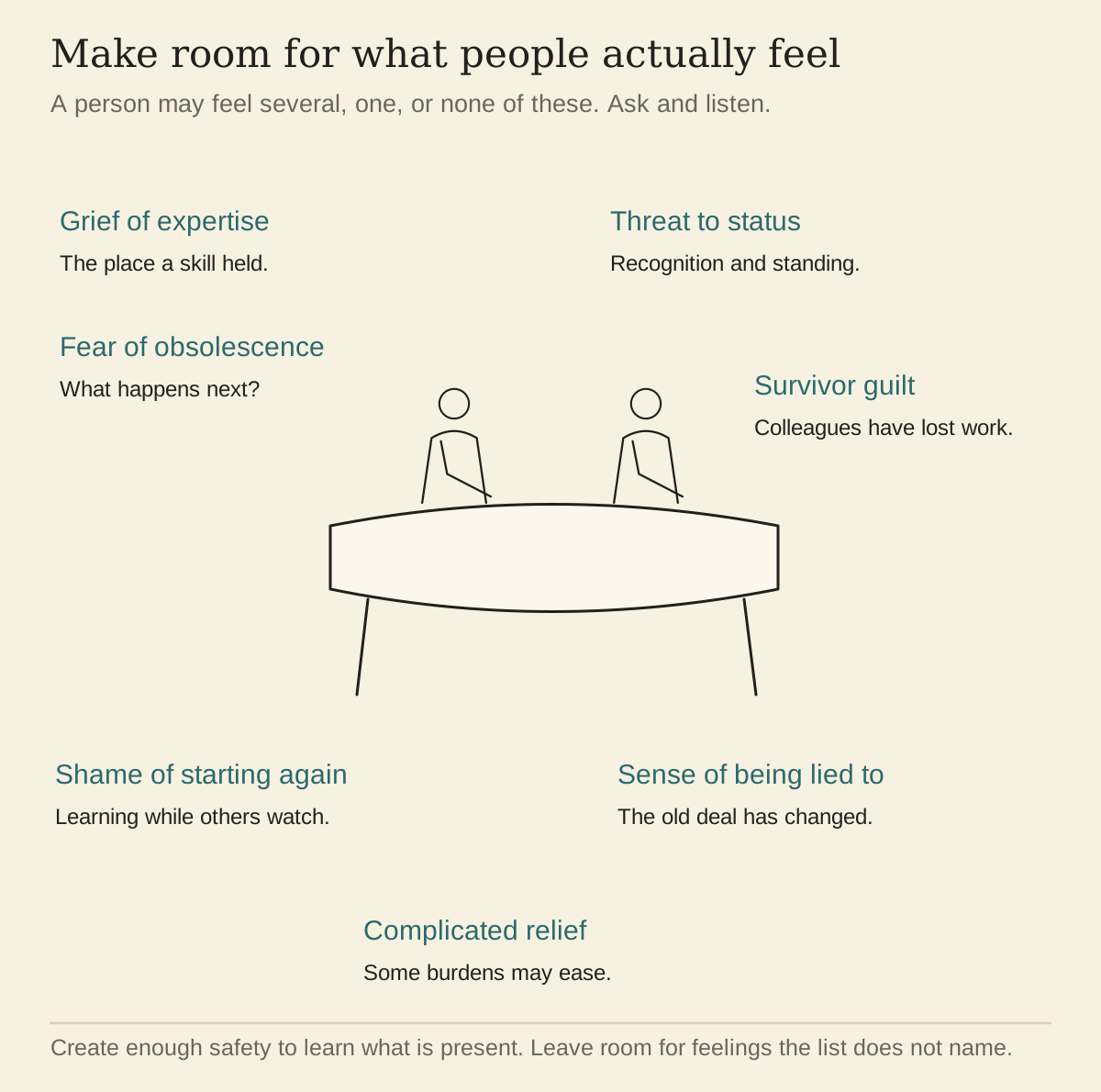
There is a grief of expertise. This is the experience of watching the skill you developed over decades become less central to the way work is done. The skill itself does not disappear. The centrality of it does. What is grieved is the place that competence held in the world.
There is a threat to status. Status in companies is closely tied to what you know that others do not, what you can do that others cannot, and the matters on which people defer to you. AI changes the distribution of all three. The status that was earned over years is being recalibrated in ways the person who earned it had no part in choosing.
There is a fear of obsolescence. This is the fear that the changes will not stop where the leadership says they will. The fear is rational. The history of corporate communications about workforce transitions is full of reassurances that did not hold. The workforce knows this. The leadership team that pretends the workforce does not know it is producing the cynicism that becomes the obstacle to the transition.
There is survivor guilt for those who keep their jobs while colleagues do not. The person who is still employed after a workforce reduction carries the knowledge that the difference between them and a former colleague was not always merit. It was often luck, or politics, or which team happened to be in the path of the change. The survivor's relationship to the company is altered by this. The company often does not address it, because the survivor is still there and the colleague is not, and the conversation feels uncomfortable to have.
There is the shame of starting again. The senior person who has to learn a new way of working is doing it visibly, in front of colleagues who used to look to them as the expert. The learning is slow. The mistakes are public. The status that was solid is now provisional. The shame of being a beginner again, after a career of being the one others learned from, is real and is rarely named in the rooms where transition decisions are made.
There is the quiet sense that the company has lied to them. The deal that the workforce had with the company, the implicit contract about what loyalty was worth and what experience earned, was made under one set of assumptions. The new set of assumptions is being introduced without the deal being renegotiated. The workforce is being asked to accept the new terms while the leadership team frames the situation as if the old deal still applies. The workforce is not fooled.
There is also a complicated relief. Some of the work that is now being automated was crushing the people doing it. The analyst who has been burning out for years on the volume of routine work is genuinely glad to have AI handle the routine. The relief is real. It is also complicated, because it is mixed with the other emotions on this list, and because the person who feels relief has to operate in a workplace where expressing it openly would be misread.
These seven emotions are a vocabulary. A given person may feel several, one, or none of them, and every transition produces its own mix. Relief and opportunity can sit beside fear, grief, anger, or none of them. The leadership choice is whether to create enough safety to learn what is actually present rather than assume it away. Section 5.8 follows these people past the moment of change.
Why the Reckoning Belongs at the Center
There is an argument that the human reckoning is a topic for HR rather than for the leadership team designing the AI-Native transition. The argument would be that the technical and operational decisions are what produce value, and the human side is a downstream consequence to be managed by the appropriate function.
That argument is wrong, and it is wrong for operational reasons before ethical ones. A workforce excluded from an honest conversation is less likely to trust or engage deeply with the transition. Institutional knowledge about how work actually gets done is distributed among the people experiencing the change, as well as in systems and artifacts. Useful capture requires participation, and participation is easier to earn when leadership treats people honestly. HR has essential expertise here; the senior leadership team cannot delegate its own accountability to HR.
A company that skips the human reckoning may discover later that deployed systems are not improving as expected. They work on easy cases and fail on exceptions. One possible cause is that the design lacks institutional knowledge held by experienced people who were never engaged, never asked the right questions, or had no reason to trust the process. That is not the only cause (data, architecture, evaluation, and model limits also matter), but it is one technology work alone cannot repair.
Companies that take the human reckoning seriously create better conditions for engagement, knowledge transfer, correction, and learning. Those conditions can support compounding advantage over time. They do not guarantee it, and honest treatment should not be reduced to a tactic for extracting knowledge. The ethical case stands on its own; the operational case makes neglect even harder to defend.
The Leaders Go First Principle
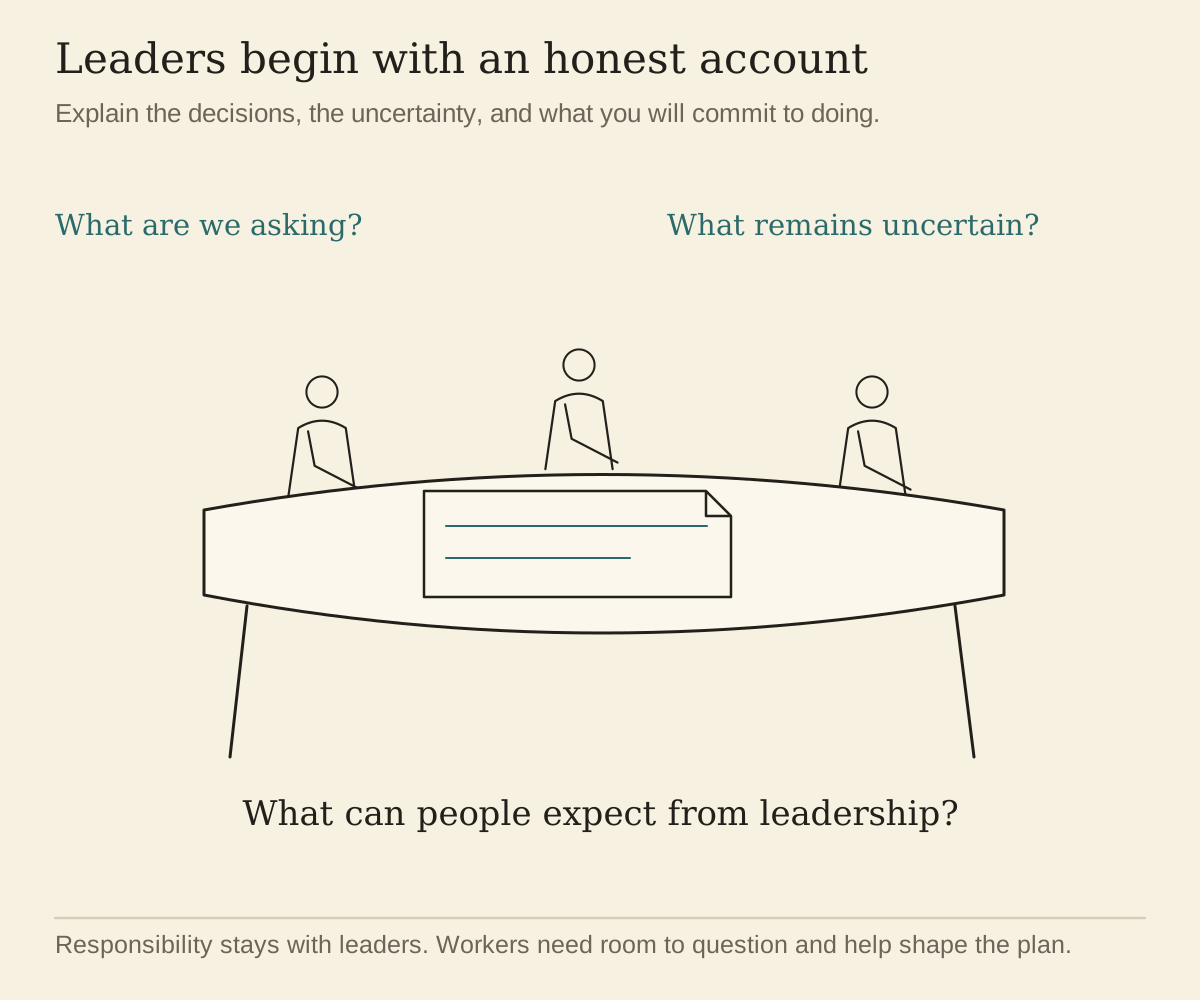
None of this reckoning is possible unless your leadership team is willing to be honest themselves first.
The leadership team has to acknowledge, in the room, what they are asking of the workforce. They have to acknowledge their own uncertainty about how the transition will unfold. They have to acknowledge that they are making decisions with incomplete information and that some of the decisions will turn out to have been wrong. They have to acknowledge that the careers of people they have worked with for years are being altered in ways the leadership team is responsible for, and that the responsibility weighs on them.
This kind of acknowledgment is rare in corporate settings, and the reason it is rare is that leaders have been trained, often over decades, to project confidence and control. The training served them in earlier transitions. It does not serve them here. The workforce going through an AI-Native transition has more information than the leadership team realizes. They know what is happening. They know what is being said publicly and what is being said privately. They know when they are being managed. The leadership team that projects unrealistic confidence is producing the cynicism that defeats the transition. The leadership team that speaks honestly is producing the trust that enables it.
The honest speech does not have to be elaborate. A senior leader who stands in front of the workforce and says, simply, "I know this is hard. I know some of you are afraid. I know I am asking you to do something that I would find difficult to do in your place. I want to tell you what I am committing to in return for what we are asking of you," has done more than a leader who delivers a polished transformation narrative.
What We Are Leaving Behind, What We Are Carrying Forward
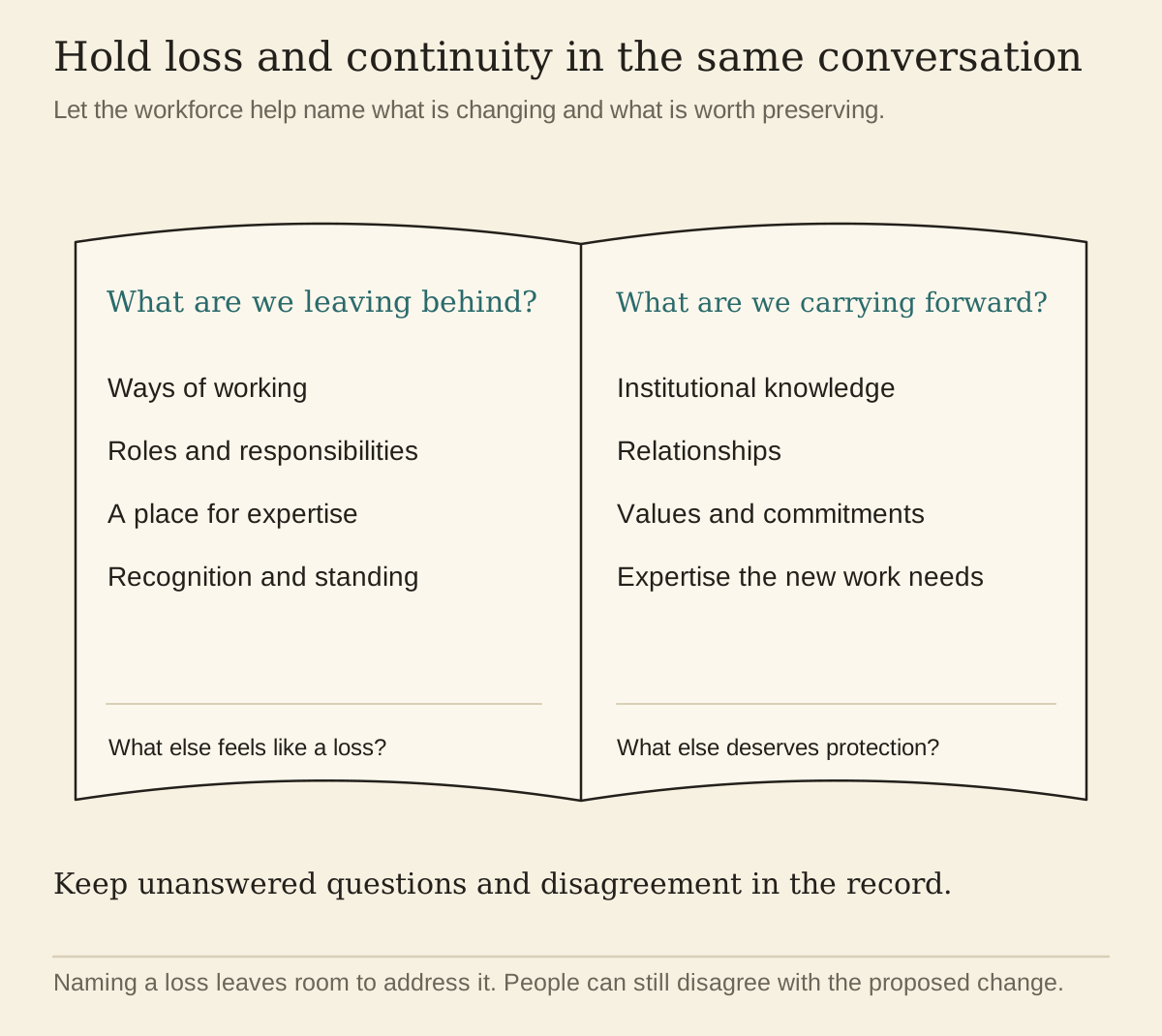
What makes the reckoning bearable in practice is pairing two questions, asked together, in the same conversation.
What are we leaving behind. This is the honest acknowledgment of the losses. The ways of working that are changing. The expertise that is being recalibrated. The roles that are evolving or ending. The status structures that are dissolving. The leadership team names these out loud. The workforce names what is being lost from their side. The conversation is uncomfortable because the losses are real and naming them does not eliminate them.
What are we carrying forward. This is the honest acknowledgment of what is being preserved. The institutional knowledge that matters. The values that define the company. The relationships that have been built. The expertise that becomes more valuable in the AI-Native context. The commitments to people that survive the transition. The workforce participates in naming these too, because the workforce often knows better than the leadership team what is genuinely worth preserving.
Pairing them matters because loss without a credible account of continuity can deepen fear, while preservation language that leaves no room to name loss can feel evasive. Neither reaction is universal, and resistance may also be a rational disagreement with the plan. The pairing holds continuity and change in the same conversation, giving the workforce a more honest basis on which to respond.
Intellectual lineage. What I am describing draws on a leadership posture Edgar Schein spent his career naming. Schein, a foundational scholar of organizational culture, argued that leaders who default to telling can miss what they most need to know. Leaders who ask, and ask in ways that lower status barriers and invite candid answers, can learn what formal reporting hides. He called the practice humble inquiry. Schein and Warren Bennis also used the term psychological safety in their 1965 work on organizational change, an early root of the later research tradition discussed in Section 6.1. The covenant below is one possible artifact of humble inquiry practiced during a serious transition, and I answer for the method.
Schein, Edgar H. (2013). Humble Inquiry: The Gentle Art of Asking Instead of Telling. Berrett-Koehler. / Schein, E. H., and Schein, P. A. (2016, 5th ed.). Organizational Culture and Leadership. Wiley. / Schein, E. H., and Bennis, W. G. (1965). Personal and Organizational Change Through Group Methods. Wiley.
The Covenant
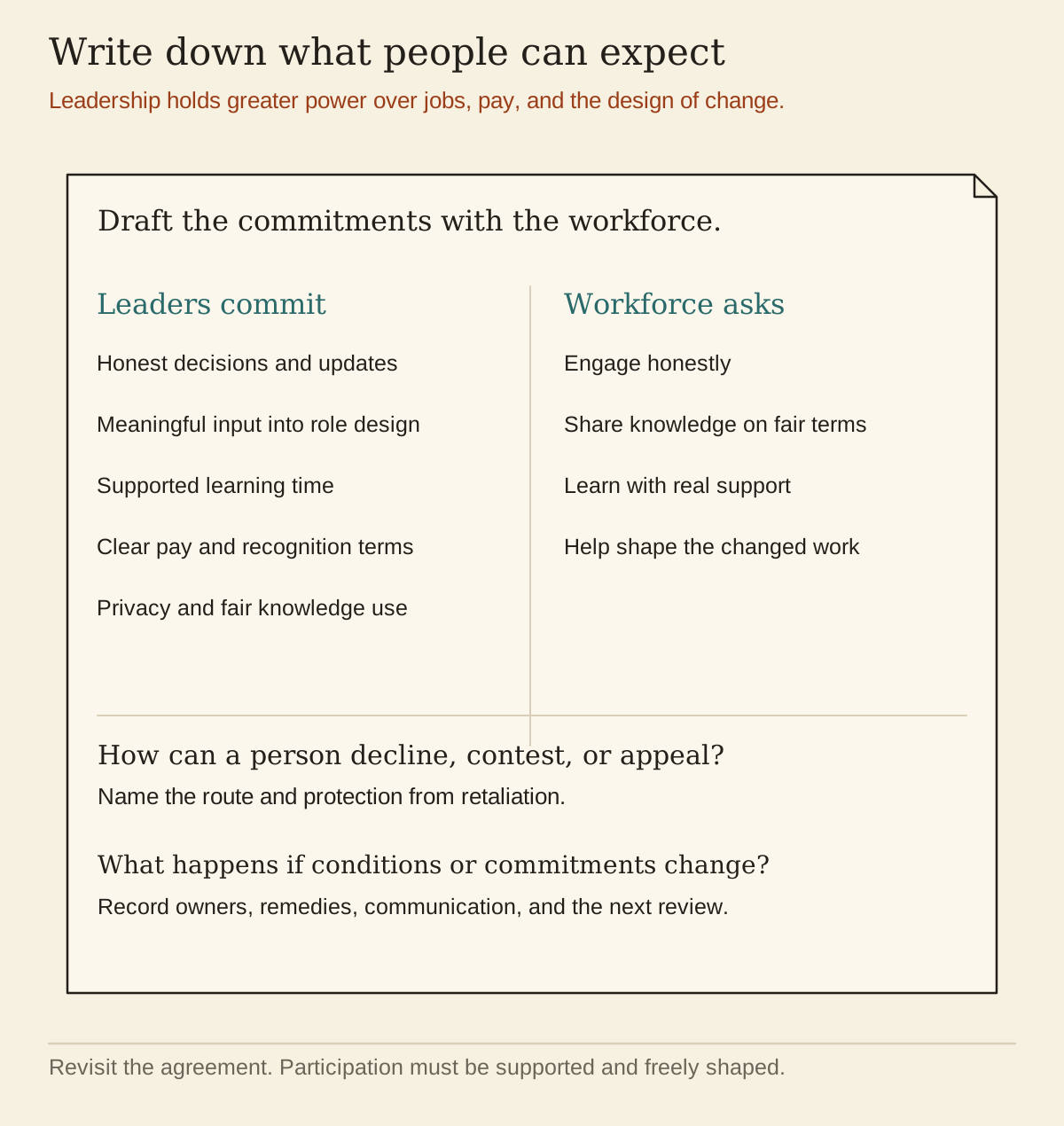
Out of that reckoning comes a covenant. I use the word deliberately. A covenant is not a contract. A contract specifies exchanges. A covenant specifies commitments. The covenant in an AI-Native transition is the explicit, named, public agreement between the leadership team and the workforce about what each commits to and what each is asking of the other.
The leadership team commits to specific things. To name the truth even when the truth is uncomfortable. To honor the institutional knowledge of experienced workforce members through their participation in the design of the new operating model. To invest in the development of every workforce member who wants to participate in the AI-Native company. To make compensation, role, and recognition decisions that match the rhetoric. To acknowledge the human cost of the transition rather than pretending it does not exist.
The workforce is asked to commit to specific things: to engage honestly in the work of transition, share institutional knowledge under fair and transparent terms, learn what needs to be learned with real support, and participate in shaping the company rather than wait for it to be done to them. These asks are not morally equivalent to leadership commitments because leadership holds greater power over jobs, compensation, and the design of the transition. Participation must not become coerced consent, and knowledge capture must not become an undisclosed mechanism for eliminating the person who provided it.
That power difference also means the workforce needs a credible way to decline, contest, or appeal an ask without retaliation. A commitment made because a person's livelihood is at risk is not evidence that the covenant was freely shaped.
A covenant is a real artifact. It can be written down. It can be revisited. It can be referenced in the moments when the transition is producing strain and the question of what was agreed needs to be answered. The companies that produce a real covenant have given themselves a reference point. The companies that produce a covenant in rhetoric only have given themselves a hostage to fortune.
Bring this into the room. The covenant is a real artifact, meant to be written down. Draft it with the workforce at the table alongside the leadership team, in two columns: what leaders commit to and what they ask of the workforce. Make the commitments specific: compensation, role design, recognition, learning time, privacy, appeal, and knowledge-capture terms. Make the asks specific: engagement, knowledge sharing, and willingness to learn. State what happens when conditions change or a commitment is broken. Sign it, communicate it, and revisit it quarterly.
The Institutional Knowledge Connection
A connection runs through here that should be made explicit: the link between the human reckoning and the institutional knowledge architecture from Section 4.1.
The knowledge architecture described in Section 4.1 draws partly on institutional knowledge held by experienced workforce members. Capturing and validating that knowledge requires their participation. Willingness is influenced by whether the process feels respectful, safe, consequential, and fair, and by whether people believe the stated purpose of capture.
Experts who feel honored are more likely to share deeply. They may sit for interviews, walk modelers through what they know, challenge architects when the representation is wrong, and take pride in supporting the next generation. But respect is not a transaction that purchases disclosure; workload, incentives, legal duties, personality, and the limits of tacit recall also affect what can be captured.
Experts who feel threatened may protect their knowledge, comply narrowly, or disengage. They may answer questions without volunteering what the interviewer did not know to ask, or leave errors unchallenged. Sometimes the knowledge leaves with them through no bad intent, because the company failed to create the time, method, or trust required to make it explicit.
The human reckoning can influence the difference between those outcomes. Investment in honoring the workforce therefore supports institutional knowledge capture, but it is not sufficient by itself; modeling quality, governance, maintenance, and technical design still matter. A company that treats people merely as a source to be mined is likely to build a shallow representation and damage the trust needed to repair it.
This is the strategic argument for the human reckoning, alongside the ethical one. The ethical argument is sufficient on its own. The strategic argument is the additional reason why leadership teams who care about competitive advantage should treat this work as foundational rather than as overhead.