What does the AI-Native transition look like at the leader's own desk?
Stage 4 laid out the architectural work an AI-Native company has to do, and then the money argument that pays for it. The knowledge graph. The collaboration surface. The disciplines of epistemic hygiene. Rent and equity. The structural decisions are real and they matter.
Whether the transition succeeds runs through a smaller number of people than most leadership teams want to acknowledge. It runs through the individual leaders themselves, and through what they do with AI at their own desks. How they engage with it. Whether they have done the work they are asking the workforce to do. The workforce calibrates on this. The calibration is not loud and it is not stated. It shapes everything the workforce does in response to the transition the leader is announcing.
That work is the bridge into Stage 5, which addresses the human dimension of the AI-Native company at every level. Before the leadership team can credibly ask the workforce to undertake the reckoning in the next section, individual leaders need to begin their own. Order matters here. A leader who skips their own reckoning and moves straight to the workforce's risks breeding cynicism. A leader who starts with their own practice has a stronger basis for the credibility the rest of the work requires.
What the Leader's Own Practice Is
Your practice is how you use AI in your daily work: the tasks you give it, the checks you make, and the decisions you make.
A leader with a working practice does several specific things. They use AI directly in at least some of their own substantive work rather than experiencing it only through an assistant. They engage with output as a provisional contribution, pushing back, asking for evidence and alternatives, and integrating it with their own judgment rather than treating it as authoritative. They notice when AI is substituting for effort they need to retain and pull back. They have patterns of work in which AI is invited and patterns in which it is not. They are conscious about the calibration.
The distinction becomes clearest on consequential work. Imagine a leader preparing a recommendation that will move capital, close a site, change a customer promise, or alter someone's role. A superficial practice asks AI for the answer and edits the tone. A working practice uses it to expose assumptions, build countercases, locate missing evidence, and test how the recommendation changes under different conditions. The leader still speaks with the people who hold context the system lacks. They still own the decision. Direct use matters because it lets the leader feel where speed helps, where fluency seduces, and where the work becomes more demanding rather than less.
A leader without a working practice does not do these things. They delegate the AI work to their team and receive summaries. They have other people prompt for them. They use AI as a search engine or a fancy autocomplete and call it AI use. They have not developed the cognitive posture Section 5.4 describes as the difference between using AI for thinking and using AI as thinking. They are operating at the surface of the technology while asking their workforce to develop depth with it.
That distinction sounds technical and it is operational. A leader whose own practice is shallow is less equipped to evaluate whether the company's AI investments are producing value. They may struggle to distinguish good AI-mediated work from polished AI slop or to tell when a team is using AI rigorously versus hiding behind output that looks substantive and is not. The shallow practice can also be visible to the workforce in ways the leader does not realize.
Founder Conviction Cannot Be Outsourced
The most direct statement of why a leader's own practice matters is this: conviction cannot be outsourced. A founder or executive who has not engaged seriously with the tools, and whose AI strategy arrives entirely from a consultant or technical function, risks building a program the workforce can feel is hollow at the center. Advisors and technical leaders are essential; borrowed conviction is not. Personal use does not make the leader technically omniscient. It gives the strategy contact with experience.
Barry O'Reilly makes the enterprise version of this argument in a 2026 Kyndryl Institute practitioner essay based on his executive coaching and venture-building experience: organizations that thrive with AI tend to be led by leaders who adopt it first. This is not a survey finding or a universal ceiling on workforce fluency. Skilled employees can outpace their leaders, and often do. The leadership effect is more practical: leaders shape permission, incentives, resources, risk tolerance, and whether changed work is recognized or punished.
The conclusion is still demanding. A leader who tries to direct an AI-Native transition without developing any personal practice places a boundary on what they can recognize, question, and model. That boundary may be invisible to the leader and visible to the workforce. It can slow the transition and make shallow adoption look deeper than it is. The transition can survive it.
Intellectual lineage. A useful way to frame this is leadership as technical input. The leader's specifications, judgments, and corrections shape what the system is asked to optimize and what the organization accepts as good. If leaders cannot articulate what they want in terms people and systems can act on, AI cannot rescue the ambiguity. Delegating implementation is necessary. Delegating the underlying intent and judgment is delegating strategy. AI work is not merely engineering work handed to engineers; it is leadership work conducted with engineering, domain, risk, and workforce expertise.
Author's synthesis.
The Four Stages of Leader AI Adoption
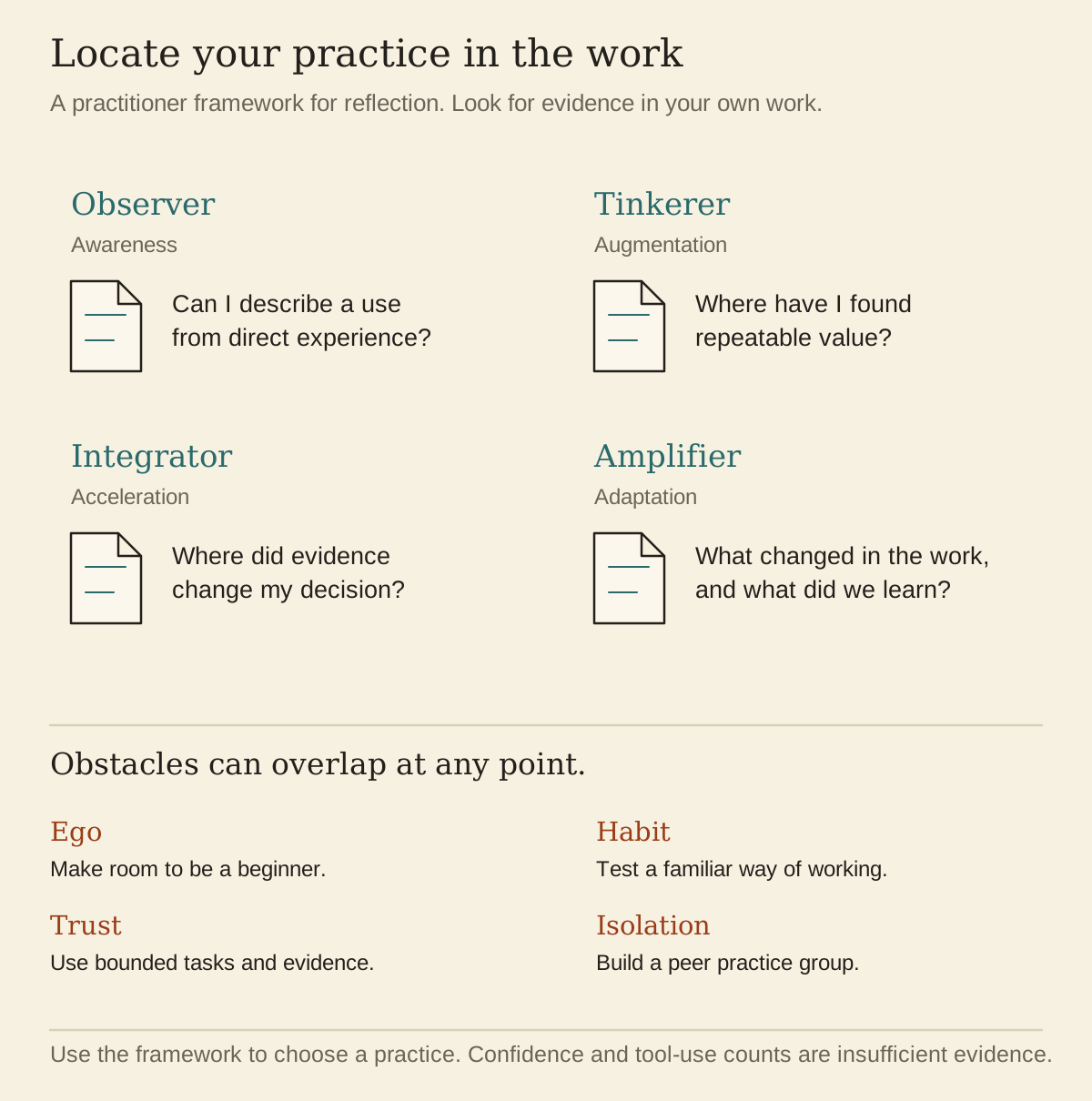
O'Reilly's Kyndryl Institute essay offers a four-stage practitioner framework, explicitly described as a recurring pattern rather than a maturity model: Awareness, Augmentation, Acceleration, and Adaptation. The plain-language descriptions below translate those stages as observer, tinkerer, integrator, and amplifier. This is a useful reflection tool, unvalidated as a population map of executive development.
Stage one is awareness: the observer. The leader knows AI is happening. They have read about it. They may have approved budgets for it. They have not used it themselves in a meaningful way. Their engagement is mediated through others, so their opinions are not yet anchored in direct experience.
Stage two is augmentation: the tinkerer. The leader has begun using AI personally, usually for low-stakes tasks: summarizing material, drafting routine communications, or retrieving and synthesizing information. The use is real but remains at the periphery of work that carries greater judgment or consequence. The leader has begun demystifying the technology without yet redesigning how they work.
Stage three is acceleration: the integrator. The leader uses AI inside substantive work: refining documents, exploring strategic questions iteratively, and pressure-testing assumptions. AI is becoming part of the workflow rather than a separate activity. The leader develops more evidence about when output is useful, shallow, or wrong. In suitable tasks, the resulting work may improve in speed, breadth, or quality, but the improvement still needs to be judged rather than assumed.
Stage four is adaptation: the amplifier. The leader has built patterns of AI use specific to their work and is redesigning some workflows around what human-AI collaboration can do. They also help design how AI appears in the company, informed by personal experience and by expertise beyond their own. The intended change is a different capacity to frame, test, decide, and learn. Faster output is the smallest part of it.
The stages are developmental prompts to reflect with, in whatever order fits. No reliable evidence establishes that most leaders move through them in twelve to twenty-four months, and some may develop different practices in parallel. The warning at stage two remains useful: occasional low-stakes use can create confidence without the deeper practice required for consequential work. The remedy is not to rush upward on a ladder. It is to test one's actual capability against the work that matters.
Movement between stages shows up in behavior, which a count of tool sessions will miss. The observer can describe a use from direct experience. The tinkerer begins to distinguish novelty from repeatable value. The integrator can show where evidence changed a decision and where a control prevented a mistake. The amplifier can explain which parts of a workflow were redesigned, what people now do differently, and what the organization learned after the first version failed. Those are stronger signals than confidence, enthusiasm, or prompt volume. They also make regression visible: a leader can use AI every day and still retreat to shallow practice when time pressure rises.
The Three Behavioral Shifts
Three behavioral shifts translate that framework into practice. They are my synthesis of the leadership argument rather than findings measured by the Kyndryl essay.
The first shift is from delegating AI work to doing AI work. The leader stops asking others to use AI on their behalf and starts using it themselves. The shift sounds trivial. It is, in my experience, the hardest of the three for most senior leaders, because it requires the leader to be visibly inexperienced in front of a workforce that has been deferring to their expertise for years. The willingness to be visibly a beginner, at fifty-five or sixty, in front of people who used to come to you for answers, is rare. It is also the condition on which everything else depends.
The second shift is from treating AI output as answers to treating it as material for evaluation. Depending on the task, that material may be a draft, analysis, option set, calculation, code change, or action proposal. The leader who pushes back, asks for sources and alternatives, tests claims, and replaces weak output with their own thinking models a stronger cognitive posture. The leader who accepts and forwards polished output without engagement models the posture that produces hollow work.
The third shift is from private AI use to visible AI use. The leader stops hiding their AI use and starts making it part of how they communicate with their team. They acknowledge when AI helped produce a document. They share the prompts that worked. They discuss what AI got wrong. The visibility produces two effects. The first is that the workforce sees the leader engaging with AI as a working tool, which gives the workforce permission to do the same. The second is that the workforce sees the leader's own development, including the parts that are not yet polished, which builds the trust the next section's covenant needs.
The Obstacles
Access is broader than it was, but it is not universal: price, disability, language, policy, security, and infrastructure still matter. For leaders with approved access, O'Reilly names four personal obstacles worth examining: ego, habit, trust, and isolation.
Ego. A leader who has been the expert for years may have built an identity around knowing more than the people around them. AI can retrieve or synthesize some subjects faster and more broadly while remaining wrong in important ways. That encounter can be uncomfortable. One ego response is to collect failures and conclude that the system has no useful role. Another is to overidentify with the technology and dismiss human expertise. Both protect identity at the expense of learning.
Habit. A leader's working habits were built over decades and often served them well. Some now deserve testing: drafting from scratch when a model might provide useful raw material, searching manually when AI-assisted research might accelerate discovery, or holding a meeting before generating concrete options. AI will not improve every one of these tasks, and speed is not the only value. The work is to examine the habit rather than preserve or discard it automatically.
Trust. The leader may have been burned by software that promised more than it delivered and watched companies waste money on immature technology. Skepticism is healthy. It becomes an obstacle when it hardens into refusal to test any suitable use personally. Trust should be calibrated through bounded use, independent evidence, evaluation, and knowledge of consequences. Promotional claims and repeated use are weak evidence.
Isolation. The leader is often the only person at their level in the company. They do not have peers with whom to compare practice. They cannot easily ask a question that exposes their lack of expertise without it being noticed and reported. The isolation produces a particular kind of stuckness, in which the leader knows they need to develop a practice but does not have a safe space where it can develop. The companies whose senior leaders have found a peer group of other senior leaders working through the same questions have, in my experience, produced the most consistent development. The isolation is real and it has a solution. The solution is structural: build the peer group, deliberately.
The four obstacles rarely arrive one at a time. Habit can dress itself as skepticism. Isolation can make ego more expensive because every beginner's question feels public. A breach of trust with one vendor can become a reason not to test a different use under different controls. That is why naming the obstacle is only the start. The leader has to design a response around it: a private practice environment, a peer willing to compare failures, a bounded task with a clear verification method, or protected time in a calendar that otherwise converts every experiment into after-hours work. Personal development still has operating conditions.
The Practical Operating Loop
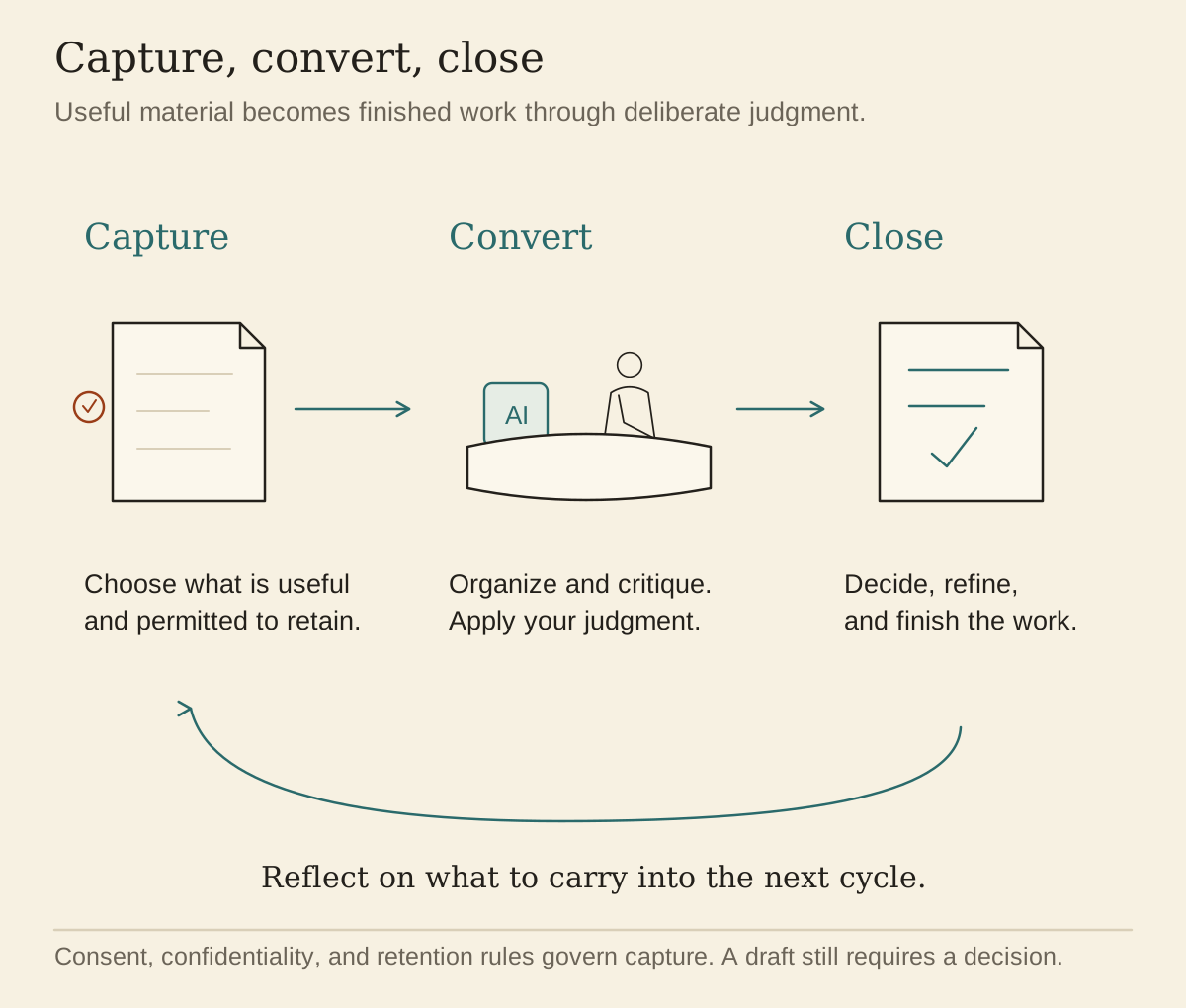
The development of practice is not abstract. It happens through repeated cycles of specific behaviors. Two patterns are worth naming because they have been refined by leaders who have done this work.
Capture, Convert, Close. O'Reilly names this as a practical loop in his Kyndryl Institute essay. Capture means preserving the useful meetings, ideas, reflections, and decisions that consent, confidentiality, and retention policy allow, and choosing what is worth keeping. Convert means using AI to organize or critique the material and then applying the leader's own judgment. Close means reflecting, refining, deciding, and completing the work rather than letting an AI draft become the deliverable by default. The conversion and closure are where the leader's development happens.
The Wish List Tactic. A second simple practice is to keep a running list of things you wish AI could help you do but do not yet trust it to do. Review the list weekly. Pick one bounded item and test it at an appropriate consequence level. The practice builds the habit of imagining new uses while producing evidence about what works, what fails, and where the boundary of the leader's practice currently sits.
What the research shows. Microsoft's 2026 Work Trend Index surveyed 20,000 AI-using workers across ten countries. Its self-reported composite analysis attributed more than twice as much reported AI impact to organizational factors (culture, manager support, talent practices, and related conditions) as to individual factors alone (67 percent versus 32 percent). Workers who said their managers openly used AI were also associated with higher readiness and value scores. The report supports a management effect, but it does not show that visible manager use doubled workforce fluency or establish causation. The broader lesson is that individual skill develops inside an organizational system.
Microsoft (2026). 2026 Work Trend Index Annual Report: Agents, Human Agency, and the Opportunity for Every Organization.
Why the Modeling Effect Compounds
The modeling effect can form a reinforcing loop in the systems-thinking sense of Section 7.1. A leader develops practice and makes appropriate parts visible. That visibility can give the workforce permission and support to experiment. Workforce practice then surfaces use cases the leader had not considered, deepening the leader's understanding in return. Under the right conditions, the cycle compounds.
The same loop can run in the opposite direction. A leader does not develop practice, rewards no changed behavior, and communicates mainly through slogans. The workforce reads the incentives and keeps AI use shallow or hidden. That weak adoption then confirms the leader's sense that AI is not producing value. This is one plausible failure loop among several; access, job design, trust, governance, capability, and the quality of the tools also matter.
The leader's decision to develop practice is therefore one point of influence among several. Its cumulative effect can still be large because leaders influence the organization's funding, rewards, permissions, and learning.
Visibility also needs a boundary. The point is not for a CEO to turn every prompt into theater or make employees perform experimentation because the boss is excited. Useful modeling is specific and honest: here is the task, here is where AI helped, here is what it missed, here is what I checked, and here is why I remained accountable for the result. A leader who shows only polished wins teaches concealment. A leader who exposes confidential material teaches recklessness. The practice compounds when people can see disciplined judgment, including the decision not to use AI where it does not belong.
Bring this into the room. If this section has surfaced that you have not yet developed your own AI practice, three concrete moves are worth making this week. First, locate your current stage using the adapted four-stage framework. Treat the answer as a prompt for reflection. Second, name the obstacle most active for you right now: ego, habit, trust, or isolation. Naming it makes the intervention more specific. Third, start a wish list and run one bounded AI experiment per week. Record what worked, what failed, what evidence you checked, and what you would change. Six weeks of deliberate practice will teach you things reading alone cannot.
The Strategic Case
The strategic argument for taking the leader's own practice seriously is that the alternative produces a particular kind of AI-Native failure that is difficult to diagnose from the outside.
The company has invested in AI. The technical work is competent. The workforce has received the communications. The transition is, at the surface, underway. Eighteen to thirty-six months in, the leadership team notices that the AI-Native transition is not producing what was expected. The pilots are not graduating. The workforce is using AI but in shallow ways. The strategic decisions that AI was supposed to inform are still being made the way they were made before. The leadership team commissions an analysis. The analysis cannot find a single root cause, because the cause sits outside the system. It sits in the leadership team's individual practices, which have not developed enough for the leadership team to recognize what depth in the rest of the company would look like.
Companies whose leaders have done this work can produce a different outcome. Strategic and architectural decisions are informed by direct experience as well as specialist advice. Communication with the workforce can carry more credibility because leaders speak from practice rather than briefings alone. It improves the quality of the questions, trade-offs, and behavior leaders model. Compounding capability may follow.
The leader who has begun their own practice has done the precondition for the work the next section describes. The human reckoning with the workforce, the honest acknowledgment of what is happening, the construction of the covenant, all depend on the leader's own credibility. The credibility comes from the work the leader has done with themselves. The next section addresses what the leadership team does once that work has begun.