How do you fund a transition whose most valuable investments produce nothing to demo?
Stage 4 has made four architectural arguments, and each ends with a version of the same funding problem. Knowledge architecture costs real money now and may compound over years. Operating-model work requires foundations even when there is no announceable win in the current quarter. A collaboration surface can cost more than deploying chat tools, while its early return is harder to isolate. Epistemic hygiene can read as overhead on a conventional budget line. Invest now. Measure leading evidence. Compound later if the system earns it. Be patient, but not credulous.
Somewhere in the room where those arguments land, there is a CFO who has heard "be patient" before. This section is for her, for the CEO who has to win her over, and for the leadership team that will eventually have to defend the spending to a board. The compounding argument has been made. What has been missing is the money argument underneath it, and a transition that cannot survive a budget review is a mood with a budget line.
The CFO Is Doing Her Job
Consider what the CFO actually sees. AI spending has grown quickly while returns remain difficult to attribute. The 2025 GenAI Divide report from MIT's NANDA initiative reported limited measurable financial returns across much of its sample. The preliminary report combined interviews, a senior-leader survey, and public implementation accounts; its findings have limited reach beyond that sample. RAND's 2024 report, discussed in Section 1.2, cited an external estimate that more than 80 percent of AI projects fail, about twice the rate claimed for non-AI IT projects, then used 65 expert interviews to study causes rather than independently measuring that failure rate. The headlines are imperfect. The CFO's skepticism is still rational. She may never have read the studies. She has probably lived a local version of stalled pilots and returns nobody can isolate.
Now the board is asking about payback periods, and look at what is arriving in her inbox. A knowledge graph she cannot demo. A collaboration surface that costs more than the chat licenses that already "work." A request to pull the company's most expensive experts off the line for knowledge-capture interviews. Governance and monitoring infrastructure that, on paper, slows everything. Training time that shows up as output going backward.
Put yourself in her chair honestly. The spending that came with demos has failed to return, and the new proposal is to spend more on things that come without demos. A CFO who waves that through is not doing her job. The resistance is the financial discipline the company hired her to have, and the worst possible response to it is to ask her to have faith. She should not run on faith. The case for the invisible layers can be made in her language, and the rest of this section makes it.
Where the Money Actually Goes
The money in an AI-Native transition goes to three places, and only one of them appears cleanly in a budget.
The visible spend is the part procurement negotiates and the board sees. Licenses and seats. Compute and tokens. Vendor contracts, systems of agents, integration work. One genuinely new problem hides inside this category: usage-based pricing means the cost grows with adoption, so the bill rises in exactly the quarter things start working. A budget built on fixed-license assumptions will be surprised by its own success, and the surprise will arrive looking like a problem. Tell the CFO this early. She will appreciate being the first to know rather than the last.
The invisible spend is the case this book has been making. The paid hours of experienced operators engaged as teachers in knowledge capture (Section 4.1). The workflow discovery and redesign required to place agents safely in the work (Section 4.2). The building and curation of shared context, reusable workflows, and review surfaces (Section 4.3). The design of governance that enables rather than merely restricts. The training time, which can mean thousands of workforce hours and a temporary output dip while capability builds. Much of this never appears in an AI budget. It lives inside payroll, where it can look like people being taken away from their jobs. That visibility problem is one reason foundational work goes unfunded.
The third category is the spend nobody budgets. Leadership attention is the largest item in it: the five mandates from Section 4.2 are hours, recurring hours, from the most expensive people in the company. Next to it sits the productivity dip. A redesigned workflow underperforms the workflow it replaced for a while, because the team is learning, the handoffs are new, and the exceptions have not surfaced yet. Stage 5 will add the emotional labor of the human reckoning to this category. None of it has a line item. All of it is real cost, and a plan that has not priced it will read the dip as failure and retreat at precisely the wrong moment.
On proportions, I will not pretend to a formula. The honest numbers vary by archetype and starting point. But the pattern I keep seeing is consistent enough to name: leadership teams budget as if the visible spend were most of the total cost, while successful transitions often require comparable or greater investment in workflow, knowledge, integration, governance, learning, and leadership attention. That is an observation from practice, and it should be weighed as one. Companies may spend too little or too much overall; the recurring error is concentrating what they do spend in the category with invoices and undercounting the organizational work required to make it useful.
Rent and Equity
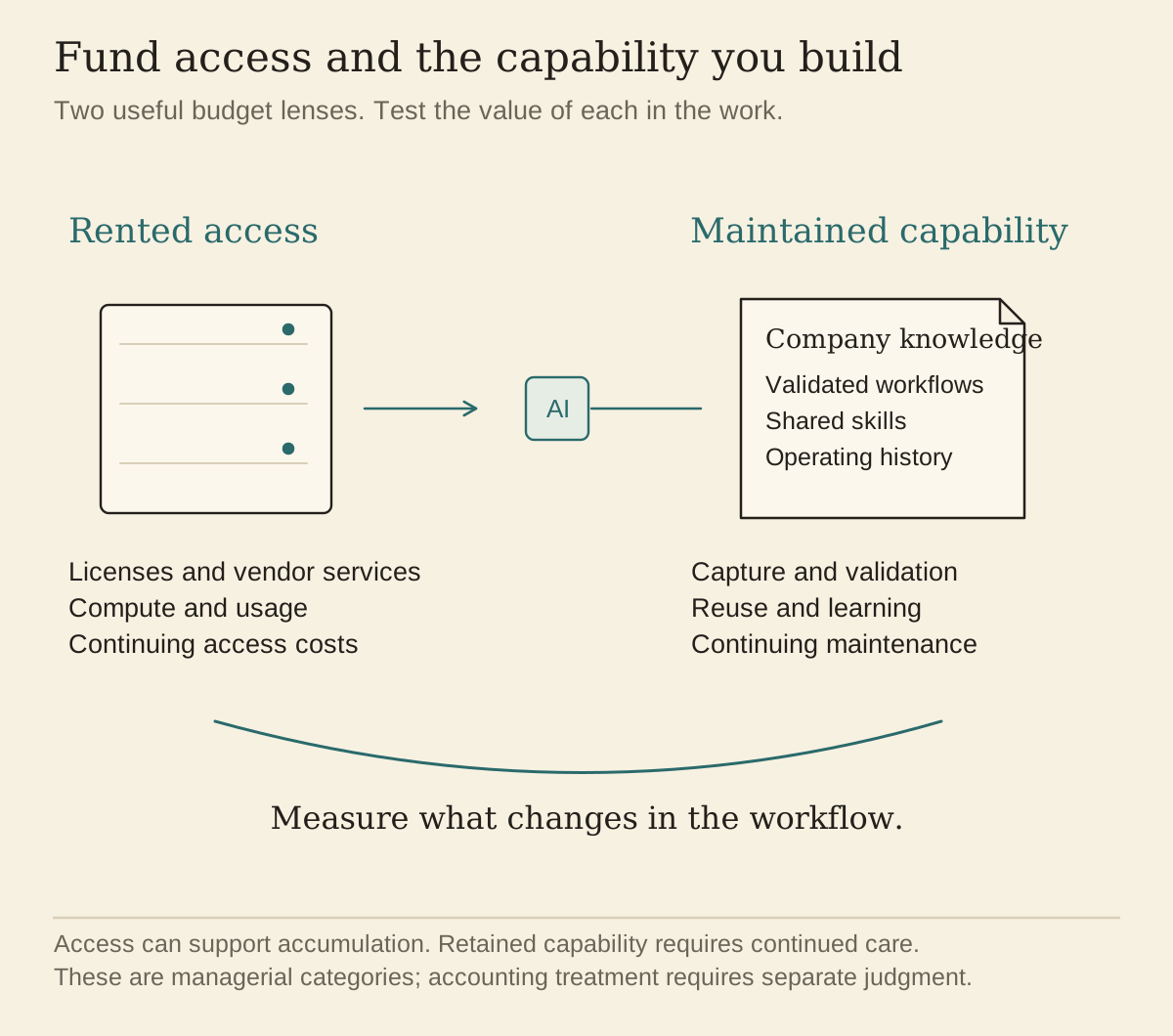
Here is the financial distinction that organizes everything else in this section. Some AI spending pays rent. Some builds equity. Both are legitimate. Confusing the two is where transitions lose their money.
Rent is what many visible-layer purchases buy. Licenses, seats, and vendor agent systems provide access while the contract continues, often to capabilities competitors can also purchase. Stop paying and access may stop, but the workflows, skills, configurations, and data developed around the product do not necessarily vanish. The gains may plateau as competitors adopt similar tools, yet execution can still differ on an identical vendor stack. Rent is fine. Companies rent critical infrastructure indefinitely. Rented capability should simply be priced, measured, and defended without pretending the license itself is a moat.
The invisible layers can behave differently, and the difference is the heart of the argument. A maintained knowledge graph may become more useful as validated entities, relationships, and use cases accumulate; a neglected one depreciates as the operation changes. A collaboration surface can convert local skill into shared workflows and learning (Section 4.3). Epistemic hygiene protects the integrity of both, as controls protect the integrity of a ledger. Competitors cannot buy your operating history off the shelf, though they can build analogous capability and sometimes catch up. In this chapter's managerial vocabulary, rent buys access; equity builds company-specific assets and practices that can support advantage.
The cost of not building the equity layer rarely appears as a line item, which is why it goes unmanaged. It appears as perpetual rent: the pilot budget that renews every year because little accumulated from last year's pilots. It appears as the graveyard from Section 1.2, re-funded each planning cycle under new names, and as the multi-million-dollar sunk costs when initiatives get abandoned. Some of the pilots are old enough to have anniversaries. It appears as the write-off nobody records when institutional knowledge walks out the door (Section 8.2, Case Five). In companies that stay stuck at Stage 2 of this model, the AI budget is rarely small. Too much of it pays again for access and activity that never became durable organizational capability.
Intellectual lineage. The financial shape this section describes has a close analogue in the economics literature. Brynjolfsson, Rock, and Syverson model how adoption of a general-purpose technology requires complementary intangible investment: process redesign, human capital, and new organizational forms. Because conventional productivity measurement may not capture the creation of those complementary assets when costs are incurred, measured productivity can be understated early and rise later as benefits are harvested. They call that pattern the productivity J-curve and connect it to earlier general-purpose technologies. Their intangible capital is close to what this book calls the invisible layers, although the managerial categories here are not accounting classifications.
Brynjolfsson, Erik; Rock, Daniel; Syverson, Chad (2021). "The Productivity J-Curve: How Intangibles Complement General Purpose Technologies." American Economic Journal: Macroeconomics, 13(1), 333–372.
How to Fund It
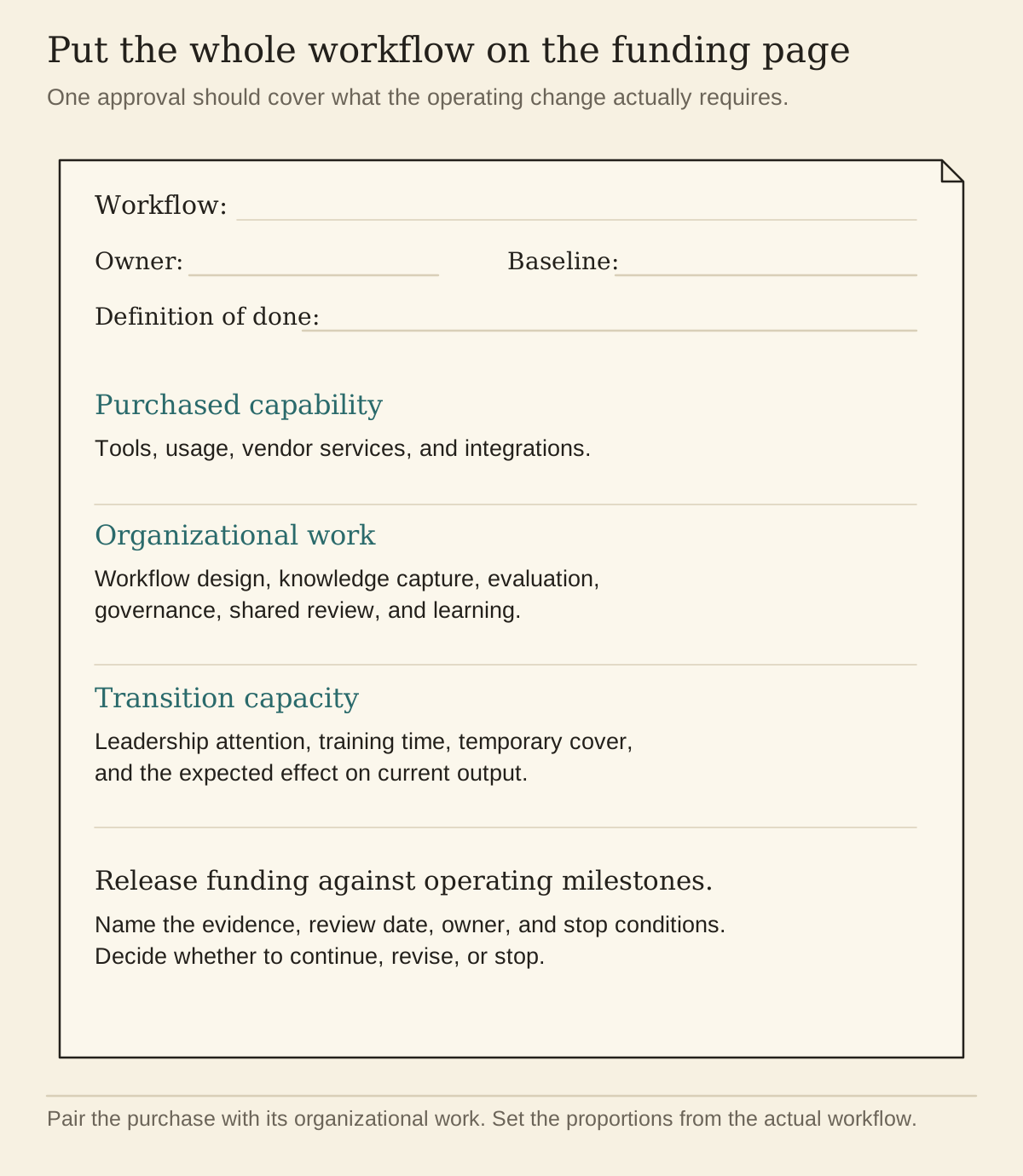
Four funding patterns have held up across the organizational transitions I have run and the AI work examined here. None of them requires believing anything on faith. Each is a discipline the CFO can enforce.
First, fund workflows rather than tools. The unit of funding is a named workflow being redesigned end to end, with an owner, a baseline measurement, and a definition of done at the operating-model level. Tool purchases attach to a funded workflow or they wait. This one rule screens out much of the pilot-graveyard pattern, because a pilot with no workflow attached has nowhere to apply for money.
Second, stage-gate by operating-model milestone rather than activity alone. Release the next tranche when the redesigned workflow is in production with people actually working differently, when required domain knowledge is available through the chosen architecture, and when governance operates inside the flow rather than sitting in a document beside it. Pilot and demo counts measure activity. Production use, quality, control effectiveness, adoption, and business outcomes measure whether a transition is taking hold.
Third, the pairing rule. Every visible purchase gets approved together with its invisible counterpart, in the same decision, on the same page. Buy the customer service system of agents, and in the same approval fund the workflow redesign, the knowledge capture from the experienced service leads, and the review surface where the agents' work lands. If the pair costs too much, the purchase costs too much. Approving the visible half alone risks buying access while underfunding the organizational capability that makes the access useful. It is one of the most common allocation errors I see.
Fourth, run the portfolio honestly. Keep the rent list and the equity list distinct, expect different things of each, and do not let a commodity license borrow a moat argument without evidence. A compounding claim belongs to spending that demonstrably accumulates something: validated knowledge coverage, captured expertise, reusable workflows, shared skill, data, or operating feedback. Rented tools may enable that accumulation, but access and asset are not the same thing. Commodity productivity tools are worth buying when their measured benefits justify their continuing cost.
Bring this into the room. Take two columns into your next budget conversation. In the left column, list everything the company spent on AI in the last twelve months: licenses, vendor contracts, pilots, dedicated headcount, consulting. In the right column, write what each item bought at the operating-model level: a workflow now in production, knowledge captured into a shared structure, a reusable capability, or a measured outcome. A blank cell may or may not mean waste. It does expose an item whose value nobody has articulated. The pattern between the columns reveals more about the company's actual AI strategy than the strategy deck does.
What to Tell the Board
The honest financial shape of this transition is uncomfortable to say out loud, which is why it often goes unsaid until the numbers force the conversation. Costs land first. Some visible tools produce quick, attributable gains; others do not. Foundational layers can consume money and attention for quarters or years before their contribution is visible in financial results. Then, if adoption, workflow change, architecture, and market conditions align, returns may accelerate. The MIT CISR research behind Section 2.4 found its strongest financial-performance difference between the second and third maturity stages. It was an association in the study's sample, and timetables elsewhere will differ. Pay first. Test continuously. Earn later only if the operating change works.
A board that has not been told this possible shape in advance may read an expected investment period as failure or mistake activity for progress. Set the thesis at the beginning as a staged, multi-year commitment with named milestones, stop conditions, and an honest range for cost, timing, and uncertainty. Boards accept long-payback commitments such as plants, acquisitions, and market entries when the case and controls are credible. AI often arrives dressed as software even when much of the work is organizational transformation. Present the invisible layers as capability construction rather than merely licenses, but leave capitalization and expense treatment to the applicable accounting standards and the company's finance professionals.
While financial results are still emerging, report leading indicators of operating-model progress alongside outcome measures. Workflows running in production rather than pilots merely launched. Pilot-to-production conversion. Knowledge coverage and validation. Experienced operators engaged as teachers. Adoption of sanctioned tools, measured in privacy-respecting ways. Cycle time, quality, rework, incidents, customer outcomes, and unit economics against pre-redesign baselines. The portfolio's balance of rented access and accumulating internal capability. Movement in these indicators supports the investment thesis; it does not prove that financial returns must follow. Their value is that they reveal progress or failure earlier than a retrospective ROI slide.
And arm the CFO rather than managing her. Make her a co-author of the milestone framework, the gates, the two lists. A CFO defending a funding structure she helped design is a different force in a boardroom than a CFO reading someone else's conviction off a slide. In the transformations I have watched hold together through budget pressure, whatever the subject, the CFO was the one holding them.
Before the next budget cycle, run the two-column exercise, split the AI budget into its rent list and its equity list, and apply the pairing rule to the next purchase request that crosses your desk. Those three moves will tell you more about your actual position than any maturity score.
That completes the architectures. The knowledge architecture exposes relevant company structure to the systems that reason over it. The operating-model design combines the ingredients into a coherent whole. The collaboration surface enables capability to compound across the organization. Epistemic hygiene provides evidence for justified trust at scale. The economics fund the work long enough to learn whether compounding is occurring. Stage 5 turns to the people, starting with the leader's own practice, because the workforce watches what leaders do before it believes what they say.
Consider. If you keep three things from Stage 4: 1) Documents carry narrative and evidence; graphs make relationships explicit; the model and surrounding software reason with both. 2) The collaboration surface can turn isolated use into shared, compounding capability. 3) Rent buys access; company-specific knowledge, workflows, and practice can build equity; advantage depends on how well either is used.