How does an organization tell the difference between AI output that is true and AI output that sounds true?
The output of an AI system is text. The text is articulate. The text is plausible. The text often sounds confident even when the underlying analysis is wrong, missing, or fabricated. A workforce learning to work with AI has to develop a set of disciplines for evaluating the text, sourcing it, verifying it, and managing the ways the text can mislead. Without those disciplines, the AI's plausibility becomes a liability rather than a capability.
By epistemic hygiene, I mean the habits and checks people use to decide whether an AI-generated claim deserves trust. Those habits need time, evidence, and tools that make verification possible.
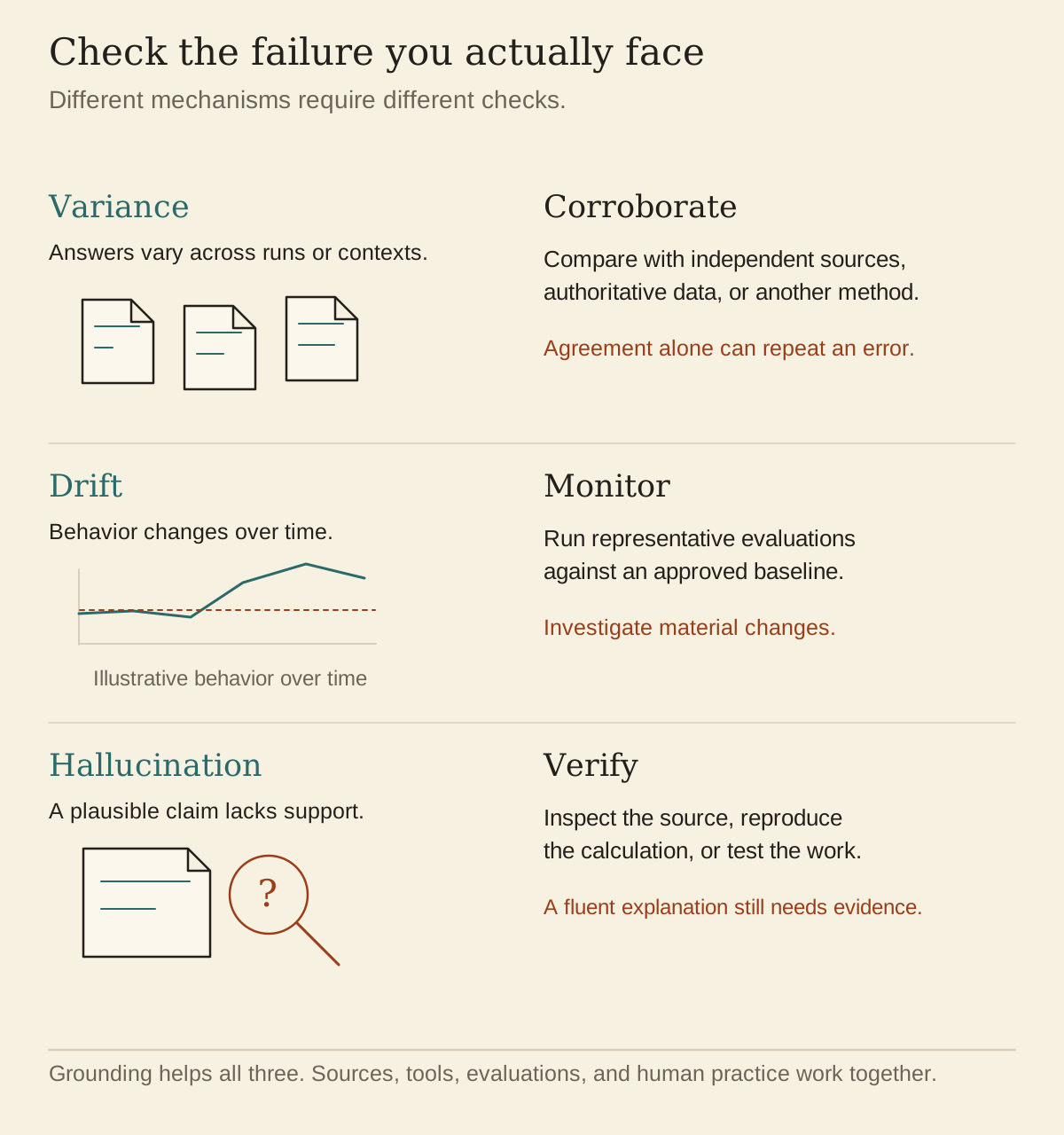
AI introduces three distinct problems, and each requires its own discipline. Grounding in authoritative, current evidence helps with all three, but it is not their single cause or complete cure. Variance arises from probabilistic generation and changing context. Hallucination can arise even when sources are available. Drift can enter through models, prompts, tools, retrieval, data, users, and the world the system operates in. The three problems interact, but keeping their mechanisms distinct makes the disciplines more useful.
Problem One. Variance
Ask the same AI the same prompt on different occasions and you get different answers. Sometimes the differences are small, sometimes large. They are almost always invisible to the user, who asks once, gets an answer, and treats that answer as the answer. The user does not know that asking again would produce something different. The user does not know that a colleague asking the same question yesterday got a meaningfully different response.
The variance is structural. Generative models produce outputs from probability distributions, and results can change with sampling settings, model versions, hidden system context, tool results, and infrastructure. Some systems and tasks can be made highly repeatable; exact reproducibility across hosted model changes is harder. A workforce that treats every AI response like a deterministic database result adopts the wrong mental model.
Corroboration is one discipline that addresses variance. When the answer matters, rerunning or reframing the task can reveal instability. But agreement among several answers from the same model is not independent confirmation; the model can repeat the same error. Strong corroboration compares the claim against primary sources, authoritative data, deterministic tools, alternative methods, or qualified reviewers. Repetition diagnoses sensitivity. Independent evidence supports truth.
The collaboration surface from Section 4.3 can support corroboration by making variants, evidence, tests, and reviewer judgments comparable where sharing is appropriate. The discipline is still possible in private work, a careful individual can rerun and verify, but shared infrastructure makes it teachable, reviewable, and measurable across the organization.
Problem Two. Drift
Whatever model the company is using changes over time. Vendors update it. The fine-tuning is adjusted. The training data is refreshed. The system prompts are revised. The retrieval indexes are rebuilt. Each of these changes can produce subtle shifts in how the AI responds, what it considers, what it surfaces, what it omits. The shifts are usually small at the level of any individual response. They accumulate at the level of organizational output over months and years.
A workforce that does not monitor drift discovers, eventually, that the AI is doing something different than it was doing a year ago. No one noticed because no one was looking. The work products that the AI produces have shifted in subtle ways. The default outputs have changed. The patterns the AI surfaces are different. The blind spots are different.
Monitoring is the discipline that addresses drift. Run representative evaluations on a defined cadence and compare task-level quality, safety, cost, latency, and failure patterns against an approved baseline. Investigate material deviations rather than treating every wording change as drift. Trace them, where possible, to changes in models, prompts, retrieval, tools, data, or the operating environment, then address the implications for the company's AI-mediated work. This is an ongoing operational discipline, analogous to the way mature engineering organizations monitor production systems for behavioral changes that might indicate problems.
The infrastructure that supports drift monitoring is Layer 8 of the nine-layer AI stack from Section 2.3, the evaluation and observability layer. The discipline can start with a small, curated test set and manual review; it becomes systematic only when the organization builds the versioning, evaluation, and observability needed to see change over time. The alternative is to operate blind.
Vendors vary in how much notice and detail they provide about model updates, and release notes cannot predict every behavioral change in a customer's workload. Many customers also lack monitoring capable of detecting those changes. The work can therefore shift under the company's feet even when an update was announced. The protection is a versioning, evaluation, and change-management practice tied to the organization's own use cases.
Problem Three. Hallucination
The most well-known AI failure mode is the one in which the AI generates output that is plausible, articulate, and wrong. The AI asserts a fact that is not true. The AI cites a source that does not exist. The AI describes a connection that has no basis in reality. The output reads as confident expertise. The output is fabrication.
Hallucination is becoming better understood, and model and system designers have reduced it on many measured tasks through better training, retrieval, tools, and verification. Elimination is not in sight, and performance varies by domain and benchmark. A workforce that treats AI output as inherently reliable will still encounter fabricated or unsupported claims and may act on them in damaging ways. The discipline is to refuse the assumption that improving average model quality has solved the use-case-specific problem.
Verification is the discipline that addresses hallucination. Check asserted facts against source data. Open and inspect citations. Reproduce calculations. Test code. Confirm that conclusions follow from stated premises and evidence. A generated chain of reasoning can itself be a post-hoc or inaccurate explanation, so it is not a substitute for an external check. Verification takes real effort and adds time. It is also what prevents the company from acting on confident fabrication.
Verification depends on the whole system being designed to support it. The interface should provide citations or provenance in a form that can be checked, expose relevant uncertainty and limitations, and allow abstention or escalation. Models do not possess honesty or willingness in the human sense, and instructions alone cannot guarantee calibrated uncertainty. Reliable verification comes from configuration, evidence, tools, tests, workflow, and human practice together. Optimize only for fluent output and the system can produce more sophisticated errors.
Watch for this. The most dangerous AI output is not the obviously wrong kind. It is the well-written, confident, plausibly-sourced output that is wrong in a way no one in the room can immediately verify. The clarity of the prose disguises the gap. Leadership decisions made on the basis of polished AI summaries, without corroboration against actual data or expert judgment, are the failure mode that destroys the most institutional credibility per dollar spent. The hygiene practice is to require the corroboration before the decision.
Why Single-User Architecture Weakens All Three Disciplines
At organizational scale, the three disciplines (corroboration, monitoring, and verification) depend on appropriate visibility. They require infrastructure that makes relevant AI outputs, actions, evidence, and outcomes observable, comparable, and reviewable over time. That does not require the company to inspect every private exchange. It requires visibility proportionate to the risk of the work and enough shared evidence to evaluate the system rather than only the individual user.
The single-user chat architecture makes all three disciplines harder to practice organizationally. Variance stays local when each user sees only one response. Drift stays hidden when no one compares current behavior with a baseline. Hallucination may escape review when no one besides the user sees the output before it is used, especially when that user lacks the domain knowledge or source access needed to challenge it.
The collaboration surface from Section 4.3 is an architectural foundation for making epistemic hygiene shared practice. On it, the disciplines can be taught, instrumented, reviewed, and improved. Careful individuals can and do verify work in single-user tools, and enterprise controls can monitor some private use. What private chat does not provide by itself is an organizational learning loop.
Architectural decisions and disciplinary practice reinforce each other. A collaboration surface makes epistemic hygiene easier to institutionalize; it does not create rigor automatically. Without one, a company needs other deliberate mechanisms for evaluation, review, versioning, and shared learning.
The Three Integrity Mechanisms
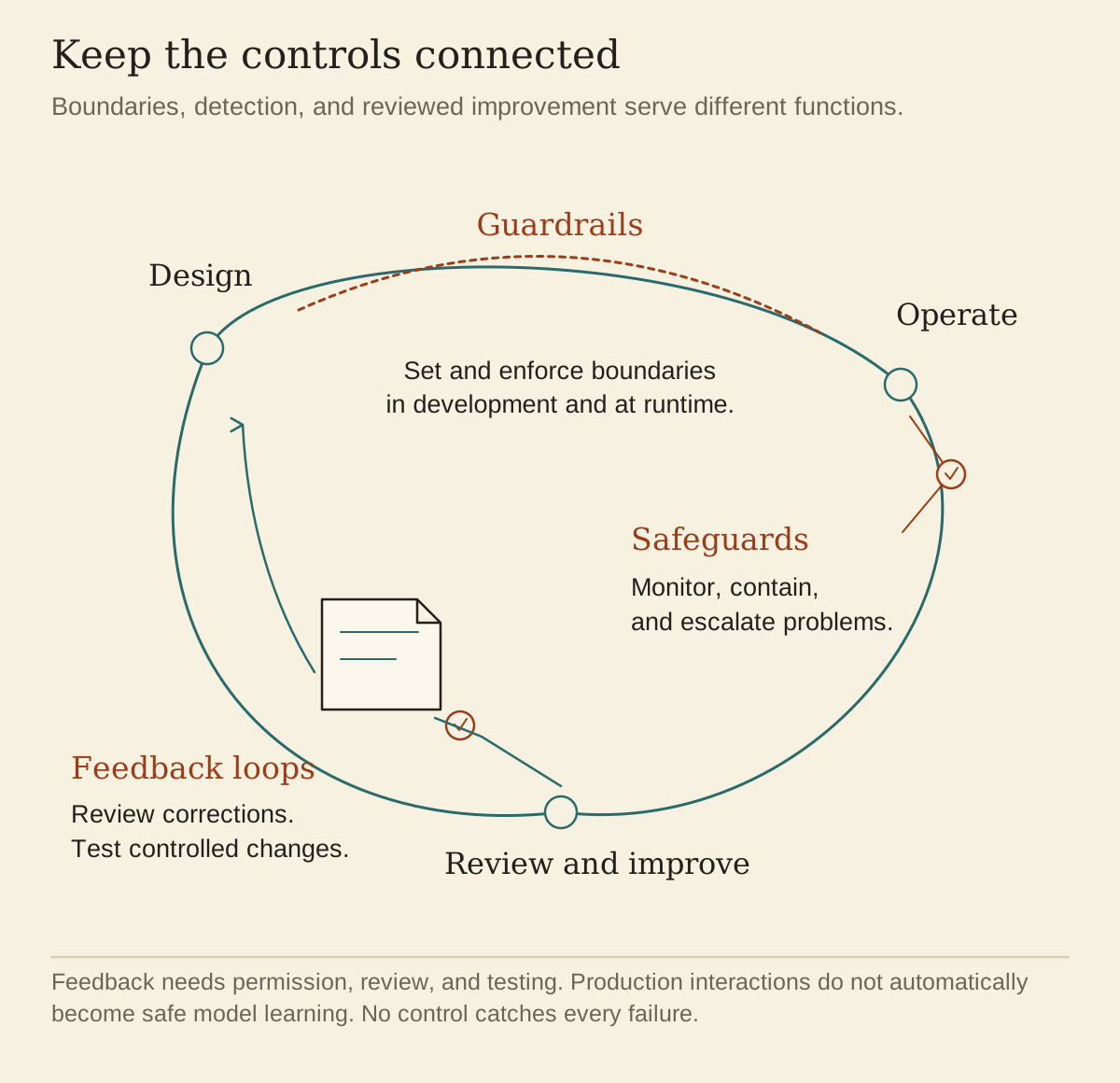
The three problems and disciplines need infrastructure at the right points in the system's lifecycle. I organize that infrastructure into three practical categories: guardrails, safeguards, and feedback loops. My notes from the HBS Online AI for Leaders course, taught by Karim Lakhani and Iavor Bojinov, helped shape the framing; the triad and the definitions used here are this book's own synthesis, and any errors in them are mine. The labels overlap in ordinary industry usage; here they name different functions rather than universally accepted technical definitions.
Guardrails set boundaries in development and at runtime. They include instructions, permissions, schemas, allowlists, policy checks, tool restrictions, and deterministic constraints that refuse, redirect, or escalate requests outside permitted scope. Guardrails are how parts of company policy become enforceable behavior rather than a document sitting next to the system. They must be tested before deployment and continuously re-evaluated as the system changes.
Safeguards monitor deployed systems in operation. Outputs and actions are evaluated against use-case-specific thresholds. Alerts trigger when behavior deviates from expected ranges. Human review is invoked when inputs are unusual, evidence is insufficient, monitoring detects risk, or an action would cross a defined consequence threshold. Model-reported confidence alone is not a dependable trigger. Safeguards are circuit breakers intended to catch and contain problems before they propagate; no safeguard catches everything.
Feedback loops track performance over time so people can improve the system. User corrections, errors detected by safeguards, and drift detected by monitoring may feed into retrieval content, prompts, rules, evaluations, workflows, or, when the organization actually controls a training process, model updates. Production models do not automatically learn safely from every interaction. Feedback must be reviewed, permissioned, and protected against poisoning and privacy leakage.
The three mechanisms work together. Guardrails set or enforce boundaries. Safeguards detect and contain production failures. Feedback loops inform controlled improvement. A company that relies on only one has a fragile system. Even all three do not make AI intrinsically reliable; they create layered evidence and controls that support justified reliance for a defined use case.
Why This Discipline Will Become Strategic
Practiced as an organizational discipline, epistemic hygiene produces evidence for deciding when AI-mediated work deserves trust, institutional learning that accumulates, and a capability competitors cannot copy merely by buying the same technology. Left solely to individual diligence, quality varies widely, unsupported claims occasionally surface as embarrassments, and behavioral changes go untracked. The fragility tends to appear when the work matters most.
Stage 4 has now built most of the technical and organizational foundations. The knowledge architecture for grounding and relationships. The AI-Native operating model for combining ingredients into a coherent design. The collaboration surface for organizational compounding. Epistemic hygiene for justified trust over time.
One architectural conversation remains, and it is the one the board will ask about first: what all of this costs, and why the layers that produce no demo are the investment rather than the overhead. The next section speaks the CFO's language.