What happens to AI work when it stays inside private chats?
Whether AI compounds across an organization or fragments into isolated islands depends heavily on one architectural decision: the collaboration surface. Companies often make this decision by default when they deploy AI primarily through private chat sessions. Enterprise products may provide administrative controls, shared projects, or audit features, but the work itself can still remain invisible and unreusable to colleagues. That default produces a particular kind of organizational AI failure, and it is preventable.
The Thirty Islands Problem
A company deploys AI tools to its workforce. Every employee gets access. Every employee starts using the tools. Every employee has their own chat history. Every employee writes their own prompts. Every employee develops their own workflows. Every employee produces their own AI-mediated work.
Thirty employees are doing this, or three hundred, or three thousand. That number does not change the shape of the problem, which is that the AI capability is individual rather than organizational.
The thirty employees produce thirty different versions of the same kind of analysis when thirty different customers ask similar questions, because nothing in the system causes them to converge on a shared approach. The thirty employees discover thirty different effective prompts for the same use case, none of which the other twenty-nine ever see. The thirty employees ask the AI thirty similar questions, and the AI answers each one fresh because nothing in the system accumulates the context of the previous twenty-nine answers. The thirty employees produce thirty drafts that the manager has no way to see in aggregate, because each draft is buried in a private chat. Each of the thirty would report, accurately, that the tool is great.
The company has invested in AI. The investment has produced thirty individuals using AI. The investment has not produced an AI-Native organization. The difference matters and compounds.
Multiplayer AI
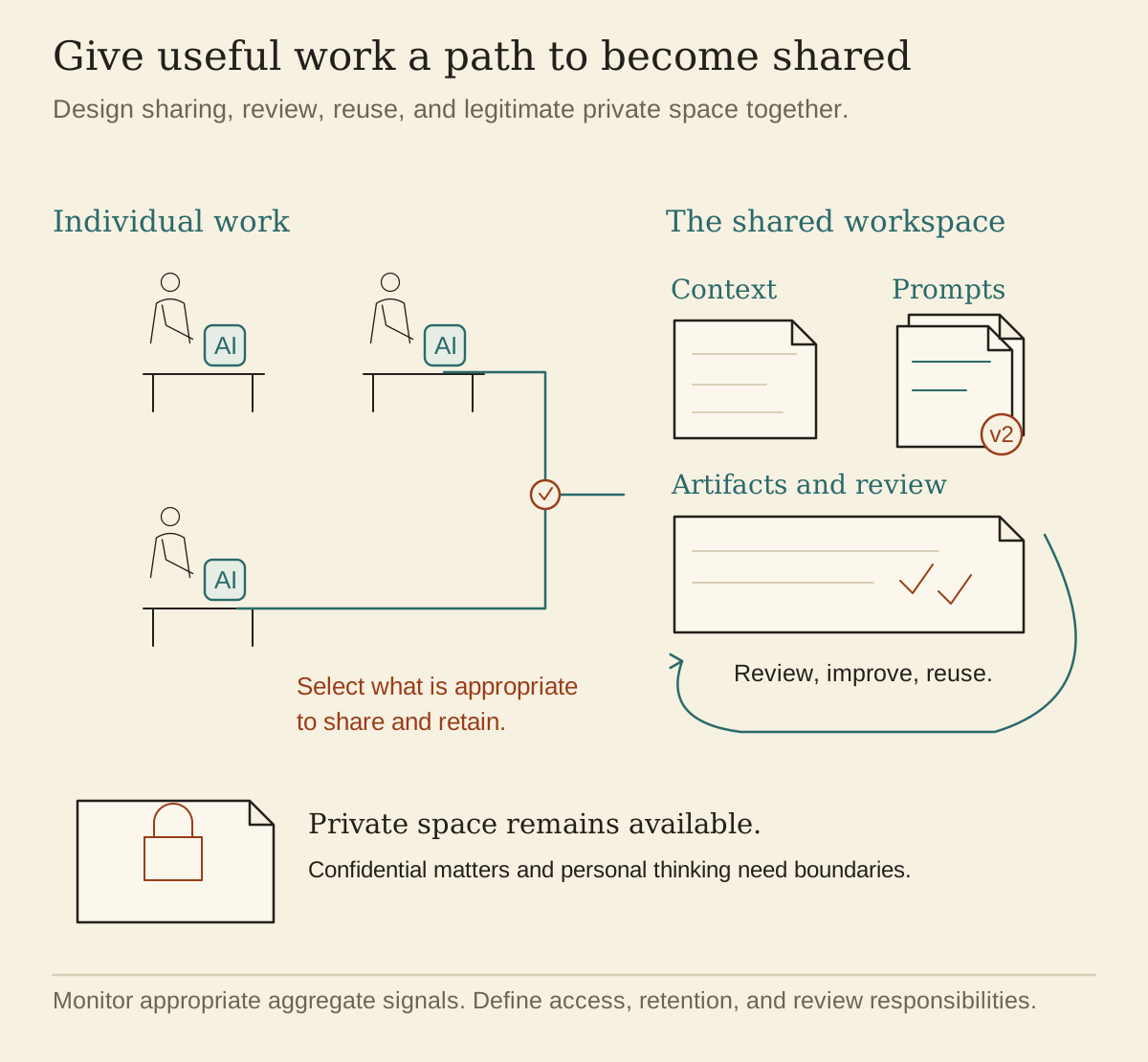
The alternative architecture is sometimes called multiplayer AI, by analogy with the gaming distinction between single-player and multiplayer experiences. The shift is from AI solely as a personal tool toward AI as a shared working environment, accessed and shaped by teams while preserving legitimate private space.
A multiplayer AI surface has several components. The first is permissioned shared context. Relevant prior work, decisions, customer history, project state, and institutional knowledge can be available to authorized team members and systems. The second member of the team does not have to re-explain what the project has already established. The system can retrieve what that person is entitled to use, with provenance and current state, rather than treating all team information as one undifferentiated memory.
The second is shared prompt libraries. When someone in the team finds a prompt that works particularly well for a recurring kind of analysis, the prompt is saved to a library that the rest of the team can use. The prompts are versioned. The prompts can be improved over time. The team's collective skill at working with AI accumulates as a shared asset rather than dissipating into thirty private chat histories.
The third is shared workspaces for AI-mediated work. When a team member is working on an artifact intended for collaboration, the work is visible to the appropriate team. Colleagues can see what is being produced, comment on it, contribute their own AI-mediated input, and build on what is already there. The work product can be collaborative from the start rather than assembled at the end from isolated pieces. Draft privacy, sensitive personnel matters, privilege, and need-to-know boundaries still require private spaces.
The fourth is shared review. When the AI generates output that will be used in some way that matters, the output goes to a shared review surface where the relevant team members can see it, evaluate it, flag concerns, suggest revisions. The review happens before the work is delivered, ahead of any problem in production.
The fifth is shared monitoring. Authorized owners can see appropriate aggregate signals about what AI is being asked to do, what patterns are emerging, and what outputs or actions warrant attention. Monitoring should be proportionate: collecting every private prompt can create surveillance, labor, confidentiality, and data-retention risks. Governance requires visibility, but not indiscriminate visibility.
Why This Is Architectural, Not Cultural
The instinct of many leaders, on encountering the thirty-islands problem, is to address it culturally. Train people to share their prompts. Encourage cross-pollination. Set up a Slack channel where people can post what is working. These cultural moves are useful and they do not solve the problem.
This problem is structural. Single-user chat tools make sharing high-friction by default. To share a prompt, an employee has to copy it from one tool, paste it somewhere else, write context about what it does and when to use it, and post it where someone might find it. To use someone else's shared prompt, an employee has to find it in the place it was shared, copy it, paste it into their own tool, adapt it to their specific situation. Friction at every step is high, and that friction is what keeps sharing sporadic instead of systematic.
Multiplayer AI changes the architecture. The prompts are in the system. The context is in the system. The work products are in the system. Sharing becomes the default for work intended to be collaborative because the architecture makes it easy. Private work remains a designed mode where confidentiality, privilege, sensitivity, or simple thinking space requires it.
This is why the collaboration surface is an architectural decision as well as a cultural one. Architecture shapes the default behavior; culture determines whether people trust and use it. A company that wants AI capability to compound organizationally has to build a surface that makes useful sharing easier while protecting work that should remain private.
The Shadow AI Risk
Single-user chat architecture carries a particular risk, and it is becoming one of the dominant concerns in enterprise AI. Shadow AI is the unauthorized, unmonitored, ungoverned use of AI tools by employees who are working around the company's official AI strategy.
Employees turn to shadow AI for several reasons. Official tools may be insufficient for their actual work. The official tools may be slower or less capable than what the employee can access on their own. The official tools may be governed in ways that prevent the employee from doing the work they need to do quickly. Whatever the reason, the result is that the employee starts using consumer-grade AI tools with their own accounts, pasting company data into them, and producing work that the company cannot see.
The shadow AI problem is harder in an architecture centered on private sessions because legitimate work and unauthorized work can look similarly isolated. An enterprise tool may still be materially better governed than a consumer account through contractual data controls, identity management, retention settings, connectors, and administrative logs. But procurement controls alone do not make the work reusable or assure that employees will choose the approved path.
Multiplayer AI changes the incentive structure. The official surface can offer permissioned team context, prompt or workflow libraries, existing artifacts, and review by colleagues. The shadow tool leaves the employee to reconstruct that context alone. When the approved environment is both safer and more useful, the unofficial path becomes less attractive. That can reduce shadow use, although endpoint controls, education, policy, procurement, and enforcement still matter.
Companies rarely solve shadow AI through prohibition alone. They improve their odds by making approved tools genuinely capable, reducing needless friction, setting clear boundaries, and enforcing the boundaries that matter. Architectural design carries policy into daily work. Written acceptable-use rules remain necessary, but they are not substitutes for getting the product, incentives, and controls right.
The Connection to Governance
The collaboration surface determines what kinds of governance are practical. Layer 8 of the nine-layer AI stack from Section 2.3 (evaluation, monitoring, and governance) depends on appropriate observability. Private work can still be governed through enterprise identity, retention, data-loss prevention, audit events, sampled review, and outcome monitoring. But when neither inputs, outputs, actions, nor downstream outcomes are observable, errors are harder to detect, drift harder to measure, and compliance harder to demonstrate. Governance cannot rest on work the organization has designed itself never to see.
A company serious about governance needs architecture that produces the visibility its risks require. There is no policy that compensates completely for missing controls, and no collaboration surface that compensates for bad policy. The choice between predominantly private and deliberately shared AI affects how learning compounds, how shadow AI is addressed, and which governance mechanisms are available.
What the Choice Costs
Honestly accounted for, a multiplayer collaboration surface costs more than deploying single-user chat tools. The shared context infrastructure has to be designed. The prompt library has to be built and curated. The collaborative workspaces have to be integrated with the company's existing tools. The review surfaces have to be designed to fit the team's actual workflow. The monitoring infrastructure has to be deployed.
The investment is real, and so is the potential return. A well-used collaboration surface lets practices, validated workflows, and review standards accumulate across the workforce. Work products can improve through visible iteration. Governance becomes more practical because the architecture supports appropriate observability. Shadow AI risk may decline because the approved surface offers advantages the unofficial alternative lacks.
Companies that do not build these capabilities risk the inverse: skill that remains local, work products that vary without a shared improvement mechanism, weaker governance, and more incentive for shadow AI. Some organizations can achieve parts of the same outcome through existing document, code, workflow, and collaboration systems; the requirement is the capability, whatever product delivers it.
The cost differential may produce little visible return in the first quarter because shared context, evaluation, and governance are capability investments. Their value should be measured over time through reuse, cycle time, quality, risk reduction, adoption, and avoided duplication. A leadership team judging only immediate seat-level productivity will miss much of the case.
The next section addresses the discipline that runs across all of this and determines whether the AI's output can be trusted as the practice scales.