What does it mean to design a company around AI?
AI-Native is currently being used to mean three different things, and the conflation produces operating-model decisions that do not match the company's actual posture.
The first posture is AI-Augmented. AI is a feature added to existing products and workflows. The org chart, the operating model, and the processes are unchanged. AI sits on top, providing assistance to people doing the same work they were doing before. Copilots inside Microsoft 365. Embedded assistants in Salesforce. AI-powered search inside legacy enterprise tools. These are real and often valuable. They are also, structurally, the lightest touch a company can have with AI. AI-Augmented is a feature strategy.
The second posture is AI-First. AI is a strategic priority and a core capability. The organization recognizes that AI changes what is possible and is rewiring itself to take advantage. Workflows are being redesigned. Roles are evolving. Investment is real. But the underlying operating model still assumes pre-AI logic. The company was designed before AI existed and is being modernized rather than rebuilt. Many large incumbents that are serious about AI are in this posture, whether they call themselves AI-First or AI-Native. Real work is happening. The transformation is partial.
The third posture is AI-Native. The operating model assumes from the ground up that AI will participate in work alongside people, applications, and data. Intelligence is embedded in workflows rather than layered at the edges. AI agents are treated as architectural components with clearly defined roles and operating limits. Decisions about how much autonomy AI has, what data it can use, and where human review is required are made at the design stage, before systems reach production. IBM's working definition captures it: AI-native means designed from the ground up with AI as a core component rather than bolted on as a feature.
The distinction matters because the three postures call for different investments, different organizational structures, and different time horizons. An AI-Augmented company that announces it is becoming AI-Native without changing its operating model is producing what I have come to call performative AI-Nativeness: the language without the substance. The phrase makes the earnings call in February, and a banner goes up in the lobby. By August the night shift is still keying readings from one system into a second one by hand, the work order still crawls through the same approval chain, and the one visible change is a chat window docked at the corner of the operator's screen. The workforce can tell. The board eventually figures it out. The market figures it out faster.
A useful analogy: traditional organizations operate like assembly lines. Each step is predefined, sequential, and dependent on human intervention. AI-Augmented organizations are assembly lines with smarter tools at each station. AI-First organizations are reconfiguring the assembly line. Same factory, new layout. AI-Native organizations operate more like navigation systems. They interpret inputs, adjust in real time, and guide outcomes. Some work will remain sequential and standardized; the difference is that the operating model no longer assumes every important path can be fixed in advance.
Now the honest reset. Most established companies will not become AI-Native in the pure startup-built-from-scratch sense. The company born this year with AI in its DNA from day one has structural advantages an incumbent cannot fully replicate. The legacy systems, the institutional habits, the workforce hired for pre-AI roles, the customers accustomed to pre-AI experiences: these are all real and they all create friction that a startup does not have. As a planning assumption, an incumbent might move from AI-Augmented to AI-First over several years of serious work. Moving from AI-First toward a deeply AI-Native operating model can take much longer and may never have a clean finish. Eighteen to thirty-six months and a decade are useful orders of magnitude for planning, and they carry no more authority than that.
Intellectual lineage. Clayton Christensen offers a useful lens on the three postures, but not an exact mapping. Christensen distinguished sustaining innovation, which improves established offerings along dimensions existing customers value, from disruption, which begins through a new-market or low-end foothold and develops along a different value network. AI-Augmented often behaves like sustaining innovation because it improves the existing operating model. AI-First can still be sustaining even when the rewiring is substantial. AI-Native may create a different operating model, cost structure, talent profile, and way of serving customers, but that alone does not make it disruptive in Christensen's precise sense. It becomes disruptive only when the market path and value network fit the theory too. The Innovator's Dilemma still illuminates the section's honest reset: existing customers, profitable models, legacy investments, and organizational habits create gravity toward improvements the incumbent already knows how to value. Startups may have less of that gravity, though they carry constraints of their own.
Christensen, Clayton M. (1997). The Innovator's Dilemma: When New Technologies Cause Great Firms to Fail. Harvard Business School Press.
The most valuable transition for most incumbents is the move from AI-Augmented to AI-First, and from AI-First to a deeply integrated, near-AI-Native operating model. MIT CISR research reported that enterprises in the first two stages of its AI maturity model had financial performance below their industry average, while enterprises in stages three and four were above it (Weill, Woerner, and Sebastian, 2024). The underlying survey covered 721 companies in 2022, so the results primarily describe analytical AI, and the relationship is an association rather than proof that AI maturity caused the performance difference. Follow-up research has continued to locate the largest financial shift around the move from pilots to scaled ways of working. The practical point is not to become a platonic AI-Native startup. It is to build the capabilities that move AI from scattered tools and pilots into the way the enterprise works.
This book is written primarily for the leadership team of an established company that is serious about AI-First and aspirational about AI-Native. Some of what I describe applies more cleanly to startups designing from scratch. Most of it is calibrated for the harder problem: taking an organization that exists and moving it through real change, in the real world, with real people whose lives and livelihoods are part of the equation.
The spectrum tells you your current posture. It does not tell you what version of AI-Native you are aiming to become. Within the AI-Native end of the spectrum, there are at least five distinct legitimate models, and the choice among them shapes everything the operating model becomes.
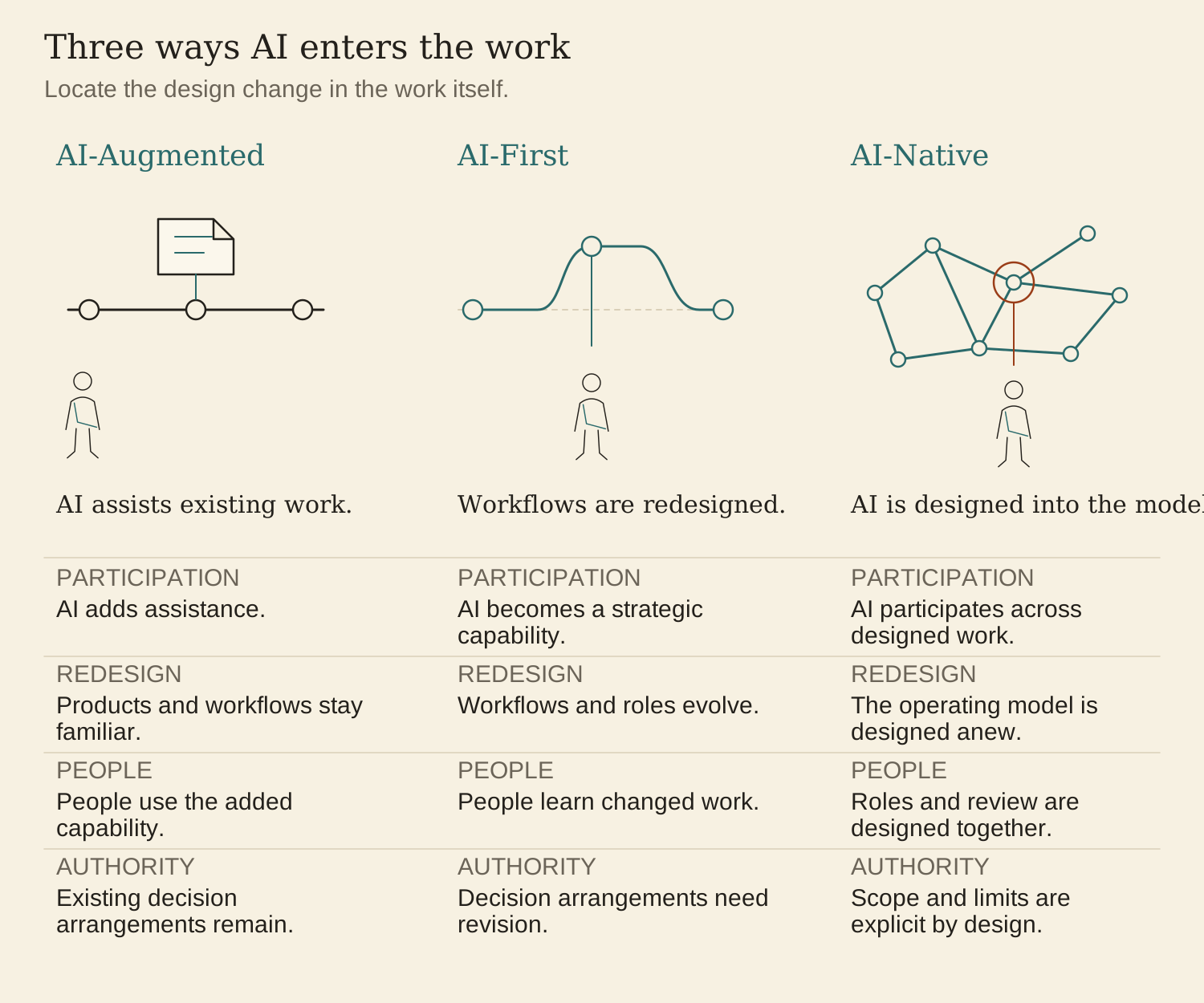
Consider. Which posture does your company actually occupy? Set aside the one that was announced and the one the strategy deck claims. The honest answer may be one posture earlier than the public one. If you cannot find a single example of the operating model itself being redesigned around AI, you are AI-Augmented regardless of what the announcement said. Honest self-location can prevent pilots from being asked to carry a transformation they were never designed to deliver.