What different shapes can an AI-Native company take?
The standard discourse treats AI-Native as if it were a single destination. It isn't. Within the AI-Native end of the spectrum, there are at least five distinct legitimate models of what an AI-Native company can be, and they produce dramatically different cultures, decision-making patterns, and risks.
The dimension that distinguishes them is structural. Where does the intelligence sit in the operating model, and where do humans sit relative to it? The five archetypes answer that question five different ways, and the answers are not interchangeable. A company that chooses the wrong archetype for its business will produce friction, attrition, and underperformance that look like execution problems. They are architecture problems.
I walk through each archetype with the same structure: where the intelligence sits, where humans sit, what the archetype is good for, where it breaks, and a real-world reference point. After the five, I name two variants, the hybrid portfolio and the anti-archetype. Most real companies end up in one of these rather than in a pure archetype.
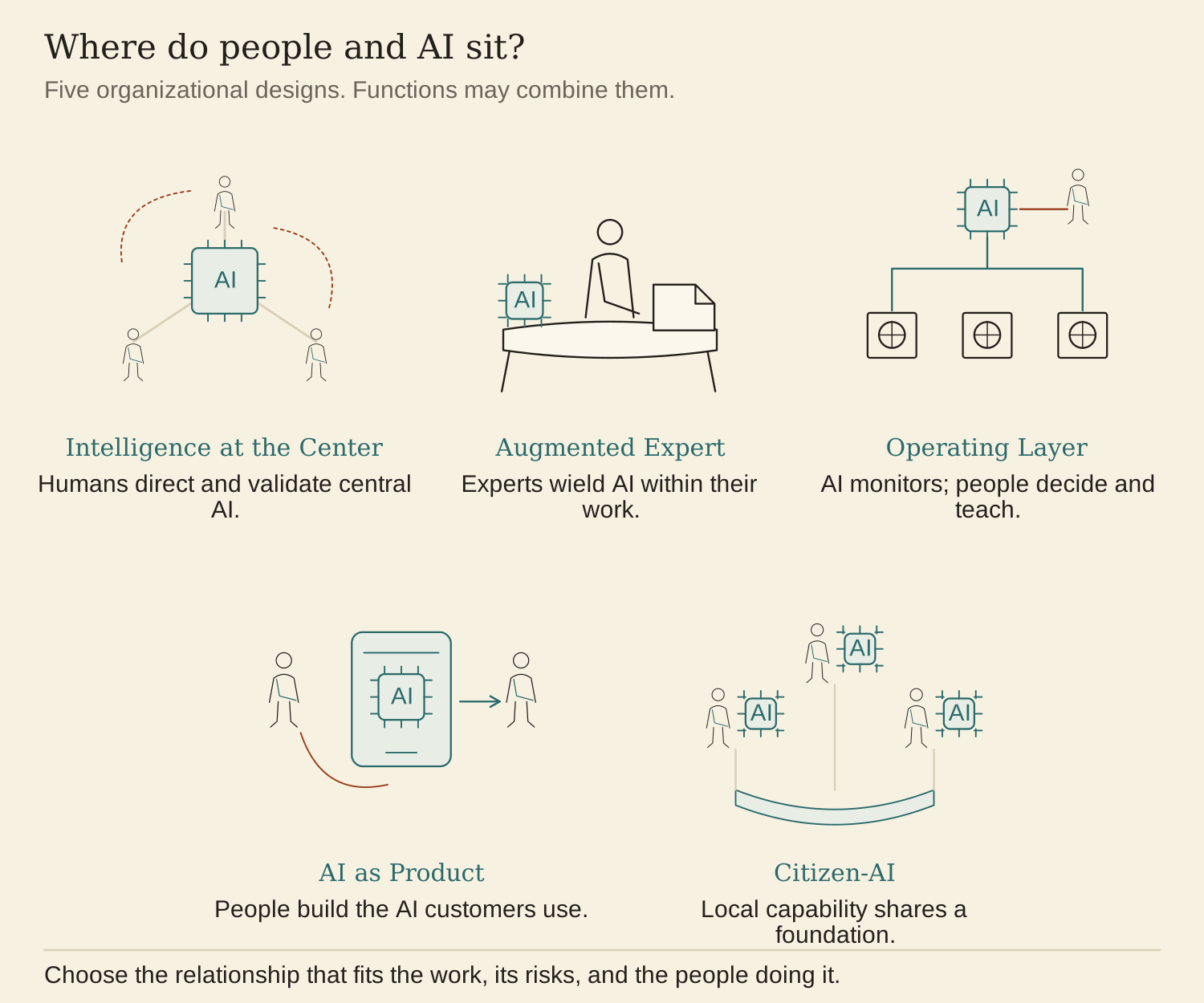
Intelligence at the Center (the "God Model")
Where the intelligence sits: at the architectural center of the company. AI is the substrate. The operating model is built around feeding, directing, and aligning the AI.
Where humans sit: at the edges. Aligners, validators, directors, prompters. Player-coaches rather than pure managers. The organizational structure is designed to flatten, with smaller teams and, at the limit, experiments in single-person pods orchestrating fleets of agents. Whether those experiments become a durable operating model remains an open question.
The public reference point is Coinbase. On May 5, 2026, CEO Brian Armstrong announced a fourteen-percent workforce reduction, approximately seven hundred employees. Coinbase's SEC filing described two purposes: responding to market conditions and optimizing operations for the AI era. Armstrong's public memo framed the goal as rebuilding Coinbase to be lean, fast, and AI-native. The announced design capped the org chart at five layers below the CEO and COO, called for managers to act as player-coaches rather than pure managers, and proposed experiments with smaller "AI-native pods," including one-person teams spanning engineering, design, and product responsibilities with agent support. Those are announced changes and experiments, and the evidence that the model works is still to come. Block moved in a similarly aggressive direction in February 2026, reducing its workforce by more than forty percent while describing a smaller, flatter organization enabled partly by AI and automation.
Coinbase had posted a $667 million net loss in Q4 2025, while reporting that total quarterly revenue of $1.8 billion was down five percent from the preceding quarter. The company nevertheless reported full-year revenue growth and substantial cash reserves. The crypto market downturn and cost pressure therefore belong alongside the AI framing, without reducing the restructuring to either story alone. Both things can be true. The structural changes Armstrong announced are real, the AI-native framing may be sincere, and the financial pressure was also real. A book that presents Coinbase as a pure AI-native pivot without naming the financial context is missing half the picture.
What the archetype is good for: high-volume, high-velocity, digital businesses where speed and unit economics dominate. Software companies, fintech platforms, content production at scale, some forms of e-commerce. Businesses where the work is mostly amenable to AI orchestration and where the competitive moat is execution speed.
Where it breaks: operations-heavy environments with physical reality and complex interdependencies. Regulated environments where human accountability for decisions is non-negotiable. Contexts where institutional judgment under genuine ambiguity is the whole game. Any environment where the institutional knowledge has not yet been captured into systems the AI can reason over (without that knowledge, the AI is operating on shallow context and producing confident but wrong outputs at scale). Any context where workforce trust matters and the announcement reads, accurately, as "we are replacing you."
The honest critique of this archetype: it is currently producing a lot of press and short-term market enthusiasm, but the long-term track record is unproven. The companies moving aggressively into this model are betting that AI capabilities and redesigned workflows will compensate for at least some of the institutional knowledge and coordination capacity removed with people and management layers. That bet may succeed. It may also produce, over the next several years, companies that are structurally lean, technically sophisticated, and operationally fragile in ways that become visible only under stress. We do not know yet. The leadership teams choosing this archetype should know they are making a real bet rather than adopting the inevitable future.
Augmented Expert
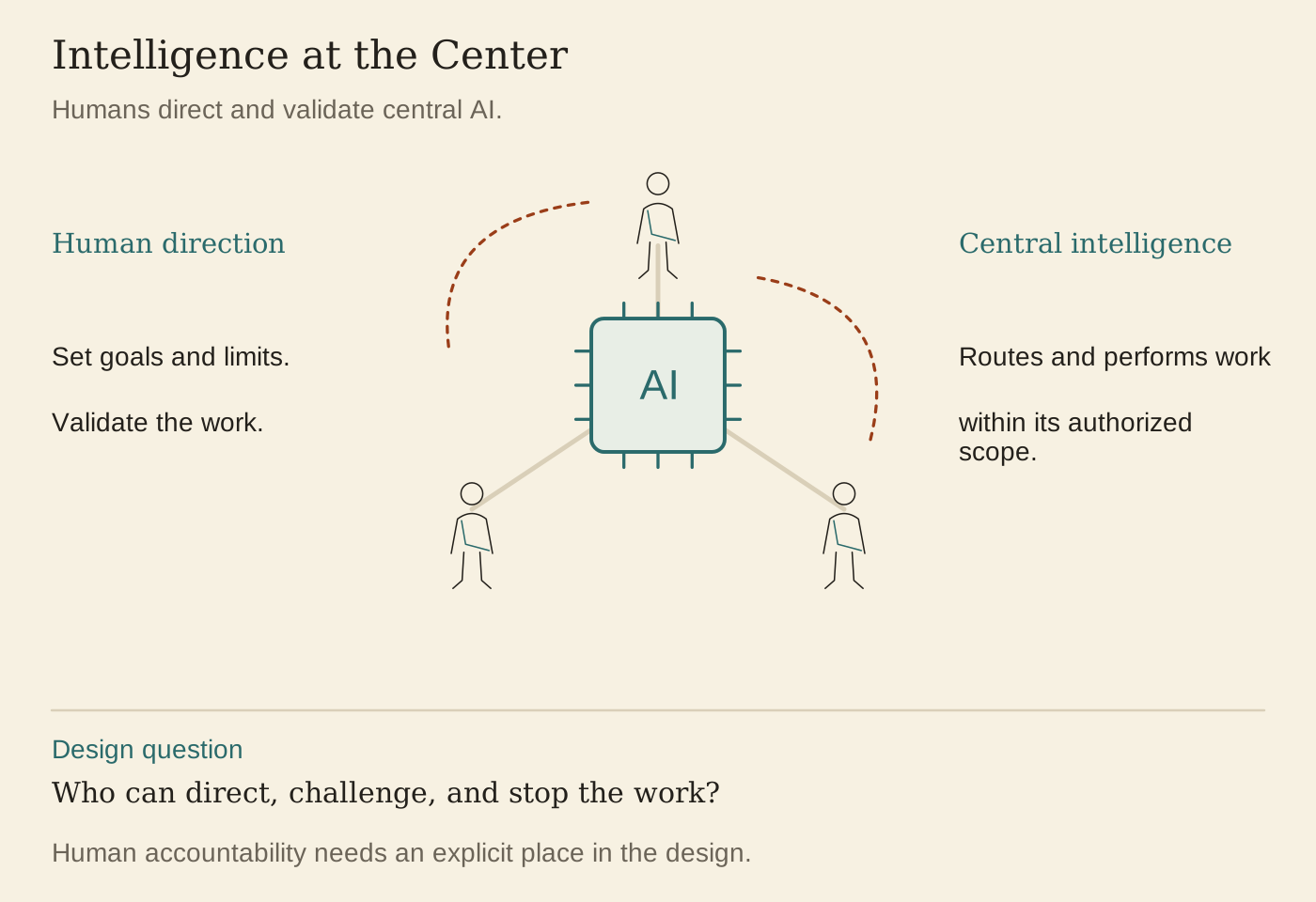
Where the intelligence sits: distributed across roles, with AI showing up in workflows but not owning them.
Where humans sit: at the center. The expert is the unit of value. AI is the tool the expert wields. Each individual produces more, sees more, acts faster. But the human is still the actor.
What the archetype is good for: professional services, advanced engineering, R&D-heavy organizations, law, medicine, deep enterprise sales. Anywhere the value is concentrated in specialized human judgment and the AI's role is to give that judgment more reach and depth. Many large consulting firms describe themselves this way. Many ambitious AI deployments in healthcare, legal, and engineering are operating in this archetype.
Where it breaks: it can become a sophisticated form of AI-augmented stagnation if leadership does not push it. The path of least resistance is to give every expert a Copilot license and call that the transformation. Nothing about the operating model, the org chart, or the work has changed. Your expert is now slightly faster at producing the same kind of output, and you have missed the structural opportunity. Competitive advantage erodes, because every other firm in the industry is doing exactly this.
This archetype asks the firm to name what its experts can now do: offer a new service, examine a problem in greater depth, or spend more time framing a decision and testing the recommendations. That choice gives the productivity gain a strategic purpose.
Operating Layer (the AI-Native Operations Model)
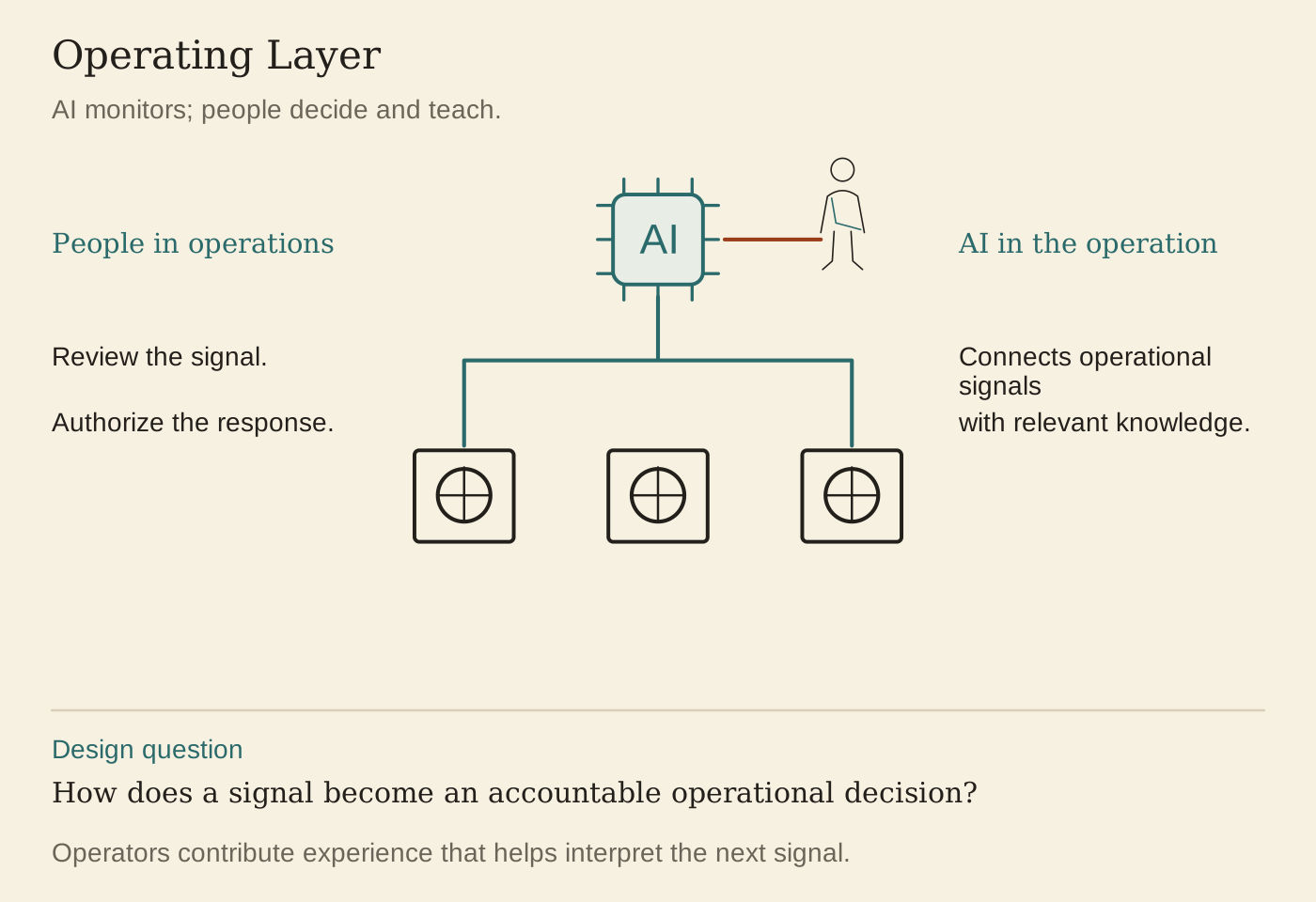
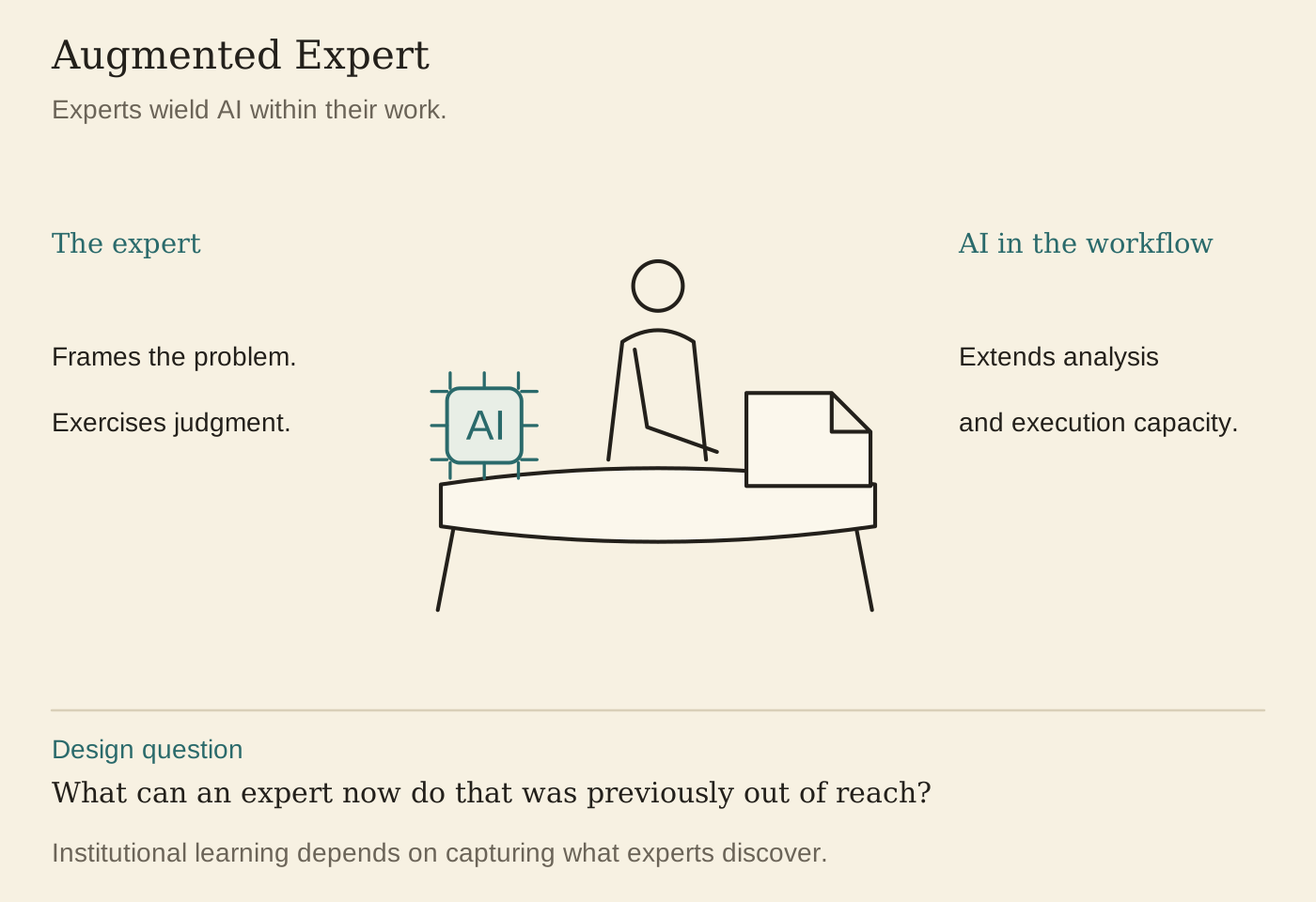
Where the intelligence sits: embedded in operations. AI is the always-on layer that watches systems, predicts states, recommends actions, surfaces anomalies, captures institutional knowledge into reasoning structures.
Where humans sit: above and around the operating layer. Operators validating AI recommendations at the moment of decision. Domain experts shaping how AI reasons by teaching the systems. Leaders setting policy and remaining accountable for outcomes. The org structure thins in middle management and thickens in domain expertise and judgment roles. At 2 a.m. in the control room, the operating layer flags a feedwater pump whose vibration signature has drifted over three shifts. The operator on duty has twenty-two years on that unit. She traces the reasoning back through the maintenance history, checks it against what she felt on her walk-down an hour earlier, and schedules the shutdown for Thursday, three days before the machine would have run itself to failure. The AI surfaced it. She decided it.
What the archetype is good for: manufacturing, energy, defense, healthcare, logistics, hospitality at scale, complex supply chains. Operational environments where reliability and trust are existential, where the cost of an error is high, and where much of the knowledge that makes the operation work lives with experienced people who are aging out of the workforce. This archetype can fit many operations-heavy companies. It also receives less useful attention in the dominant AI-Native discourse, which is often written from knowledge-work environments rather than operational ones.
Where it breaks: if the knowledge architecture is weak, the AI may never become trustworthy enough for consequential work. If the human-AI handoffs are not designed deliberately, operators may stop trusting recommendations and quietly revert to working around the system. If institutional knowledge is not captured before the experts retire, the AI is built on sand and the operating layer becomes fragile at the moment the company most needs it.
This archetype asks for investment in knowledge architecture before investment in agent capability. Without the structured representation of how the operation works, including the entities, the relationships, the dependencies, and the soft knowledge that experienced operators carry, the AI is just a chat interface bolted onto a control system. With that structured representation, the AI becomes a reasoning partner that augments the operator without replacing the judgment.
AI as Product
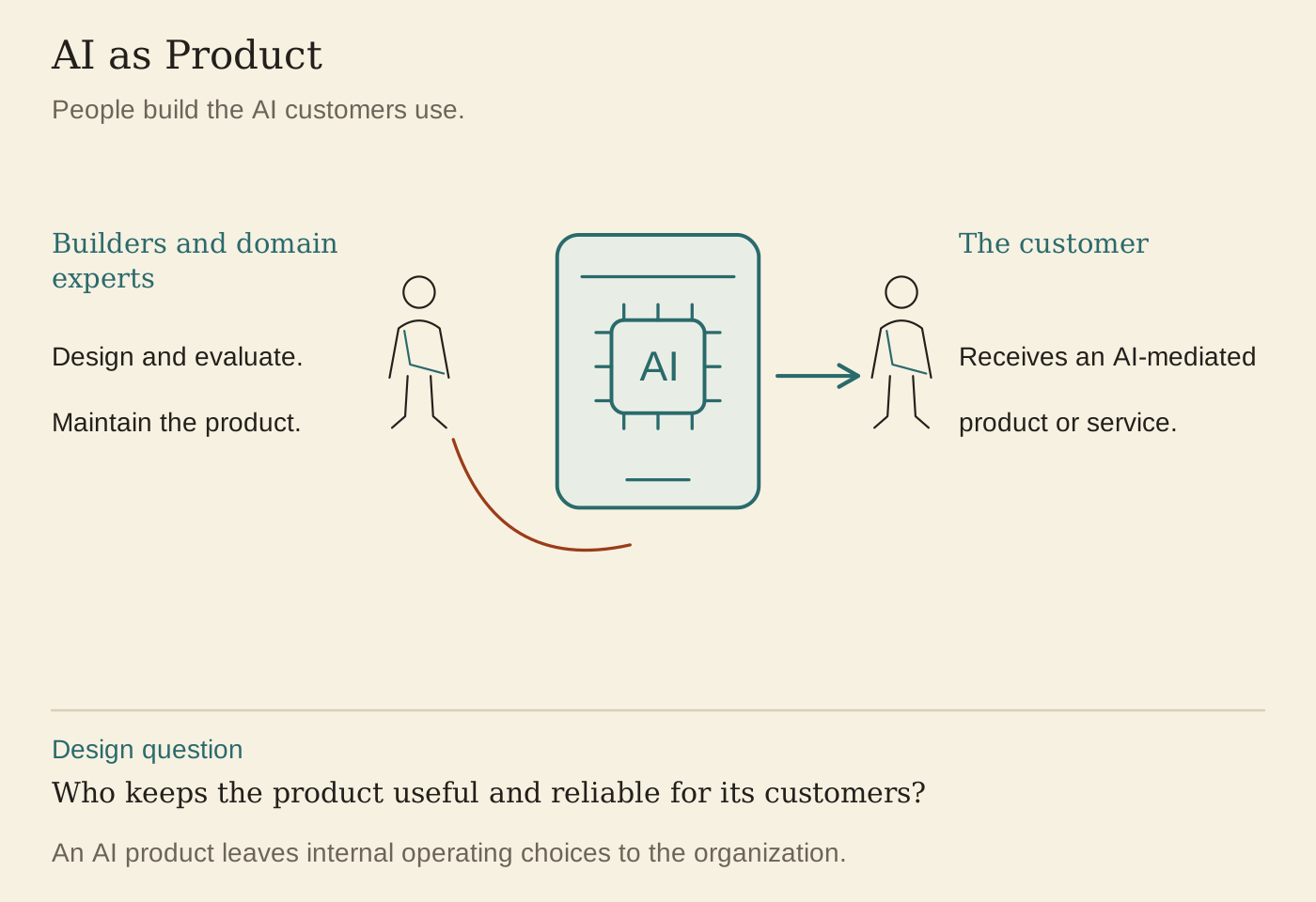
Where the intelligence sits: in the product. The company's value to customers is mediated by AI. The internal operating model still has to be AI-Native to some degree, but the strategic question is "how do we build, deploy, and improve AI-powered products" rather than "how do we use AI to run ourselves."
Where humans sit: building and tending the AI. Domain experts shaping its behavior. Operators monitoring it in production. Customer-facing teams interpreting it. The work is the AI work.
What the archetype is good for: SaaS companies pivoting their products toward AI-native experiences, AI-first startups, companies whose competitive position depends on AI capabilities customers can feel directly. The companies in this archetype have settled "should we use AI internally." Their question is "how do we ship better AI to our customers faster than our competitors do."
Where it breaks: conflating "we sell AI" with "we are AI-Native internally." Many AI product companies have impressive AI in their product and operational chaos in their back office. Building responsible, governed, continuously improving AI products demands more inner-loop discipline than most companies realize, and the gap between the product surface and the operational reality widens past what is sustainable.
Citizen-AI (Democratized Capability)
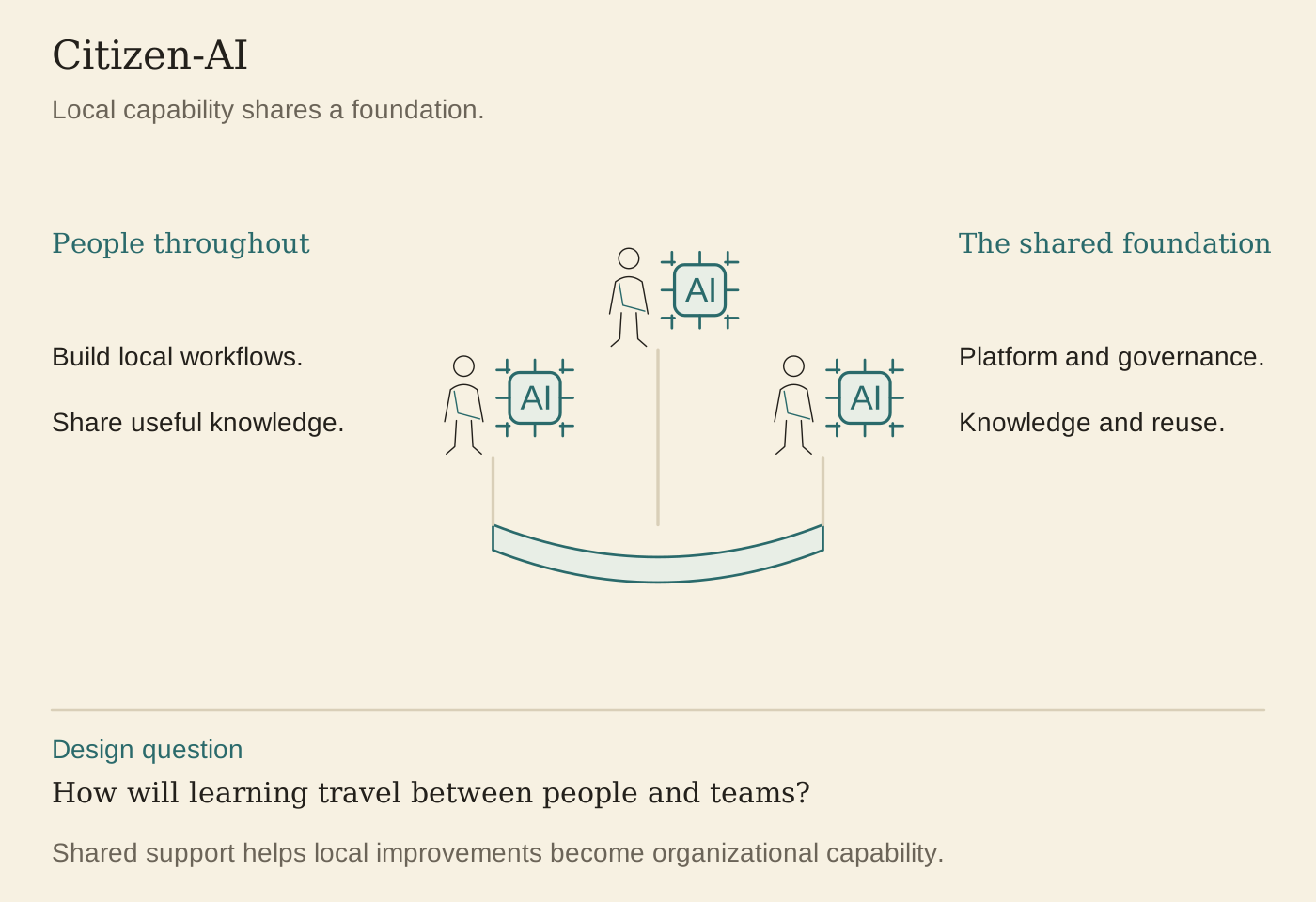
Where the intelligence sits: distributed across the workforce. Every employee has AI capability. Every team builds its own AI-powered workflows. The center provides platforms, governance, and shared services. The bulk of AI innovation happens at the edge, by domain practitioners who know their own work best.
Where humans sit: throughout. AI is woven into every role rather than concentrated in any. The bet is that a thousand employees each making their work modestly better with AI produces more total value than a centralized AI strategy could deliver in the same time. Microsoft's pitch for enterprise Copilot at scale is the clearest commercial articulation of this archetype.
What the archetype is good for: large, diverse organizations where the operating model is too varied for a single AI strategy. Knowledge-work companies where the work itself is heterogeneous. Companies with strong existing platform discipline that can deploy shared services across many different use cases.
Where it breaks: this archetype is especially exposed to the "thirty islands" problem. Thirty employees, each with their own AI tools, each producing their own AI-mediated output, little of it compounding into team-level or organization-level intelligence. Without strong platform discipline and a deliberately designed shared surface for AI work, the kind Section 4.3 takes up in full, Citizen-AI can produce fragmentation rather than capability. Shadow AI and governance become substantial concerns because use is broadly distributed. Companies that handle the pattern well invest in shared knowledge layers, reusable instruction assets, and review surfaces. Companies that do not may end up with more individuals using AI while the organization gains little shared capability.
The Hybrid Portfolio
Most real companies, especially large ones, will not be a single archetype. They will be a portfolio. The operations division runs as Operating Layer. The product group runs as AI as Product. The corporate functions run as Augmented Expert or Citizen-AI. The leadership challenge becomes coherence across the portfolio rather than choosing one model.
For most enterprises with more than a few thousand employees and more than one line of business, the hybrid portfolio is the realistic destination. It asks you to name each part of the company with its archetype, design the operating model for each part accordingly, and manage the interfaces between archetypes deliberately. A common failure mode is to apply one archetype's logic uniformly across the whole company, which produces serious mismatches. Running operations like a citizen-AI environment, or running professional services like an intelligence-at-the-center model, will not work. It will also not stop being broken because leadership wishes it would.
The Anti-Archetype
Some companies will deliberately not become AI-Native in any of these senses, and will make their value proposition the human, the artisanal, the relational. Healthcare already contains versions of this choice, even where AI supports diagnosis, planning, or administration: the accountable clinical relationship remains human. The premium artisanal coffee shop where you know the barista. The human-only therapy practice. The white-glove law firm that markets "your lawyer, never an AI." The luxury concierge service whose entire promise is unmediated human attention. These are real strategic choices and they are probably underestimated in the current discourse.
Some industries may bifurcate into an AI-Native commodity tier and a deliberately human premium tier, with the middle struggling. Companies positioning coherently at either pole may outperform ones caught between them. That is a strategic hypothesis that the market has yet to confirm.
Not becoming AI-Native is a legitimate strategic choice for some companies. It reflects a different bet about where value concentrates rather than a failure of vision.
Defensibility within the Archetypes
Choosing an archetype is the first strategic decision. Making the chosen archetype defensible is the second.
The defensibility question matters more in the AI-Native era because access to capable models and the ability to prototype software are becoming widely available. Frontier models are not interchangeable commodities: capability, reliability, cost, deployment options, and policy still differ. But access to GPT-class, Claude-class, Gemini-class, and open-weight systems is no longer scarce enough to be a moat by itself. Nor is a working software prototype. AI-assisted development can compress prototyping dramatically, while secure operations, distribution, workflow fit, support, and sustained product quality remain difficult. Some old moats around proprietary software and exclusive model access are therefore weakening rather than disappearing.
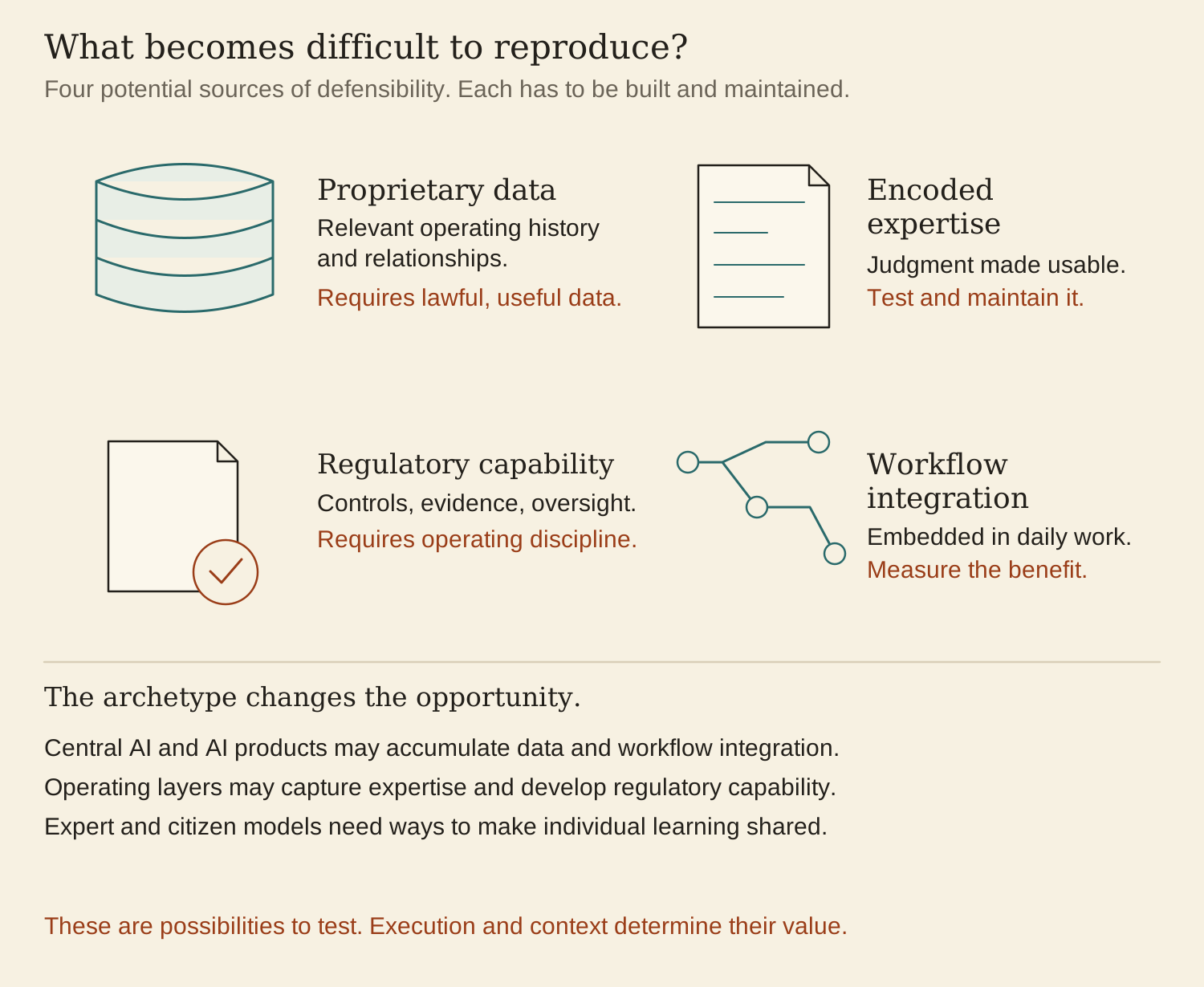
Four recurring sources of defensibility are visible. They are not an exhaustive taxonomy and none is automatic. They can compound, and the strongest businesses often combine more than one.
The proprietary data moat. The company has accumulated data over years of operation that no competitor can replicate. The data is operational (customer transactions, equipment telemetry, support conversations) rather than something that can be bought. The AI built on top of that data is therefore distinctive in ways that the models, in isolation, are not. The venture firm CRV has made the same argument in its vertical AI thesis: the strongest vertical AI companies accumulate data through customer relationships that no amount of compute can replicate. Vertical AI companies have a structural edge here that horizontal AI products cannot match.
The encoded expertise moat. The company has captured the institutional knowledge of its experienced workforce into systems built for AI reasoning. The knowledge graph, the decision history, the named failure patterns, the soft judgments that experienced operators make without thinking. Encoded expertise can be harder to replicate than data because data can sometimes be purchased; encoded expertise has to be elicited, tested, maintained, and connected to the conditions under which it applies. Competitors that do not have access to the people and operating history behind it cannot reproduce it merely by licensing the same model.
The regulatory moat. In regulated industries, the cost of operating an AI system that meets the regulatory bar can be high. Startups and incumbents alike have to prove the controls, records, oversight, and validation their setting requires. Companies that treat compliance as product work rather than overhead may turn that investment into a barrier to entry, though compliance itself is not evidence of product quality. A 2026 Bessemer Venture Partners case study reports that Graph AI built its pharmacovigilance system around SOC 2, FDA 21 CFR Part 11 controls, immutable audit trails, electronic signatures, human sign-off, and obligations it identified under the EU AI Act. That is a useful documented example of the design pattern; the case study is an investor profile and carries no independent regulatory weight.
The workflow integration moat. The company has built AI capabilities that are integrated into the customer's or operator's actual work rather than standing alongside it. The integration creates switching costs: ripping out the AI means redesigning the work around the absence. IBM names this as the intelligence moat: mature AI systems are difficult to copy because intelligence is embedded into workflows rather than features. The improvement creates compounding returns that traditional software does not achieve.
The four moats are not equally available to every archetype. Intelligence-at-the-Center companies often lean on workflow integration and proprietary data. Operating Layer companies can lean on encoded expertise and regulatory capability. AI-as-Product companies often combine proprietary data with workflow integration. Augmented Expert companies may struggle to create organizational defensibility unless the firm redesigns the work to capture institutional knowledge structurally. Citizen-AI may be especially vulnerable when individual gains remain isolated: the thirty-islands failure from the archetype description, restated as a moat problem. These are tendencies to test against a particular business, and each business will order them differently.
A useful diagnostic, when evaluating any AI-Native strategy: ask what specifically gets harder for a competitor as your AI-Native operating model matures. If the answer is that your software gets faster or your model gets better, the moat is weak. If the answer is that your data compounds, your experts teach the system, the regulators give you a multi-year head start, the customers' workflows depend on you (and you can name the specific mechanism for each), then the moat is real. Most companies in the current AI-Native conversation cannot name the mechanism. The companies that can name it are the ones whose AI-Native positioning will last.
The Position Statement
There are AI-Native companies, plural. The question is which one you intend to be.
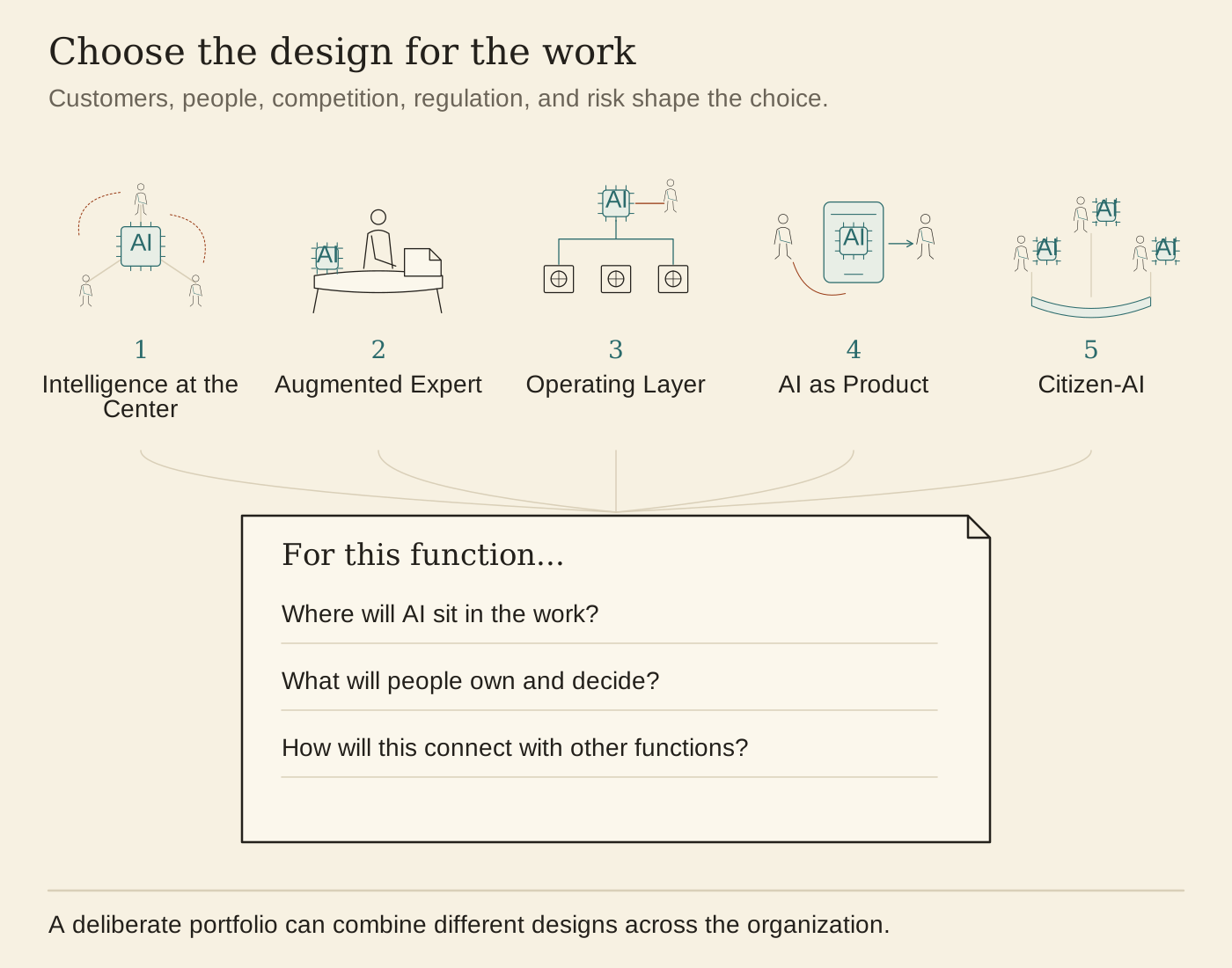
Choosing deliberately is one of the most consequential strategic decisions a leadership team makes, and it is rarely made deliberately. It usually emerges by default, shaped by which executives are loudest, which vendors get traction, which pilots happen to succeed, and which department happens to have budget. The result is a company that is mostly Augmented Expert with a Citizen-AI overlay and pretensions toward Intelligence at the Center. None of it is coherent. All of it is consuming budget. The spending is on schedule. The leadership team cannot tell why the transformation is not producing the results they expected.
The deliberate version requires the leadership team to look at their business honestly. Their customers, their talent, their competitive position, their regulatory environment, their tolerance for risk. And choose. The choice is constrained. Not every archetype is available to every company. But the choice within the available options is consequential, and it is the leadership team's to make.
This book's job is to give you the substrate for that choice: the frameworks, an honest analysis of each archetype, and a structure for deciding that honors the human reality of the choice. None of it substitutes for the leadership team doing the work.
The next question, having chosen an archetype, is what technical foundation will support it. That is the AI Stack.