What is AI, beyond the chat box?
Many leadership teams I work with operate with a mental model in which "AI" means "the chat thing my employees use." That model is wrong. It is also producing under-investment and mis-investment in the companies I see. The chat layer is one of nine distinct layers in a working AI stack. A company investing only in chat is choosing one of the most fragmented, lowest-return, least governable forms of enterprise AI, and mistaking the front door for the building.
The reframe matters because the choice of archetype from Section 2.2 is partly enabled, and partly constrained, by which layers of the stack a company funds. An Operating Layer archetype that has not invested in structured knowledge representation cannot function. A Citizen-AI archetype that has not invested in a shared collaboration surface produces fragmentation rather than capability. An Intelligence-at-the-Center archetype that has not invested in agent orchestration is just chat with confidence.
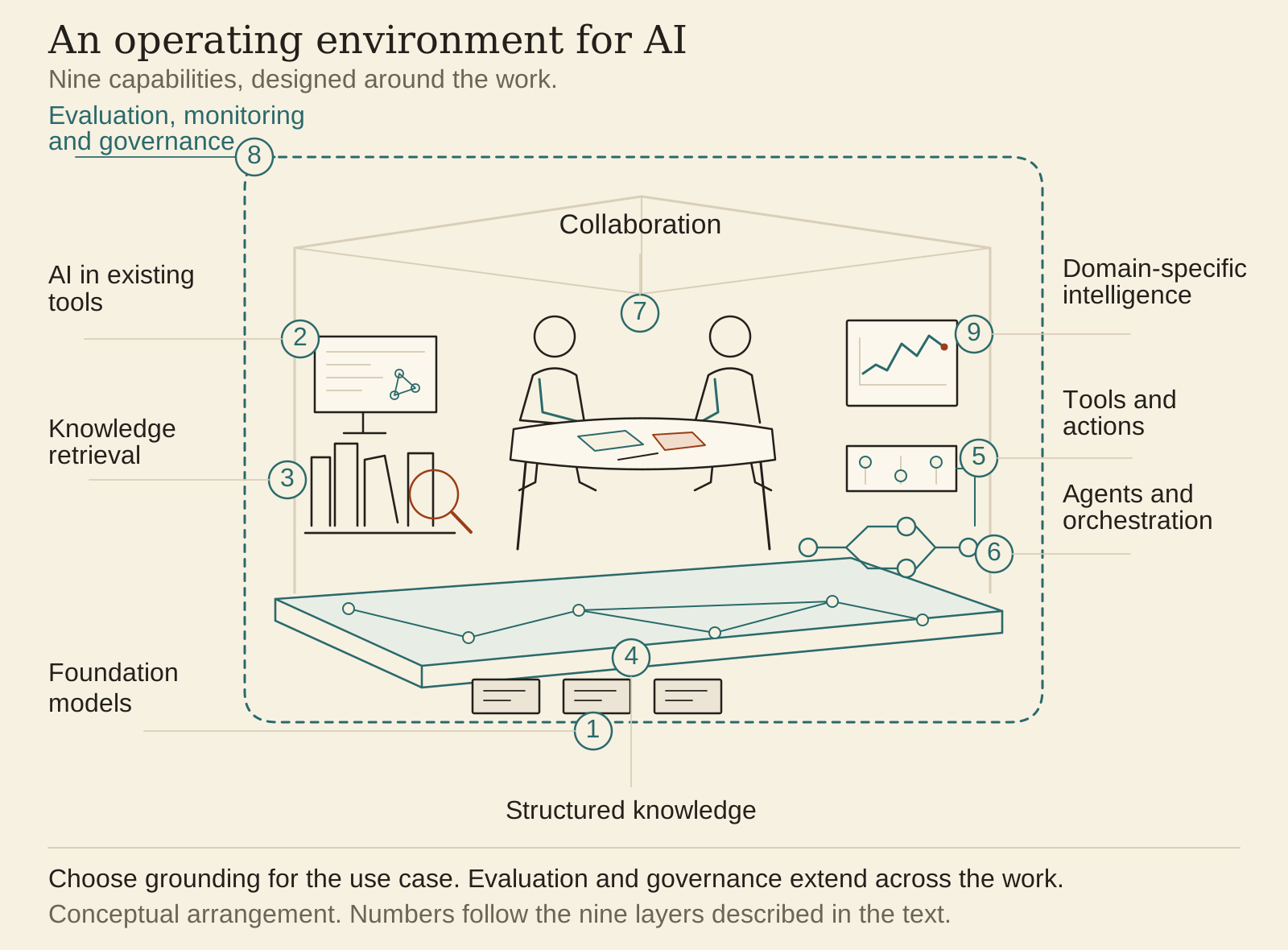
The stack has nine layers. Each has a different purpose, a different cost structure, a different governance profile, and a different organizational implication. I will walk through them from the foundation upward.
Layer 1. Foundation Models
The raw intelligence. Claude, GPT, Gemini, open-source models. These are the substrate. Most companies interact with foundation models through chat interfaces, but the model itself is the underlying capability that the chat interface exposes. Strategy at this layer comes down to model selection (which models for which use cases), model access (direct API, through cloud providers, on-premises for sensitive applications), and model diversity (do we use one model or several). Most companies under-think this layer. They use whatever model their primary vendor surfaces and call that their AI strategy.
There is a second reason to under-think it, and by 2026 it is the better reason. The frontier has become more competitive. Leadership changes by model, benchmark, workload, price, latency, and release date; capable open-weight models have narrowed gaps that once looked structural. That does not make the models interchangeable. It makes permanent allegiance to one leaderboard winner a weak strategy. Mature architectures increasingly preserve the option to route different work to different models and to change providers when economics, policy, or performance changes. The strategic question has widened from which model to what you have built around the models you can use, because model access is rented and replaceable more often than the surrounding data, evaluations, permissions, and workflows are.
Layer 2. Embedded Intelligence in Existing Tools
AI features inside the productivity and business tools your people already use. Copilot in Microsoft 365. Gemini in Google Workspace. AI features in Salesforce, Notion, Figma, ServiceNow, Slack. This layer is often the highest-adoption, lowest-friction layer because it usually requires less tool change and workflow redesign than a standalone deployment. It still requires judgment, training, and governance. Your people are already in the tool; the AI shows up where they are.
The trap at this layer is that adoption is not the same as value. Employees using Copilot to write emails faster is genuine productivity that falls short of transformation. The risk is that an organization invests heavily at Layer 2 and concludes it has become AI-Native because adoption metrics are strong. The emails do get written faster. Adoption is necessary. It is not sufficient.
Layer 3. RAG and Knowledge Retrieval
Grounding AI responses in your organization's own data. Documents, wikis, systems of record. Retrieval-Augmented Generation, in the technical vocabulary. This is what turns a generic AI assistant into "an assistant who knows our company." Without this layer, the AI is operating on whatever it learned during training plus whatever the user types in the prompt. With this layer, the AI can answer questions about your specific policies, your specific customers, your specific products, your specific institutional context.
Strategically, this layer comes down to which knowledge gets exposed to which AI surfaces, and how. Technically, it comes down to embedding models, vector databases, retrieval strategies, and the relentless work of keeping the indexed knowledge current. For many companies, the first serious AI investment after foundation models is at Layer 3. That investment can be worthwhile, and the trap is the same one waiting at Layer 2. A company can confuse a working RAG system with a transformed operating model. RAG is often useful infrastructure; it is not the transformation itself.
One thing about this layer changed shape recently and is worth knowing before you buy it. The familiar retrieval pipeline chops documents, embeds them, fetches likely matches, and hands a fixed candidate set to the model. Agentic retrieval adds an iterative path: the model can decide what to search for, inspect what it finds, navigate within documents, and search again. Microsoft Research reported substantial gains on three open benchmarks in May 2026, including a 21.8-point recall@1 improvement over its strongest embedding baseline on BRIGHT. Those are benchmark results, production will vary, and iterative retrieval adds latency and token cost. The practical architecture is often a router: use the inexpensive single-pass path when it is enough and reserve the agentic path for questions whose complexity earns the cost.
Layer 4. Knowledge Graphs and Structured Reasoning
Beyond document retrieval. An explicit, structured model of how the entities, relationships, and dependencies in your business connect to each other. Unlike a wiki, a knowledge graph is a graph of nodes and edges representing the actual structure of how your operation works: which system feeds which other system, which expert holds which kind of knowledge, which process depends on which other process, which decision is constrained by which regulatory requirement.
The distinction between RAG and knowledge graphs matters because they represent context differently. RAG retrieves passages or records relevant to a question. A knowledge graph represents named entities and relationships that a system can traverse, query, and combine with other evidence. Neither reasons by itself; the model and surrounding software perform the reasoning, and many strong systems use retrieval and graphs together. For operations-heavy environments (manufacturing, defense, healthcare, energy, complex logistics), graphs can help preserve dependencies, provenance, constraints, and exceptions that are difficult to recover reliably from document similarity alone. Documents carry narrative and nuance. Graphs carry explicit structure. Operational AI often needs both.
This is where Nodalix lives architecturally. It is also where the Operating Layer archetype from Section 2.2 most depends on getting the foundation right.
Layer 5. Tools and Actions
AI doing things. The AI can query databases, call APIs, update systems, trigger workflows, place orders, send messages, file tickets. The technical term is "tool use" or "function calling." The strategic implication is that the AI moves from advisor to actor. This is where the governance questions get serious. An AI that can act in the world can also act wrongly in the world. The consequences of mis-action are different in kind from the consequences of mis-advice.
A company that has only deployed Layers 1 through 3 has AI that can speak. A company that has deployed Layer 5 has AI that can move. The two are different categories of organizational risk and different categories of organizational capability.
Layer 6. Agents and Orchestration
Multi-step workflows where AI plans, retrieves, acts, evaluates outcomes, and iterates without human intervention at every step. Where a chatbot answers, an agent takes a goal, decomposes it into steps, executes the steps with appropriate tools, evaluates whether the goal has been met, and either completes or escalates.
Orchestration is the meta-layer above individual agents. It is the system that coordinates multiple agents working on multiple parts of the same problem, manages handoffs between them, and resolves conflicts when they arise. This is where some of the most ambitious AI-Native operating models live, and it is also where the field remains immature. Technical capability is moving quickly; reliable organizational practice for deploying it safely is still being worked out.
Anyone who read the 2025 coverage of this layer should know that its central recommendation changed. More agents is not automatically better. When every step depends on the one before it, small failure rates can compound: under a simplified independence assumption, ten steps that each succeed ninety-five percent of the time yield an end-to-end success rate near sixty percent. Real workflows are messier, and the warning still holds. Complexity needs to earn its place. Start with one capable agent and good context. Add staged handoffs when the stages produce something worth auditing. Use parallel agents when they bring genuinely independent evidence or expertise.
The connective tissue also moved toward neutral governance. The Model Context Protocol and the Agent2Agent protocol are now hosted within Linux Foundation projects rather than governed only by the companies that originated them. That improves openness, interoperability, and the odds of durable multi-vendor support. It does not make an implementation secure by default. Both protocols and their security practices are still evolving fast enough that a vendor's claimed support, version, authentication model, and permission boundaries are worth reviewing regularly.
And agents need identities. Who an agent is, what it may do, and on whose behalf it acts moved from an open question to a product category and a standards effort inside about a year. Section 5.10 takes up what that means for the workforce.
Layer 7. The Collaboration Surface
The shared workspace where individual AI capability becomes team-level intelligence. Shared context loaded once and available to everyone's AI work. Shared prompt libraries with versioning. Shared knowledge bases that accumulate as the team works. Shared review surfaces where AI-generated output is visible, comment-able, and improvable by the team rather than buried in private chats. Shared monitoring of what the AI is doing across the team.
This is one of the most under-discussed layers in the field and one of the most consequential. A company that has deployed Layers 1 through 6 without Layer 7 risks producing the thirty islands problem from Section 2.2, with individual AI work contributing little to shared capability. A well-designed Layer 7 gives that individual capability a path to become organizational intelligence. This layer deserves its own treatment, in Section 4.3.
Layer 8. Evaluation, Monitoring, and Governance
The pipelines and disciplines that keep the AI behaving as expected over time. Continuous evaluation of output quality. Drift detection, which means noticing when the model's behavior has changed for reasons that may not be obvious. Hallucination metrics. Audit trails. Decision rights enforcement. Policy controls on what the AI can and cannot do, expressed as actual technical controls embedded in the workflow rather than as documents.
AI monitoring has to test the quality of answers and actions alongside availability, latency, and cost. Section 4.4 takes this layer up in depth, because it is foundational to everything else working over time.
There is a specific and measurable gap inside this layer that many companies can land in without noticing. Watching what your AI does has become more common. Knowing whether it is right has not. In LangChain's self-selected 2025 State of Agent Engineering survey of 1,340 practitioners, 89 percent reported agent observability, 52 percent reported offline evaluations against test sets, and 37 percent reported online evaluations. The sample is a slice of the market, and the gap still captures the operational problem. Observability tells you what happened. Evaluation tests whether it should have. A company with dashboards and no evaluations can watch a system degrade in high resolution.
Layer 9. Domain-Specific Intelligence
The specialized capabilities that some kinds of companies need and most published AI-Native frameworks ignore. For operations-heavy organizations: virtual sensors that estimate measurements from other signals without direct physical instrumentation. Predictive maintenance models that estimate failure risk before breakdowns happen. Graph neural networks that learn patterns across complex interconnected systems. Systems with governed learning loops that are evaluated and updated from operational evidence. Federated learning approaches that train models across distributed sensitive data without pooling the raw data in one place.
This layer can hold a moat for industrial, healthcare, and defense companies because it joins AI capability to domain-specific data, physics, workflows, validation, and expertise. Generic AI assistance is rarely enough. A company in one of these sectors that ignores domain-specific intelligence may leave its most defensible capability untouched. A company that invests well may build something competitors cannot easily replicate. This is one of the layers Nodalix is built to address.
Two of the nine are better drawn across the stack than stacked neatly above the others. Layer 4, structured knowledge, can act as a floor for systems that must reason over the company's entities, dependencies, policies, and history. Some use cases can skip the knowledge graph. Higher-consequence systems need an explicit grounding architecture of some kind, beyond model memory and a prompt. Layer 8, evaluation and governance, is a wrapper rather than a rung. It does not sit on top of the agents; it reaches around the whole structure, because an audit trail that covers only the last step tells you little about how the answer or action was produced. The floor grounds the system in the company. The wrapper makes its behavior inspectable and accountable.
Design Principles Across the Stack
The nine layers describe what the stack contains. Two design principles describe how the layers behave together. The principles cut across every layer and shape every architectural decision. They are also independent of the archetype choice; every AI-Native company has to settle them.
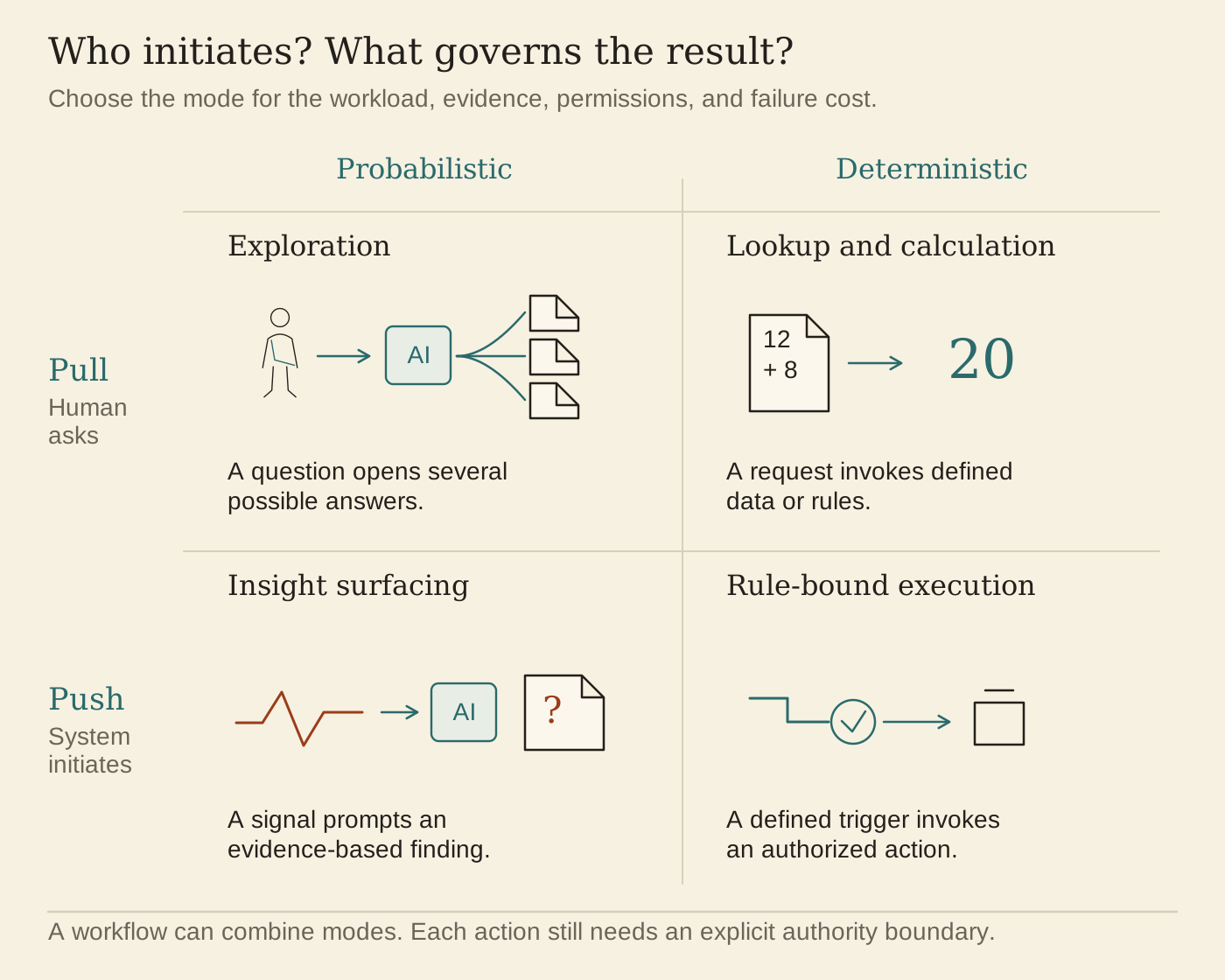
The first principle is hybrid determinism. Generative models are probabilistic systems, even though a particular configuration can make outputs more stable. Similar prompts and data can still produce different inferences as models, context, retrieval, or sampling changes. That variability is useful for exploration and unacceptable for work products that must be reproduced, audited, or reconciled exactly. The architecture therefore has to support both: probabilistic components for generative work and deterministic controls, calculations, rules, and records wherever repeatability is required. Which workloads sit where is an operational choice, and it shapes how the system can be governed.
The second principle is push versus pull. Pull is the chat-style interaction: the human asks, the AI answers. Push is the inverse: the system surfaces what the human did not know to ask. Insights arrive before they are requested. Risks are flagged before they become incidents. Recommendations appear before the decision moment. The push model requires more sophisticated infrastructure than the pull model because the system must decide what is worth surfacing, to whom, with what urgency, and with what evidence. A noisy push system is not intelligence. It is an alarm people learn to ignore.
The two principles combine into a four-quadrant matrix. Pull plus probabilistic produces exploration mode, the familiar chat use case. Push plus probabilistic produces insight surfacing. Pull plus deterministic produces trusted lookup and calculation. Push plus deterministic produces rule-bound automated execution. A mature AI-Native company may use all four, but not every company needs every quadrant and not every workload belongs in only one. The architectural question is which operating mode each decision or task requires.
What the Stack Buys: The Autonomy Ladder
All of that describes what the stack is and how it behaves. What it buys is a separate question, and the one a leadership team actually asks. The answer is altitude. There are five rungs of autonomy. A company using AI is operating on one or more of them, whether it has named them or not; a company not yet using AI stands below the first.
The first rung is inform. The AI retrieves and synthesizes, and a human does everything else. This is where the chat box lives, and the value is time saved.
The second is advise. The AI reasons about this specific situation and recommends with evidence attached, and a human decides and acts. The value is better decisions.
The third is act. The AI takes bounded actions through tools while a human oversees. The value is work executed rather than recommended.
The fourth is operate. The AI runs a closed loop and a human supervises by exception. The value is sustained autonomy at a frequency, speed, or scale that may be impractical to provide through headcount alone.
The fifth is embody, where AI drives machines that act on the physical world.
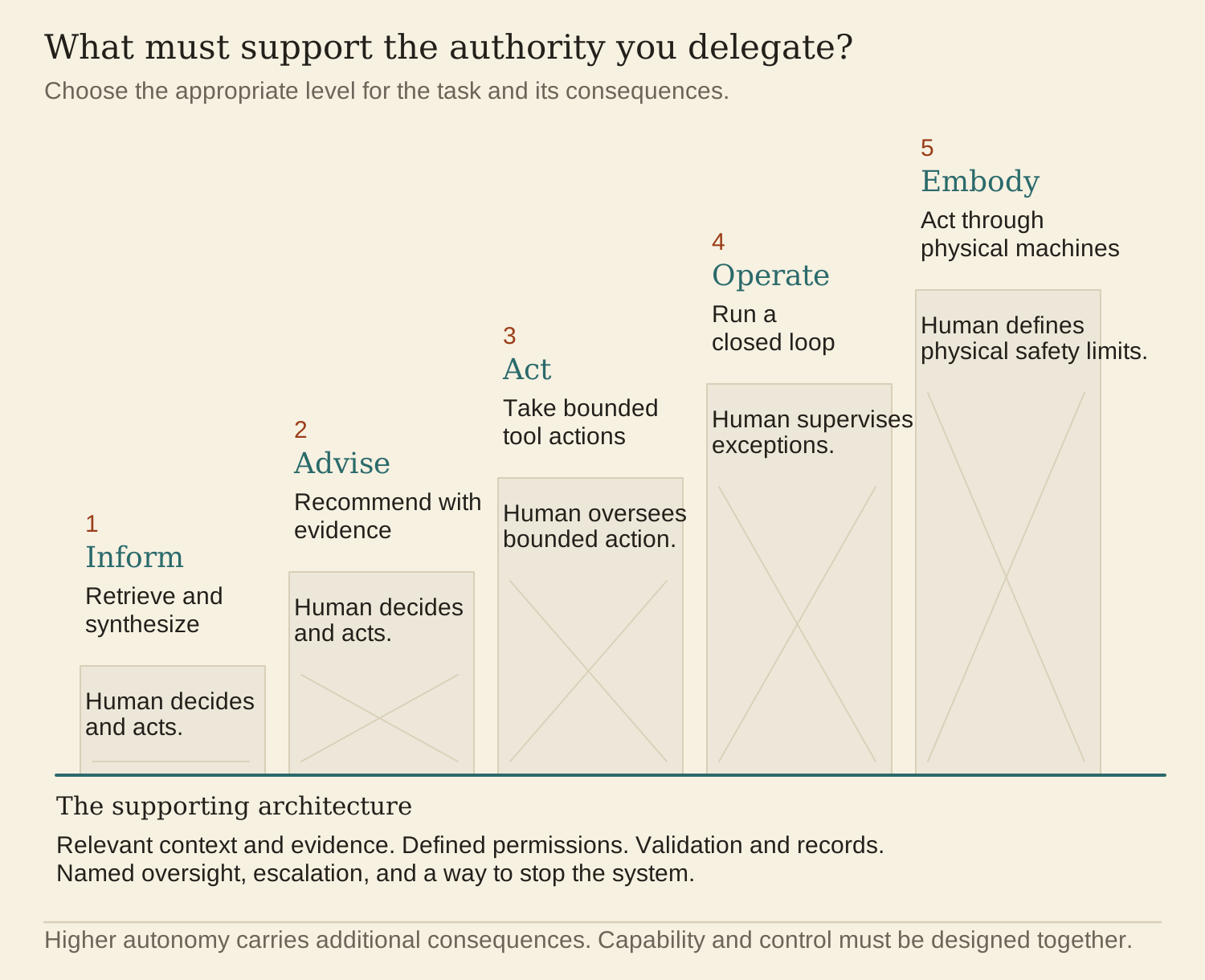
Two things can climb together as you go up, and only one of them is obvious. Potential value rises, which is why leadership teams want the higher rungs. The required substrate and the consequences of failure rise with it, which is why many organizations stall. Even a recommendation needs reliable context and a way to judge the evidence behind it. An action taken on your behalf adds tool permissions, validation, an audit trail, bounded authority, and a way to stop it.
That asymmetry produces the mistake I see most often. A leadership team tries to buy altitude. They read about agents operating autonomously, they want that, and they reach for it on top of a substrate that is one chat license wide. Autonomy is vertical. How well the system knows your business is horizontal. You can only climb as high as the substrate carries you, and moving up without widening it does not add capability. It raises the consequences of a confident wrong answer. You earn altitude by widening the substrate, and only by widening it.
This also explains a plateau many companies hit and cannot diagnose. The chat pilot goes well, the second one goes well, and then little compounds. The pilots were all on rung one, where the substrate requirement is lower and the durable advantage is usually limited. Every rung above it demands more of the layers that many budgets never reach.
The Strategic Implication
The altitude argument has a stack-side reading, and it is the practical one. Section 2.5 reads the same architecture a third way, as a progression over time. Every rung of autonomy corresponds to a depth of investment, so the question of how high a company can climb resolves into the question of how far up the layers it has actually built. Every company makes those architectural decisions about which layers to invest in, how they connect, and what to build versus buy. The decisions are usually made tactically, by procurement, vendor by vendor, with the leadership team approving budgets without engaging the architecture. They should be made strategically, by the leadership team, with the operating model in mind and the archetype choice from Section 2.2 as the orienting frame.
A company at Layer 1 only has raw chat access to foundation models and nothing more. Every employee has their own chat session. The work does not compound. Central governance and visibility are difficult because the organization cannot readily see what the AI is producing. Shadow AI risk is high.
A company at Layers 1 and 2 has added embedded AI in existing tools. Adoption is real and productivity gains are real, but the organization has not yet become AI-Native in any meaningful sense.
A company with meaningful capability across Layers 1 through 4 has a foundation for deeper transformation: foundation models, embedded AI, retrieval, and knowledge architecture that grounds systems in the company's actual context. A given use case may need only some of these grounding mechanisms. This is where AI-First can seriously begin.
A company at Layers 1 through 6 has agents and tools that can act in the world. This is the technical foundation for Intelligence-at-the-Center or Operating Layer archetypes.
A company with the relevant capabilities through Layer 8 working coherently has added a collaboration surface that can convert individual capability into team intelligence, plus evaluation and governance that help keep behavior within defined bounds over time. This is a technical foundation for sustainable AI-Native operations, and a foundation is all it is.
An operations-heavy company at Layers 1 through 9 has the same plus the specialized domain intelligence that creates real moats. This is the technical foundation for an AI-Native operating model in an industrial environment.
Not every company needs to invest at every layer. The point is that the choice of which layers to invest in, and in what sequence, is a strategic decision that flows from the archetype choice. Making this decision deliberately, with the leadership team engaged, is much better than letting it emerge by accident from procurement.
The next section gives a way to honestly assess where your company is in the AI-Native transition, regardless of which archetype or which layers you have chosen. That assessment is the maturity model.
Watch for this. The most common investment trap in AI-Native programs: over-investing in Layers 1 and 2 (chat tools and copilots) and under-investing in the knowledge, action, orchestration, collaboration, and evaluation layers that make individual use compound. The visible spend is at the interface. The durable capability is usually underneath it. If most of the AI budget buys seats while little funds shared knowledge, integration, evaluation, security, and operating-model change, the portfolio deserves a redesign.