What actually produces a financial return on AI?
The field is full of AI maturity models, and many of them are not useful for honest self-location. Some are too vague to be actionable. Some are too rigid to fit real companies. Some are designed to make the company commissioning the assessment look like it is doing better than it is. I am going to propose a five-stage model that is simple enough for a leadership team to stand in front of, opinionated enough to distinguish between stages, and honest about what real companies will and will not achieve.
The stages are developmental rather than a rigid implementation sequence. Each builds on capabilities established earlier, and apparent shortcuts usually leave a dependency unpaid. A company can deploy a later-stage technology before it has the governance, knowledge, or cultural foundation beneath it; that is not the same as having reached the later stage. Companies can also be unevenly developed: strong on the technical capabilities of Stage 3 while still operating culturally at Stage 1, for example. The model is most useful when a leadership team uses it to find where its own capabilities are uneven rather than to score itself at one number.
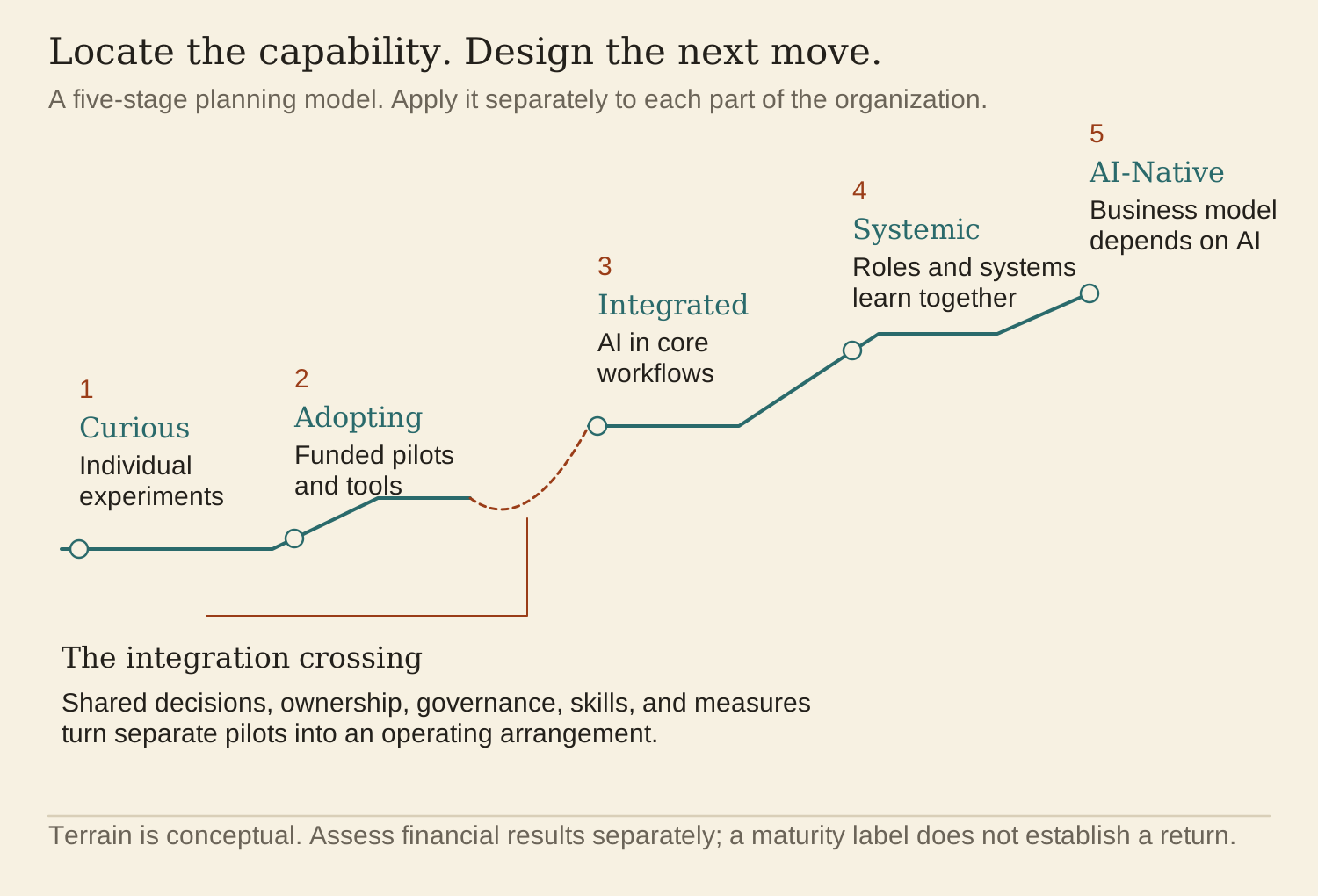
Stage 1. Curious
AI is a topic of conversation. Individual employees are experimenting with consumer-grade tools, mostly on their own time, mostly without organizational knowledge. There is no AI strategy. There is no shared vocabulary across the leadership team. There is no governance framework. There is no taxonomy of work indicating which tasks are good candidates for AI and which are not.
The symptoms of Stage 1 are familiar. Slack channels with prompt-sharing. "Has anyone tried this?" emails. Inconsistent answers when different executives are asked what the company's AI position is. Different teams using different tools, sometimes paid for through personal credit cards. Cost mostly invisible because the spend is decentralized. The talent that cares most about AI is quietly looking for jobs at companies that take it more seriously. The talent that fears AI most is anxious in ways the company has not yet acknowledged.
Most companies are at Stage 1 longer than they realize, because the experimentation activity creates a feeling of progress that masks the absence of strategy. Companies at Stage 1 should be honest about it, because moving forward requires acknowledging where you are.
Stage 2. Adopting
Pilots are underway. Tools are being deployed in pockets of the organization. Investment is real and growing. There is at least one named AI initiative with a budget and an owner.
This is also where most organizations get stuck. Stage 2 shows itself in disconnected pilots multiplying across business units, power struggles over who owns AI strategy, shadow AI projects competing with sanctioned ones, executive burnout from constant AI updates that do not aggregate into a coherent picture, rising costs with unclear returns, and competing definitions of "AI strategy" depending on which executive you ask.
The pilot-graveyard company from Section 1.2, whose numbers Section 8.2 fills in, is the textbook Stage 2 organization. The energy is real. The investment is real. The output is small because the alignment was never produced.
The MIT CISR research from Section 2.1 (Weill, Woerner, and Sebastian, 2024) is most clarifying at this stage. In its sample, companies at the second maturity stage had not yet converted their investment into the stronger financial performance associated with the next stages. Many organizations can stay stuck here for years: spending, piloting, and learning without producing a return commensurate with the effort. This is the chasm.
The researchers place the greatest financial impact at the move from their second maturity stage to their third, where performance crosses from below to above the industry average. The 2025 study, by Woerner, Sebastian, Weill, and Káganer, drew on a survey of 152 executives and examined that transition more closely. The result is an association. Crossing a line on a maturity model may or may not cause a return. Even so, the pattern matters. The earlier moves are setup. The later moves refine. The middle move is where the curve turns. This is the threshold the architecture has to be designed to cross.
Source. MIT CISR's four-stage Enterprise AI Maturity model, based on a 2022 survey of 721 companies and 2024 interviews with executives at nine enterprises. The five-stage model in this book builds on the MIT CISR four-stage framework. The financial-performance curve is theirs; the additional stage and the framing of the chasm are mine.
Weill, P., Woerner, S. L., and Sebastian, I. M. (2024). "Building Enterprise AI Maturity." MIT CISR Research Briefing, December 19, 2024. / Woerner, S. L., Sebastian, I. M., Weill, P., and Káganer, E. (2025). "Grow Enterprise AI Maturity for Bottom-Line Impact." MIT CISR Research Briefing, August 21, 2025.
Stage 3. Integrated
AI is operational in core workflows rather than only in pilots. A shared vocabulary across the leadership team is emerging, though it may not yet be fully consistent. Cross-functional ownership of AI is structured rather than improvised. Governance exists as actual practice embedded in execution rather than as a document. Decision rights are explicit for routine cases. Who decides what, when AI is involved, with what oversight. The workforce has begun real upskilling rather than communication about the importance of upskilling. Pilot-to-production conversion is rising.
This is the stage where the financial curve in the MIT CISR sample bends upward sharply. Integration does not guarantee a return, and maturity labels do not create one. But this is where scattered experiments can begin producing real, measurable, sustained financial results because the operating system around the technology finally exists. Companies that remain in perpetual pilot mode rarely capture the same compounding effect.
Moving from Stage 2 to Stage 3 is the hardest single step in the model, and it is where most leadership-team alignment work has to happen. This is an operating-model transition. The technology of Stage 2 and Stage 3 may look similar from the outside. The difference is that Stage 3 has shared decisions, shared accountability, shared metrics, and shared discipline behind the technology.
Stage 4. Systemic
AI is the substrate of work rather than a feature added to it. Knowledge architecture is intentional, with deliberate decisions about which systems are authoritative, who owns definitions, and how institutional knowledge is captured and curated for AI reasoning. Roles, decision rights, and metrics are designed around human-AI partnership rather than around pre-AI assumptions. New roles emerge: AI Agent Trainers, AI Agent Managers, Knowledge Stewards, whatever the organization calls them. These are real positions with real authority. Continuous learning loops are part of the design; the company learns from each AI deployment and the learning improves the next. Governance is embedded from the start.
A Stage 4 company can build sustained competitive advantage from its AI investment. Learning moats are forming. The data, the institutional knowledge, the prompt libraries, and the validated workflows improve with use. A competitor can buy the same vendor but not the accumulated context, judgment, and operating history. That does not make the lead permanent. It makes imitation slower and forces the competitor to do the institutional work rather than merely procure the technology.
For an ambitious incumbent, Stage 4 is a plausible destination, but the calendar depends on its starting point, regulatory environment, technical estate, and willingness to redesign work. Five to ten years is a rough planning horizon, offered without any promise attached. This is the realistic destination for many leadership teams that are serious about the work. It is also where durable advantage can live, because the capability is difficult enough to build that procurement alone cannot reproduce it.
Stage 5. AI-Native
The business model itself depends on AI capabilities that competitors cannot easily replicate. The economics of the company (how it creates, prices, and captures value) are shaped by AI rather than merely enhanced by it. In the right work, cycle times can fall dramatically and capacity can expand without moving in lockstep with headcount. New revenue pathways can open that did not exist in the pre-AI version of the business. These are design possibilities, and each one has to be designed in.
The workforce is designed around an explicit division of labor between people and AI. The org chart protects human authority where judgment, relational presence, ethical accountability, lived consequence, and original synthesis matter, while AI expands what those people can see and do. The boundary is designed and revisited rather than inferred from whatever the technology happens to automate first.
Stage 5 is rare in incumbents. The companies most credibly approaching it are either AI-first startups built within the last few years or established companies that have been investing in AI for a decade or more with sustained leadership commitment. For most incumbents, the realistic destination is deep Stage 4 with selected Stage 5 capabilities in the parts of the business where AI most enables a new business model.
The Diagnostic Move
A leadership team using this maturity model to do honest self-assessment should not score themselves at one number. The honest answer is almost always scattered.
A typical leadership team that takes this assessment seriously will discover something like the following pattern: Stage 3 on technology (the tools are deployed and integrated). Stage 2 on people and culture (the workforce is anxious and the upskilling is rhetorical). Stage 1 on knowledge architecture (no one has done the work of structuring the company's institutional knowledge into a form AI can reason over). Stage 3 on customer-facing AI (the product is doing well). Stage 1 on operational AI (the back office is unchanged). Stage 2 on governance (policies exist but enforcement is uneven).
The scatter is the diagnosis. A company that is at Stage 3 on average but Stage 1 on knowledge architecture has a foundation problem likely to undermine gains in other dimensions. A company that is at Stage 2 on average but Stage 4 on people and culture has a workforce that is more ready than the systems it is being asked to use. The leadership work is to look at the scatter and decide where to invest next based on which gap is most consequential rather than which score is most embarrassing.
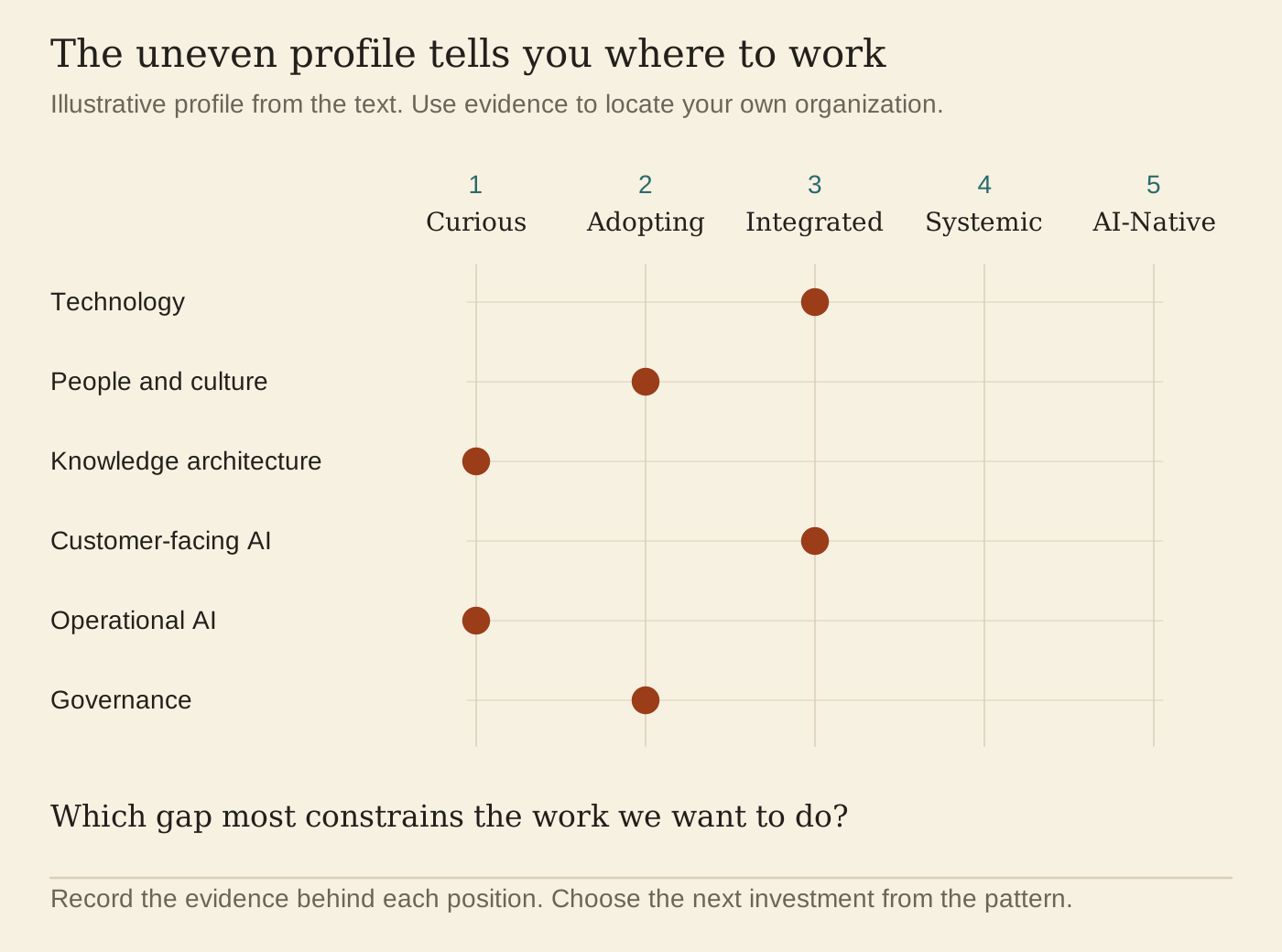
The maturity model becomes most useful when applied to each dimension of your company separately, in whatever cut fits your operation: technology, people, knowledge architecture, customer-facing AI, operational AI, governance. The single number is for press releases. The scatter is for actual planning.
A Word on Maturity Models Generally
Maturity models have a recurring failure mode. They become competitive scorecards rather than diagnostic instruments. A leadership team starts using the model to assess where they "should be" relative to peers, instead of where they are and where they need to invest next. The model stops being useful for self-improvement and becomes a status game.
This model is meant for honest self-location rather than benchmarking. There is no prize for being at Stage 4 when your business does not require it. There is no shame in being at Stage 2 if you are genuinely working to get to Stage 3. The point of the model is to give a leadership team a shared language for talking about where they are and what they need to do next. Reducing it to a score for the board deck throws that away.
I should say plainly that this model is newer than the rest of my practice, and AI is new enough that I have not yet run it with a room. I built it as a self-assessment. Used well, a leadership team should come out of it with three things: an honest read of where they sit on each dimension, a decision about which dimension is the highest-return place to invest next, and a clear view of what would have to be true to advance a level there. Then the real conversation, which is whether the level you are aiming at is the one you actually want. Everything else is decoration.
The dimensions themselves are what Stage 3 takes up. Before that, one more piece of vocabulary, because the maturity model and the stack both assume a reader who can tell an agent from a harness from an operating system, and those words are being used interchangeably in the market right now.
Consider. Locate your operations division on the five-stage curve. Now locate your corporate functions. Now locate your product group. Most companies are not at one stage everywhere. They have one part at Stage 3 and another at Stage 1. The honest map is a multi-stage portrait rather than a single point. The leadership question is whether the stages across the company are coherent with each other, or whether they are creating internal friction.