What are you actually buying when someone sells you AI?
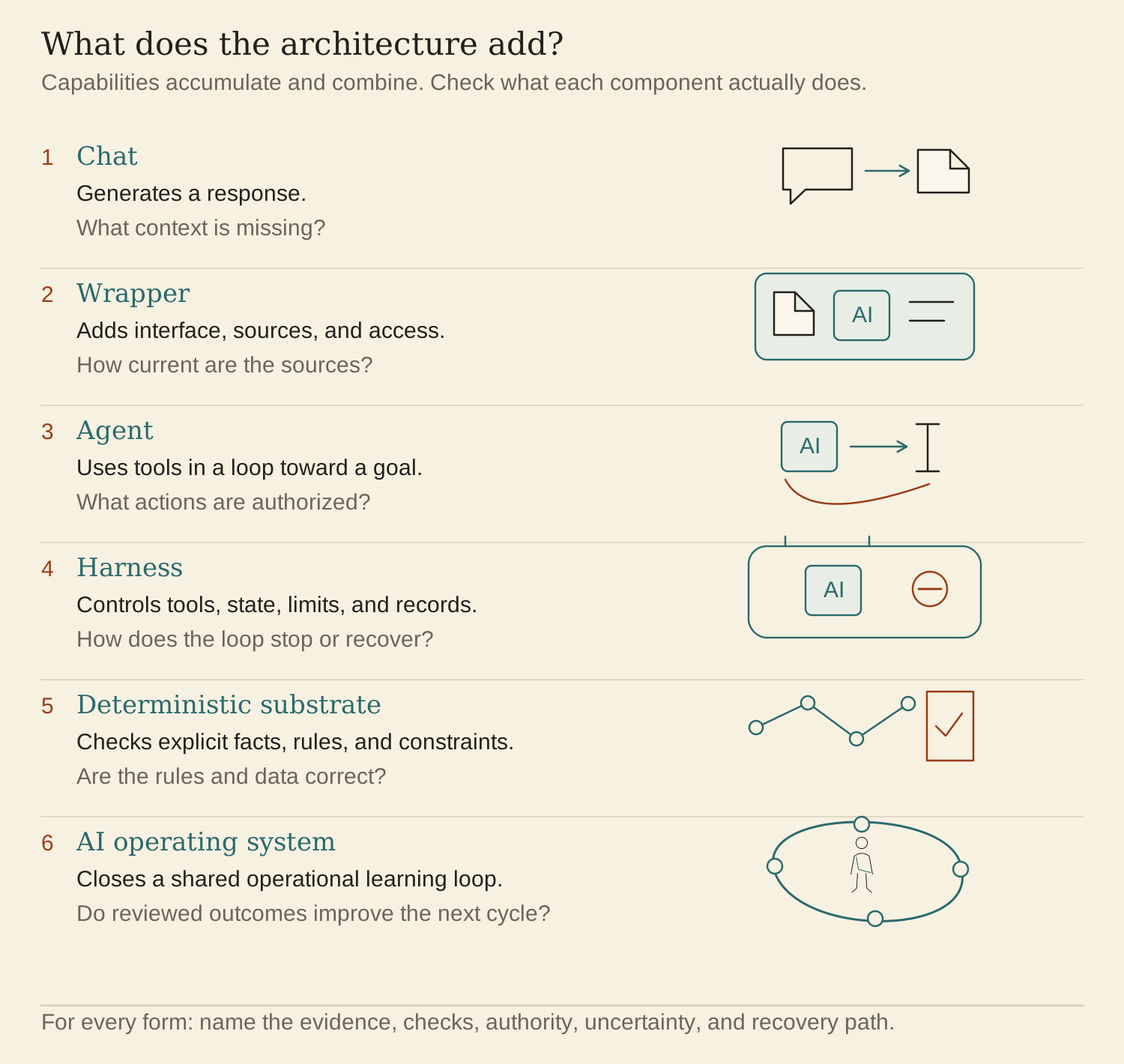
Every few months the thing being sold as AI changes shape. A leadership team that bought a chat license in one budget cycle is being pitched an agent platform in the next and an operating system in the one after, and the words arrive faster than the definitions. This section is the vocabulary. Six architectural forms, arranged in the order their capabilities generally accumulate, each one containing elements of the last.
The progression matters more than the labels. Each form responds to a ceiling in the one below it, and the ceiling is often the same shape: the system produced something plausible that nobody could adequately check. What follows is a history of trying to close that gap. The chronology is loose, because the ideas overlap and products combine them.
One. Chat
A person types a question and a model answers it. In its bare form, the model brings broad training and little or no knowledge of you. It can sound as though it knows everything in general while knowing nothing authoritative about your particular situation, which is why the answers can feel impressive and still land shallow. A chat product may retain conversation history or user memory, but that is not the same as building shared institutional knowledge. Every colleague can still end up with a different private context, and little accumulates anywhere the company can govern or reuse.
The ceiling: without retrieval or tools, the model cannot look up the current facts that matter, so it predicts what a good answer would sound like from the context and patterns it has. That is a useful way to draft an email and a poor basis for a consequential decision. Value here is time saved by individuals, which is real but compounds only if the organization captures and improves what people learn.
Two. The Wrapper
Put an interface around the model, point it at some company documents, and give it a name. Much of what has been sold as enterprise AI begins here. The wrapper can add retrieval, citations, access controls, workflow context, and a place for the conversation to live. The model remains the generative core, but the surrounding software can carry meaningful product value. Take the model out and the intelligence disappears; take the wrapper out and the model loses the organizational context and controls that make it usable.
The ceiling: retrieval grounds the answer in a document, and a document is a description of the work written by someone, for someone, at a moment. It is not the work. Ask a wrapper what happens if a supplier misses a delivery and it will find you the paragraph in the contingency policy. It cannot trace what actually depends on that delivery, because nothing in the architecture knows.
Three. The Agent
Give the model tools, state, and a control loop and it can move from answering toward doing. Depending on the design, it may take a goal, choose or follow steps, call tools, inspect results, and either finish, retry, or ask for help. This is a real change in kind. The system moved from advising to acting, and the consequences of a wrong action are different from the consequences of wrong advice.
The ceiling: an agent places a probabilistic component inside a system that can act. It will sometimes choose the wrong action, misread a result, or pursue a flawed plan, and longer chains create more opportunities for error even when checks catch some of them. Confidence is not a reliable measure of correctness. Agents alone do not solve the trust problem; they raise the stakes of not having solved it.
Four. The Harness
The harness is the software wrapped around the model that turns capability into work. It hands the model its tools, decides what context the model sees, runs the loop, and enforces limits on every step. Most of what people credit to the model is actually the harness. The same model inside a good harness and a poor one produces work of visibly different quality, which is why teams comparing models often discover they were comparing scaffolding.
This is where the field spent most of its energy, and the payoff was real. A harness gives you retries, memory, tool permissions, a place to log what happened, and a way to stop a runaway loop. It is also the point at which the strategic picture inverts. The model is rented, swappable, and improving on someone else's schedule. The harness is yours.
The ceiling, and this is the one worth understanding: a generic harness governs how the system works without necessarily holding an authoritative model of what it is working on. It can enforce permissions, schemas, budgets, and tool-call rules. It can run tests or evaluators when the domain supplies them. What it cannot infer from orchestration alone is whether a substantively plausible answer is true. Process checks matter, but the failures that matter most in an operating business are often failures of substance.
Five. The Deterministic Substrate
So the next move is to give the system a source of truth for checking its answers. A substrate is an explicit model of the thing being operated on: what exists, how it connects, what depends on what, and what is not possible. In an industrial setting that is a graph of the plant plus the physics that constrains it. In a services firm it is the structure of clients, engagements, obligations, and dependencies. In either case it is a live representation of the actual operation rather than a pile of documents about it.
What the substrate makes possible is substantive checking. Not only checking that the model followed a procedure, which a harness can enforce, but checking a claim or proposed action against an authoritative constraint. A proposal that violates a dependency, a conservation law, an approval rule, or a contractual obligation can be rejected before it reaches a person, and rejected for a reason the person can read. The check is only as trustworthy as the rule and underlying data, but it is qualitatively different from asking another model whether the first model sounds right.
This is what deterministic assurance means in practice, and it is worth being precise, because the word gets used loosely. Nobody has made the model deterministic. The model still generates probabilistically, and not every business judgment can be reduced to a rule. The architecture instead gives deterministic components authority at boundaries where explicit constraints exist: the model proposes; validated rules decide what is permitted. Probabilistic proposal, deterministic constraint. Inside a tested control boundary, that arrangement can enforce specified rules consistently. Correctness still depends on the rules being right. That is a material difference between an interesting demonstration and something you would let near an operation that can hurt someone.
It also attacks three related problems from a common direction. Variance, hallucination, and drift have different causes, so no substrate eliminates all three. But each becomes easier to detect and contain when outputs are checked against authoritative state and explicit constraints. More guardrails are not automatically better; the useful guardrail is one tied to a real property of the work.
The ceiling: a substrate can make individual claims and actions more checkable. It does not make every answer trustworthy, and it does not make an organization run on them. A company can have an excellent graph and still have thirty people asking it thirty private questions whose answers never meet.
Six. The AI Operating System
The last stage is the one with the least agreement about what it means, so here is what I mean. An operating system is what you have when sensing, structure, reasoning, action, and assurance are wired into a loop that closes and keeps closing. Work comes in, gets placed against the model of the business, gets reasoned over, produces an action or a recommendation, gets validated, gets recorded, and the record improves the next pass. Any one of those parts on its own is a feature. The loop is the operating system.
Three things distinguish it from everything below. It is proactive rather than waiting to be asked, because a system that holds a live model of the operation can notice things nobody queried. It is shared rather than private, because the loop runs where the team can see it. And it can accumulate: when outcomes are reviewed, records are curated, and corrections are carried forward, each closed cycle can improve the next pass.
This is also the point where the thing stops being a tool the company uses and becomes part of how the company runs, which is why the rest of this book is about the operating model rather than the technology. Stage 3 takes up what that means for the work itself.
Reading the Progression
Two warnings about using this list. The first is that capabilities tend to accumulate, but the forms are not a mandatory product ladder. An operating system still calls models and needs orchestration and assurance, but it may not expose every earlier form as a separate component. A product can combine several levels at once. A company that tries to buy form six without the necessary grounding, assurance, and orchestration capabilities beneath it has bought a diagram.
The second is that this progression gives you a useful vendor question: Where does your product actually sit, and what does it use to check an answer? A wrapper may answer with its model and retrieval sources. A harness may answer with orchestration features, evaluators, and tool controls. A serious answer to the second question names the authoritative data, rules, tests, or domain constraints used to check substance, independent of any model asked to grade the first.
Many companies are somewhere between two and four and describing themselves as six. The exact distribution is not measured here; the category inflation is visible in the market. The gap between those two positions is not merely a marketing problem. It is the work.
Consider. If you keep three things from Stage 2: 1) There are AI-Native companies, plural, and choosing your archetype deliberately is among the most consequential decisions you will make. 2) The chat box is one of nine layers, and the durable capability lives in the middle layers many budgets never reach. 3) The strongest financial-performance shift in the MIT CISR research appears in the move from Stage 2 to Stage 3; honest self-location, dimension by dimension, is what helps an organization cross the chasm.