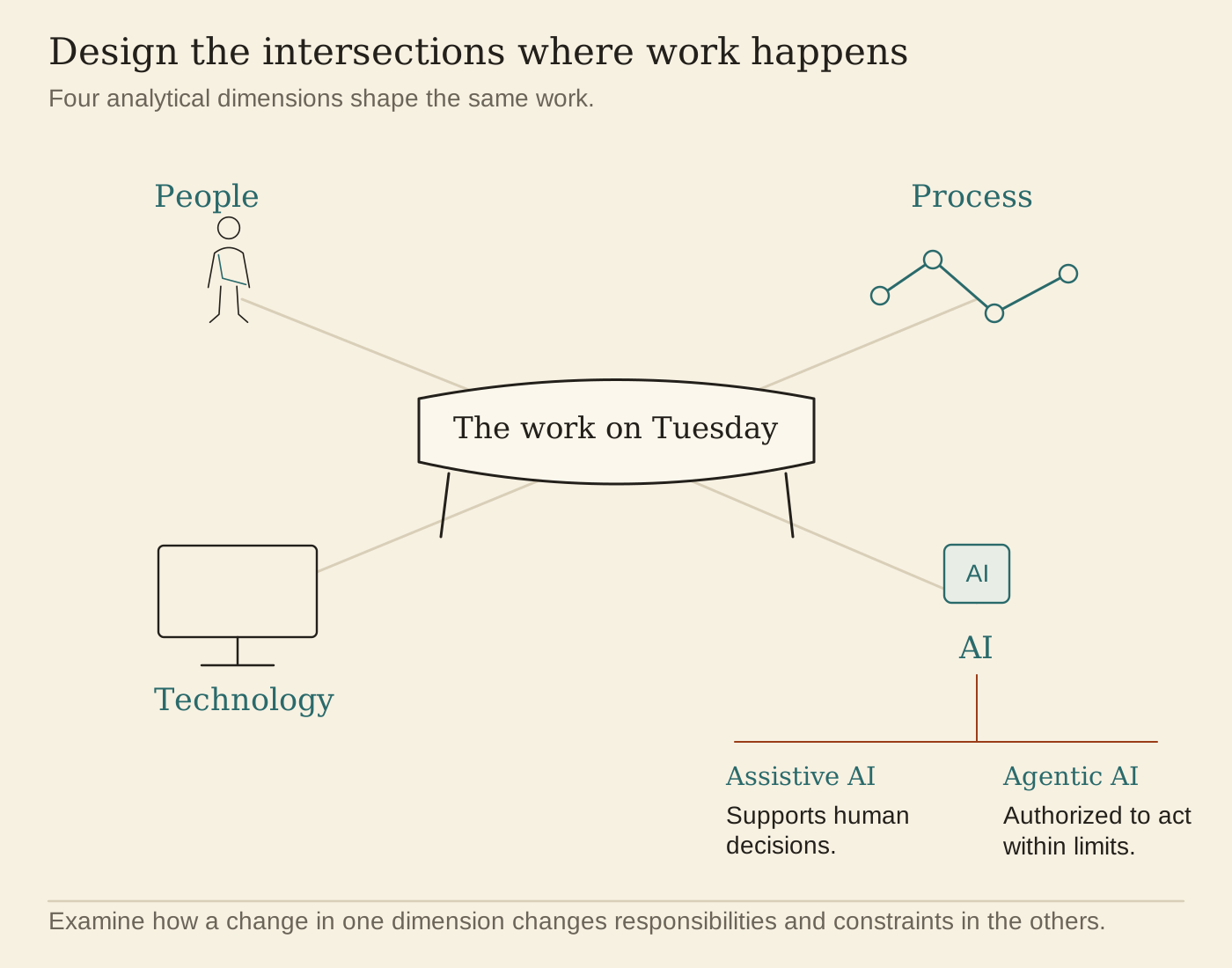
What changes when AI becomes a dimension of the operating model?
For decades, a dominant frame for analyzing how a company actually works has been People, Process, Technology. The trio shows up throughout consulting and operating-model redesign. It endures because it captures something true. How a company functions is the joint product of the people in it, the processes they follow, and the technology they use. Move one without accounting for the other two, and the change is unlikely to stick.
That trio is now insufficient for the design problem this book addresses. AI is still technology, but treating it only as another tool hides its distinct role in the work. People work with it, on it, around it, and against it. Processes are rewritten by it, rewritten around it, sometimes partly replaced by it. Technology itself becomes harder to define because the line between tool and participant is no longer clean. AI cuts across the existing trio in ways that make it useful to analyze as its own dimension.
So the working frame is People, Process, Technology, and AI. Four dimensions. Each one has its own logic. Each one interacts with the others. The intersections are where the actual work of an AI-Native operating system gets designed.
Intellectual lineage. The four-dimensional structure has a direct ancestor. Harold Leavitt, at Carnegie Institute of Technology and later Stanford, described industrial organizations in 1965 through four interdependent sets of variables: Task, People, Structure, and Technology. Change one, he argued, and compensatory or retaliatory changes usually follow in the others. The later People, Process, Technology trio is often traced to this lineage, with Process absorbing much of Task and Structure, although its exact path into management practice is less tidy than the familiar origin story suggests. My separation of AI as a fourth analytical dimension is an extension of that systems logic. Intelligence has become an architectural component of the work, and changing it changes the rest.
Leavitt, H. J. (1965). "Applied Organizational Change in Industry: Structural, Technological and Humanistic Approaches." In J. G. March (Ed.), Handbook of Organizations (pp. 1144-1170). Rand McNally.
The standard term in this field is "operating model." We use "operating system" instead, for the following reasons.
The operating model is the strategic frame. It describes how a company creates value, who its customers are, how it organizes to deliver, what it measures. The operating model is necessary and the leadership team needs to be aligned on it. It is also too high-altitude to do the work the chapters ahead require.
The operating system is the practice-level frame. It describes how a specific process actually works, who does what, what tools are used, how decisions get made, what good output looks like, where the failure modes are. The operating system is where the texture of work lives. It is where AI either gets integrated into the work or fails to integrate. It is where the question "what does our company actually look like on a Tuesday afternoon" gets answered.
What I mean by altitude is simple enough. An operating model is the framework for understanding the parts of the business and how they fit together, and it sits high on purpose. To transform how a company runs, you have to define the operating model at a far more granular level: how you actually operate today, and how you intend to operate once AI is part of it. That granular level is what I am calling the operating system.
And the proposal in the title is deliberate. An operating model normally encompasses strategy, structure, people, process, and technology. I am separating AI analytically from the technology box because systems that generate, recommend, and act create design questions that ordinary tools do not. This is a design choice. AI is still technology. That is the argument this stage has to earn, and the rest of it is about how you would actually design AI into the operating model rather than bolt it alongside.
Both frames matter. The operating model tells you why your company exists and how it intends to compete. The operating system tells you how it actually runs. AI-Native transformations that work at only the operating model level produce strategies that do not translate to execution. AI-Native transformations that work at only the operating system level produce tactical improvements that do not aggregate into strategic advantage. The leadership work is both.
Everything that follows in Stage 3 works at the operating system level. It inventories the processes that make up that system and treats several of them in depth. The destination is concrete enough that a leadership team can take a process they recognize, hold it up against the AI-Native form, and decide what to do about it.
The figure below draws one distinction the four-part frame compresses. At the strategic level, AI is one dimension. At the practice level, the diagram splits it into assistive AI and agentic AI: systems that advise and systems authorized to act. They share some design questions, but they are staffed differently, governed differently, and fail differently. This is not a fifth independent category layered onto the argument. It is a closer view of the fourth.