What does the work of a company look like when AI participates in it?
The operating system of a company is the catalog of processes that actually produce the work. The catalog is usually longer than the leadership team realizes. The catalog is not written down anywhere central. People in the company know how their own piece works and have a vague sense of how the adjacent pieces work, but no one holds the whole picture.
This is one of the quiet costs of the pre-AI era. Companies could function without an explicit operating system inventory because the institutional knowledge to operate each process lived in the heads of experienced people, and the cross-process coordination happened through meetings, relationships, and informal escalation. The system worked despite never being mapped.
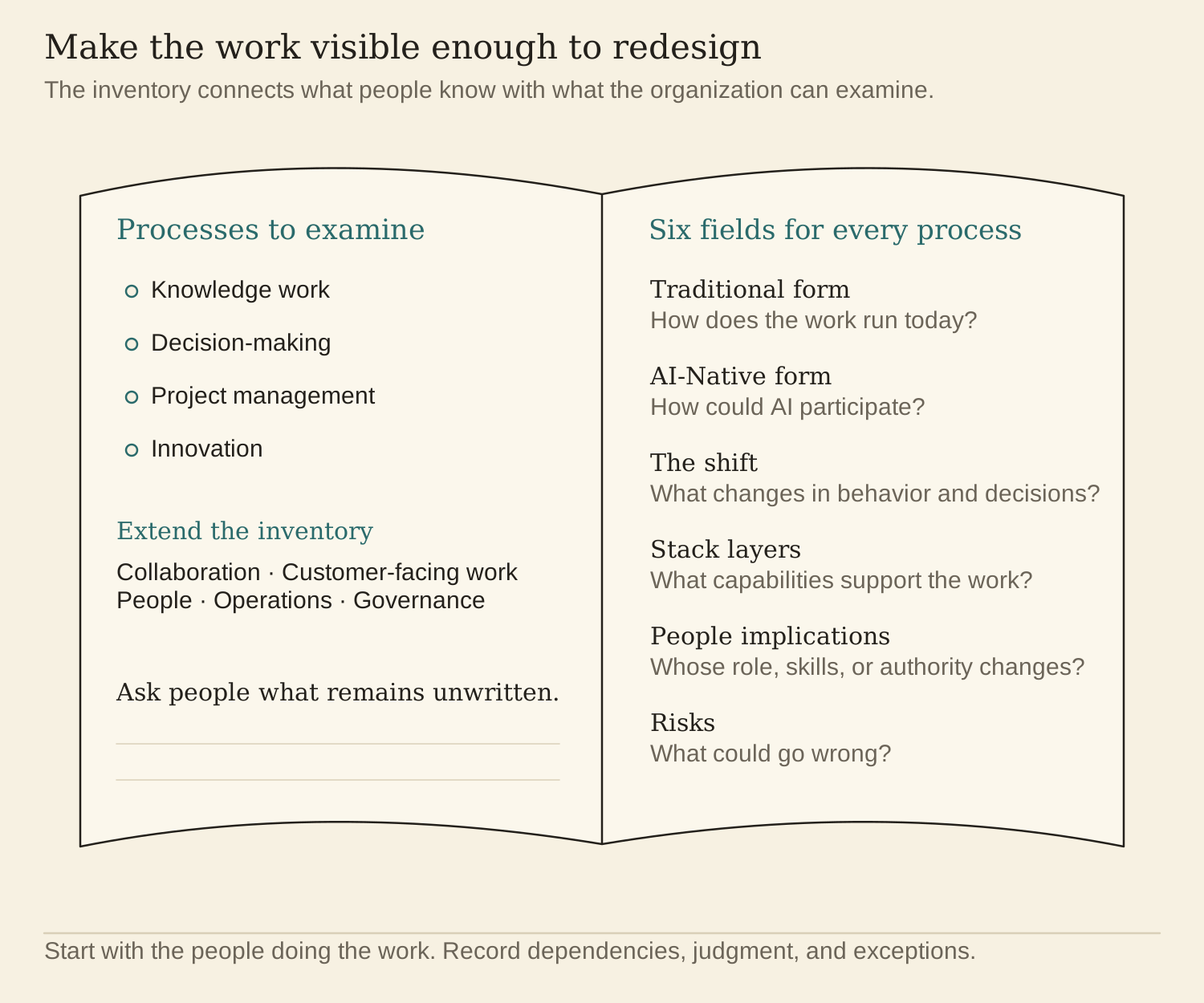
AI changes the economics of this. An AI-Native company cannot be built reliably on top of an operating system that remains largely unmapped. AI can infer from examples and work with context supplied in the moment, but it cannot consistently apply institutional knowledge it cannot access. Processes that depend on unwritten judgment are therefore difficult to automate safely and difficult to improve systematically. So an early piece of the AI-Native transition, and one of the most undervalued, is making the operating system inventory explicit enough for people and systems to use.
Four processes are treated at depth here. Each uses the same six-field template.
First, the traditional form. How the process worked in the pre-AI operating system. This is an honest description of the process as competent companies have run it for decades.
Second, the AI-Native form. How the process works when AI is a designed participant in it rather than a feature attached to its surface. This is the destination, and the current state does not always match it.
Third, the shift. What specifically changes between the two forms: less the technology delta than the behavior delta, the decision delta, the role delta.
Fourth, the stack layers engaged. Which layers from the AI Stack are involved in the AI-Native form. This makes the connection between architecture and practice explicit.
Fifth, the people implications. What changes for the humans doing this work. Who does it now, who used to do it, what gets harder, what gets easier, what new skills are needed.
Sixth, the risks. What can go wrong in the AI-Native form: the risks of adopting AI and getting it wrong, rather than the risks of failing to adopt it, which is a different conversation.
Knowledge Work
Traditional form. An analyst is asked on a Tuesday morning for a competitive assessment of a market the company is thinking about entering. She blocks the afternoon, opens a blank document, and starts pulling: old board decks, industry reports, a call with a colleague who worked that market two jobs ago. By Thursday she has a draft. It goes to her manager, comes back with comments, and ships the following week. Blank page to delivered output takes eight working days, and how good it is rests on what she knows and how hard she pushes.
AI-Native form. The same assessment now starts with an hour of writing down what the AI cannot know: why the company wants this market, what the board balked at last time, which competitor actually worries the CEO. A structured draft comes back before lunch, and she spends the afternoon checking its claims, cutting what is generic, and adding what only she knows. What goes out Thursday morning is a synthesis of what the AI produced and what she brought. Section 3.3 draws the full cycle: prompt, level-set, validate, build, integrate. The unit of work has changed.
The shift. For suitable work, the cycle can be faster, sometimes dramatically so. The work is also different in kind. The mix of skills that makes a knowledge worker valuable is changing. The ability to produce a competent first draft is becoming less scarce. The ability to frame the right question, evaluate output critically, and synthesize across sources becomes more important. The shift runs from one kind of human work toward another, with AI doing a substantial share of tasks that used to be performed only by people.
Stack layers engaged. Layer 1, foundation models. Layer 2, embedded intelligence in existing tools. Layer 3, RAG against the organization's knowledge base. Layer 7, the collaboration surface where AI work is shared and reviewed by the team. Layer 8, governance, especially around sourcing and attribution.
People implications. The knowledge worker's effective scope can expand. A senior analyst may be able to do work that previously required a team, depending on the work, the evidence required, and the surrounding system. The implication is that the team shrinks, the work expands, the standard rises, or some combination of the three. Cost pressure makes the first option tempting and visible. The strategic argument for the second and third is that capacity expansion or quality improvement can create differentiation. Team reduction alone rarely does, because the same cost lever is available to competitors.
There is a second people implication, and it lands on juniors. Work that taught them the trade, the first drafts, the basic research, the routine syntheses, is exactly what AI now does. How the next generation of senior knowledge workers gets trained is a real and unresolved question. Companies that figure this out will have an advantage. Companies that do not will discover, in five to ten years, that they have senior people retiring and no one to replace them.
Risks. The first risk is cognitive offloading. Knowledge workers who use AI as a thinking partner can preserve and extend their judgment. Those who routinely substitute its output for their own effort risk weakening skills they no longer practice. The effect depends on the task and the way the tool is used; the slow feedback is what makes the risk easy to miss. Section 5.4 treats this fully.
The second risk is homogeneity. When people use similar models with similar instructions and accept their defaults, output can converge in structure, language, and assumptions. Companies seeking advantage will need their people to use AI in ways that produce more distinctive work. This requires deliberate context, judgment, and effort.
The third risk is governance erosion. Without shared workspaces and shared review, the AI-mediated work of the company becomes invisible to the company. No one knows what prompts are being used, what sources are being consulted, what the AI is being asked to produce on behalf of the company. This is the shadow AI problem and it is the natural outcome of Citizen-AI without the collaboration surface.
Decision-Making
Traditional form. A decision is needed. Relevant data is gathered. Options are formulated. Stakeholders weigh in. A decision is made, often by a human in authority. Someone communicates it and the organization executes. How good that decision is depends on the information available, the rigor of the analysis, and the judgment of whoever made it.
AI-Native form. The decision-making process incorporates AI participation at multiple stages and with varying degrees of authority. AI may surface that a decision is needed by noticing a pattern a human had not yet seen. It may gather and structure relevant data faster than a human team could, formulate additional options, or model possible consequences using authorized company data and explicit relationships in a knowledge graph or other decision system. The human still makes the decision in most consequential cases. That person may make a different decision than they would have made without AI because the inputs are broader, faster, or more structured, but those inputs are better only if their data and reasoning survive validation.
For some classes of decisions, an AI-enabled system can execute autonomously within bounds people have set. The bounds should be explicit, the decisions reviewable, and escalation paths real. Human and organizational accountability does not disappear merely because software performed the action; its exact allocation depends on the decision, the law, and the governance design.
The shift. The most important shift is the explicit recognition that decision rights are now a designed thing rather than an inherited thing. In the pre-AI operating system, decision rights were often implicit, embedded in role descriptions, organizational hierarchy, and culture. In the AI-Native operating system, decision rights have to be explicit because AI is a participant in the process. The question of what AI decides versus what humans decide has to be answered by design.
The second shift is that some decisions can be made faster without sacrificing quality, and some can improve on both dimensions. That possibility changes the frontier; it does not abolish the trade-off. Weak data, poor framing, or inadequate review can still make a fast decision worse.
Stack layers engaged. Most layers are involved here. Layer 4, knowledge graphs, for the institutional knowledge that informs decisions. Layer 5, tools and actions, for AI to gather and structure data. Layer 6, agents, for the structured workflows that prepare decisions. Layer 8, governance, for the audit trails and decision-rights enforcement that make the system trustworthy. Layer 9 in operations-heavy environments, for the domain-specific intelligence that makes operational decisions trustworthy.
People implications. Decision-making roles change. Middle managers whose work is dominated by coordinating information flow and making repeatable, moderately complex decisions face particular exposure because AI can absorb a meaningful share of those tasks. Senior roles are exposed too, though strategic, ambiguous, and relationally complex decisions remain harder to delegate. Leaders may be better informed than before when the system is well grounded and critically used. The middle is one place where task displacement is likely to be felt first; whether that removes roles or redesigns them is a management choice as well as a technical outcome.
The skill that becomes more valuable is the ability to frame a decision well, to ask the right question, to know when to override the AI's recommendation and when to follow it. These are higher-altitude skills than the routine analytic skills that used to fill the middle of the org chart.
Risks. The first risk is automation bias: people may over-rely on an automated recommendation or fail to contradict it, especially when the output is polished and the underlying basis is opaque. A model's verbal confidence is not evidence of correctness. The discipline of questioning the recommendation, holding alternative hypotheses, and exercising independent judgment is harder than it sounds and can erode without deliberate practice.
The second risk is decision opacity. If the AI's recommendation is followed, but no one understands why the AI recommended what it did, the company has made a decision it cannot defend, learn from, or revise. The Layer 8 governance disciplines are what make AI-informed decisions auditable. Without them, the company is making decisions in a way that cannot be sustained.
The third risk is the slow erosion of decision-making capability in the workforce. If AI handles all the routine decisions and humans only see the hard ones, the humans never build the judgment that comes from making many decisions. This is the same problem as the junior knowledge worker problem in a different context.
Project Management
Traditional form. A project is defined. A project manager is assigned. The project manager plans the work, coordinates the people doing it, tracks progress, surfaces risks, manages stakeholder communication, resolves blockers, and reports up. Project management tools support the work. The project manager is a human in the loop on every dimension of how the project actually runs.
AI-Native form. AI is a participant in the project from the planning stage forward. It can help decompose work into tasks, maintain the project plan as a living artifact when reliable signals are available, track explicit dependencies, surface possible blockers, draft stakeholder communications, prepare meeting summaries, and identify risks the humans had not named. The project manager is still present but is doing different work. The administrative load can drop. The judgment load becomes more visible.
The shift. Project management can become less about administration and more about leadership. Plan maintenance, status updates, and routine communication are increasingly automatable, although each still requires ownership and quality control. Deciding what to do when the plan breaks, handling stakeholder politics, and making human calls about pace and priority remain judgment work and can occupy more of the role as the administrative burden falls.
Stack layers engaged. Layer 2, embedded intelligence in project tools. Layer 3, RAG against project artifacts and historical project data. Layer 5, tools and actions, for AI to update plans and prepare communications. Layer 6, agents, for the structured workflows that maintain the project. Layer 7, the collaboration surface where the project lives.
People implications. Junior project managers are exposed because administrative coordination, status reporting, and basic plan maintenance are among the tasks AI-enabled tools can increasingly support. Senior project managers are exposed differently, but much of their value lies in judgment and leadership, where current systems remain less reliable. If automation actually removes administrative burden rather than adding another layer to supervise, they can spend more time there.
The career path question is the same one knowledge work faces: the work that trained junior project managers is the work AI now does, and the developmental path has to be redesigned.
Risks. The first risk is the loss of relational context. A human project manager who has been close to the work knows things that do not show up in any project artifact. They know who is on the verge of burnout, which stakeholder is quietly resistant, which dependency is shakier than it looks on paper. AI does not have this knowledge by default. If the project manager's role thins too much, this context gets lost, and the project starts running on artifacts that miss what is actually happening.
The second risk is over-automation of communication. AI-drafted stakeholder updates can be competent and still be generic. The relational work of project management, the moments when a real human reaches out at the right time in the right way, is difficult to automate because its meaning depends on trust and context. A project run primarily through auto-generated updates risks losing signals that deliberate human communication would catch.
The third risk is plan brittleness. A plan maintained by AI looks more complete than a plan maintained by humans because AI is good at filling in detail. The completeness can be deceptive. A plan that is detailed and current but built on wrong assumptions is more dangerous than a plan that is sparse but built on right assumptions.
Innovation
Traditional form. Innovation in most companies is structured as some form of separated process. Innovation labs, R&D departments, dedicated time, hackathons, ideation sessions, design sprints. The premise is that the day-to-day work and the innovation work are different things and have to be separated, because the day-to-day work crowds out the innovation work otherwise.
AI-Native form. Innovation becomes less separable from the day-to-day work. AI can lower the cost of exploring ideas, prototyping concepts, and testing approaches enough for more of these activities to happen inside ordinary work. For some digital problems, a team can produce a useful prototype in hours rather than weeks. A leader can explore an initial hypothesis in minutes rather than waiting days for a first analysis. The cost of trying can fall enough that experimentation becomes a normal part of work rather than a special event.
Dedicated innovation processes keep their value. Their character changes. Innovation processes in an AI-Native company are less about generating ideas, which now happens everywhere. They are more about evaluating ideas, scaling promising ones, and protecting time and attention for the kinds of innovation that need sustained focus.
The shift. The shift is from innovation as event toward innovation as continuous practice. Many companies have not redesigned their innovation processes for this, so AI-enabled experimentation across the workforce remains uncaptured, uncoordinated, and largely invisible to leadership. Companies that get this right can build a much larger and more legible innovation pipeline than companies that do not, even when their nominal investment is similar. The size of that advantage must be measured rather than assumed.
There is also an honest limit to name. Current generative AI is especially useful for recombining existing knowledge, exploring within a frame, and accelerating well-defined parts of innovation. Whether a model can contribute to a genuine breakthrough is harder to separate from the people, tools, data, and selection process around it. The combinatorial strength is real. So is the risk of mistaking fluent recombination for original insight. A company should use AI to broaden exploration while protecting the human attention, experimentation, and dissent from which first-principles advances often emerge.
Stack layers engaged. Variable, depending on the kind of innovation work. Layer 4, knowledge graphs, becomes especially important for innovation in operations-heavy environments where understanding how the existing system works is foundational to changing it. Layer 6, agents, for sustained explorations of solution spaces. Layer 7, the collaboration surface, for innovation work to be visible and shareable across the company.
People implications. The innovation lab, the dedicated R&D team, the chief innovation officer, all remain, and their function changes. They become less about being the place where innovation happens and more about being the place that supports innovation happening everywhere. Their work is to provide infrastructure, governance, evaluation criteria, and the protected space for the kinds of innovation that the distributed model does not produce.
For the rest of the workforce, the implication is that innovation becomes part of the job description, in a way it usually was not. The skill of seeing a problem and immediately exploring whether there is a better way becomes a default behavior rather than a special skill.
Risks. The first risk is innovation fragmentation. A thousand small experiments running in parallel produce a lot of motion but not necessarily a lot of result. Without curation, evaluation, and the discipline of choosing which experiments to scale, the company produces a graveyard of half-finished prototypes.
The second risk is that the combinatorial strength of AI is mistaken for sufficient creativity. Companies that rely on model output as the whole innovation process risk producing work that is technically novel but conceptually unsurprising. Human first-principles thinking, empirical testing, and informed dissent are counterweights, and they require deliberate effort to maintain.
The third risk is innovation theater, where AI enables a lot of activity that looks like innovation but does not translate into changed products, services, or business outcomes. This is the same risk as the pilot graveyard in Section 1.2, at a finer-grained level.
The Others, in Brief
The full operating system inventory is longer than these four processes.
Collaboration processes. How humans and AI work together inside teams, how AI is present in meetings, how artifacts are produced and reviewed, how feedback flows.
Customer-facing processes. How AI participates in customer interactions, where humans remain in the loop, how the brand voice is held across AI-mediated touchpoints.
People processes. How AI participates in hiring, performance management, development, succession planning, compensation. These processes are particularly sensitive because the human stakes are highest, and the failure modes when AI gets these wrong are severe.
Operations processes. How AI participates in the ongoing running of the business, the supply chain, the production lines, the service delivery, the operational decisions that happen every day. This is the domain where the Operating Layer archetype lives most fully.
Governance processes. How the AI itself is governed. The evaluation, monitoring, drift detection, hallucination management, decision rights enforcement, audit trail discipline. Layer 8 of the stack from the operating side.
Each of these deserves the same six-field treatment. The work of building the full inventory is one of the deliverables of a serious AI-Native operating model engagement. The four treated here are the most universally applicable across companies.
The next section deepens the treatment of one of the four. The new knowledge work loop is the deepest single shift in how work gets done. It benefits from being drawn explicitly: each step named, each role specified, each risk identified. That is Section 3.3.