How does knowledge work change when AI is in the room?
Section 3.2 sketched the traditional form of knowledge work in outline: an assignment, a blank page, a draft, iteration, review, delivery. The new loop is best understood against it.
The basic loop survived the arrival of word processing, search, and collaboration software. Those tools changed speed, access, and coordination, but the knowledge worker remained the primary engine of the draft. Everything else was support.
The AI-Native loop is different in kind because the tool now produces substantive candidate work. The shape of the cycle changes, the human role at each step changes, and the failure modes change with it. I want to draw the new loop explicitly. Many organizations are already operating inside some version of it without having named the change, and their practices vary as a result.
The new loop has five steps.
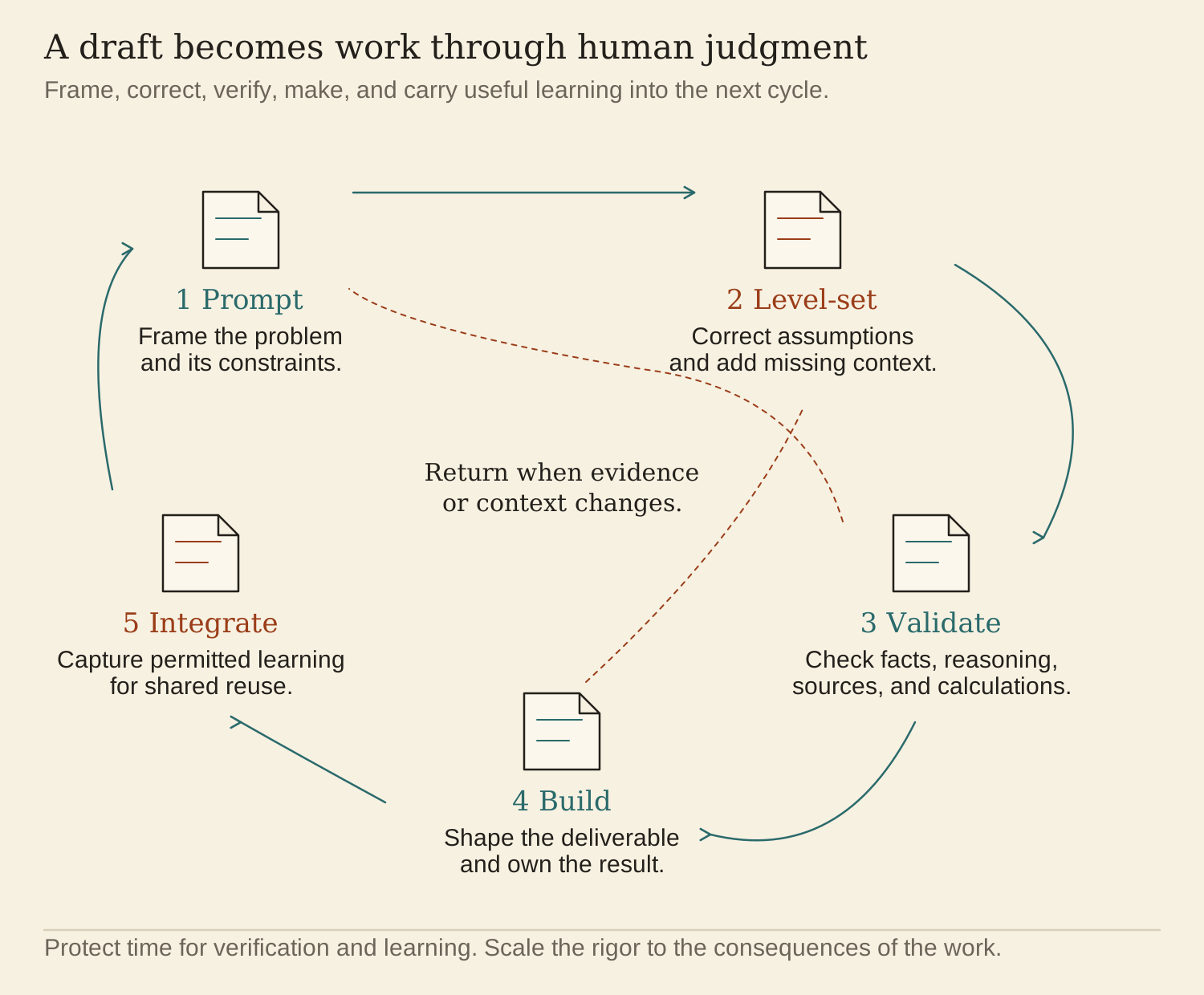
Step One. Prompt
AI-mediated work often begins with an instruction rather than a blank page. That instruction may be a conversational prompt, a structured brief, a specification, or a task assembled by software. It frames the question and orients the system to what is needed. Its quality strongly shapes what follows, along with the model, tools, supplied context, and surrounding workflow.
The human role at this step is framing. What problem are we actually trying to solve. What does success look like. What constraints apply. Who is the audience. What has been tried before. What is the context that someone outside the situation would not know. This is the work of being clear about what is being asked for, which is harder than it sounds and which most organizations do badly.
The AI role at this step is initial response. Based on the prompt, the AI offers a first take, a draft, a structured approach, a set of options, depending on what the prompt requested.
The risk at this step is prompt-as-shortcut. A hasty, generic, or context-poor instruction makes shallow output more likely, even though a capable system may sometimes recover by asking questions or using tools. The output can look impressive, especially to someone who does not know the subject well, while still being wrong for the work. Garbage in, plausible garbage out. Poor framing produces bad work that may escape diagnosis because it looks good on the surface.
Step Two. Level-Set
A first AI output is rarely the final answer. Treat it as a starting point. Your job at this step is to read it critically, identify where it landed well, where it landed wrong, what context the AI did not have, what assumptions the AI made that need to be revised.
The human role is critical reading. Reading with the kind of attention that the human would give to a colleague's first draft, with the explicit understanding that the AI does not know what the human knows about this specific situation and may have gotten meaningful things wrong.
The AI role is revision without ego. The system can challenge a conflicting instruction, surface missing information, or explain the basis of an answer, but it does not need to defend a draft for social reasons. The human is the authority on intent and accountable judgment. Facts still need checking, whoever states them. The human's correction and added context become inputs to the next pass.
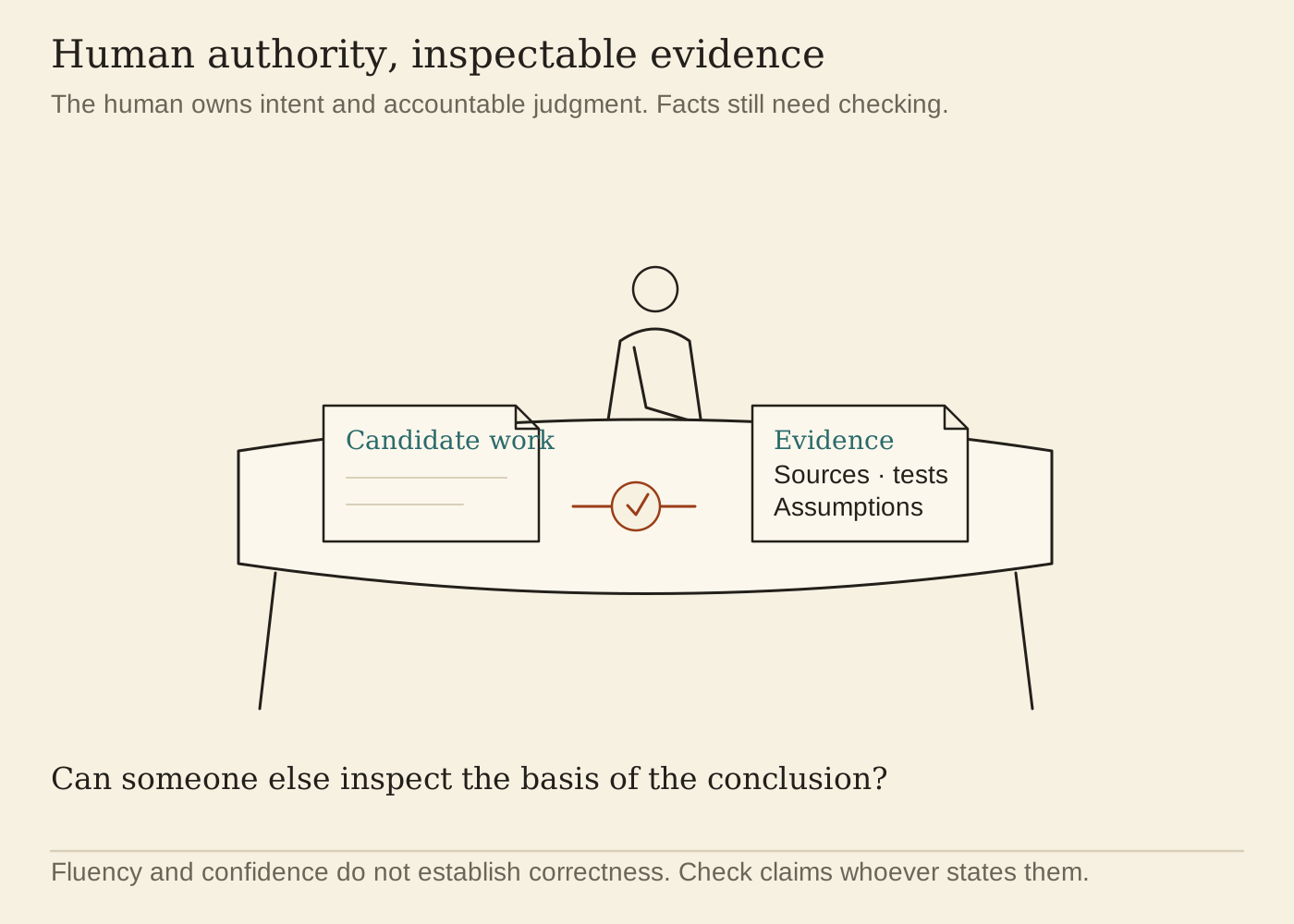
The risk at this step is acceptance bias. People can accept AI output too readily, especially when it is articulate and confident. The discipline of holding the output at arm's length, looking at it skeptically, and saying explicitly "this is not quite right because" is harder than it sounds. It is a central failure point in AI-mediated work. Section 5.4 develops this risk in detail.
Step Three. Validate
The human has revised the framing. The AI has produced a revised output. Now the human has to validate that the output is correct on its facts, sound on its reasoning, and appropriate for its audience.
The human role is verification. Check the facts that the AI asserted. Check the sources, if any are cited. Check the argument, assumptions, and calculations. Check that the conclusions actually follow from the premises. Look for the kinds of errors AI characteristically makes: confident assertions about things it does not know, plausible-sounding citations to sources that do not exist, smooth narratives that paper over real complexity.
The AI role is to produce inspectable support for what needs to be verified: source links or document references, stated assumptions, calculations, intermediate artifacts, test results, and clearly marked uncertainty. A fluent explanation of the model's reasoning is not proof that the underlying process was faithful or correct. Validation should rest on evidence and reproducible checks. A persuasive generated rationale proves nothing by itself.
The risk at this step is verification debt. Validation takes effort. In a hurry, humans skip it. Skipped validation accumulates as debt that eventually surfaces, often badly, when the output is used somewhere consequential and the error becomes visible. For consequential work, build validation into the loop as a required step, scale its rigor to the stakes, and allocate enough time to do it properly.
Step Four. Build
Validated output becomes the input to the actual work product. In the build step you integrate what the AI contributed with your own knowledge, judgment, voice, and the human context it does not possess on its own.
You decide what belongs in the deliverable and what needs further work. Combine the AI's contribution with your knowledge of the situation, write in your own voice, and take responsibility for the result through the organization's review process.
The AI role is supporting role. The AI may continue to participate at this step, drafting specific sections on request, exploring alternative phrasings, surfacing related information that the human had not requested. But the human is now the lead.
The risk at this step is authorship erosion. If the human incorporates AI output without genuinely engaging with it, unexamined model choices begin determining the work while the human remains accountable for it. That is bad for the work product, because the system may lack context the human holds, and bad for the human, because they have bypassed the work that would have exercised and developed their judgment.
A useful diagnostic question at this step is: could the human defend this output in a conversation where someone challenged its premises? If the answer is yes, the human has done the build step well. If the answer is no, the human has copy-pasted the AI's output and put their name on it, and is at risk on multiple fronts.
Step Five. Integrate
The work product is delivered. Reflection and organizational learning existed before AI; what is new is the volume of reusable instructions, evaluations, corrections, and interaction traces the work can now generate. The integrate step makes appropriate capture deliberate, subject to privacy, permission, retention, and security limits. Many organizations are not yet doing it consistently.
The human role is reflection. What did we learn from this cycle that should inform the next one. What prompts worked. What prompts did not. What kinds of validation effort were worth it. What kinds of integration moves produced better outputs. This learning is what turns one good cycle into a practice that improves over time.
The AI role, where the infrastructure supports it, is contributing to organizational learning. Prompts that worked well can be saved to a shared library. Approaches that produced strong outputs can be templated for reuse. Errors that emerged can be flagged for the team. The collaboration surface from Layer 7 is what makes this possible.
The risk at this step is the absence of integration entirely. Teams can complete the cycle and move to the next one without capturing what was learned. The same mistakes then recur, useful instructions get reinvented, and organizational practice fails to improve even as individual workers become more skilled. This is a pervasive and easily overlooked form of underinvestment in AI capability.
Reading the Loop
The five steps are sequential but they are not always neat. In practice the loop iterates. The validate step often surfaces problems that send the work back to the prompt step for re-framing. The build step often surfaces missing context that sends the work back to the level-set step. The integrate step often produces learning that improves the prompt step on the next cycle.
The loop is also not the only loop. Some kinds of knowledge work follow this pattern. Other kinds do not. A long-form strategy document follows this loop. A spontaneous Slack response does not. A research-heavy analysis follows this loop. An immediate client question may not. The loop is the dominant pattern of substantive knowledge work in an AI-Native operating system rather than a universal template.
What matters is that the loop exists, is visible to the people doing the work, and is taught explicitly. Organizations often give people AI tools and expect sound practice to emerge on its own. It emerges unevenly. Some workers develop a rigorous version of the loop and produce good work. Others skip steps and produce work that is fast and shallow. The variation is large, and the organization captures less value than it could because the practice is not shared.
A leadership team that takes AI-Native work seriously will teach this loop, build the supporting infrastructure for it, evaluate whether the work meets its standards without turning private activity into surveillance, and adjust as the practice evolves. Calling this training undersells it. This is operating system design.
The Connection to AI-for-Thinking
The new loop is the operational expression of a deeper cognitive posture. Knowledge workers who use AI well use it for thinking. They engage with the output, push back on it, and integrate it with their own judgment, creating the possibility of work better than either could produce alone. Knowledge workers who use AI poorly use it as thinking. They prompt, accept, integrate without engagement, and deliver. The first posture exercises judgment. The second risks allowing judgment to atrophy.
Section 5.4 treats this distinction at length, because it is one of the most consequential ideas in this book. The point here is that the new knowledge work loop is the operational expression of the AI-for-thinking posture. Doing the loop well requires the cognitive posture that Section 5.4 will describe. The two are inseparable.
AI Software Factories: A Worked Example
The new knowledge work loop generalizes across kinds of work. A worked example in one specific domain shows what it looks like when the loop is taken seriously and the supporting architecture is built around it.
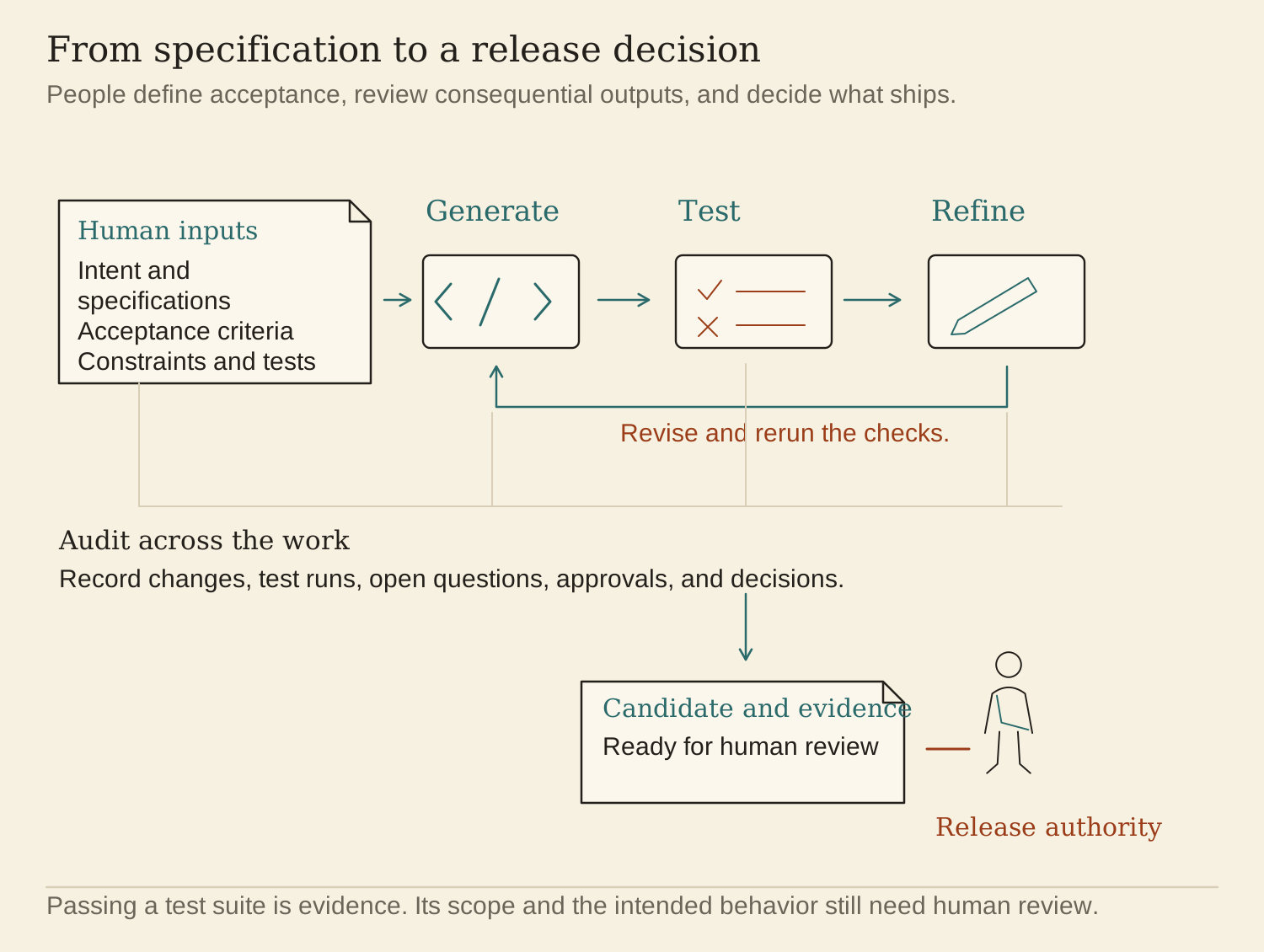
Software development has advanced quickly, partly because code can be executed and many requirements can be expressed as tests. An emerging pattern is often described as an AI software factory. In its stronger form, this is a working architecture rather than a slogan: specifications and tests guide AI agents that generate and iterate on code, while people review the work and retain control over what ships. Software is unusually suited to this pattern, but even here an incomplete specification or test suite can certify the wrong result.
The factory can be understood through four activities, whether separate agents perform them or one agent cycles among them. Generate produces candidate code from specifications. Test runs appropriate checks and reports failures. Refine addresses failures, adds missing cases, and iterates. Audit records changes, test runs, approvals, and important decisions so people can review both quality and pattern. Parallelism is an implementation choice, and the architecture works without it.
The humans on the loop do specific work. They own the specifications and acceptance criteria. They ensure the tests represent the intended behavior, whether people or agents drafted those tests. They review consequential outputs, refine the brief, and rerun the system when the result is not what they intended. They may still code by hand where that is faster, safer, or more illuminating. The role shifts from producing every line toward setting the conditions under which code is produced and deciding what is acceptable.
The pattern can extend to domains beyond software, with significant adaptations. Marketing teams can build campaign pipelines, legal teams contract-review pipelines, and operations teams incident-response pipelines. But prose, legal judgment, and operational action are harder to grade than code with a strong test suite. The common element is not necessarily a four-agent topology. It is a generate, evaluate, refine, and audit loop, with human authority placed according to consequence.
The factory is one form the new knowledge work loop can take at scale. The infrastructure is real and reported gains can be meaningful, but results depend on specifications, environments, evaluations, review, and the kind of work. A deliberate shared system can accumulate learning in a way that isolated one-off prompts cannot.
Stage 3 has built the operating system frame. Four dimensions, the inventory of processes, and the new knowledge work loop. How an AI-Native company actually runs at the practice level is now in view.