How does AI come to understand how a company actually works?
How institutional knowledge gets structured for AI to use is among the most important architectural decisions an AI-Native company makes. In the companies I see, it is often made by default. The default is the lowest-effort option: put documents into a retrieval system and let AI search them at query time. That option can create substantial value. It also encounters a wall when the questions depend on relationships and operational state the documents do not represent reliably.
The wall is this: documents describe the work. They describe parts of it, from particular perspectives, with assumptions about who will read them and what those readers already know. A policy document is an authoritative expression of policy, but it may not encode every condition in executable form. A process map represents the process at a particular moment, by a particular author, for a particular audience. The structure of the work is distributed across documents, databases, event histories, system configurations, observed behavior, and experienced people: entities, relationships, constraints, dependencies, and soft knowledge. Some of it is in documents. Much of it is not explicit, current, or connected enough for a system to apply reliably.
A company that wants AI to work across that structure has to make the relevant parts explicit and keep them current. A knowledge graph is one powerful artifact for doing so, especially when relationships and dependencies are central to the questions. What follows explains what that means, why it matters, and where it changes the architecture.
What a Knowledge Graph Is
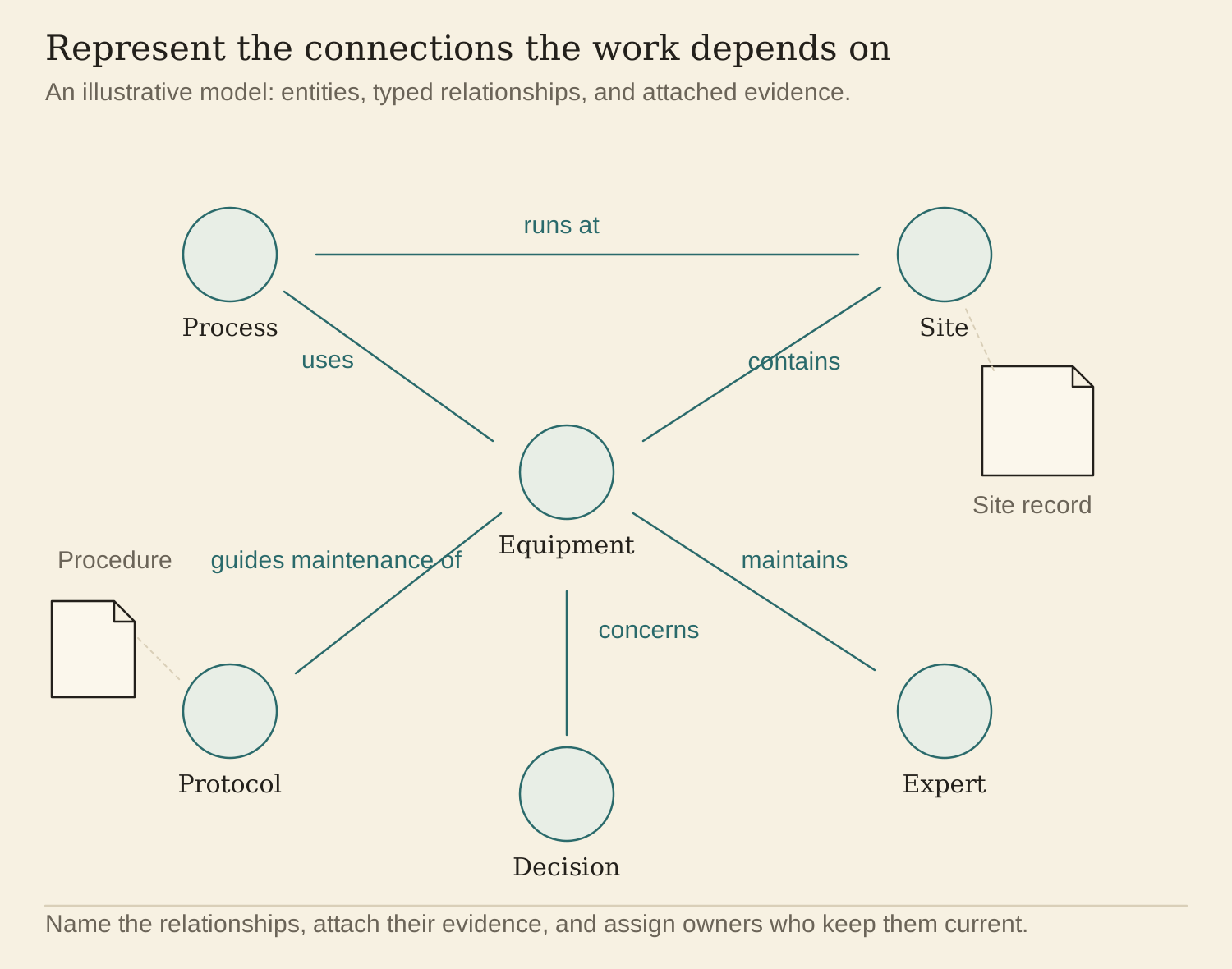
A knowledge graph is a structured representation of how the entities in a company connect to each other. The entities are the things the work involves. Systems, processes, people, decisions, products, customers, contracts, regulations, equipment, sites, projects, programs, risks, suppliers, dependencies. The connections are the relationships between them. This system feeds that one. This process depends on that one. This expert holds the knowledge for that operation. This decision is constrained by that regulation. This customer's account is managed by that team. This piece of equipment is maintained according to that protocol.
A conventional relational database stores records and can also encode meaning through schemas, keys, and joins. A graph database makes relationships first-class: each node an entity, each edge a typed relationship, the whole a machine-navigable map optimized for questions about connection and traversal. The distinction is not records versus meaning. It is how explicitly the data model represents relationships and how naturally the system can query them.
Documents still have a place. They attach to nodes in the graph. The policy document attaches to the policy node. The process map attaches to the process node. The training manual attaches to the role node. But the documents are artifacts about the entities. The entities and their relationships are the substance.
This distinction is one of the most consequential ideas in this book. In the companies I see, institutional knowledge is often treated primarily as a documents problem. They invest in document management, search, and retrieval-augmented generation. Those investments are useful and that work is real. But some use cases stall because the underlying relationships, definitions, and operational state have never been structured. The system is doing the best it can with the substrate it was given, and the substrate becomes the limit.
RAG and the Knowledge Graph Compared
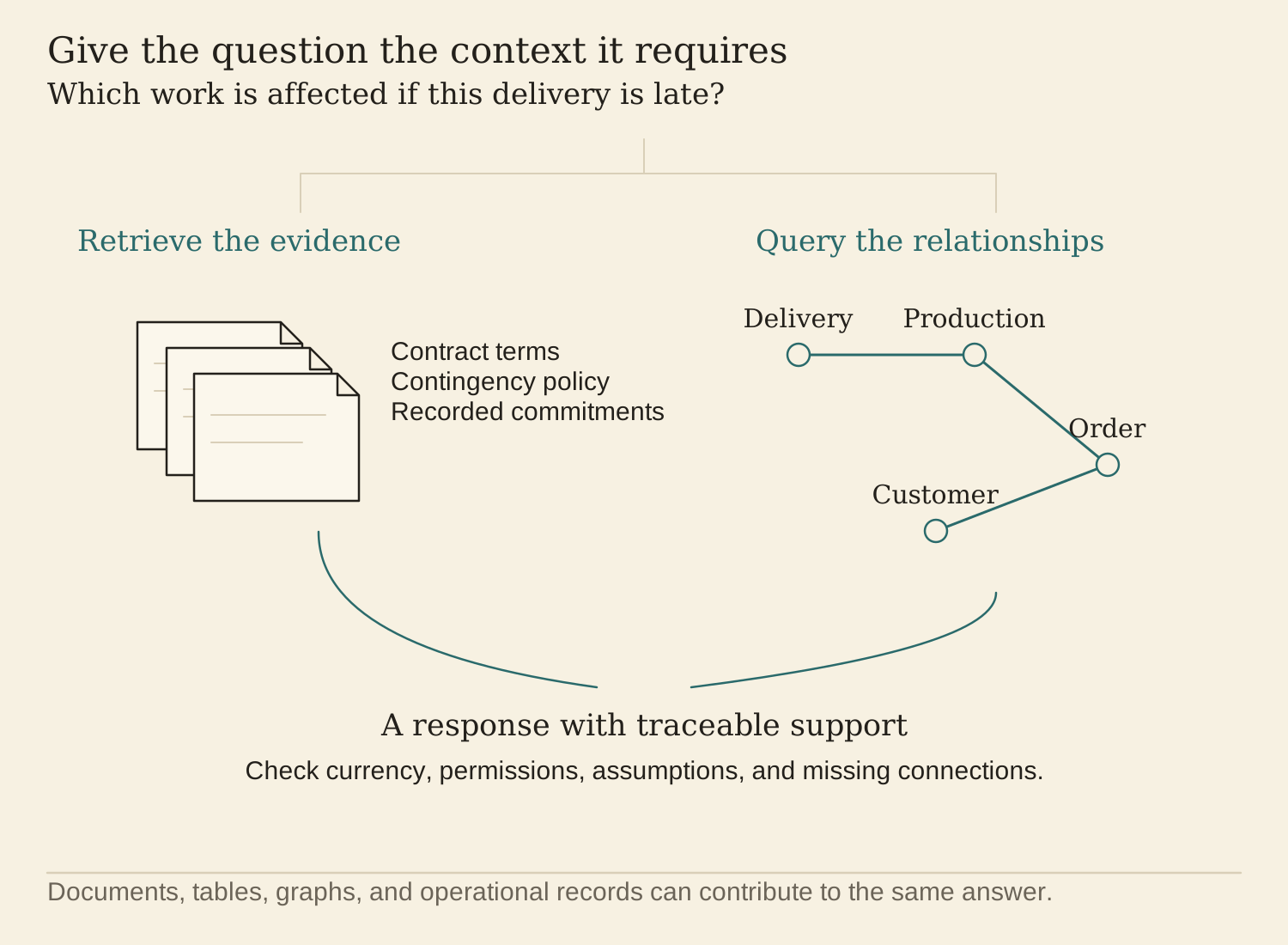
Retrieval-Augmented Generation, a common architecture for grounding AI in a company's own data, is Layer 3 of the nine-layer AI stack from Section 2.3. In its first form the architecture was simple. The user asked a question, the system fetched the closest-matching documents from the company's repository, put them in the context window, and the AI answered from what it was handed.
Some newer systems work harder than that. The model gets search as a tool and can run it repeatedly, choosing what to look for, inspecting what comes back, and deciding whether another search is warranted. Section 2.3 covers what that can buy and what it costs. Assume that stronger version for the rest of this section. Retrieval quality can keep improving while the document-only ceiling remains: relationships or current state that were never represented clearly cannot be recovered reliably merely by searching the prose harder.
RAG works well for questions that have answers in the documents. What is our policy on remote work. What did we agree to in the contract with this vendor. What were the key findings of the last quarterly review. These are document-retrieval questions. The answer is in a specific place. The system finds it. The AI summarizes it. The user gets the answer.
RAG works less well for questions that require reasoning across the structure of the company. If this regulation changes, which products are affected. Which customers do we have whose contracts expire in the next ninety days and who have an open support ticket about a related issue. Which experts have institutional knowledge about this kind of decision that we should consult. If we move this team from this site to that one, what dependencies will be disrupted.
These are relationship and traversal questions. They require the system to follow connections between entities, evaluate second-order and third-order effects, and identify patterns spanning multiple sources and parts of the business. Document-only semantic retrieval is a poor fit when those connections are absent, ambiguous, or scattered across prose. More capable retrieval systems can combine documents with SQL, metadata filters, APIs, and iterative tool use, so the boundary is not RAG versus everything else. The question is whether the relevant relationships are represented explicitly somewhere the system can query.
A knowledge graph holds those connections explicitly and makes multihop traversal natural. The graph does not reason by itself; the model, query engine, rules, and surrounding software reason with what the graph exposes. The same model, given reliable graph context, can answer relationship-heavy questions that document retrieval alone may miss. The architectural difference can be profound, particularly in operations-heavy systems, but documents, tables, time-series data, and graphs are complementary rather than rival substrates.
Why This Matters for Operations-Heavy Companies
A consulting firm can run a long way on retrieval. Much of its output and institutional record is documentary, and many questions are document-centered. A well-designed retrieval system can therefore move a consulting firm a long way toward AI-Native operations, although relationships, permissions, provenance, and current client state still matter.
A manufacturer cannot run safely on document retrieval alone. The work is the operation of physical equipment, the management of supply chains, the coordination of shifts, the maintenance of safety, and the optimization of throughput. The knowledge that matters is distributed across control systems, sensors, maintenance records, engineering models, procedures, and operators who have run the line for decades. It also lives in the patterns by which one plant differs from another and in failure signals experienced supervisors recognize before an incident.
A manufacturer that represents relevant relationships in a graph can build a capability a document-only system cannot easily reproduce. The graph may connect equipment and parameters, maintenance history, roles and qualifications, batches, incidents, and operating constraints. Combined with current sensor data, validated predictive models, and rules, the system can investigate why a machine is behaving differently under a particular set of conditions, estimate failure risk, and support operators in real time. The graph supplies context and relationships; it does not by itself establish causation or predict failure.
The same logic applies to defense, healthcare, energy, logistics, and other operations-heavy environments. Much of the knowledge that makes the operation work is structural or state-dependent. Relevant parts must be represented in queryable forms to be used reliably by AI. Documents remain part of that evidence, but documents alone are rarely enough.
This is the architectural commitment that Nodalix exists to support. Knowledge graph construction for operations-heavy environments, integrated with virtual sensors, predictive models, and agent systems, is one technical foundation of the Operating Layer archetype from Section 2.2. A company in this archetype that has not invested in an authoritative relationship-centered model, whether implemented as a graph or an equivalent architecture, has not yet built the foundation for what comes next.
The Strategic Prize
The strategic prize of investing in a knowledge graph is institutional knowledge capture in a form that can be connected, queried, governed, and reused at scale.
Somewhere in a plant there is an operator who has run the same unit for thirty years. He can hear a compressor start to labor two days before any alarm sounds, and he knows which gauge reads a hair high on cold mornings and means nothing. He retires in the spring, and the plan for his thirty years is a farewell lunch, an exit interview, and a request to record a few training videos before he goes. The videos will capture his face and his voice. Every operations-heavy company is losing some version of him right now, and the conditions that taught him are not being reproduced for anyone behind him.
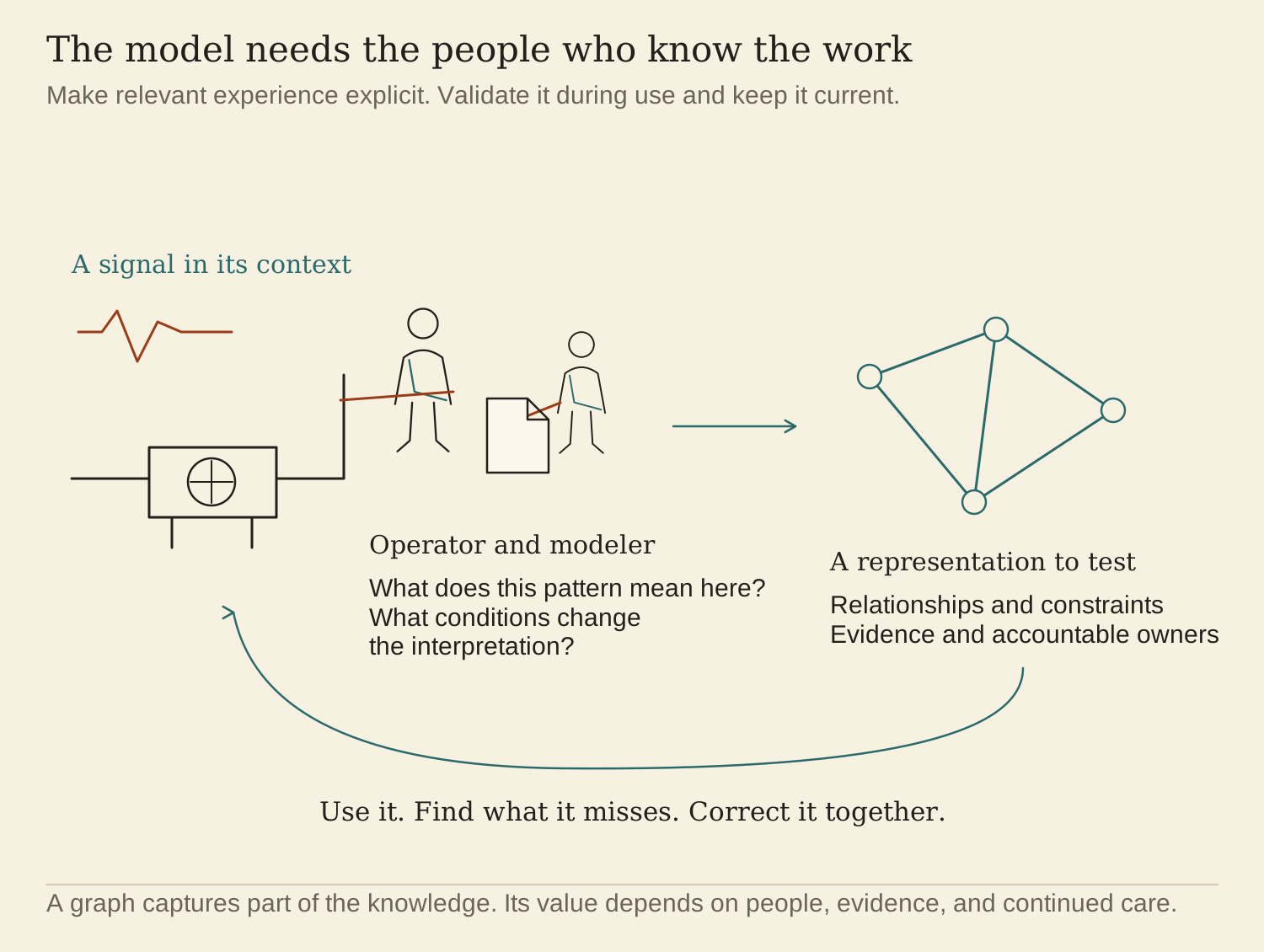
A knowledge graph can capture part of the structure the operator has been navigating: the entities and relationships involved, the questions prompted by a pattern, the factors considered when conditions deviate, and the rules that constrain a decision. It cannot extract a lifetime of tacit judgment perfectly. This is hard work, and it requires experienced operators to be engaged in deciding what the representation gets right and what it misses. The company has to invest in them as teachers rather than relying on them to leave behind documents. It is one of the most undervalued investments an operations-heavy company can make. The value can compound if the structure is used, validated, and maintained as the operation changes.
This work can build a moat. Two competitors with the same vendors, foundation models, and retrieval systems will not necessarily perform identically; execution already differs. But a competitor that also accumulates validated domain structure, operating history, and feedback has an advantage another firm cannot acquire with a license. Over a five-to-ten-year planning horizon, that gap can compound and become difficult to reverse. The outcome is not guaranteed, and a stale graph is not a moat. The investment window is open now.
The Work of Building a Knowledge Graph
Many technical components are mature: graph databases, ontology languages and modeling tools, and integration pipelines. Production graph systems still face hard engineering problems: identity resolution, temporal state, permissions, provenance, data quality, and change management. Harder still is capturing and validating the institutional knowledge that goes into the graph.
Experienced operators and modelers work together to represent operating knowledge as entities and relationships. Architects design the graph around the questions it must answer. Named owners keep it current as the operation changes, and the team continues to validate it during use.
This is a craft. The people who do it well are rare. Build durable ownership internally, with patient investment, and it can become an advantage. External specialists can accelerate the work, but no consultancy can substitute for domain experts, accountable internal owners, and people who will maintain the model after the engagement. Without them, the graph comes back shallow or grows brittle.
A company that takes this seriously and invests accordingly can build an institutional knowledge architecture that survives individual applications and model cycles. Skip the structural work where the use case requires it and rely on documents alone, and the wall returns repeatedly. The longer definitions, identities, and dependencies remain unresolved, the more expensive they can become to reconcile.
Connection to the Rest of the Book
A knowledge graph can be central architecture beneath an AI-enabled operating system when the work depends on dense relationships, multihop questions, shared definitions, or changing operational state. The processes treated in Section 3.2 require an underlying structure that supports grounded reasoning, but that structure may combine graphs with relational databases, event streams, documents, rules, simulations, and domain models. Decision-making, operations, and innovation require authoritative context. They do not all require the same storage technology.
The knowledge graph is also the architecture beneath the human work. The institutional knowledge that must be honored rather than discarded is the knowledge the graph captures. The experienced operators at the center of the human reckoning that Section 5.2 will name are the experts whose knowledge the graph represents. The covenant that comes out of that reckoning is enabled by the work of capturing knowledge structurally. That work treats the experienced workforce as teachers rather than as overhead.
Where the use case calls for it, the graph is both technical foundation and values commitment. A company that builds one well has decided to take institutional knowledge, provenance, and relationships seriously. A company without a knowledge graph may have made a sound architectural choice for simpler use cases, or it may not yet have recognized that critical structure is going uncaptured. The test is not whether the company bought a graph database. The test is whether its systems can represent and govern the knowledge the work actually requires.
The next section takes the graph and everything around it and asks the design question directly: what are the ingredients of an AI-Native operating model, and what shapes can they form.