What is at stake in this transition beyond strategy?
Beneath the alignment problem is a deeper question that almost no leadership team has explicitly opened.
Here is the question: what is this place going to be, for the humans who spend most of their adult lives here?
Nothing about this question is soft. It determines whether the operating model decisions a leadership team is about to make produce a place worth working in or a place that quietly hollows out the people inside it. It is also the question that AI is forcing open, whether leadership teams want it opened or not. AI changes the texture of the eight or ten hours a day that people spend at work, in ways the old conversation about work was not built to handle.
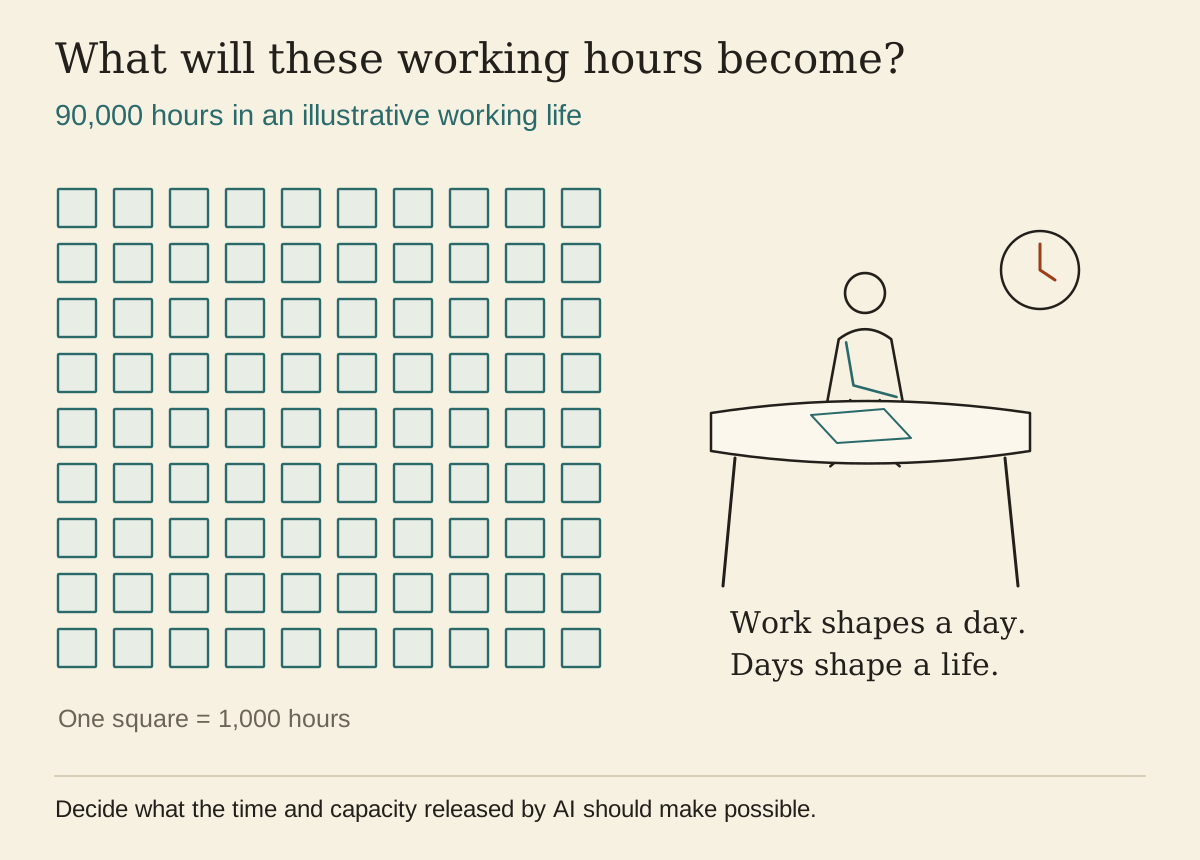
Ninety thousand hours. A person who works a typical full-time career, twenty-two to sixty-five, two thousand hours a year, will spend roughly that much of their life at work. Sit with that number. It is more time than they will spend on almost anything else except sleep. It is more time than they will spend with their spouse if they marry in their late twenties. It is more time than they will spend with their children, often by a substantial margin. For the person, whether those ninety thousand hours are spent well is the question. Everything else in their life is shaped by it: their energy at home, their relationships, their health, what they think they are worth, what their life becomes.
Companies are the container in which most of that time happens, for most of the people this field guide is for, and the container shapes what the time can be. A company takes ninety thousand hours of a person's life in exchange for money. A company that is indifferent to what those hours do to the person is exercising enormous influence over a life without acknowledging the responsibility. Many companies manage that influence with policies and processes and performance reviews instead of care.
People have made this observation, in many forms, for a long time. What is new is that AI is opening a window in which leadership teams can finally act on it, if they choose.
Here is why. Until now, the conversation about whether work was a place where humans could flourish ran into a hard constraint. The work needed to be done. Most of the work was what it was. The company's job was to extract maximum output from finite labor. Whether the work was meaningful, whether the time was well spent, whether the person was becoming more themselves or less, all of it sat at the edges, because the operational center was already fully committed. There was no slack.
AI changes the slack. Whatever else AI does, it can take over a meaningful share of the work that previously filled those ninety thousand hours. The routine analysis. The first draft. The standard synthesis. The volume work. How much varies by role, task, organization, and the capability of the systems available at the time. The estimates will keep moving. But in a growing number of settings, some work that required human effort can now be handled or accelerated by AI. That leaves a choice that no previous moment in working life has put in quite this form.
The choice is what to do with the time and cognitive capacity that AI releases.
The default answer is to extract more output. If a person used to produce X with their hours, and now produces 1.5X with AI assistance, the company captures the 0.5X gain and asks for more next quarter. This is what I expect most companies to do, because their operating models are optimized for it and their compensation systems reward it and their boards expect it. There is nothing evil about that answer. The system was built to produce it.
The other answer is to use some portion of the released capacity to make work more humane. More meaningful, more developmental, more connected, more honoring of the fact that the people in the building are spending the largest share of their lives there. This answer requires a deliberate choice. It happens because a leadership team decides it should happen and then designs the operating model to produce it.
I expect most leadership teams to make the first one by default. The second one requires articulating values they have not had to articulate, defending against pressures that will push them back toward the default, and accepting that some of the productivity gain from AI will be reinvested in human flourishing rather than captured as margin. The second choice is harder, takes longer, and is harder to defend in any single quarter. My wager is that, over a decade, it produces companies that become genuinely different from their competitors. That is a proposition to test before anyone claims it as a result.
This choice is the premise underneath everything that follows. Every later argument depends on it.
The maturity model in Stage 2 assesses where a company is in its AI-Native transition, but the underlying question is whether the maturity is being directed at extraction or at human flourishing.
In Stage 3 the operating system describes how processes change when AI is involved, and the design decisions inside each process come down to whether the redesign serves output or the people doing the work. The choice shows up everywhere.
The architectural decisions in Stage 4 (knowledge graphs, agent systems, collaboration surfaces) look like technology choices on the surface. They are also choices about whether the company's intelligence accumulates in shared, observable, human-comprehensible structures or in private, opaque, individually-held tools. The architecture shapes the work, and the work shapes the lives of the people doing it.
Stage 5 treats the choice most directly, though it runs through every part of the book as the spine.
Optimizing for employee happiness at the expense of business outcomes would be naive and strategically incorrect. Companies that fail to perform do not have the durability to be good places to work over the long term.
My argument is that whether work is humane and whether the company performs are not separable questions. Fear can produce short bursts of output, but sustained engagement creates conditions for learning, candor, and discretionary effort that fear erodes. Less obvious: I expect a company that captures institutional knowledge from experts who feel honored to build better AI systems than one trying to capture it from experts who feel threatened. People who trust the purpose are more likely to contribute context, exceptions, and judgment rather than the minimum they can safely disclose. And a leadership team that decides what kind of place it wants to be, and designs deliberately to be that place, is building an advantage that quarter-by-quarter extractors will find difficult to copy. The hard-eyed business case and the human flourishing case can point in the same direction, on the timescales that matter.
A leadership team that takes this premise seriously is signing up for five specific things. I name them briefly here so they hang in the air as the chapters develop.
The team has to make explicit choices about what to do with the capacity AI releases: to extract, to reinvest in people, or to do some intentional mix of both. The default choice is to extract, so making any other choice requires deliberate work. The useful version of this question is concrete. If a person is letting go of spreadsheet management, what does that now allow them to do? You have people carrying real wisdom and domain experience, and the question is where you point them. Early on, some of that released capacity gets repurposed into managing the transition itself, because a change of this size needs people with time to focus on it. After that phase, the honest options are to explore the white space in the market you serve, to put more time into researching and designing new products, or to serve customers better than you could before. Growing the revenue, or protecting the revenue you already have. And some of it goes to a job that did not exist before, which is the human work of managing the AI.
The team has to design jobs that give people worthwhile work and room to develop. When AI takes on part of a job, work with the person doing it to decide how the role should change. Agree the responsibilities, support, and learning time that change will require.
The team has to honor the people whose expertise is being supplemented by AI, in ways that are structural rather than ceremonial. You can give someone a hug and a pat on the back and tell them their job is being affected by AI. Or you can evolve the role, redesign it, sometimes eliminate it and build a new one deliberately. Compensation is part of this and it can genuinely move: a commission model might become salary, or a salary model might flip to commission. Role design, recognition, institutional knowledge capture. The honoring has to be real or the workforce will know it is not.
The team has to recognize, and then protect, the conditions under which people exercise capabilities and standing the organization still needs: deep thought, relational presence, accountable ethical judgment, original synthesis, meaning-making. Recognition comes first, because a condition nobody has named is one nobody defends. These are among the first casualties of efficiency pursued without boundaries, and holding onto them takes explicit design.
The team has to acknowledge, out loud and early, the emotional reality of what people are carrying. This is the thing that does not get talked about enough. Many workplaces were getting better at recognizing when someone was struggling, and then AI arrived inside the jobs themselves. It can land on people's mental health. It affects anxiety and worry, because people who thought they had a career that would carry them to retirement are no longer sure what that looks like. So step into the uncomfortable part of it. Let people be heard, and let them raise concerns without being labeled as negative on AI. Let it get explored over time, rather than leaving someone feeling they have to defend why they still deserve to be here. A lot of people are worried about losing their jobs while their organizations have not yet put comparable effort into redesigning the work around them. The alternative is pretending the transformation is only an opportunity and never a loss. That pretense corrodes trust and produces resistance that leaders later misread as the obstacle.
These five asks are demanding, and I want to be honest that I have not yet watched a leadership team take on all five, because this is all still new. If I had to guess which one goes first, it is the fifth. The emotional reality is the softer side of the human, and the workplace shies away from that. Some of the third would go too, because structural honoring costs something. Drop the fifth and six months later things can quietly deteriorate. Morale drops, people get more anxious, and nobody connects it back to the thing that was never said. These asks are, in my reading, what may separate the companies that compound into something durable from the ones that do not. The wager behind this book is that companies that take ninety thousand hours of their people's lives and use AI to make those hours better will outperform companies that use AI only to extract more from them. The first kind of company may be rare. I am writing for the leadership teams that are considering becoming the first kind.
The rest of the book is built to help with the work. The frameworks, the architectures, the operating system, the practices: all of it presumes the premise just laid out. If you disagree with the premise, much of the book will read as misdirected. If you agree, or if you are not yet sure but willing to hold it as a serious possibility, this book is for you.
Consider. Before reading further, sit with the five asks for ten minutes. Which of them is your leadership team genuinely ready to take on? Which would be hardest? Which would feel impossible? The book that follows assumes the asks are real and the reader is willing to engage them.
Consider. If you keep three things from Stage 1: 1) AI-Native is an alignment problem dressed up as a technology problem; the gap between your executives' private definitions is the work. 2) Design belongs at the front of the transition, and the new economics of design have made that work more affordable. 3) Underneath the strategy sits the ninety-thousand-hour question: what will this place be for the humans who spend most of their adult lives here?