What does it take to turn "we will become AI-Native" into shared meaning?
Somewhere in the last year, in an all-hands meeting, a CEO stood at a whiteboard and wrote the sentence: we are going to become an AI-Native company. The room nodded. It landed well. Afterward the Slack channels lit up with reactions ranging from energized to cautious to cynical. By the next quarter, three different executives had launched three different transformations, each based on a private definition of what the CEO had meant.
This is the situation a great many leadership teams are now living inside. The phrase is hot. The intent is real. The alignment is missing.
The CFO heard cost reduction. AI is going to let the company do more with less headcount, and the timing matters because the board is asking about margin. The CTO heard modernization. The legacy platforms have been groaning for years and AI is the forcing function that finally produces the budget for the rebuild. The CHRO heard workforce anxiety. Half the workforce is already worried about their jobs and the announcement just made it worse. The CMO heard personalization at scale. The CIO heard infrastructure investment. The general counsel heard new regulatory exposure. The head of operations heard we're going to break things if we move too fast.
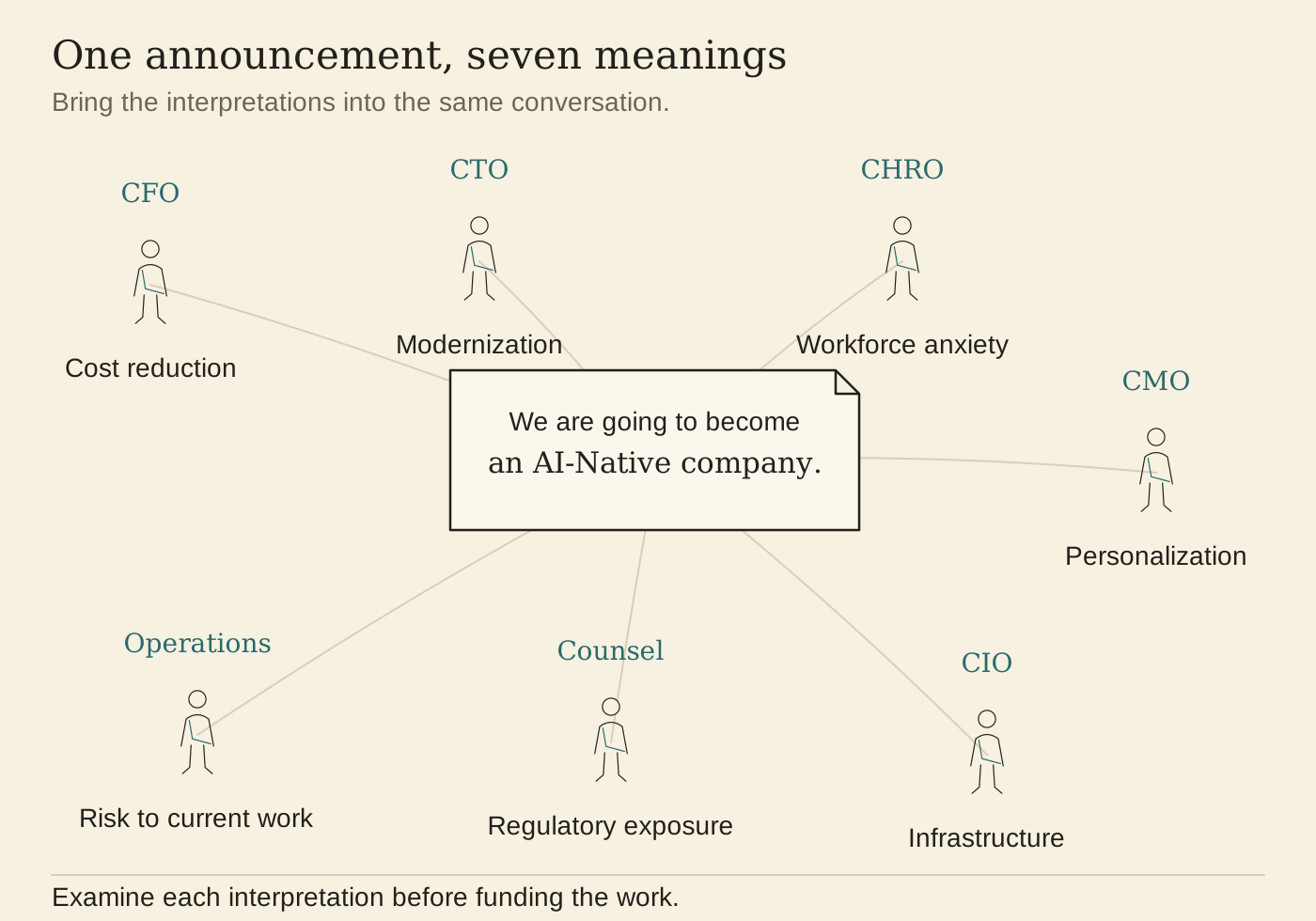
Each of these is a legitimate interpretation. Each is also incomplete. And each is now driving budget decisions, hiring decisions, vendor decisions, and roadmap decisions. None of it will converge into anything coherent unless someone in the room does the work of making it converge.
This is what I see leadership teams discover, sometimes after eighteen months and several million dollars of pilots, sometimes earlier: AI-Native is an alignment problem dressed up as a technology problem.
Intellectual lineage. What is happening on the whiteboard is what Karl Weick called organizational sensemaking. A leader writes a phrase. The phrase is the same on the surface for everyone in the room. Underneath, each person constructs a different meaning from it, based on what they were already thinking, what they have heard before, and their own fears and hopes. The construction is private and rapid, and it feels, to the person doing it, like understanding. The misalignment is invisible because it lives in the meaning rather than the words. The leadership team's job is to make those private constructions visible, build enough shared meaning to act, and record the disagreements that remain.
Weick, Karl E. (1995). Sensemaking in Organizations. Thousand Oaks, CA: Sage Publications.
Research supports the need to frame the problem correctly, though not the claim that technology is the only obstacle. A 2024 RAND report noted that, by external estimates it cited, more than eighty percent of AI projects fail, roughly twice the reported failure rate of information-technology projects without AI. RAND did not produce that failure-rate estimate. Its own contribution came from interviews with sixty-five experienced data scientists and engineers, which surfaced five leading causes: misunderstanding or miscommunicating the problem, insufficient data, chasing technology rather than user need, inadequate infrastructure, and applying AI to a task beyond its capabilities. Problem definition led the list. Executives funding competing initiatives can destroy execution capacity regardless of how good the underlying AI is, but models, data, and infrastructure can fail too.
Source. A recent interview study of why AI projects fail. RAND interviewed sixty-five experienced data scientists and engineers, identified five leading causes, and named misunderstanding or miscommunicating the problem as the first. The widely repeated failure-rate estimate traces to external sources that RAND cited, which makes RAND the messenger for that number.
Ryseff, James; De Bruhl, Brandon F.; Newberry, Sydne J. (2024). The Root Causes of Failure for Artificial Intelligence Projects and How They Can Succeed. RAND Corporation, RR-A2680-1.
I have come to call the result the pilot graveyard, and it shows up repeatedly in the industry literature and in my own work. The composite that follows gathers that pattern into one company. It runs eleven pilots. Marketing pilots a content engine, operations pilots a scheduling model, finance pilots a forecasting tool, and none of the three sponsors ever sit in the same review. All eleven draw on the same four-person data team, which spends its weeks context-switching among executives and finishing nothing. Eighteen months and four million dollars later, zero systems are in production. The leadership team is sincere, the capital is allocated, and nothing ships, because every initiative is solving for a different definition of the goal.
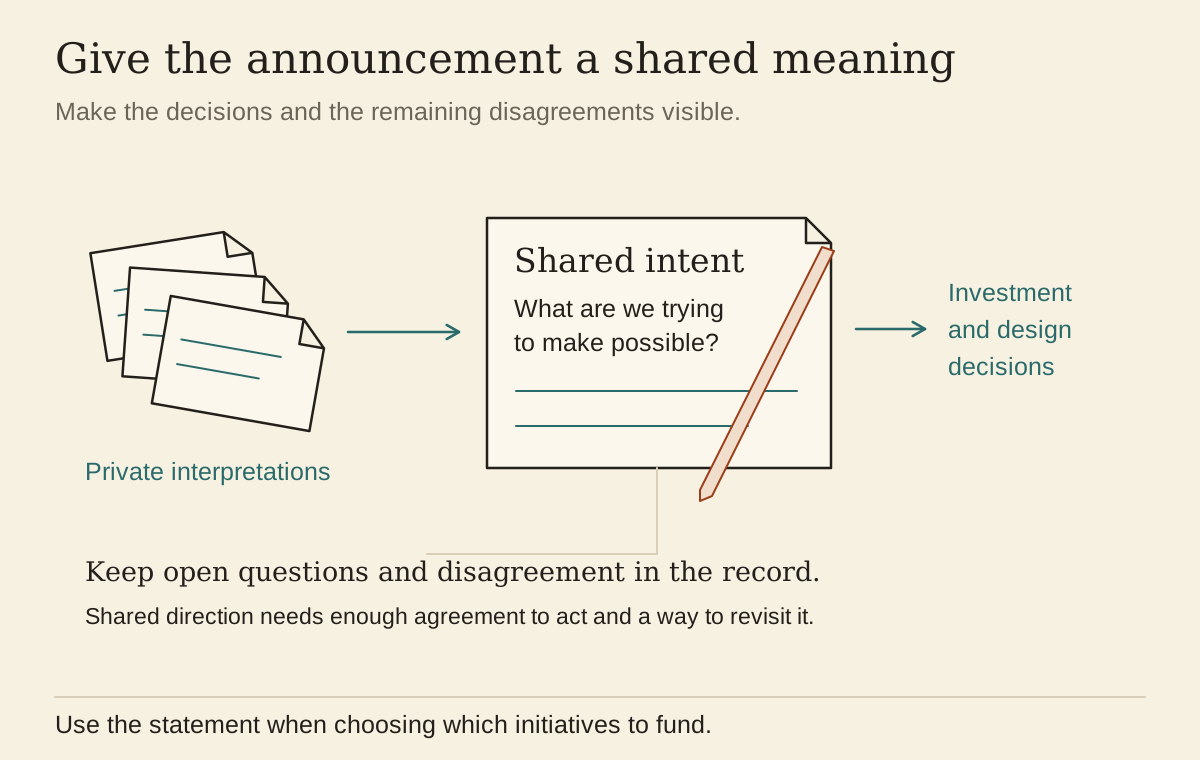
Companies that escape this pattern do something that looks small on paper and is unreasonably hard in practice. They produce a shared definition, and record the disagreements that remain, before they spend money on initiatives that depend on it. What works is recognizable in shape, and it is worth picturing concretely even in the abstract. A leadership team commits to a two-day session with an outside facilitator and produces a single statement of intent. Every subsequent AI initiative then gets evaluated against that statement. Proposals that do not support it get rejected or deprioritized. That two-day investment can become some of the most valuable work the leadership team does. Everything else is downstream of it.
No two of those statements look alike, and none of them would transfer. What matters is producing one together, with the senior team in the same room and the disagreements surfaced rather than buried. Without that work, the announcement that the company will become AI-Native is a wish wearing the language of strategy, executed by people who each heard a different wish.
This matters more for AI than it did for digital transformation or a cloud migration, because AI is unusually susceptible to private definition. A cloud migration can at least be anchored to named workloads and infrastructure, even when its business purpose is disputed. Digital transformation is broader but still constrained by the artifacts it produces: a customer portal, a data platform, a modernized ERP. AI-Native has no comparable technical finish line. The phrase can mean almost anything, and so it comes to mean whatever the listener already believed should happen. The CFO who already wanted cost reduction hears cost reduction. The CTO who already wanted modernization hears modernization. So the phrase confirms each executive's existing priorities rather than producing new shared ones, and because that confirmation feels like alignment, the misalignment stays invisible.
That is the central problem this field guide is built around. There is no single right definition of AI-Native to hand you. Stage 2 explains why. A field guide that pretended otherwise would be misleading you. What this field guide offers is the substrate for producing your own definition, together with your team, in a way that holds across the executive group and survives contact with execution.
Everything from here on is built around that work. The frameworks are inputs to alignment. They do not substitute for it. The maturity stages are tools for honest self-location. The archetypes are options. Everything in this field guide presumes the work of becoming AI-Native is yours to do.
One more thing about the phrase on the whiteboard. The CEO who wrote it was not wrong to write it. The instinct that something is changing, that the company has to respond, that AI is not optional, those instincts are correct. The ambition is right. The mistake is assuming it translates into shared understanding without the work of translating it.
Bring this into the room. In your next leadership meeting, before any other agenda item, ask each member to write down in one sentence what they think "becoming AI-Native" means for the company. Do not let anyone speak until everyone has written. Then read them aloud. The gap between the sentences is the consensus problem made visible. That gap is the work.