Where in the work does human presence matter most?
The argument across Stage 5 and the previous section implies a question worth addressing directly. If humans retain standing, responsibility, relationships, and capabilities that the company means to protect, where should human attention concentrate in an AI-Native operation. The question is operational. Its answer shapes where AI may assist, where human authority is mandatory, where participation is a matter of dignity or rights, and where the company invests scarce attention.
Two answers to the question can be set aside before I name the one I hold.
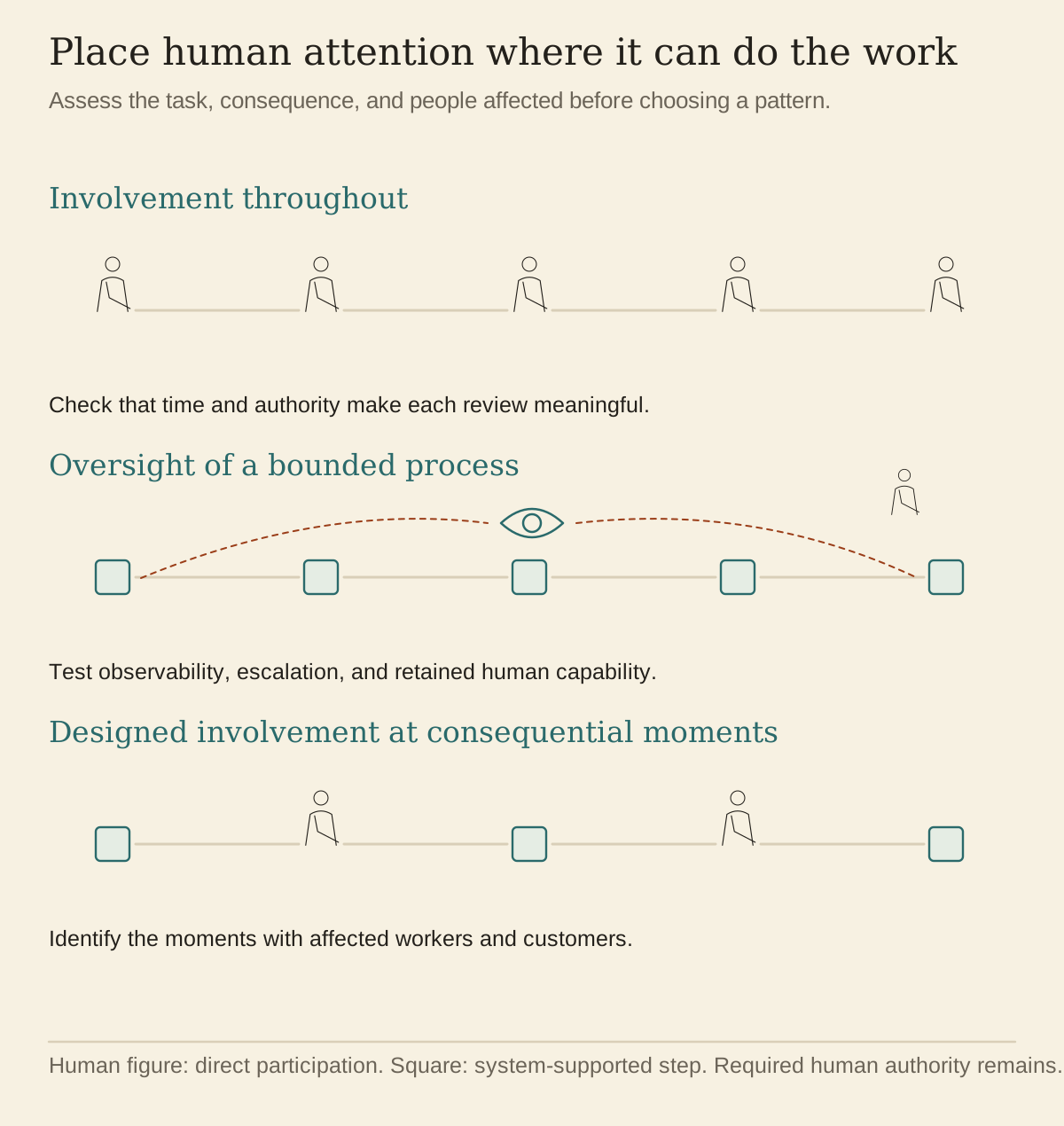
The first incomplete answer is that a human should touch everything. Every interaction, decision, and customer contact passes through a person. The answer sounds protective, but a ceremonial approval can add delay without adding judgment. People become rubber stamps when volume exceeds attention. Some customers prefer fast self-service, and some low-consequence automation needs no individual review. Other domains legally or ethically require a qualified human. The design question is not human everywhere or nowhere. It is what meaningful human involvement requires in this consequence and context.
The second incomplete answer is that humans should sit only at the edge. AI does the work; people align it, oversee it, and intervene on failure. This resembles the Coinbase archetype introduced in Section 2.2 and challenged in Section 5.3. It can work for bounded, observable processes with strong tests and reliable escalation. It fails when supervisors lack enough contact with the underlying work to recognize error, maintain skill, or challenge the system. Oversight then becomes a ritual. Edge supervision is a pattern to validate in each operation where it is tried.
The answer I hold to is different from both. Humans should be at the moments that matter.
Intellectual lineage. Jan Carlzon popularized “moments of truth” while leading Scandinavian Airlines through its early-1980s turnaround. In his 1987 English-language book, he estimated that ten million customers each encountered about five SAS employees for an average of fifteen seconds: fifty million annual moments in which the airline was “created” in a customer's mind. The phrase described frontline service encounters. Whether any single contact defined the relationship, or caused the financial turnaround, is a separate question. Carlzon's operating lesson was to orient the organization around customers and give frontline employees information and authority appropriate to those moments. I am adapting that service framework to a broader question: which moments warrant human attention when AI increasingly participates in the operation itself.
Carlzon, Jan (1987). Moments of Truth: New Strategies for Today's Customer-Driven Economy. Ballinger Publishing Company. (Originally published in Swedish as Riv pyramiderna!, 1985.)
What the Moments That Matter Are
A moment that matters is a point in the operation where human attention, authority, or relationship makes a disproportionate difference. Some are identifiable in advance; others become visible only through incidents, worker experience, or customer feedback. They may occupy a small fraction of operational volume. That is a design hypothesis, and the fraction will vary. They concentrate value, risk, rights, and meaning in ways an average transaction may not.
These moments share several characteristics. They carry high consequence, where the outcome matters more than the average outcome. They are moments of high ambiguity, where the analysis alone is insufficient to determine the right action. They are moments of high relational stakes, where the experience of being met by another human is part of what produces the outcome. They are moments of meaning-making, where the way the moment is held shapes how the people involved understand what happened.
They cluster in identifiable places rather than at random. I want to walk through several categories with examples to make the concept concrete.
A Taxonomy of Moments
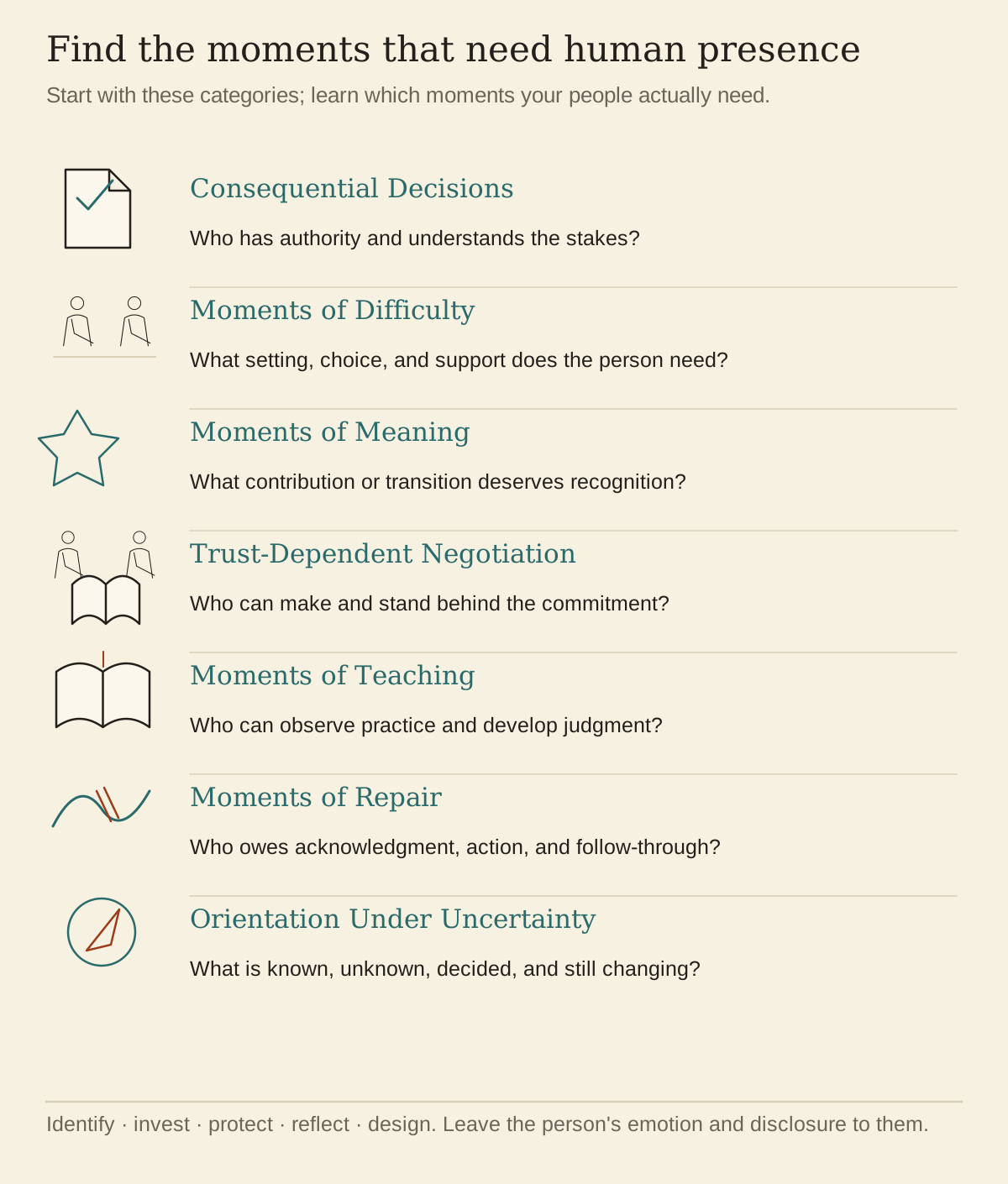
Category one, Consequential Decisions: decisions that shape the trajectory of the company, team, customer, or individuals involved. The strategic move that commits the company. A senior hire. Entry into or exit from a market. A credit, care, employment, or safety decision that materially affects a person. AI can assemble evidence, test scenarios, and expose inconsistency. Legitimate human decision-makers should remain accountable, understand the basis, consider affected people, and be able to depart from the system for reasons they can defend.
Category two, Moments of Difficulty for the people involved. The performance conversation. The layoff. The diagnosis. The financial setback. A relationship breakdown with a counterparty. A director held one of these moments well. She booked a small conference room, closed the door, and set the written review face down on the table. The engineer across from her had missed his numbers two quarters running, and she said, tell me what is actually going on. He was quiet, then described his mornings since his wife's diagnosis, and the next forty minutes followed no script either had brought. What he carried from that room was how it was held. Not every moment is that heavy. Someone stuck for three days walks to a colleague and says this thing is killing me. The colleague has no answer, but has ten minutes and understands why it is maddening. That is enough to make work possible again. AI may help a person prepare words or options. It cannot occupy the employer's obligation, the clinician's duty, or the colleague's reciprocal relationship. Automating delivery of consequential human news without choice and support can impose costs in dignity, trust, and comprehension that a throughput measure misses.
Category three, Moments of Meaning. The launch of a product. Completion of a project that took years. A colleague's retirement. A new team member's arrival. Recognition of work that mattered. Operations can continue without marking these moments, but people may lose continuity, credit, and a shared account of what changed. Ritual is culturally specific and should not compel emotion. Held honestly, it can help a group remember, welcome, grieve, or close.
Category four, Trust-Dependent Negotiation: the complex sale, partnership discussion, supplier agreement with years of consequence, or customer rescue after failure. AI can research, model terms, draft language, and simulate objections. Parties may even use automated negotiation for bounded transactions. Where the relationship itself carries value, authorized humans need to understand commitments, read context, disclose material AI use where required, and stand behind the bargain.
Category five, Moments of Teaching. Mentorship. Onboarding into a culture. Transmission of institutional knowledge from an experienced worker to a less-experienced one. Development of judgment through cases, explanation, attempt, feedback, and consequence. AI can tutor, generate practice, and provide immediate feedback. Human mentors contribute situated standards, recognition, sponsorship, observation over time, and responsibility for what the learner is trusted to do. The strongest design may be human-to-human and human-with-AI rather than a forced choice.
Category six, Moments of Repair. A team conflict. A customer let down. A colleague harmed. A relationship strained. AI can help reconstruct events, identify options, or draft an apology. Repair itself requires acknowledgment and action from the person or institution that owes it, participation from the harmed party on terms that do not coerce reconciliation, and follow-through that changes the conditions. Presence matters because responsibility cannot be outsourced to the drafting tool.
Category seven, Orientation Under Uncertainty. A crisis, disruption, strategic pivot, or competitive shift. The workforce needs evidence, decisions, and orientation from leaders who can state what is known, unknown, changing, and still expected. AI can monitor signals and generate scenarios. Leaders remain responsible for priorities, tradeoffs, communication, and promises. Meaning should be built with the people living the change, by them as much as for them.
These seven categories are starting points, and the answer will vary by context. A company can identify its own moments by asking where human authority is legally or ethically required, where relationship changes the outcome, where people want a person, where independent capability must be preserved, and where absence would be felt as a loss. Ask affected workers and customers. Leaders alone may not see the moments in which their systems feel most impersonal or consequential.
The Design Principles
A company that takes the framing seriously has to design deliberately because high-volume routine work can crowd out the low-frequency moments carrying disproportionate consequence.
Principle one, Identify. You have to identify them explicitly. What are the moments in our company where the human presence makes the difference. What does each moment look like when it happens well. What does it look like when it happens poorly. Who is involved. What is at stake. The identification is a continuous practice of paying attention to where the human work is actually concentrating.
Principle two, Invest. They deserve more investment than the average moment. The people who hold them need time to prepare, development to do them well, and support from colleagues. The investment is disproportionate to the time the moments occupy because the possible impact is disproportionate too. Underinvestment raises the odds that a consequential moment goes poorly. When it does, the story can travel through the workforce as evidence that the human work was rhetoric rather than reality.
Principle three, Protect. They require conditions that let them be held well. The performance conversation needs a private room and uninterrupted time. The strategic decision needs the right people present and the freedom to deliberate. The mentorship conversation needs the relationship to have been built over time. The protection is the leadership team's work. Without protection, the moments degrade into rushed versions of themselves that do not produce what the moments are capable of producing.
Principle four, Reflect. Afterward, ask what worked, what did not, what evidence exists, and what should change next time. Do not demand emotional disclosure from the people involved or turn a private conversation into training data without explicit authority and consent. Reflection develops craft when it protects dignity and produces a change, and it stops working once every human moment becomes material for the organization to extract.
Principle five, Design. Preparation, setting, sequence, participation, and follow-through can all be designed. The aim is to create conditions for a worthy interaction and leave the other person's response, and their emotion, to them. Some well-designed moments will be remembered for years; some should pass quietly. The quality lies in whether the design serves the people and purpose involved; memorability is a side effect.
The Connection to the Method of This Field Guide
A connection runs through the entire book and comes to the surface here.
The Arc5 method that produced this field guide, and that I use with leadership teams, treats moments as a unit of transformation work. It designs specific settings in which a leadership team can build alignment, a workforce can participate, and a transition can become concrete. No method can guarantee alignment or engagement, and a designed workshop is not the transformation itself. The distinction from generic facilitation is the deliberate connection between each moment, the operating decision it must enable, and what happens afterward.
The framing is the larger version of that idea. The AI-Native company can concentrate scarce human attention without reducing the rest of the workforce to machine supervision. Leadership identifies, invests in, protects, reflects on, and designs the moments with the people affected. Arc5 is one method for doing this in leadership transformation. The same logic can be adapted, with care, at other levels of operation.
The moments that matter are held by people, and how well they are held depends on what those people bring to them. The next section takes up the conditions under which a workforce brings real passion to the work.