What does passion have to do with AI?
Section 5.6 made the case for passion at the level of the individual: what can make a person care about the work, what may cultivate that caring, and what can destroy it. The leadership-team counterpart is about the measurable state of the workforce on which an AI-Native transition lands and the conditions a leadership team can change. Passion itself is not an organizational KPI, and no leader gets to require it.
Many AI-Native transitions land on workforces reporting low engagement, mixed feelings about AI, and pressure at the manager layer. Those are population-level signals, and any particular employee or company may differ. A leadership team that ignores its own evidence may spend years trying to change the operating model without the trust, time, participation, and capability the change requires. What follows is a way to examine those conditions, why they matter, and what leaders can do within the legitimate boundaries of work.
Here I use passion broadly for care about the subject, customer, team, competition, or craft. Research defines it more narrowly: a person values an activity, identifies with it, and gives it time and energy. Engagement, satisfaction, commitment, motivation, and passion have different meanings in that research. Keep those distinctions when reading the findings below. People bring many reasons for doing good work. Leaders should create fair conditions for care, curiosity, pride, and growth, with room for people to decide what work means in their lives.
What AI-Native Actually Needs from the Workforce
Before the substance, a framing point. Employee engagement is a family of survey constructs, each measuring more than whether people show up and comply. Different instruments measure involvement, energy, needs, commitment, or favorable attitudes in different ways. An AI-Native transition also needs concrete behaviors and conditions that a broad engagement score may not reveal.
It needs people with appropriate authority to take ownership of outcomes as well as tasks. It needs worker participation in deciding what the work should become, pride in quality, supported learning beyond current mastery, and the critical effort required to use AI as an active system rather than an unquestioned answer source. These are not obligations employees can satisfy through attitude alone. Leaders have to provide authority, time, tools, safety, voice, and a credible reason to participate.
A workforce cannot be “produced” into this state by exhortation. The claim that most people in most companies are not bringing themselves to work is not established by engagement surveys and turns a structural question into a moral judgment. People may meet the employment bargain exactly, reserve identity for life outside work, or withhold discretionary effort after experience taught them it was unsafe or unrewarded. Contract terms, schedule control, disability, caregiving, immigration status, union representation, prior layoffs, and whether improvement ideas have ever been honored all shape what participation costs. Leaders asking for ownership should first ask whether workers have the information, authority, protection, and share in the benefit that make ownership real. An AI-Native transition still needs active participation from the people whose work changes. The obligation is to design that participation and earn it. When technical wins fail to change the operating model, the design is the first place to look.
Autonomy support, opportunities to build competence, relatedness, fair treatment, and useful feedback appear across research on motivation, passion, learning, and work. The constructs overlap; they are not the same outcome, and their relationships are not a single causal law. Purpose is also associated with health and longevity in observational research, but that does not mean workplace passion extends life or that the same mechanism predicts company survival. The three scales are a metaphor to examine, and the science behind each is separate.
The State of the Workforce
Workforce surveys in 2025 and 2026 offer a sobering but method-dependent picture.
Ten trillion dollars is Gallup's model-based estimate of global productivity lost to low engagement in 2025, equal to about nine percent of global GDP. Its State of the Global Workplace 2026 report classified 20 percent of employees worldwide as engaged, down from 21 percent in 2024 and the lowest since 2020 under Gallup's Q12 method. Achievers Workforce Institute, using a different vendor survey and definitions, reported 36 percent engaged and 24 percent psychologically safe in 2025; the numbers should not be compared as if they measured the same population and construct. Pew's survey of U.S. workers, conducted in October 2024 and published in 2025, found 52 percent worried and 36 percent hopeful about future workplace AI use; respondents could select multiple feelings. Research summarized by Northwestern's Hatim Rahman adds a useful frame: technology's effects depend heavily on organizational choices, occupational power, and who participates in design. None of these sources says anxiety is inevitable or that a vision statement alone resolves fear of job loss.
This is the backdrop, and each workforce has its own story inside it. Engagement is low under Gallup's global measure, U.S. worker feelings about AI are mixed, and people have rational questions about whether a company is investing in them or replacing them. A leadership team should establish its own baseline, disaggregate it by role and power, listen before prescribing, and revisit it during the transition. The warning is that technical delivery and operating-model adoption can diverge for a long time before the dashboard makes the gap obvious.
The manager layer deserves particular attention without making managers solely responsible for everyone else's engagement. Gallup reported that global manager engagement fell from 27 percent in 2024 to 22 percent in 2025, its largest year-over-year manager decline in that series. Individual-contributor engagement was 19 percent. The former manager engagement premium has narrowed. Managers are workers inside the same system: spans of control, role ambiguity, restructuring, administrative burden, authority, training, and support all shape what they can provide to a team.
The Manager Problem and AI
Section 5.6 argued that the manager's job has changed, toward the human work of engagement. AI makes the problem worse, because it gives managers new ways to disengage from exactly that work.
First failure mode: using AI as a reason to step back indiscriminately from the team. If automation removes status collection, some meetings can become shorter or less frequent, which may be an improvement. What cannot be inferred is that people need less context, coaching, protection, or access to decisions. Engagement never came from presence alone, and not everyone wants more check-ins. Managers should ask what contact is useful, replace surveillance with trust, and use released time for the human work the team actually values.
Second failure mode: outsourcing judgment and relationship through ghostwritten communication. AI can help a manager organize notes, improve accessibility, translate, or find clearer language. The manager still has to supply the observation, make the judgment, check every claim, protect confidential data, and own the message. A generic draft is not automatically hollow, and teams do not possess a universal AI detector. Trust erodes when communication is inaccurate, impersonal, undisclosed where disclosure matters, or presented as attentive human judgment that never occurred.
Both failure modes share a pattern. The manager uses AI to avoid responsibility rather than reduce avoidable administration. AI can also perform parts of coaching, feedback, and communication well enough to be useful; the boundary is not administrative versus human. The durable boundary is whether the manager remains informed, available, accountable, and in a real relationship with the people affected. Leadership should evaluate that outcome rather than police which sentences began with a model.
This is a leading risk because surface signals can move in the opposite direction from underlying capability and trust. Reports may become cleaner while people understand less. Communication may become more polished while access to the manager declines. Productivity can rise while apprenticeship weakens. These are testable possibilities, and they need testing. Pair output measures with capability tests, error and escalation data, manager access, voluntary workforce feedback, and evidence that concerns lead to action.
What the Research Tells Us About the Conditions
Research offers several useful lenses on the conditions associated with autonomous motivation and work passion. It does not provide a formula for producing a passionate workforce. Three lenses are useful for a leadership team if their limits remain visible.
Section 5.6 introduced Vallerand's distinction between harmonious and obsessive passion. The leadership question is what working conditions encourage each.
The two forms show different patterns of association. A 2015 meta-analysis synthesized 94 studies and linked harmonious passion more consistently with adaptive wellbeing, motivation, cognition, and behavior; obsessive passion had mixed and often maladaptive associations, including conflict and rumination. A 2025 Human Performance study used a convenience sample of 194 matched employee-coworker dyads in the Philippines. In its time-lagged survey, perceived organizational support predicted self-reported harmonious passion, while organizational time demands predicted obsessive passion. The design supports relationships among measured variables. Whether leaders determine which passion a worker develops is beyond what it can show. Context matters, as do identity, personality, culture, history, and life outside work. The practical signal is strong enough: support and reasonable boundaries are more compatible with harmonious engagement than pressure to sacrifice nonwork life.
The second lens is Self-Determination Theory, developed by Edward Deci, Richard Ryan, and many collaborators over decades and studied across cultures and domains. It proposes three basic psychological needs: autonomy, the experience of volition; competence, the experience of effectiveness; and relatedness, the experience of connection. Workplace meta-analyses associate need support and satisfaction with more autonomous motivation and favorable outcomes. The theory does not say that satisfying all three guarantees engagement, performance, wellbeing, or passion, or that frustration leaves motivation only controlled or absent. Pay, justice, safety, health, labor conditions, and the work itself remain consequential. The overlap with harmonious passion is useful without making the constructs identical.
The third lens is the object of care. Formal passion research allows the valued activity to vary, but my five objects (subject, customer, team, competition, and craft) are a practitioner taxonomy, and nobody has validated them as a scale. A person may care about several, about economic security, about public service, or about work being bounded enough to support a meaningful life elsewhere. None is inherently superior. Leadership should offer more than one credible connection to the work and learn from workers what matters, without sorting people into motivational types or treating reluctance as a defect.
Together, these lenses suggest a direction rather than a switch: support meaningful choice inside real constraints, develop competence, foster connection, respect different reasons for working, and limit cultures of compulsory availability. This is not an invitation to personalize every job until the manager becomes responsible for each employee's inner life. Autonomy includes privacy. Relatedness does not require disclosure. Competence does not require endless advancement. A healthy employment relationship can leave room for ambition, steady contribution, temporary survival, and a life centered elsewhere. Getting those conditions right does not make passion appear across a workforce. Getting them wrong can frustrate motivation and make controlled or obsessive patterns more likely. The outcome has more than three states, and people retain agency within it.
The Longevity Layer
There is a deeper layer to this conversation that most leadership playbooks leave alone, and I think it is important enough to flag explicitly.
The Blue Zones project popularized observations from Okinawa, Sardinia, the Nicoya Peninsula, Ikaria, and Loma Linda, places reported to have unusual concentrations of long-lived people. Dan Buettner's synthesis includes purpose among nine recurring lifestyle themes and helped make the Japanese concept of ikigai familiar to a global audience. This is an influential journalistic and commercial framework. Establishing nine causes of longevity would take a controlled twenty-year experiment, and none exists. Demographers continue to debate validation, boundaries, changing populations, and how much can be inferred from selected regions. The broader literature stands more securely on its own: longitudinal studies and meta-analyses associate a stronger sense of purpose with lower mortality, cardiovascular risk, and dementia risk. Those associations remain vulnerable to selection, health, socioeconomic, behavioral, and social confounding.
Possible mechanisms are multiple. Purpose may organize behavior, encourage persistence, reduce some forms of stress, or strengthen social connection. Health and social resources may also make purpose easier to report and sustain. Epidemiological associations across large samples justify further study; they do not prove the chain “purpose produces motivation, motivation produces health, health produces longevity,” and they do not establish workplace passion as the relevant purpose.
What this means for leadership is not that the company can lengthen life by cultivating work passion. That claim is absent from the evidence and would give an employer an alarming jurisdiction over personal wellbeing. Work conditions can affect stress, injury, sleep, time, relationships, mental health, and access to resources; leaders therefore carry obligations that reach beyond output. Create healthy work because people deserve it and because the company controls part of their environment. Those reasons are enough.
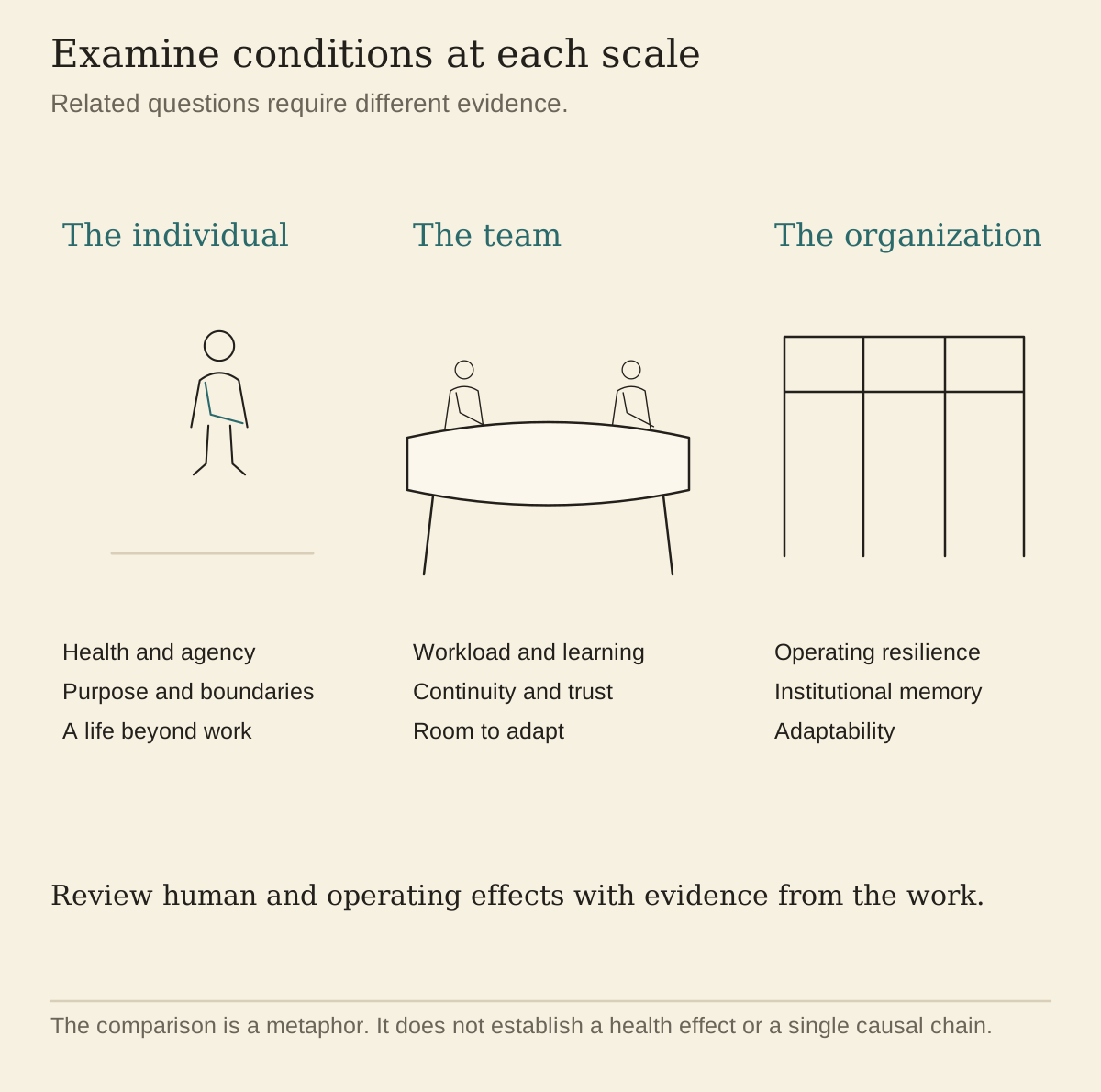
Longevity can be used as a metaphor at the team and company level, but the biology does not transfer. Harmonious passion is associated with lower burnout and some favorable work outcomes; it does not guarantee retention, institutional memory, adaptation, or corporate survival. Teams also sometimes should end, and companies can persist while harming people. Across the three scales, humane conditions may support resilience. They do not constitute one empirically demonstrated mechanism.
The point of naming this layer is to make the conversation bigger without turning metaphor into medicine. This is not “soft.” A quarterly engagement campaign rarely changes the work system. Leadership can instead invest in conditions whose human and operational effects are reviewed over time, while remaining humble about health claims and honest that durability has to be demonstrated.
What the Leadership Team Actually Does
The practical content of the section. What does the leadership team do to create the conditions described above? Four areas, each substantive.
Area one, Demonstrate by Example. Leaders who approach the transition with curiosity, ownership, and enough hands-on practice to understand the work send one signal. Leaders who call it transformation while delegating every encounter with the substance send another. Modeling matters, but leadership is not an absolute ceiling: expertise and energy often live deeper in the organization, and leaders should create room for them rather than demand imitation. The obligation is credible participation, informed decision-making, and visible willingness to learn. People can tell when executive passion is a performance.
Area two, Set Clear Expectations. “Be passionate” is neither actionable nor appropriate. Define instead what the transition asks people to do, learn, decide, disclose, and stop doing. Twenty percent learning time and one quarterly artifact may be useful in one role and absurd in another; they are examples to adapt. Set role-specific expectations with worker input, provide the resources to meet them, distinguish experimentation from evaluated performance, and create a safe path to challenge the plan. Ownership grows from meaningful authority and participation. A target by itself supplies neither.
Area three, Create Time and Space. People need paid time to learn new tools, redesign work, test them safely, and sometimes practice the underlying task without them. Adding transformation to an unchanged workload turns learning into overtime and selects for people with fewer obligations outside work. Protect hours, project capacity, access, support, and slack in a form that includes hourly, frontline, contract, disabled, and distributed workers. Some people will still prefer bounded adoption over passion. The investment is real because participation is work.
Area four, Give Real Feedback. Specific, useful, well-timed feedback can support competence by providing information for development, autonomy when it preserves agency, and relatedness when it reflects genuine attention. Bad feedback can frustrate all three. McLean & Company's 2025 vendor report analyzed surveys collected from roughly 216,000 employees across 236 organizations between 2019 and 2024. It reported that employees receiving meaningful manager feedback were 5.7 times as likely to feel supported in career advancement. That is a large association based on the vendor's measures, and causal return on investment would need a different study. Build feedback discipline around quality, evidence, dialogue, bias checks, and employee usefulness. Frequency quotas and AI-generated volume measure activity.
A note on what is missing from this list. Employee resource groups, recognition, wellness initiatives, benefits, compensation, job security, labor voice, and fair systems are not interchangeable “programs,” and some are substantive institutions in their own right. None substitutes for daily management, time, authority, and feedback; the four areas do not substitute for them either. Leaders should examine the whole employment system. Passion may emerge for some people. Fairness, safety, dignity, and the ability to do good work are obligations even when it does not.
Why All of This Matters for the AI-Native Transition
Pulling the section back to the field guide's central argument.
An AI-Native transition changes how work gets done and therefore requires meaningful participation from the people doing it. Harmonious passion may help; it is neither necessary nor sufficient for a good redesign. The failure cases in Section 8.2 have structural causes as well as motivational ones. Pilots die through weak ownership, integration, economics, governance, or need, and each of those takes structural work to fix. Institutional knowledge walks out when systems fail to capture it and when experts lack reason, safety, consent, or time to share. Hollowing-out occurs when work removes practice and responsibility without rebuilding capability. Do not explain an operating-system failure as a passion deficit in the workforce.
Investing in these conditions strengthens the operational substrate of transition. Even in a supportive company, people may reasonably experience AI as opportunity and threat at once. Resistance can carry information about safety, workload, surveillance, quality, inequality, or job loss. Curiosity is not proof of wisdom, and fear is not proof of backwardness. The outcome depends on technology, work design, power, labor-market conditions, governance, and whether people can shape what happens to them.
The cultivating-passion conversation is one part of the human side of AI-Native work. Architecture and human systems interact, but they are not two clean halves. A sound architecture can still go unused when it solves the wrong problem, violates trust, lacks workflow integration, or creates more burden than value. A willing workforce cannot rescue a technically unsafe system. Adoption is evidence to investigate, and demanding it corrupts the evidence.
A version of this work that goes right looks specific.
It can look like a Monday morning where people are excited about what they will build. It can look like a team meeting where someone shares an artifact they explored during paid learning time because they wanted to see what was possible. Weekend work is not the proof of passion; people should not need to donate private time to signal commitment. It looks like a manager genuinely curious about what direct reports are learning, including things the manager has never seen. It looks like a customer interaction in which the person cares whether the customer succeeds and AI removes friction without simulating care or weakening attention.
Over time, it may look like people who continued building portable skills, found meaning in some of the work, retained boundaries around the rest, and could leave with more capability than they brought. It may look like a company that adapted beyond the first wave of AI because learning conditions were renewed again and again across twenty years.
The people are the point of this version. AI can let them do something they could not do before, remove something they should never have had to do, or create a new burden that leaders must see. A leadership team that cultivates autonomy support, competence, connection, fairness, voice, and sustainable challenge is building work that some people may remember as the most engaging of their careers, and others may simply experience as good, fair work. Both are worthy outcomes.
The version is possible. The work described above improves its odds; evidence from the workforce determines whether it is actually being built.