How does a new toolbox change the type of output a team generates, the way they communicate, and how they share knowledge?
The work humans do to communicate with each other, learn from each other, inform their customers, and report on what the company is doing still relies on a familiar set of tools. The Word document. The PowerPoint slide. The PDF report. The Excel spreadsheet. The email summary. The Notion page. Some are older than others, but together they have become the formats of knowledge work, the vocabulary the company uses to think out loud with itself and with the people it serves.
A new toolbox is now available. The tools in it can generate visualizations, build interactive interfaces, produce conversational analyses, write documents, design presentations, prototype applications, and synthesize data at a speed and level of access the older toolbox rarely offered. The older tools are still here. The shift is that they are no longer the only options, and the new options change what becomes practical for the company that uses them well.
Three things change when teams have access to the new toolbox. The first is the output itself, what the work product is and what it can do. The second is how teams communicate with each other when they have the new tools in the room. The third is how the company shares knowledge with itself and with its customers. These are different questions with overlapping answers. Taking them in turn helps the leadership team see what is actually changing and what choices the company has to make.
A note before we begin. The phenomenon I am describing is not new in concept. The interactive document, the explorable explanation, the living artifact, have been on the horizon of knowledge work for years, championed most prominently by Bret Victor in his 2011 essay "Explorable Explanations" and the work that followed it. What is new is the falling cost of building these artifacts. A prototype that once required a developer and a substantial block of time may now be assembled in hours by a domain expert working with AI. Turning that prototype into a secure, accessible, maintainable production artifact still takes engineering and judgment. But the shift from rare jewel to everyday communication medium is underway, and the lower cost of exploration is driving it.
How the Output Changes
The first thing that changes is the work product itself, what it is, what it can do, what the reader can do with it.
Consider a familiar quarterly business review. It arrives as a slide deck, perhaps twenty-five to forty slides. The team spends days or weeks pulling data from different systems, arranging it into charts, writing commentary, and reviewing it through several rounds of edits before it reaches the audience. The audience receives the deck, reads it, asks questions, and the deck becomes a static record of what was discussed.
In the new toolbox, the quarterly business review can be a different kind of artifact. It can be a dashboard the audience can interact with, drilling into the underlying data, filtering by segment, asking questions in natural language that the system answers from the same data. It can be an explorable narrative that walks through the quarter and lets the reader manipulate the variables to test their own hypotheses. It can be a working model of the business that the audience uses to review last quarter and think through the next one.
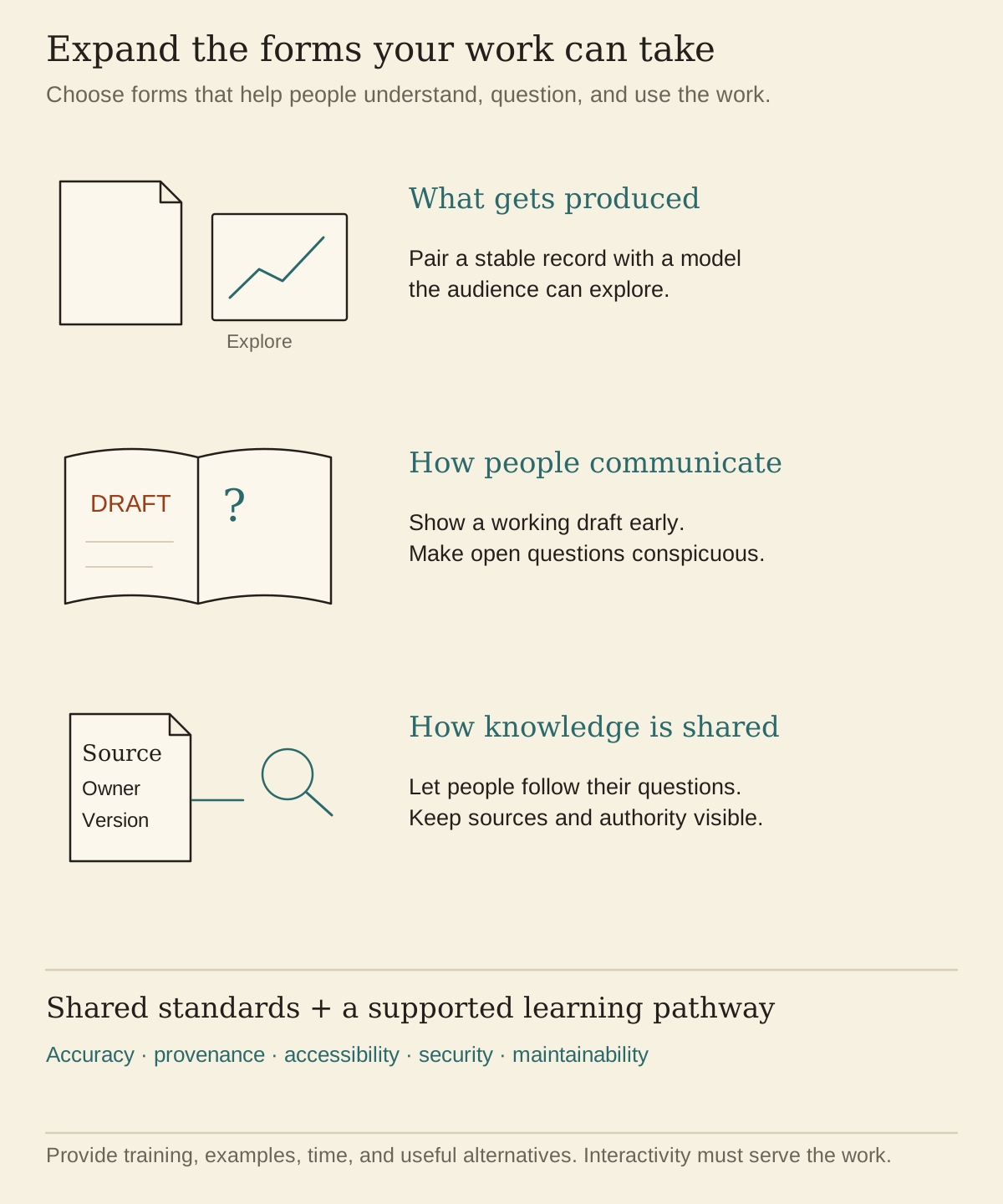
The shift from static to interactive is the most visible change. A static deck communicates what the team thought and provides a stable record that can be cited later. An interactive artifact lets the audience test the team's thinking. It may deepen engagement and improve the questions that follow, but interactivity is not automatically clarity. A badly designed dashboard can hide definitions as easily as a bad slide can. Natural-language answers need grounded data, visible provenance, appropriate permissions, and a way to inspect the source. The aim is not motion on the screen. It is better thinking together.
This is not theoretical. Parts of professional services are testing a related shift: some fees moving from hours toward outcomes and some firms moving from advice toward implementation. Where clients buy an outcome, they may expect working prototypes, dashboards, or AI tools alongside the advice. The consultant experiment in Section 5.3 shows why each new form of work needs its own quality checks. The gains depended on the task. The lesson is not that AI makes analysis better. It is that the frontier is jagged, moves over time, and has to be tested against the actual work.
The same shift is beginning inside the enterprise as well as at the boundary with consultants. A marketing report assembled manually from six dashboards every Friday can become an approved system that pulls from the same sources and delivers an analysis decision-makers can query. A financial report can pair its stable, controlled record with a conversational layer for follow-up questions. A strategy document can include an interactive model that lets the reader test its underlying assumptions. These are possibilities, and each has to be built. Each depends on data quality, access controls, validation, and a clear source of record.
The pattern across all of these is the same. The work product is no longer just a document about the work. The work product is becoming a working artifact the audience can use. That is what is changing about the output.
How Communication Changes
The second thing that changes is how teams communicate with each other in the course of producing and sharing work products.
A common communication pattern in the older toolbox was sequential. One person produced something and handed it to another. The other person read it, responded, and sent something back. Work moved between people through documents, and every handoff introduced an opportunity for translation loss or delay. A team working on a strategy might spend two weeks moving a draft through five people before the next substantive conversation happened.
The new toolbox changes the pattern in several specific ways.
The first is that the lag between thinking and showing can shrink. A team member may go from a sentence to a rough visualization of that sentence in minutes. Instead of sending only a memo that explains an idea, they can also send an artifact that demonstrates it. The conversation can move from imagining a hypothetical to inspecting several versions of it. That can compress hours of abstract debate, although verification and integration still take time.
The second is that the polished-final-output convention is starting to fray. In the old toolbox, you did not show something until it was ready. You worked on it in private until the version you would be willing to defend was the one you brought to the room. In the new toolbox, the cost of producing a presentable version is so low that bringing rough versions to the conversation is less embarrassing. The team can talk about what it is thinking earlier, with artifacts that make the thinking visible before it is finished. The risk is false completeness: a rough idea can now look final. Draft status, provenance, and unresolved questions have to be conspicuous. Used that way, the tools support more iteration, earlier in the process.
The third is that the asynchronous-synchronous distinction softens. With the old toolbox, you wrote a document and the other person read it later. With the new toolbox, an artifact can be something both people manipulate, separately or together, with an AI system helping each person engage with the other's contribution. The collaboration surface that Section 4.3 describes is one place this happens. A governed shared workspace can make the communication pattern available beyond a pair, but it is not appropriate for every conversation or every piece of data. Privacy, confidentiality, permissions, and the freedom to think without permanent capture still matter.
The communication change is harder to see than the output change because it shows up inside the team rather than in a deliverable. But it may be the more consequential of the two over the long run. A team that learns this pattern can produce stronger work faster, have better-grounded conversations, and converge on decisions with more substance. Whether it does so is an empirical question for the team, answered with evidence from the work.
How Knowledge Sharing Changes
The third thing that changes is how the company shares what it knows. With itself, internally, and with the customers it serves.
Knowledge sharing has always had two modes. One is the broadcast mode, in which one person produces content (a report, a presentation, a manual) and many people consume it. The other is the conversational mode, in which two or more people exchange knowledge directly, often with the option to ask questions in real time. The broadcast mode scales. The conversational mode does not. For most of business history, scale has required broadcast, which means knowledge sharing has been mostly one-directional.
The new toolbox changes this. An artifact that someone can explore at their own pace, ask questions of, and learn from in their own order is neither pure broadcast nor a human conversation. It is a third form: scalable and adaptive, but not reciprocal in the human sense. A company can produce a single governed artifact and have it serve hundreds or thousands of consumers, each following a path through the material rather than receiving it passively.
For internal knowledge sharing, this changes what is possible for institutional learning. The decisions the company made last quarter, the reasoning behind them, and the data they were based on can be made available as interactive artifacts that newer employees can explore, rather than buried in slide decks that few people revisit. But the generated answer must not quietly become the institutional record. The source decision, owner, date, version, evidence, permissions, and rationale have to remain visible and authoritative. With that discipline, reference architectures, strategic frameworks, and procedural knowledge can become artifacts that someone learning the company can interrogate as well as read. This is the institutional knowledge layer from Section 4.1, surfaced in a form humans can use.
For external knowledge sharing, the shift can change the customer relationship. A customer who receives an interactive artifact may drill into the data that matters to them, test assumptions against their own context, and arrive at a more informed understanding. That does not mean the artifact verifies itself. Trust still depends on transparent definitions, traceable sources, disclosed limitations, and a stable or exportable version the customer can cite. Accessibility also requires an effective alternative for customers who cannot or do not want to use the interactive layer. Built with those protections, the customer becomes a more active participant in the analysis.
The implications for customer-facing knowledge work are substantial. Sales presentations that used to be one-way pitches can become scenarios the prospect explores. Customer success reports that used to be quarterly PDFs can pair a controlled snapshot with a live dashboard the customer revisits. Product documentation that used to be the place customers gave up can become an environment in which the customer learns the product. Companies that recognize the shift early can create more useful knowledge sharing. The advantage will come from usefulness and trust. Interactivity matters only when it serves those.
The Exploration Question for the Leadership Team
The three changes above raise a question the leadership team has to address. What should the new standard be for knowledge work output in this company?
The default answer is no answer. The work products that get produced are whatever the workforce, individually, decides they should be. Some people learn the new tools fast and produce dramatically better artifacts. Some people stick with what they have always done. The output of the company becomes a patchwork, with high-fluency teams producing one quality of work and low-fluency teams producing another. The customer experience varies depending on which team serves them. The internal experience varies depending on which colleague produces the document. The company has not made a choice about what its standard is, and so the standard is defined by whoever happens to be producing the work.
At sufficient scale, that patchwork becomes difficult to sustain. A company that lets every important work-product standard emerge from individual initiative can create inconsistency that customers notice and employees feel. The leadership team that wants to avoid this has to decide deliberately where shared standards matter and where variation is useful.
The work begins with opening the hood. The leadership team has to see what is now possible, firsthand. Spend a session with the tools that are now available. Watch a working artifact get built in twenty minutes. Produce one themselves. The exploration has to be embodied, done with the tools in hand, because the gap between what people imagine the tools can do and what the tools can actually do is wide.
The work continues with looking at the company's current work products through new eyes. The quarterly review deck. The customer-facing reports. The internal training materials. The strategy documents. What would these look like if the team building them had the new toolbox and was using it deliberately? Some of the work products would not change much. The form fits the function. Others would change substantially. The form is now a constraint that the new tools have removed.
The work ends with a choice. The leadership team defines standards for the artifacts that matter, the ones that represent how the company communicates with itself and with the people it serves. Shared expectations for accuracy, provenance, accessibility, security, maintainability, and fitness for purpose, across whatever formats the work needs. The choice is a stake in the ground: here is what good looks like now, and here is the support available to help the work get there.
The Pathway Question
The exploration sets the destination. The pathway is how the workforce gets there.
The pathway is the part that gets skipped. They explore. They get excited. They set a new bar. And then they leave it to individual employees to figure out how to clear it. This produces the same two-tier outcome as having no standard at all. The early adopters meet the new standard. The late adopters cannot. The work product quality across the company stays inconsistent, because the bar moved but the support for clearing it did not.
The pathway requires deliberate design. The leadership team has to decide how the workforce learns the new tools, how the early adopters help the rest catch up, how the company invests in the transition rather than expecting it to happen on its own.
A short list of what the pathway involves:
Work-Specific Training. Investment that is specific to the work the company actually does, well beyond generic AI tool training. A finance analyst learning to build interactive dashboards with approved or sanitized financial data, inside an authorized environment, is learning something more useful than a finance analyst using the same tool in the abstract. The controls are part of the skill, learned from the start.
Champions Paired with Learners: internal champions who are already producing the new kind of work product, paired with people who are still learning it. The fastest way to learn what good looks like is often to work alongside someone producing it. The company that identifies its early adopters, gives them protected time and recognition to mentor others, and does not turn their expertise into an unpaid second job is building the pathway.
Visible Working Examples. The strategy doc that became an explorable model. The quarterly review that became an interactive dashboard. The customer report that became a live artifact. When the workforce can see the new standard in action, on artifacts they recognize, they have a target.
Permission to Learn. The transition to the new toolbox is not free. It takes hours. The workforce that is told to produce the old output at the old pace while also learning the new tools will produce neither well. The leadership team that wants the up-leveling to happen has to make space for it, explicitly, in how the workforce spends its time.
A Designed Pace. Patience with uneven adoption: the pathway should follow the complexity and consequence of the work, at whatever pace that sets. A low-risk internal prototype and a regulated customer artifact should not move at the same speed. The leadership team that pushes too hard will produce backlash and unsafe shortcuts. The leadership team that pushes too softly will produce drift. The pace has to be designed, measured, and adjusted.
The pathway is the work. The exploration is the easy part. The pathway determines whether the company raises capability broadly or fragments into supported insiders and everyone else. It should make room for disability, role differences, legitimate non-use, and people whose work does not benefit from the new form. Collective progress is not forced uniformity.
What Is Not Changing
What does not change in this transition needs naming, because the argument otherwise risks producing the impression that AI does the work and humans just learn the tools.
What does not change is the need for accountable human contribution to give a work product its impact. The judgment about what to communicate and what to omit. The framing of the argument so the audience can follow it. The willingness to commit to a position rather than presenting every option neutrally. The storytelling that turns a collection of facts into something the audience can use. The presence of a human voice the audience trusts. AI can assist with each of these, and the division of work will change. But a person or institution still has to own the judgment, evidence, consequences, and final claim.
A leadership team that confuses the form of the work product with the substance will produce a workforce that makes very polished artifacts of weak arguments. The form will impress. The substance will not. The audience will notice the gap, eventually, and the trust the company has built on the substance of its past work will erode.
Some of the up-leveling is surface: speed, polish, and the range of forms available. Some is substantive: an interactive model can expose assumptions a static document leaves hidden. Neither guarantees good work. Hold the distinction clearly and the company gets the benefit of the new toolbox without losing the judgment the toolbox is supposed to serve. Confuse polish with substance and the workforce produces artifacts that look like AI-Native work but are actually slop with better visualization.
The three changes named in this section (what gets produced, how teams communicate, and how knowledge gets shared) are happening in parallel. They can reinforce one another. Progress in only one dimension may still create value, but it can also expose mismatches: an interactive artifact inside a sequential review process, or a shared workspace with no shared quality standard. Coherence comes from designing the connections among all three.
The shift, done well, is collective without demanding identical tools or outputs from every role. The organization adopts shared quality principles, and the leadership team explicitly designs the access, training, time, and alternatives people need to meet them. The shift, done poorly, produces a two-tier workforce where the AI-fluent pull ahead and the rest fall behind, and knowledge work that is inconsistent across the company in ways customers and employees both feel.
The leadership team can influence which outcome becomes more likely. The toolbox will continue to change, and work products will change with it. The question is whether the company changes deliberately, with shared principles and support, or by accident, in fragments.
The next section takes up what happens to credit and recognition when an agent did part of the work. How a company produces, communicates, and shares can reinforce itself when the pieces support one another. Over time, the difference should become visible in the usefulness, trustworthiness, and reach of the work. How modern the artifacts look is the least of it.