Who gets the credit when an agent did part of the work?
Here is a sentence I expect to hear in every company within a few years: my agent did it.
It sounds like modesty. Underneath it is a loss. For most of working history, effort was the proof. You spent the week on the analysis, the effort showed in the result, the people around you saw it, and you knew the work was yours. In 2012 Michael Norton, Daniel Mochon, and Dan Ariely gave part of this a name, the IKEA effect: people value what they build themselves, and the effect holds when they did the labor and finished it. Pride has always run partly on effort.
Agents break that chain in two places. The effort moves to the agent, so the person can no longer feel the work as theirs. And the output stops proving anything about the person, because everyone has the same agent.
Everyone Has the Same Agent
Section 2.2 made this argument about companies: access to frontier models is no longer scarce enough to be a moat by itself. The same holds for a person. A polished memo, a clean analysis, a working prototype now say more about the tools than about whoever produced them. Praise aimed at the output lands on the machine.
That is why the old ways of acknowledging work stop working. "Great deck" used to recognize the hours, the judgment, and the craft behind it. Said today, it may recognize a prompt. The person hearing it knows the difference, and the praise lands hollow.
What the Research Shows
The effect is measurable inside the person. In experiments by Fiona Draxler and colleagues, people felt little ownership of text an AI had written for them, yet they still put their own names on it. The more influence they had over the text, the more ownership they felt. Section 5.8 described the sharper version: professionals who copied an AI's output lost ownership, confidence, and meaning, while those who drafted first and used the AI to refine kept all three. In separate experiments with 3,562 people, Wu and colleagues found that working with generative AI raised performance on the task, and that when people returned to working alone, their intrinsic motivation fell and their boredom rose.
The effect is just as measurable between people. Across four experiments with more than 4,400 participants, Reif, Larrick, and Soll found that people who use AI at work are judged lazier and less competent, and are hired less often. Oliver Schilke and Martin Reimann ran thirteen experiments on disclosure and found that people who openly said they had used AI were trusted less than people who kept it quiet, because disclosure suggested less human input and judgment.
Put those together and the incentive is plain. Use the tools the company asked you to use, say so, and you are marked down. Keep quiet, and you keep your standing. Section 8.2 described the result: shadow AI, adopted out of sight. A culture that penalizes honest use teaches people to hide it.
Value the Human Part
My instinct is that human work should be valued higher than machine work. The research shows how that instinct goes wrong when it is applied bluntly. The penalty for using AI already exists, and it pushes people to conceal what they did. The version that works values the human part of AI-assisted work, out loud, so nobody has to hide the tools to get the credit.
Section 5.4 already describes that human part. It calls it authorship in the deeper sense: who understood the problem, noticed what was missing, made the consequential choices, and can answer for the result when challenged. An agent can draft. Authorship in that sense stays with a person.
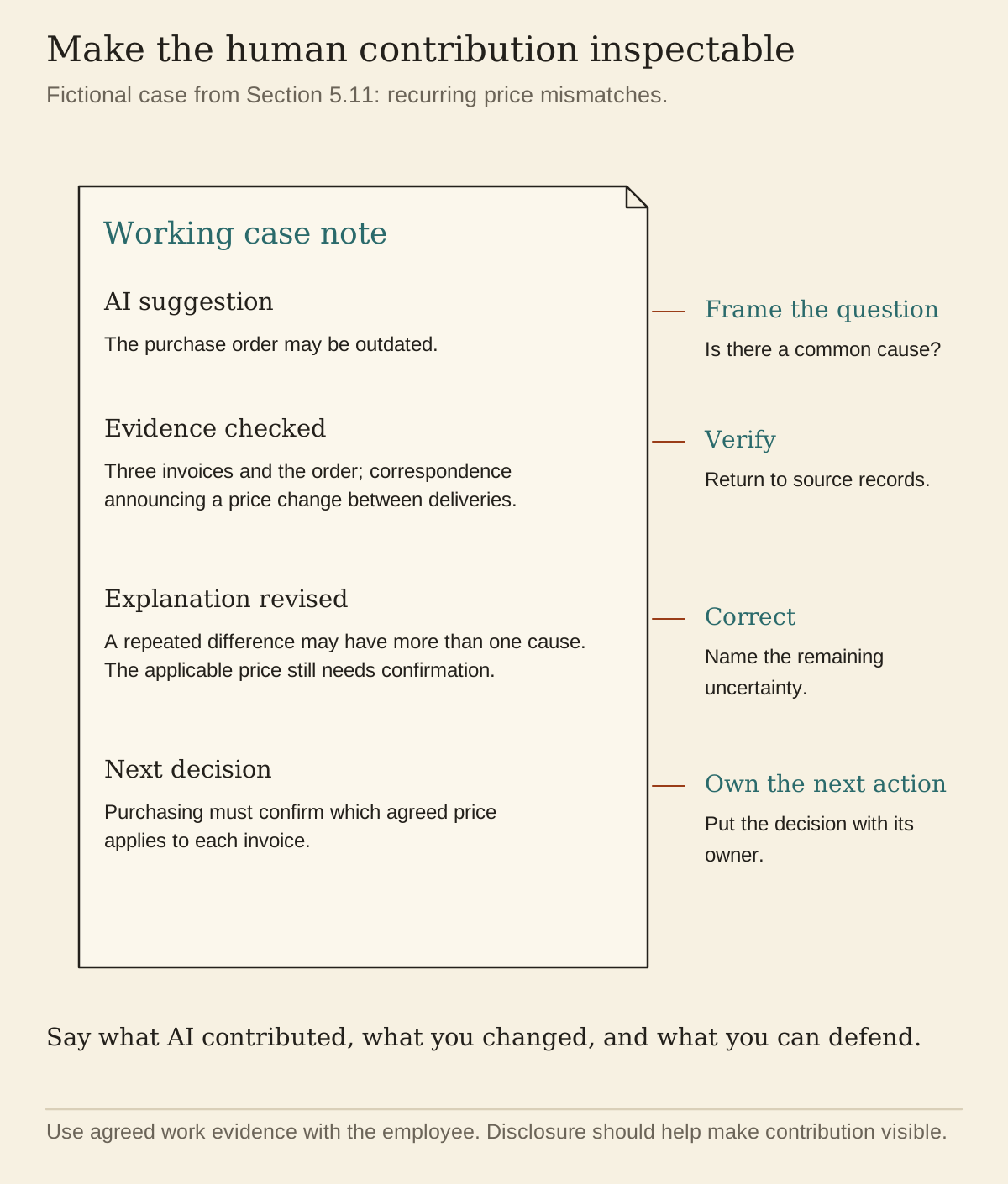
Recognition has to move there. In practice that means a new set of questions, asked in reviews, in meetings, and when work is handed over:
What did you decide, and why?
What did you throw out?
What did you know that the agent didn't?
What would you stand behind if challenged?
Each one points at the part of the work only the person could supply. Asked consistently, they also teach the habit Section 5.8 found protective: think first, then let the agent sharpen the result. Section 6.1 asks for appreciation that is specific and grounded in the actual contribution. These questions are how a team finds the actual contribution when an agent was part of the work.
An Etiquette Is Forming
Teams are already working out the manners of this. In a 2026 study of 1,534 knowledge workers at a multinational technology company, Rudrajit Choudhuri and colleagues described an emerging etiquette for AI-supported work: the obligations colleagues expect of one another when preparing it, sharing it, and taking responsibility for it. The details will vary by company. Three norms travel well.
Say what the agent did. Disclosure stops being a confession once it is routine and expected of everyone, including the people at the top.
Say what you did. The decisions, the context, the parts you rejected. This is where credit attaches.
Own the result. Whoever shares the work answers for it, whatever produced the draft.
Leaders go first, as Section 5.2 argued for the reckoning. A leader who says in a meeting, "The agent drafted this. Here is what I changed, and why," makes disclosure safe faster than any policy can.
What Changes for Managers
The manager's job shifts toward finding the person in the work. That takes more conversation and less inspection. It also takes care with evidence. Section 7.3 keeps organizational measures of the transition out of individual performance reviews, and Section 5.11 agrees role-specific evidence with each employee. Credit for the human part belongs in that second conversation, built on what the person decided and can defend.
The payoff is the one Section 5.8 described. People who can see their own contribution keep contributing what they know.
The next section returns to a different layer of the same conversation, the systems-thinking layer that explains why some transitions reinforce themselves and others defeat themselves.
Bring this into the room. Take a recent piece of work that an agent helped produce. Have the person who led it walk the team through the four questions: what they decided, what they threw out, what they knew that the agent didn't, and what they would stand behind. Then have the team say what it values in the work, aiming only at what the person supplied. Notice how hard that is the first time. Finish by agreeing the team's norms: when to say what the agent did, how to credit the human part, and who answers for the result.
Intellectual lineage. The IKEA effect explains why effort feeds pride. The ghostwriter effect and the motivation studies show what happens to ownership when an agent supplies the effort; the social-penalty and disclosure studies show why people hide it. Section 5.4's deeper authorship gives recognition somewhere to land.
Norton, M. I., Mochon, D., and Ariely, D. (2012). The IKEA effect: When labor leads to love. Journal of Consumer Psychology, 22(3), 453–460. / Draxler, F., and colleagues (2024). The AI ghostwriter effect: When users do not perceive ownership of AI-generated text but self-declare as authors. ACM Transactions on Computer-Human Interaction, 31(2). / Lee, E. H., Yin, Y., Jia, N., and Wakslak, C. J. (2026). Relying on AI at work reduces self-efficacy, ownership, and meaning while active collaboration mitigates the effects. Scientific Reports, 16, 13583. / Wu, S., Liu, Y., Ruan, M., Chen, S., and Xie, X.-Y. (2025). Human-generative AI collaboration enhances task performance but undermines human's intrinsic motivation. Scientific Reports, 15, 15105. / Reif, Larrick, and Soll (2025). Evidence of a social evaluation penalty for using AI. Proceedings of the National Academy of Sciences. / Schilke, O., and Reimann, M. (2025). The transparency dilemma: How AI disclosure erodes trust. Organizational Behavior and Human Decision Processes. / Choudhuri, R., and colleagues (2026). What makes a great co-worker in an AI-native workplace? arXiv preprint 2609.13786.
Consider. If you keep four things from Stage 6: 1) A value is what the team says; a practice is what the team does, and the practice defeats the value when the two diverge. 2) Design meaningful human involvement around consequence, context, rights, and responsibility: identify the moments, invest in them, protect them, reflect on them. 3) Watch the manager layer: AI can make distance look like attentiveness, and a clean dashboard can coexist with deteriorating conditions. 4) When an agent did part of the work, move recognition to the human part: ask what the person decided, what they threw out, and what they knew that the agent didn't.