Why do AI transformations keep producing the same problems?
Leadership teams often treat the AI-Native transition as a series of linear decisions. The plan reads: invest, deploy the tools, train the workforce, measure adoption, report progress. That framing produces a useful project plan, with milestones and dependencies and gates. It is necessary. It is not enough.
An AI-Native transition also behaves as a system. Each decision can feed loops that produce unintended outcomes, accelerate unseen dynamics, and sometimes defeat the goal itself. Leaders who cannot see the loops will struggle to explain why the transition keeps delivering the results it delivers. Leaders who learn to see them gain a better account of where intervention may matter.
Here are the major loops in an AI-Native transition. Treat the walk as a working diagnostic rather than an exhaustive catalog, one a leadership team can apply to their own company to identify what is reinforcing what, what is balancing what, and what is defeating what.
Intellectual lineage. The vocabulary of reinforcing and balancing feedback loops, system archetypes, and places to intervene in a system is not new. Jay Forrester developed system dynamics at MIT in the late 1950s; his 1961 book Industrial Dynamics gave the field a rigorous modeling method. Peter Senge brought systems thinking to a broad leadership audience in 1990 with The Fifth Discipline, including eleven laws and archetypes such as limits to growth, shifting the burden, success to the successful, and tragedy of the commons. This section applies that tradition to the specific question of how AI transformations succeed and fail. The lineage is Forrester, Senge, and the wider field. The selection and application of these ten loops are mine.
Forrester, Jay W. (1961). Industrial Dynamics. MIT Press. / Senge, Peter M. (1990). The Fifth Discipline: The Art and Practice of the Learning Organization. New York: Doubleday/Currency.
The stakes. The claim that roughly seventy percent of corporate transformations fail is so widely repeated it has become folklore, and its definitions and evidentiary basis are contested. McKinsey surveys have reported that fewer than one-third of respondents regarded their transformations as both improving performance and sustaining the improvement. That is a self-reported measure, too narrow to serve as a universal failure rate. AI-Native transformation carries familiar transformation risks plus technical, workforce, and governance dependencies of its own. Understanding the loops does not guarantee success. It gives the leadership team a better way to diagnose why an intervention is compounding, being resisted, or producing a result nobody intended.
Robinson, Harry (2019). "Why do most transformations fail?" McKinsey Insights, July 2019. / Hughes, Mark (2011). "Do 70 Per Cent of All Organisational Change Initiatives Really Fail?" Journal of Change Management, 11(4).
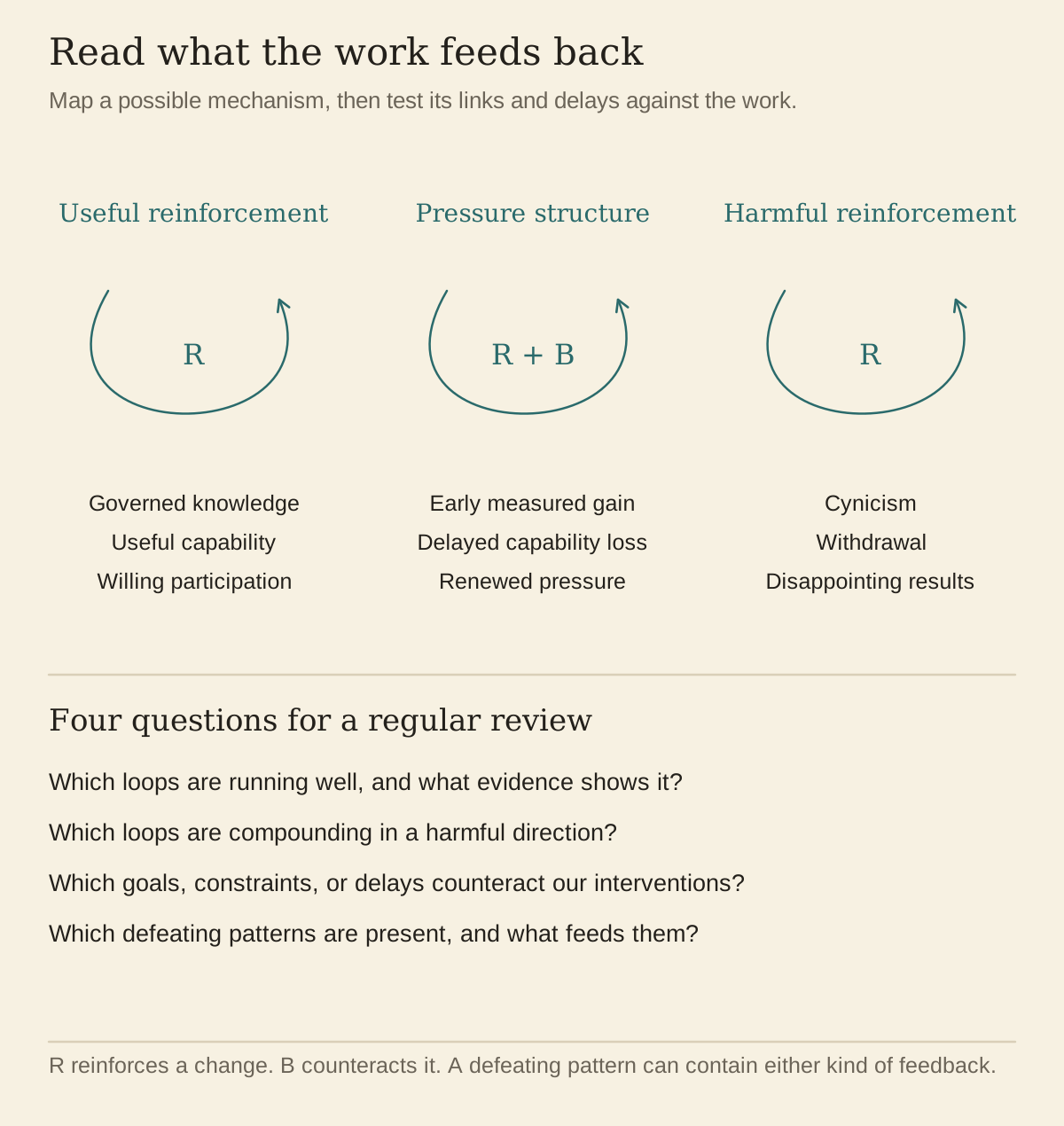
The Two Kinds of Loops
A reinforcing loop is a loop where the output of the loop feeds back into the input, producing acceleration in the same direction. The loop compounds. Small initial states grow into large states over time. Reinforcing loops are powerful and they go both ways. The same loop that produces compounding success can also produce compounding failure, depending on which direction the loop is running.
A balancing loop is a loop where a change triggers effects that oppose that change, tending toward a goal, limit, or equilibrium. It can stabilize a system, but not necessarily at its old state and not regardless of intervention. A thermostat is the familiar example: a gap between the temperature and the setting triggers action that reduces the gap. In organizations, delays, inaccurate signals, competing goals, and changing constraints can make balancing behavior overshoot, oscillate, or settle somewhere undesirable.
Every leadership team is doing work that interacts with both kinds of loops simultaneously, usually without recognizing which is which. Acceleration may indicate a reinforcing loop, but frustration alone does not prove a balancing one. The discipline is to draw the causal links, mark whether each link moves in the same or opposite direction, identify delays, and test the explanation against evidence. The names are useful only if the mechanism underneath them is real.
The Reinforcing Loops in an AI-Native Transition
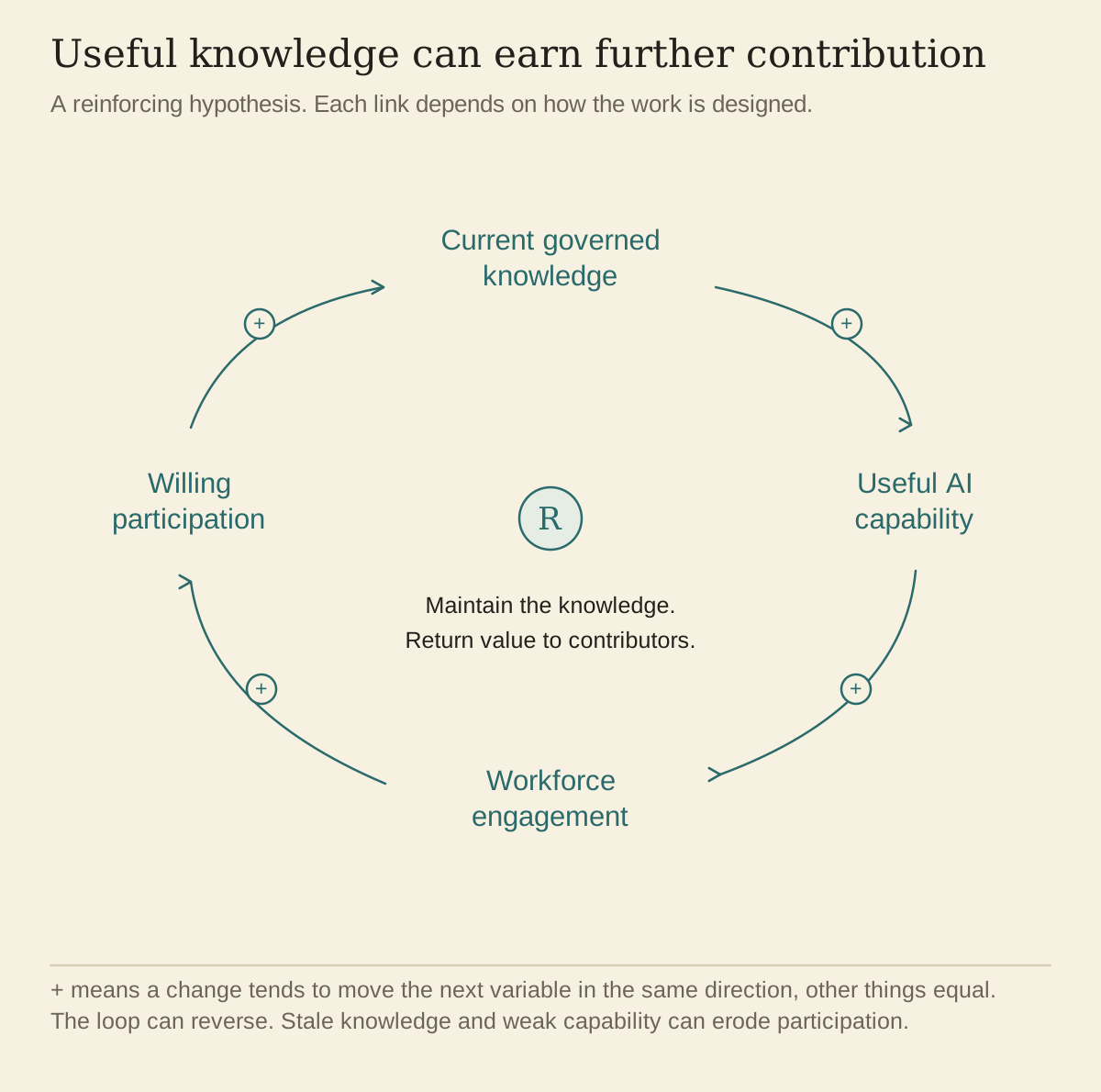
The first major reinforcing loop is what I will call the knowledge-capture loop. The company invests in capturing useful institutional knowledge through the mix of graphs, documents, records, rules, and other structures described in Section 4.1. Better governed knowledge can improve AI capability for the relevant work. Useful capability can earn workforce engagement. Engagement can feed more willing participation in keeping the knowledge current. The cycle can compound into an advantage that is difficult to copy because it consists of stored information and of years of maintenance, use, correction, and trust. The loop can also reverse: stale capture produces weak capability, which reduces use and leaves the knowledge staler still.
The second major reinforcing loop is the trust loop. The leadership team treats the workforce with honesty about the transition. Consistent words and actions can build trust. Trust can increase willingness to contribute knowledge under a fair covenant. That contribution supports AI capability that helps the workforce do its work. Visible, fairly distributed benefit can deepen trust. The loop compounds only while consent, credit, privacy, and the employment bargain hold. If capture is used against the people who contributed, the same links can turn a trust loop into a betrayal loop.
The third major reinforcing loop is the practice-and-craft loop. The team adopts the practices from Section 6.1. The practices can build craft, in the specific sense of the team developing a distinctive way of working that shows in distinctive output. Recognition of that craft can reinforce the practices because the team sees what disciplined work is earning. Over time, distinctive craft may become a source of advantage. Recognition can also corrupt the loop if it rewards appearance, heroics, or conformity instead of quality, learning, and contribution.
The fourth major reinforcing loop is the up-leveling loop. Environments that support up-leveling can grow capacities that unsupported environments are less likely to develop. Those capacities can show up as more distinctive work. Distinctive work may attract more demanding assignments, and those assignments can create the need and opportunity for further growth. The cycle is not automatic: overload, unequal access, or assignments without coaching can reverse it into burnout. The loop compounds when challenge is paired with support, time, feedback, and fair opportunity.
These four loops, when they are running well, can produce compounding capability that a tool deployment alone does not. The loops are not independent. They can feed one another: governed knowledge improves a useful capability; useful capability can earn engagement; fair participation can support trust; and trust can make continued contribution more likely. Every link remains conditional and should be tested.
The Loops That Resist or Limit the Transition
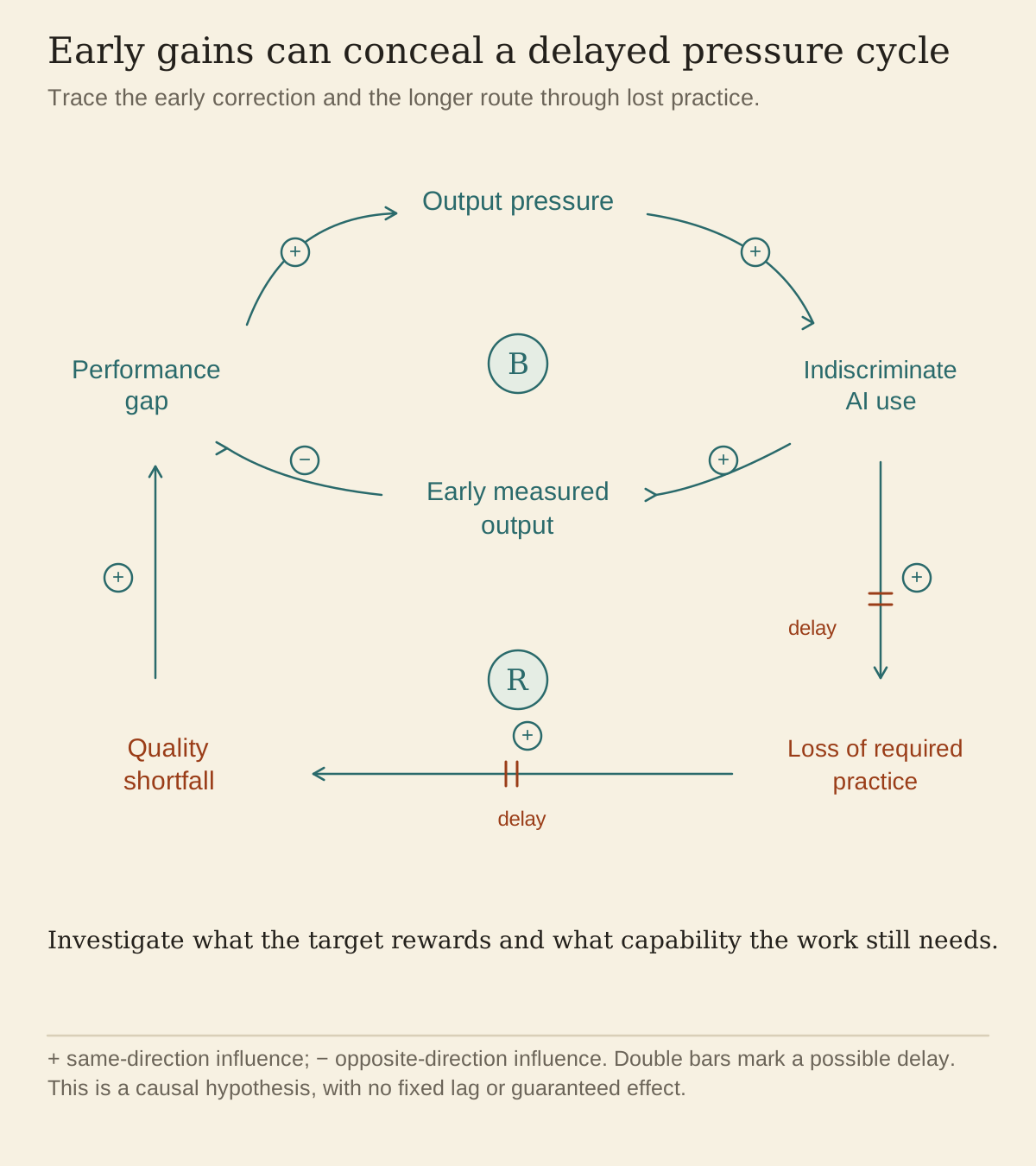
The first is the productivity-pressure structure. The leadership team measures the workforce narrowly on output. Workers respond rationally by using AI wherever it improves the measured number. Early gains may reduce the performance gap, a balancing effect. But indiscriminate use can also weaken required practice and learning from Sections 5.4 and 5.5. If capability erosion later reduces quality or sustainable performance, leadership may respond with more pressure, producing a vicious reinforcing cycle. What looks like one loop is an interacting structure with a delay: short-term correction can conceal long-term damage.
The leadership team that wants to break this loop has to recognize that the productivity measurement system is the engine of the loop. Without changing the measurement system, exhortations about up-leveling and human-AI collaboration will be absorbed by the loop.
The second is the risk-aversion structure. The consequences of a public AI failure are visible, while some costs of delayed learning are diffuse. Governance constraints reduce exposure to immediate harm, which is a legitimate balancing function. If those constraints also prevent bounded experimentation, learning slows. Limited capability can then confirm the belief that the technology cannot be used safely, reinforcing avoidance. The diagnosis matters: governance is not the enemy. Undifferentiated governance that treats a sandboxed internal trial like an irreversible high-consequence deployment is the problem.
Breaking the harmful cycle requires neither abandoning controls nor absorbing unspecified risk. It requires risk-tiered learning: low-consequence, reversible experiments inside clear boundaries; stronger review as consequence rises; explicit stop conditions; and evidence that feeds governance back. Slow adoption has costs, but so does reckless adoption. The job is to make both visible and learn without transferring the downside to workers or customers.
The third is the status-preservation structure. An organizational hierarchy distributes authority, information, pay, and opportunity; it is not only a status game. An AI-Native operating model may flatten some layers while centralizing power in others. People who lose authority or standing may resist, sometimes through politics and sometimes because they see a genuine flaw the designers missed. If leadership treats every objection as proof of obstruction, it can intensify mistrust. If it treats every objection as a veto, the old structure persists. Either response can produce nominal AI-Native rhetoric and de facto pre-AI operations.
Breaking this structure requires examining incentives, decision rights, and evidence. A person's seniority or skepticism is a poor basis for diagnosis. Some conduct will require coaching, role redesign, or fair personnel action. Some resistance will reveal a defect in the transition. Leaders have to distinguish the two through transparent criteria, due process, and workforce participation. Political power should not confer immunity, and enthusiasm should not confer correctness.
The Defeating Loops
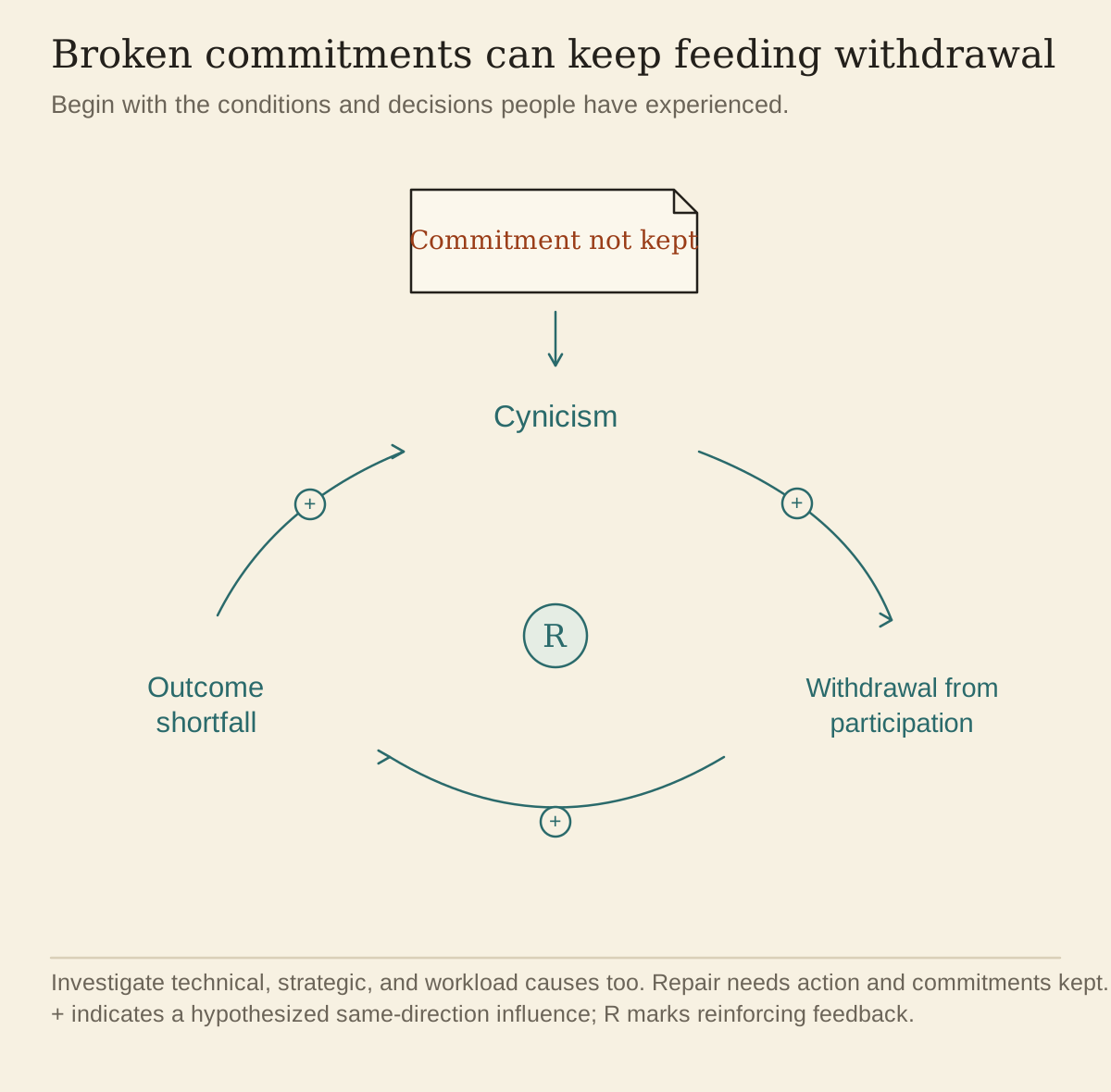
"Defeating" is not a third formal polarity alongside reinforcing and balancing. It is my managerial category for feedback structures that can defeat an AI-Native transition even when the leadership team has done the surface work well. Each structure still has to be mapped as reinforcing, balancing, or a combination of the two. These patterns are drawn from transformation research and from dynamics I recognize in practice.
The first defeating loop is the cynicism loop. The workforce becomes cynical about the transition. Cynicism can breed disengagement. Disengagement can degrade knowledge capture, practice adoption, and learning from AI use. Poor outcomes then confirm the cynical interpretation. The loop compounds in the wrong direction. A company may keep spending while returns weaken, and the weaker returns reinforce the cynicism that helped produce them alongside whatever technical or strategic failures are also present.
The cynicism loop is started by specific events. In January the CEO stands in the cafeteria and announces the AI strategy, a slide behind him, a promise of investment in every person in the room. By October the steering meetings have gone from weekly to monthly to canceled, the training budget has moved to next year, and the slide has stopped appearing in his decks. There is no second announcement. The workforce can name the month it ended. Events like these seed the loop. Once the loop is running, it is hard to reverse, because the workforce has the evidence to interpret every subsequent action through the cynical frame.
The second defeating loop is the defensive-expertise loop. Workers may decline to contribute expertise for the reasons named in Section 5.9: fear, unfair extraction, privacy, workload, professional duty, or a rational judgment that the capture method is unsound. Thin or stale knowledge can leave weak AI capability. Weak capability can then confirm that participation is not worth the cost, and the cycle reinforces itself. But weak AI performance may also be an accurate signal of model limits or a poor use case. The diagnosis cannot begin by assuming the worker is the defect.
Interrupting the harmful form of this loop requires the leadership team to address the conditions producing nonparticipation. The human reckoning and covenant from Section 5.2 are part of that work: voluntary and appropriately compensated contribution, consent and privacy boundaries, credit, workload protection, professional review, and visible benefit. Better engineering and the willingness to abandon an unsuitable use case matter too. The goal is trustworthy participation, with people deciding what they share.
The third defeating loop is the metric-displacement loop. The leadership team starts the transition with the right values. The values are translated into metrics. The metrics drive behavior. The behavior generates outcomes the leadership team did not intend, because the metrics did not actually capture the values. The leadership team responds by adding more metrics. The new metrics drive more behavior, and the behavior generates more unintended outcomes. The loop compounds. The transition becomes an exercise in metric optimization that has lost touch with the underlying values that the transition was supposed to serve.
Companies that break this loop accept that some things they value cannot be measured directly and that every proxy can be gamed. They do not abandon measurement. They combine a small set of indicators with qualitative evidence, disaggregated effects, counter-metrics, direct observation, and periodic review of whether the measure still serves the value. They invest in the practices and moments that produce the values, then use evidence as feedback rather than a substitute for judgment.
How to Read a Transition Through the Loops
A leadership team that wants to apply this framework to their own transition can do so with a simple practice. At a regular interval, the team asks four questions.
Which loops are running well? What evidence shows the improvement? What is helping it continue? How can we support it?
What loops are running in the wrong direction. Which of the reinforcing loops are compounding in the wrong direction. Which loops have started and need to be interrupted before they become self-sustaining.
What balancing effects or limiting structures are counteracting our interventions. What goal, constraint, delay, or competing incentive is producing the response. Is that response protective, harmful, or both. What would we need to change, and what protection would we lose if we changed it.
What defeating loops are present. Cynicism, defensive expertise, metric displacement. Any others specific to our company. What is feeding them. What would interrupt them.
Asking those four questions regularly is the systems-thinking discipline at the leadership-team level.
The next section addresses the deepest layer of the systems view. Where change actually takes hold.
Bring this into the room. Take the four-question diagnostic to your leadership team. Block ninety minutes. Bring whiteboards. Answer the questions for the last three months, then for the next three months. What matters is less the questions themselves than the practice of answering them in front of each other, regularly, with honest specificity. The loops you cannot see together you cannot intervene on together.
The table below compresses the ten loops of this section into one view a leadership team can hold during the four-question diagnostic. The full descriptions, and the interventions in context, are in the pages behind you.
The Ten Loops at a Glance
- [object Object]
- [object Object]
- [object Object]
- [object Object]
- [object Object]
- [object Object]
- [object Object]
- [object Object]
- [object Object]
- [object Object]