What actually makes change last?
The iceberg model is a teaching device from the systems-thinking education tradition. No single author owns it; generations of systems educators have used it to connect visible events with patterns, structures, and mental models beneath them. Donella Meadows offered a related but more detailed argument in "Leverage Points: Places to Intervene in a System" (1999): interventions differ in how much they can change a system, with a system's shared assumptions near the top of her list and the capacity to question those assumptions above them. She also warned that the most powerful points of intervention are difficult to change and easy to push in the wrong direction. The iceberg is therefore a prompt for inquiry. Some events have several causes, and sometimes the right place to act is near the surface.
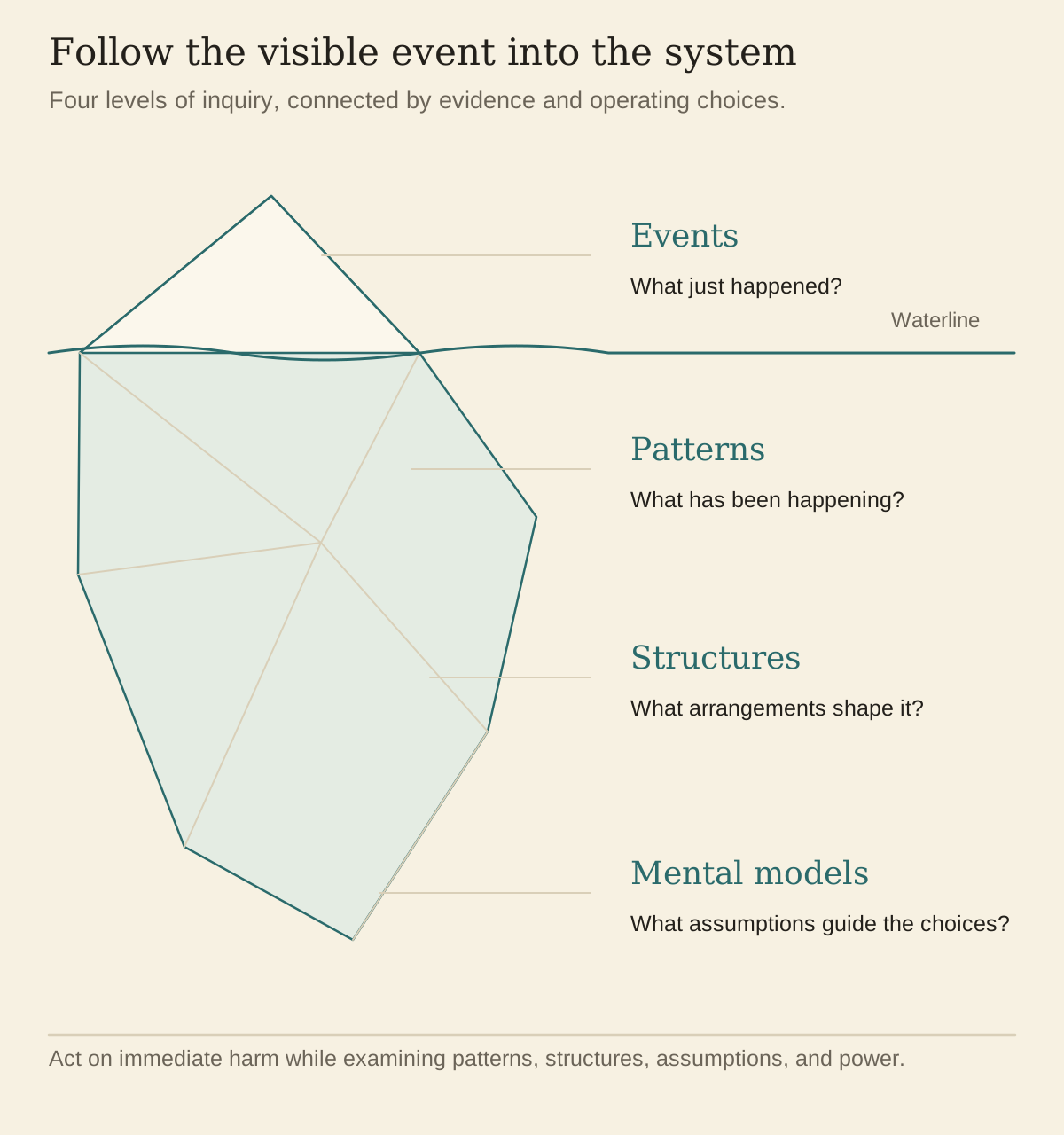
The Four Levels
The top of the iceberg is the level of events. Events are the visible occurrences in the system. They are what shows up in the news, in the meetings, in the performance reviews. A worker quits. A customer complains. A project goes over budget. An AI initiative stalls. Events are concrete and they are real. They are also, in the systems view, surface phenomena that emerge from the levels below them.
Just below events is the level of patterns. Patterns are the recurring shapes that events take over time. The third worker has quit this team in six months. The same complaint keeps coming back from different customers. Projects in this division consistently go over budget. AI initiatives consistently stall after the first eighteen months. Patterns are visible to people who pay attention to events over time, and patterns are where the diagnostic conversation starts to become useful. The pattern tells you that the event is not a one-off.
Below patterns is the level of structures. Structures are the organizational, cultural, technical, and incentive arrangements that shape the patterns. A team that loses three workers in six months may have an incentive system that rewards short-term output, a reporting line that leaves the team without advocacy, or a promotion system that fails to recognize its work. It may also be responding to labor-market or personal factors outside the team. The model asks you to investigate the structure rather than infer it from the pattern. When a structure is contributing, addressing events one by one will not be enough.
The bottom of the iceberg is the level of mental models. Mental models are assumptions, beliefs, and frames that help produce and justify structures: workers are interchangeable; output is the only thing that matters; culture sits on top of operations rather than emerging partly from how operations are designed. These models can be hard for their holders to see because they are lenses as well as objects of analysis. But causality runs both ways. New rules, tools, experiences, and power arrangements can change mental models, just as mental models can shape structures. Durable change often requires attention to both.
The practical lesson is to look for places to intervene at more than one level. Event-level intervention can stop immediate harm. Pattern analysis can show whether the occurrence is recurring. Structural intervention can change conditions that generate the pattern. Mental-model work can change the frames that make those structures seem natural. Power belongs in the analysis too. A mental model may persist because it benefits people who control resources and decisions, even after plenty of people have questioned it. In that case, insight without changed decision rights will not move the system. Deeper is not automatically better, and slower is not automatically more durable. The strongest response may combine levels: protect people now, learn from the pattern, redesign the structure, challenge the governing assumptions, and then test whether the expected pattern actually changes.
An AI-Native Example
Here is the iceberg in an AI-Native company.
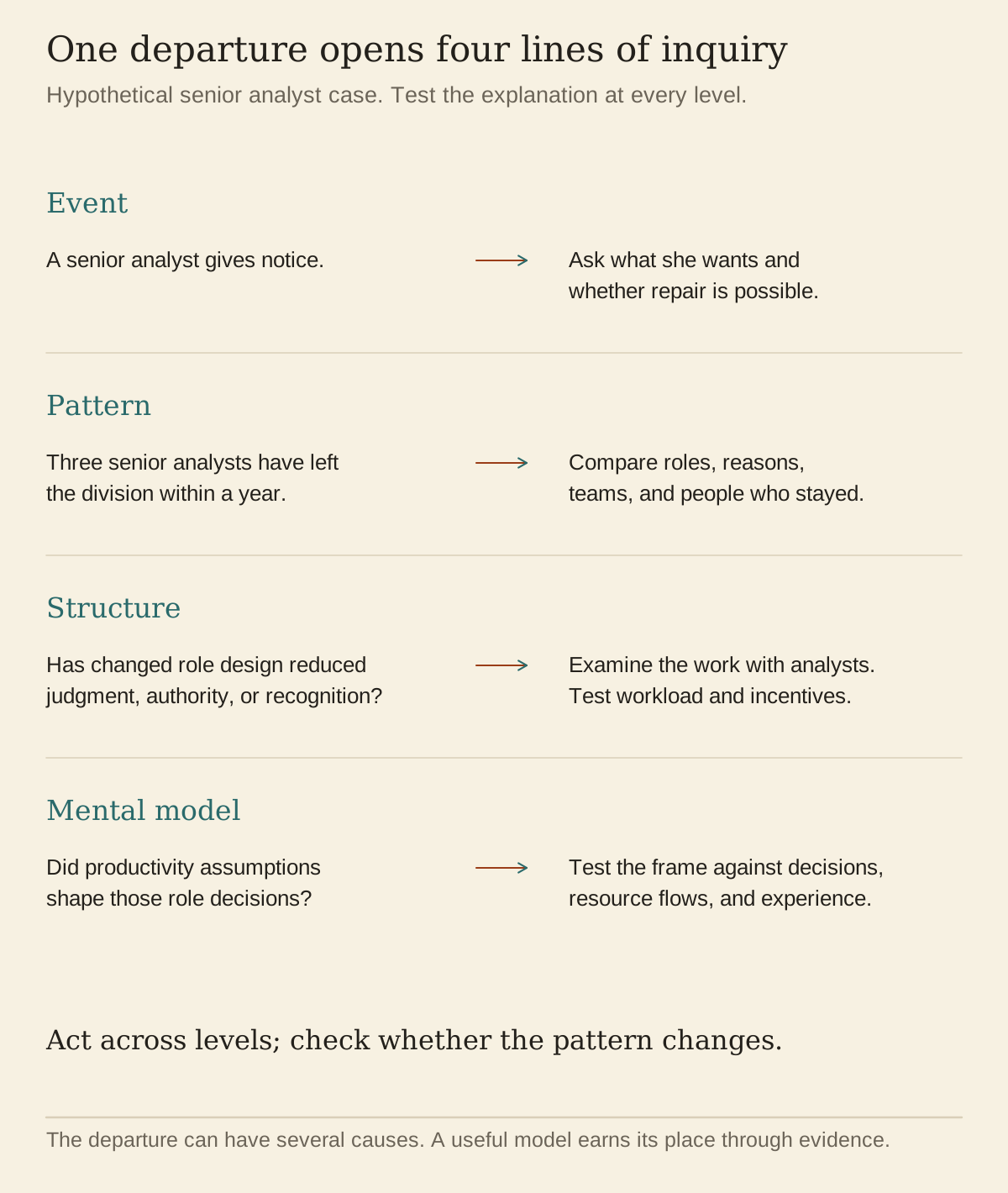
At the event level, here is what happens. On a Tuesday morning, the senior analyst who has been with the company for twenty-two years puts fifteen minutes on her manager's calendar and hands him a printed letter, one page, signed. She is taking a role at a competitor. The exit interview takes place in a glass conference room off the lobby. It is professional. The HR partner types while she talks, and she answers every question. She wishes everyone well. On her last day she packs one box, a coffee mug and the row of methodology binders she wrote herself. The company holds a leaving gift. The position is posted the following Monday.
At the pattern level, here is what becomes visible when the company examines the record. She is the third senior analyst to leave in the past year. Departures are concentrated in a specific division, under a specific manager, in a specific kind of work. That concentration is a signal, and the causal story still needs work. It tells the leadership team to compare time periods, teams, roles, stated reasons, labor-market conditions, and the experiences of people who stayed. Each departure had been treated as a one-off; together they create a question the company can no longer dismiss.
At the structure level, suppose the inquiry finds that the division introduced AI over the past two years without involving analysts in decisions about how their jobs would change. AI now handles much of the analytic work that used to define the senior analyst's role, while the analyst is left with oversight responsibilities that do not engage her capabilities and a recognition system that does not reward her accumulated judgment. In this case, the structure has converted a skilled craft role into an AI-supervision role without naming, negotiating, or supporting the change.
At the mental-model level, the inquiry may reveal a frame that helped produce the structure: AI is primarily a productivity tool to be deployed against existing roles. That frame treats work as tasks to allocate between AI and humans, with the goal of maximizing the AI share. It misses the way work can develop craft, judgment, relationship, and meaning over decades. It may treat the senior analyst's expertise as overhead rather than a capability to use and renew. The mental model helps explain why the organization repeatedly made design choices that reduced the role, and the departure may have other causes too.
The leadership team has several options for intervention, and the options correspond to the levels of the iceberg.
The event-level intervention may include a counteroffer, but it should begin by learning what the analyst wants and whether repair is possible. A counteroffer can retain someone; it can also arrive too late or leave the reason for leaving untouched. Either way, the company still has to investigate the wider pattern.
The pattern-level intervention might strengthen exit interviews, introduce voluntary stay interviews, and examine retention by team, role, tenure, pay, demographic group, and work design. That can reveal where to act and may improve retention. It becomes theater only if the company gathers the evidence and refuses to change the structures the evidence identifies.
The structure-level intervention is to redesign the work with the people who do it. The senior analyst role might move toward higher-consequence judgment, client relationships, method development, teaching, quality assurance, or other work in which her expertise matters, including work where AI assists rather than disappears. Recognition, authority, workload, and compensation have to follow the redesign. Structural change can be durable. It is more likely to hold when incentives and mental models support it, and when outcomes are reviewed rather than assumed.
The mental-model-level intervention is the work I have been recommending. The leadership team examines, with help and evidence from the workforce, the frame behind its choices. It may come to see the senior analyst's expertise as a capability to amplify and renew rather than a cost to reduce. Its view of AI may shift from productivity extraction toward capability amplification. That shift can support different structures, patterns, and events, but belief without redistribution of authority, resources, and incentives is only a workshop result. The company still has to decide what analysts will own, how their judgment will be developed, who can challenge an automated result, and how value created with their expertise will be shared. Durable change comes from the model and the operating choices changing together.
Why Change Management Can Get Trapped at the Top of the Iceberg
Corporate change management can become trapped in the top half of the iceberg. Policies, communication campaigns, training programs, reorganizations, and performance-management updates are visible, fundable, and easy to report on quarterly. Yet change-management practice is broader than this caricature: participatory, systemic, and evidence-based approaches do engage structures, assumptions, and power. The problem is not the discipline. It is using surface activity as proof of change while leaving the conditions that reproduce the old behavior untouched.
There are several reasons for this pattern. Deeper interventions can be harder to measure and therefore harder to justify in a quarterly cycle. They may require leaders to examine their own mental models, work for which many have had little preparation. Effects can take longer to appear, which is politically risky when the environment demands short-term results. And the effort may require facilitation, systems analysis, and power-aware participation that the particular change program was not designed to carry.
Some corporate change efforts I have watched produce activity rather than transformation. They look real from the outside. They consume real budgets and produce real deliverables. But if behavior, decision rights, incentives, capability, and outcomes remain unchanged, the activity is not evidence that the system moved.
Transformation efforts are more credible when they connect visible activity to deeper work and measure both. They handle events, study patterns, redesign structures, and examine the frames behind decisions. Communication and training still matter: people cannot enact a structure they do not understand or lack the skill to use. Reorganization can matter when authority genuinely moves. Policy can matter when it changes what people may do and what happens when the rule is violated. The question is not whether an intervention is visible. It is whether the causal account is credible and the evidence shows the system changing. The deeper work may look less impressive in a quarterly update, but it should still generate evidence: changed decisions, changed resource flows, changed behavior, and outcomes that persist after attention moves elsewhere.
Why Collaborative Co-Design Works
What I have been recommending is collaborative co-design at the mental-model level. Why this works matters for understanding where the leadership team needs to invest.
Mental models rarely change merely because someone declares them wrong. A leadership team will interpret the challenge through what it already believes, and may reject it or accept its vocabulary without changing its decisions. Direct instruction can still supply evidence, concepts, and challenge. It is usually insufficient by itself.
Mental models can change through experience, disconfirming evidence, reflection, dialogue, and changes in practice. A structured exercise can help a leadership team look at its operation from another frame, notice where its current explanation does not fit, and construct a better account collaboratively. The test of the shift is not what the team says in the room. It is whether later choices, resource allocations, and responses to contrary evidence change.
This is what collaborative co-design can do. The leadership team and people affected by the system examine the company from different positions. Skilled facilitation can surface assumptions, conflict, evidence, and power that an executive-only conversation misses. The group builds and tests a shared working model without forcing false consensus. Participation can increase understanding and ownership, but it does not guarantee either; decision rights, dissent, and unresolved tradeoffs should remain explicit.
A leadership team may begin this work itself, and an external facilitator can help people see assumptions, power dynamics, and blind spots that are hard to surface from inside. A consultant's recommendations can also contribute when the evidence and reasoning are open to challenge. The key is not mandatory dependence on a facilitator. It is a collaborative, structured process in which the people making and living with the decisions participate rather than merely receive. Arc5 is the method I use for that work (Section 9.1), and its results should be judged by the decisions and outcomes it changes.
The Connection to the Rest of the Book
The operating system from Stage 3, the architectures from Stage 4, the human work from Stage 5, the practices and moments from Stage 6, are all interventions at the structure level. They are real structures that generate real patterns and real events. The work of designing them well is necessary work.
The work is not sufficient on its own. Structural choices also express mental models. Choosing a graph, document retrieval, relational data, rules, or a combination is downstream of a view about what institutional knowledge is and what the use case requires. Choosing a collaboration surface, individual tools, or both reflects a view of how the organization works. Choosing to do the human reckoning reflects a view of what the workforce is and what is owed to it. Choosing moments for meaningful human involvement reflects a view about consequence, rights, responsibility, and value.
A leadership team that adopts the structures I have described without examining the assumptions behind them may watch those structures erode. Incentives and later decisions can pull the organization back toward the old design. The reverse also matters: adopting new structures can expose weaknesses in the old mental model and help people revise it. Change travels both directions through the iceberg.
A leadership team that examines its mental models while changing structures has a better chance of producing coherence. Structures can reinforce the new frame; experience with the structures can refine the frame; observed patterns can show whether either is working. That does not make a transformation immune to leadership changes or market shifts. It gives the company feedback, institutional memory, and a stronger basis for adapting without quietly reverting.
Several sections of this book have told you to measure differently without saying what to measure. The next section pays that debt, and it builds the instruments out of the loops and the iceberg rather than out of a list of KPIs.
Consider. Map your current AI-Native efforts against the iceberg. How many are operating at the events level, responding to incidents and announcements? How many at the patterns level, studying recurring behavior? How many at the structures level, redesigning processes, incentives, decision rights, and systems? How many at the mental-model level, testing what the leadership team believes and assumes? Then ask what each level needs from the others. If effort is concentrated above the waterline, investigate what keeps producing the pattern. If it is concentrated below, make sure immediate harms and operational realities are not being intellectualized away.