What does a team do to keep the human work alive day to day?
The previous part of this field guide made the case for the human work. It argued that humans hold kinds of standing and responsibility AI does not, that worthwhile challenge can support development, that up-leveling is possible under the right conditions, and that technical design cannot compensate indefinitely for a company that gets participation, trust, work design, and accountability wrong.
Those arguments are necessary and insufficient on their own, because an argument does not change what happens in a team on a Tuesday afternoon. Whatever your leadership team holds about the human work matters only to the extent that it shows up in how people actually behave. The path from values to behavior runs through practices.
I mean something specific by practice. A practice is something a team does, repeatedly, in a recognizable form, often enough that it becomes part of how the team operates rather than a special event. A practice is not a value. A value is what the team says it values. A practice is one place the value becomes observable. The two are connected. Practices can reinforce values when they are aligned and corrode them when they are not. A team that says it values human connection yet makes no protected space for attention, candor, or relationship is relying on aspiration alone. Screens are not the test; distributed teams, disabled workers, and assistive technology may depend on them. The test is what the team repeatedly makes possible.
What follows is a working set of behaviors I have seen make the human work more observable across different kinds of teams. The list is organized so a team can adopt some of the practices deliberately, test what they change, and recognize when aspiration is or is not reaching daily work.
Source. Google's Project Aristotle examined 180 teams and hundreds of candidate variables in an internal effort to understand team effectiveness at Google. The researchers reported that who was on a team mattered less than five group dynamics: psychological safety, dependability, structure and clarity, meaning, and perceived impact. Psychological safety was foundational in Google's account. This was an organizational study in a particular company. Its findings are suggestive and local. Amy Edmondson's 1999 paper established psychological safety as a shared belief that a team is safe for interpersonal risk-taking and found it associated with learning behavior in 51 teams at one manufacturing company. The ten practices below are my working set. They are compatible with parts of this literature; Project Aristotle did not test or validate them.
Google re:Work (2015). Project Aristotle. / Edmondson, A. C. (1999). "Psychological Safety and Learning Behavior in Work Teams." Administrative Science Quarterly, 44(2), 350-383. / Edmondson, A. C. (2018). The Fearless Organization. Wiley.
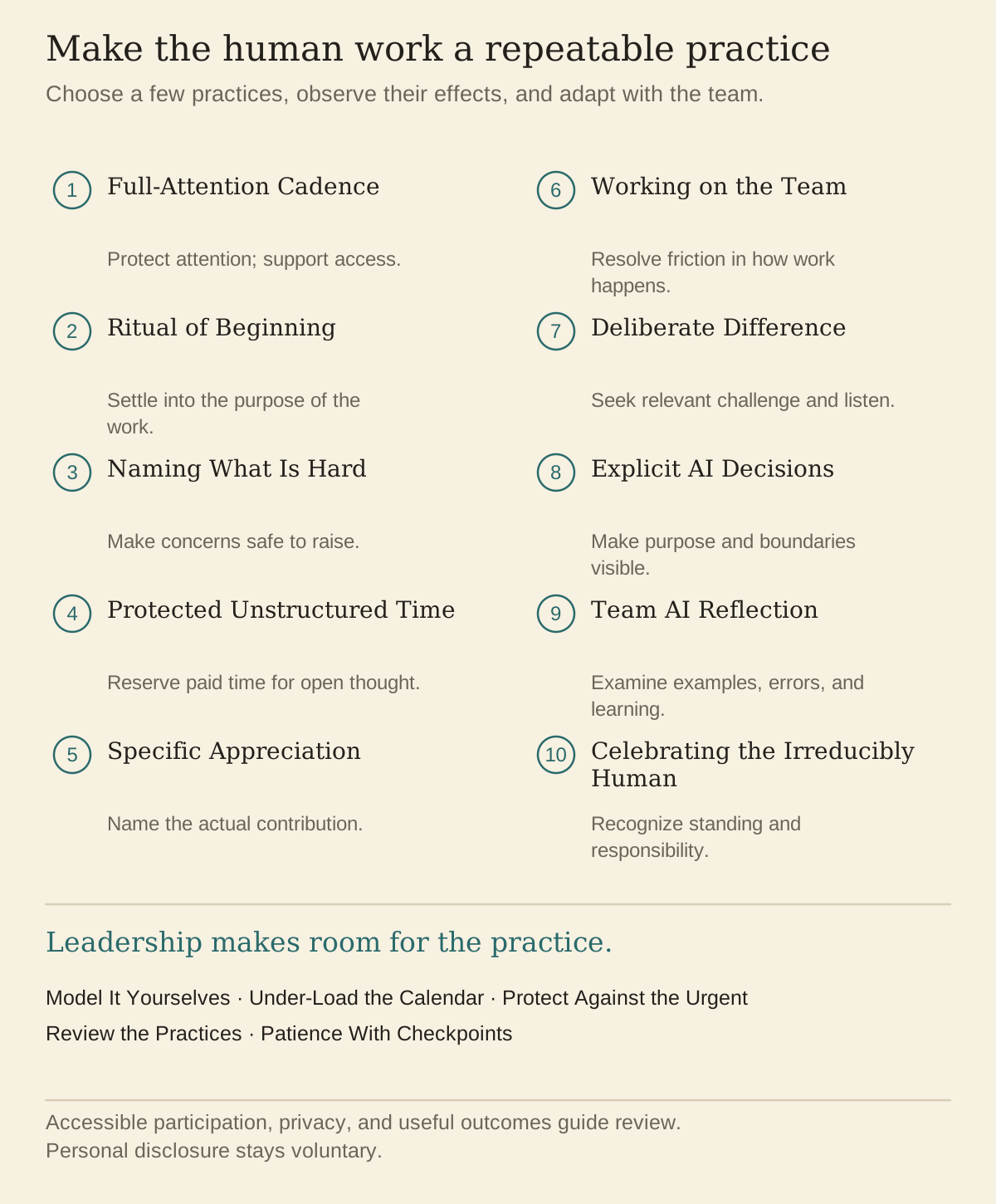
The Ten Practices
Practice one, the Full-Attention Cadence. The team gathers at a regular interval in a form designed for attention. Close unrelated content. Do not multitask. If a screen or assistive technology is necessary, use it without turning it into a second meeting. If AI records or summarizes, disclose it, obtain the consent the context requires, protect sensitive material, and ask whether its presence will reduce candor. The conversation is about the work, the team, the questions, the things that matter. The cadence can be weekly, biweekly, or monthly. The form should fit distributed, frontline, neurodivergent, and disabled colleagues rather than making one visible behavior the proof of attention.
Practice two, the Ritual of Beginning. Where a session needs an opening, use a brief check-in or statement of purpose to help people settle into the work. Keep it while it improves readiness and clarity, and let people choose how much personal information to share.
Practice three, Naming What Is Hard. The team has a vocabulary for surfacing what is difficult, uncertain, or uncomfortable in the work. When something is hard, a member can say so without performing vulnerability or requesting special handling. That only works when leaders respond without punishment, curiosity is real, and people retain boundaries around what they disclose. Vocabulary cannot manufacture psychological safety. Used inside a credible climate, it makes important facts easier to discuss before they accumulate into avoidable failure.
Practice four, Protected Unstructured Time. The team has some time in its operating rhythm that is not scheduled for a specific output. The time can support thinking, conversation that meanders, problems not yet named, and relationships not organized around a deliverable. Not every worker experiences open-ended social time as restorative, and hourly or frontline teams should not be expected to donate it. Make it paid, purposeful enough to be safe, optional where appropriate, and one source of connection and discovery rather than the only place a team becomes a team.
Practice five, Specific Appreciation. Members of the team see that their work is noticed by people whose opinion they respect. The appreciation is specific, grounded in the actual contribution, proportionate, and free of favoritism. It can be a one-line message, a moment in a meeting, or a thank-you that names what was done. Generic appreciation can be better than silence. Repeated recognition theater teaches people to distrust the signal. Specific appreciation can strengthen membership when it sits beside fair pay, credit, opportunity, and candid feedback rather than substituting for them.
Practice six, Working on the Team: the regular review of how the team is working, distinct from what it is producing. What is going well in the way we operate. What friction could we remove. What pattern is starting to hurt us. The review creates an opportunity for improvement; it does not produce improvement unless someone can act, owners and dates are clear, and the team sees what changed. A retrospective that repeatedly surfaces the same immovable problem becomes evidence of powerlessness rather than learning.
Practice seven, Deliberate Difference. The team actively surfaces perspectives different from the dominant view. When everyone agrees, it asks who is affected and absent. When a decision feels obvious, it asks what evidence would change the conclusion. Difference does not automatically improve judgment; it has to be relevant, heard, and integrated, and marginalized members should not be conscripted to represent a category. Manufactured dissent is different. The practice is to make disagreement usable and reduce shared blind spots without turning debate into theater.
Practice eight, Explicit AI Decisions. The team is conscious about when AI is invited into the work and when it is not. AI may draft for one task, retrieve evidence for another, record a session with informed permission, or remain absent because privacy, law, client expectation, psychological safety, or the learning objective requires it. AI should never be a silent participant if that means people do not know it is present. The decision, purpose, data boundary, and human owner are visible. Conscious calibration is the practice; consequence determines how formal it must be.
Practice nine, Team AI Reflection. At intervals, the team examines how it is using AI. Where did it help. Where did reliance exceed evidence. Which errors escaped. Whose work or voice became less visible. Where is capability developing, and what independent tests would reveal whether it is being lost. Collective reflection can reveal patterns no individual sees, but memory and impressions are not enough. Bring examples, operational measures, affected-worker feedback, and changes the team can test.
Practice ten, Celebrating the Irreducibly Human. The team acknowledges work in which human standing and participation mattered: the accountable judgment call, the relationship held in a difficult moment, the dissent that changed a decision, the reframing grounded in lived stakes. Do not base recognition on a claim that AI could never produce similar words or recommendations. Celebrate why the organization wanted a person involved and what responsibility, legitimacy, care, courage, or relationship that person carried. What teams notice influences what they invest in, even if celebration alone does not guarantee more of it.
These ten are not the only practices that matter. They have appeared repeatedly in teams I have observed living the human work well. That is practitioner evidence, and whether adopting all ten causes superior outcomes is still unproven. A team can select a few, define what it expects them to improve, watch for burden or exclusion, and adapt from evidence. The practices should serve the team. The team should not become a delivery mechanism for the practices.
How These Form a Team-Level Culture
Taken together those practices form more than the sum of individual behaviors. They form a culture, in the specific sense of a shared way of operating that the team holds collectively rather than individually.
The distinction matters because individual-responsibility framings are insufficient for sustained culture. A team that says each of us is responsible for embodying our values has individual aspirations but no shared mechanism for resolving the gaps between them. A team with recognizable collective practices has something members can observe, question, teach, and revise. Individual conduct still matters. Shared practice makes it less dependent on private interpretation alone.
A culture can become self-reinforcing through visible practices. New members observe what receives time, reward, protection, and consequence, then decide what the stated values actually mean. Practices propagate through daily operation more reliably than through a training event alone. Culture is not only the practices; it also includes stories, incentives, power, symbols, assumptions, and what happens after someone challenges the group. Practice is where much of that becomes visible.
A team that wants to develop this culture has to invest over time. The first attempt at a practice may be awkward. Repetition may make it natural, or reveal that the form is wrong for this team. Do not abandon a useful practice because novelty felt uncomfortable, and do not preserve a harmful ritual because persistence has become a virtue. The work is to distinguish adjustment discomfort from evidence that the practice is excluding people or failing its purpose.
How a Leadership Team Makes Them Stick
Everything I have described works at the team level. It depends, though, on conditions your leadership team controls. I want to name the conditions, because the most common reason these practices fail to stick is that the leadership team has set up the surrounding conditions in ways that defeat them.
Condition one, Model It Yourselves. A leadership team that asks its workforce to gather in full attention while its own meetings are full of split attention creates the cynicism of a double standard. Modeling gives the request credibility that a memo cannot supply. Adoption may still lag.
Condition two, Under-Load the Calendar. The leadership team has to make time for the practices. A team scheduled at nominal full capacity has no room for learning, interruption, care, or the variability real work contains. Capacity should be measured against the actual work system, including frontline schedules and paid participation, rather than solved by adding one more meeting to an already overloaded week. Slack is not waste. It is where adaptation lives.
Condition three, Protect Against the Urgent. The leadership team has to protect the practices from work that crowds them out. An immediate demand carries a deadline and a visible owner; developmental practice often carries neither. That asymmetry makes the practice easy to cancel in any given week and easy to lose through accumulation. Protection is not a one-time announcement. It is a commitment renewed in calendars and priorities week after week.
Condition four, Review the Practices. Leadership has to pay attention to whether they are happening, whom they serve, what gets in the way, and whether the expected effect appears. Counting vulnerable disclosures or ranking teams on psychological safety would corrupt the practice and invite surveillance. Use voluntary feedback, observable operating outcomes, and qualitative review with privacy and anti-retaliation safeguards. The signal should be that leadership is responsible for the conditions. Workers should never feel scored on their humanity.
Condition five, Patience With Checkpoints. Culture moves slower than a quarterly reporting schedule. Leaders should still hold practices to evidence along the way, whatever the horizon. Look early for participation, candor, reduced friction, better escalation, and changes the team can name; look longer for learning, retention, quality, and resilience. Patience and accountability belong together.
What This Section Does Not Cover
I want to be honest about the limits of what I have done here. The ten practices are a working set rather than a complete prescription, and the conditions are framing rather than a detailed playbook. The work of adopting them in a specific team, in a specific company, is real work that will require adaptation, experimentation, and refinement.
I also have not addressed the question of practices that are specific to particular kinds of teams. Engineering teams have practices that consulting teams do not have. Customer-facing teams have practices that internal-facing teams do not. The full operating system of practices for an AI-Native company is much richer than the ten I have named here, and the full operating system has to be developed in the context of the specific company, with the specific workforce, in the specific industry.
The next section addresses the question of where the human practices I have described concentrate their effect, which is in the moments that matter.