How does a team design the roles it will hold?
Becoming AI-Native means designing AI around the people who do the work and the people the work serves. A redesigned role changes a person's working day: the decisions they can make, the results they are expected to deliver, and the help available when they encounter something unfamiliar.
A manager can believe in that commitment and still struggle to design the next job. Established methods can help the team begin. Working through actual cases will show where AI helps, what people need to understand, and whether the proposed job is manageable.
Begin by getting the team in a room. Set aside the current job descriptions long enough to consider what the function needs to accomplish and how people could contribute with AI available as a resource. The manager's first responsibility is to make that inquiry possible: explain what is open to change, bring the relevant people together, and secure time and support for a trial.
The people holding the current roles know the calls, checks, and favors that keep work moving. Their account of those responsibilities belongs in the design.
Start with the Contribution
Consider a fictional accounts payable team. Its work helps the organization pay suppliers accurately and on time, maintain reliable records, and resolve discrepancies. A supplier waiting for payment needs an accurate explanation of the delay. The employee handling the invoice needs access to the records, authority to obtain a decision, and enough time to follow through.
Suppose the team has tested software that can extract invoice details, assemble supporting records, and suggest matches between invoices, purchase orders, and receipts. Some routine preparation now requires less human effort. Exceptions still need investigation, and the system introduces work of its own: checking outputs, correcting recurring errors, maintaining instructions, and deciding when a changed process is ready for use.
Map those responsibilities before creating titles. For each one, record the result it serves, the judgment it requires, the information it needs, and the consequences of an error. Include work that happens between departments. An invoice discrepancy can involve finance, purchasing, receiving, and the supplier.
Then examine what the tested technology can reliably contribute to each responsibility. Describe its limits and the action a person takes when it fails. Estimate the time required for review, follow-up, and maintenance. Those demands belong in the capacity plan.
The job redesign guide from Singapore's IMDA, PDPC, and SUTD provides a starting method: examine tasks, assess AI's effects, consult employees and managers, and recombine the work into jobs. [1]
Imagine Yourself in the New Work
For an experienced accounts payable employee, accurate processing may have been a source of pride for years. Colleagues trusted that person to keep things moving. As software takes on that work, the employee may wonder how colleagues will recognize their contribution.
Give the person space to think through that change while the role is being designed. They may need time on their own, a conversation with a trusted colleague, and several encounters with the proposed work before they can describe what they want. Offer a private conversation as well as the team discussion. People should be able to choose how much of that reflection they share.
Ask the employee to describe a morning in the proposed role, from the first case they open to the point where they need help. Explore what would feel satisfying or unsettling, and use that account to revise the work.
In the fictional example, the employee knows the satisfaction of clearing a queue accurately. Investigating a recurring discrepancy may leave the result unresolved at the end of the day. They could have done useful work and still feel that familiar sign of accomplishment is missing. The manager can recognize the work that moved the case forward: the employee obtained a missing receipt and used it to explain the discrepancy to purchasing.
Learning can require more concentration, preparation, and effort than familiar work. An experienced employee may have to ask basic questions again. Make room for that discomfort in the conversation. Ask what feels uncertain and whether the available help makes the next step possible.
Practice and useful feedback may ease the employee's uncertainty. If nobody in purchasing accepts responsibility for answering their question, the team has a problem in the role design to resolve.
Revisit the employee's interest as they discover what the job involves. Their experience should be able to change the proposal.
Build on the Person's Existing Value
The organization and its employees have spent years building knowledge together. An experienced colleague knows which records tend to be incomplete and whom to contact when a case stalls. Include that knowledge when considering them for a new role.
That experience could help the accounts payable employee investigate recurring discrepancies. A trial can show where their knowledge helps and what they still need to learn.
Look across the function for useful connections between existing capabilities and new responsibilities. Discuss possible roles with the people concerned. Give promising possibilities a supported trial and evaluate the work they actually perform. When considering an outside hire, account for the time needed to learn the organization. When considering more automation, identify the judgment and follow-up that someone will still need to provide.
Give existing employees a credible opportunity to demonstrate their potential. Explain how practice opportunities will be allocated when coaching time is limited, including how people on different shifts can participate.
Some task combinations will leave too little work to sustain the existing position. State that consequence plainly when the evidence supports it. The organization then needs decisions about available roles, training, selection, timing, pay, and support for people affected by job loss. Record those decisions alongside the role trial so the employee knows the available options and when each decision is due.
Be explicit about the organization's commitments so the employee can make choices about their own future.
Work Through a Case Together
For a first working session, invite employees who perform the work and colleagues who receive its output or make decisions it requires. In this example, that includes accounts payable, purchasing, and receiving. Before the session, explain which decisions remain open, whether staffing reductions have already been decided, and who can authorize a trial. Tell employees how their contributions to the discussion will be used. Give people time to prepare examples of work they find valuable, frustrating, or difficult to explain through the current job description.
Bring an ordinary invoice and a troublesome one. Follow each through the function. Ask the people involved to explain what they actually did, including the calls, checks, and follow-up that kept it moving. Record the contribution each action made. Then explore where tested AI support could change that sequence and what someone would still need to understand.
Suppose the system flags an invoice because the quantity exceeds the recorded delivery. The employee knows that receiving records sometimes arrive a day late. The group can now test how the proposed process would handle a valid invoice while that record is missing.
Let people sketch possible combinations of responsibilities. An employee interested in carrying a supplier case through to resolution may need authority to obtain a decision from purchasing and practice framing the question.
Keep a record of unresolved questions. Choose a limited part of the work for the first trial, name the people who will support it, and agree when the team will return to examine what happened. Record which employee suggestions changed the proposed design. Explain the decisions on suggestions the team could not adopt.
Use the first session to draft the role agreement below, then revise it after the trial.
Build a Job Someone Can Own
Group responsibilities that depend on the same knowledge and continuing relationships. In this example, invoice investigation and supplier communication could belong together because the person explaining a delay needs to understand the case. Test whether one person can carry that work alongside their other duties. The team could call the resulting role a supplier resolution analyst.
Someone also needs time to maintain the process. That responsibility includes examining recurring system errors, coordinating corrections, and arranging review of proposed changes. Estimate the weekly demand for that work, including busy periods and absence cover. Compare the estimate with the hours available in the proposed roles. If maintaining the process becomes a substantial responsibility, identify which duties will move and who will receive them.
Purchasing retains ownership of commercial terms. Receiving confirms what arrived. Authorized finance colleagues retain payment approval and execution responsibilities under the organization's controls. AI support changes how information reaches those people. The role design must state who can make each decision.
Record the proposal in a short role agreement. The analyst example below gives the team a common document to question and revise.
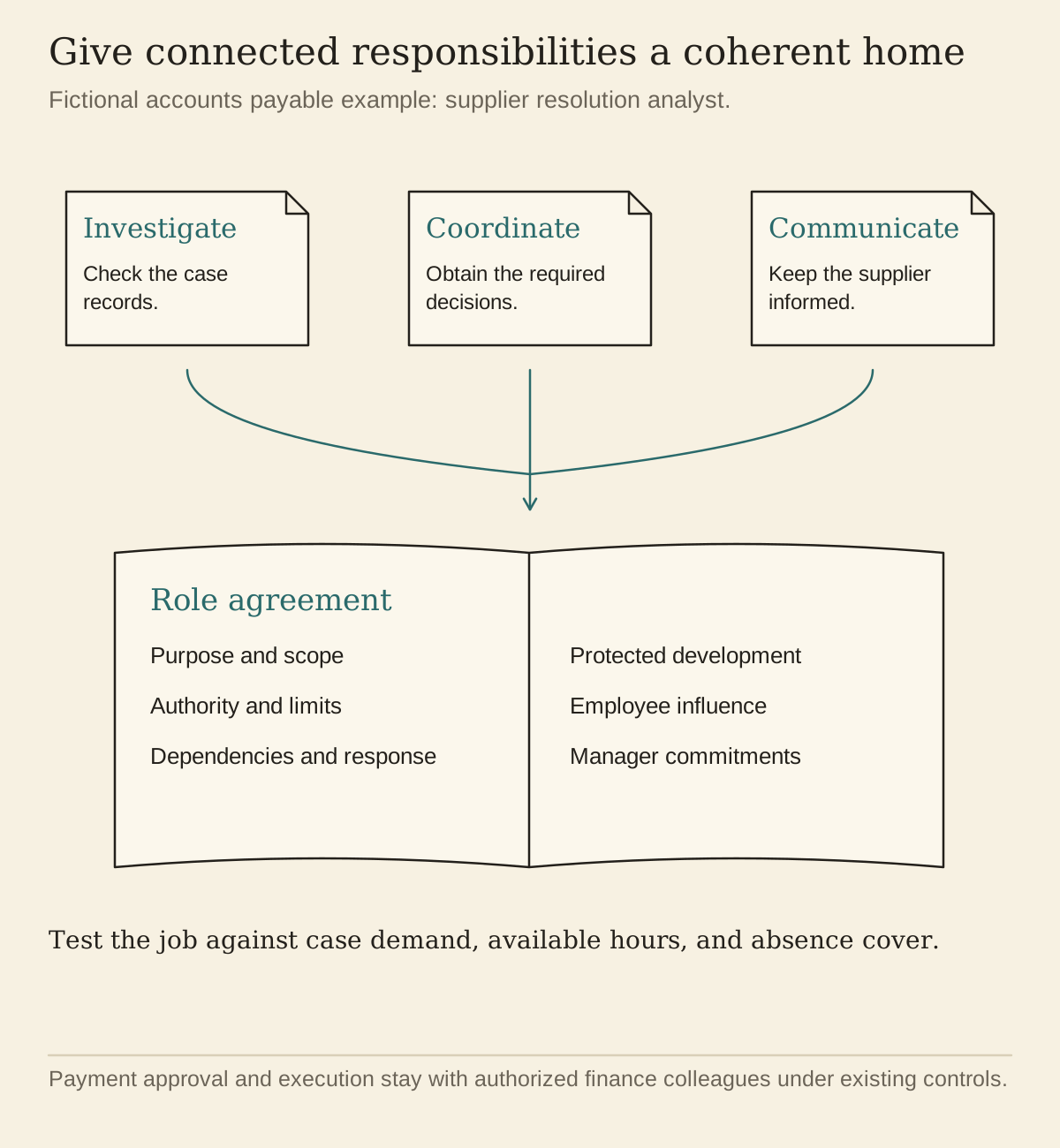
| Role agreement | Proposed responsibilities and support |
|---|---|
| Purpose | Resolve assigned invoice discrepancies accurately and keep suppliers informed while protecting the integrity of financial records. |
| Scope | Investigate agreed classes of discrepancy, coordinate required decisions, maintain the case record, and identify recurring problems. Define case classes and expected demand before the trial. |
| AI support | Extract details, assemble source-linked records, suggest matches, and prepare correspondence for review within the tested limits. |
| Authority | Request evidence, pause an uncertain case, and escalate unresolved questions. Record the actual approval boundaries; preserve the organization's payment controls. |
| Dependencies | Receiving confirms deliveries; purchasing confirms orders and terms; authorized finance colleagues approve and execute payments. Each dependency has a named owner and response agreement. |
| Development | Agree a selected new responsibility, protected practice time, a coach, review criteria, and the evidence needed before expanding scope. |
| Employee's influence | Help propose the responsibilities and learning path, raise concerns privately or with the team, and review how trial experience should change the role. Record the decisions and their reasons. |
| Manager's commitments | Provide access, cover, coaching, and a feasible workload. Resolve conflicting priorities and review material changes in case mix or system reliability. |
A responsibility that depends on repeated favors from another department needs an agreed working arrangement.
Make the Roles Work Together
Return to the invoice with the missing receiving record. Receiving must confirm what arrived. If the goods came in separate deliveries, purchasing may need to clarify the agreed payment terms.
The analyst keeps the case moving and the supplier informed. Receiving confirms the delivery; purchasing settles questions about the terms. Record what each person needs from the others to complete that work.
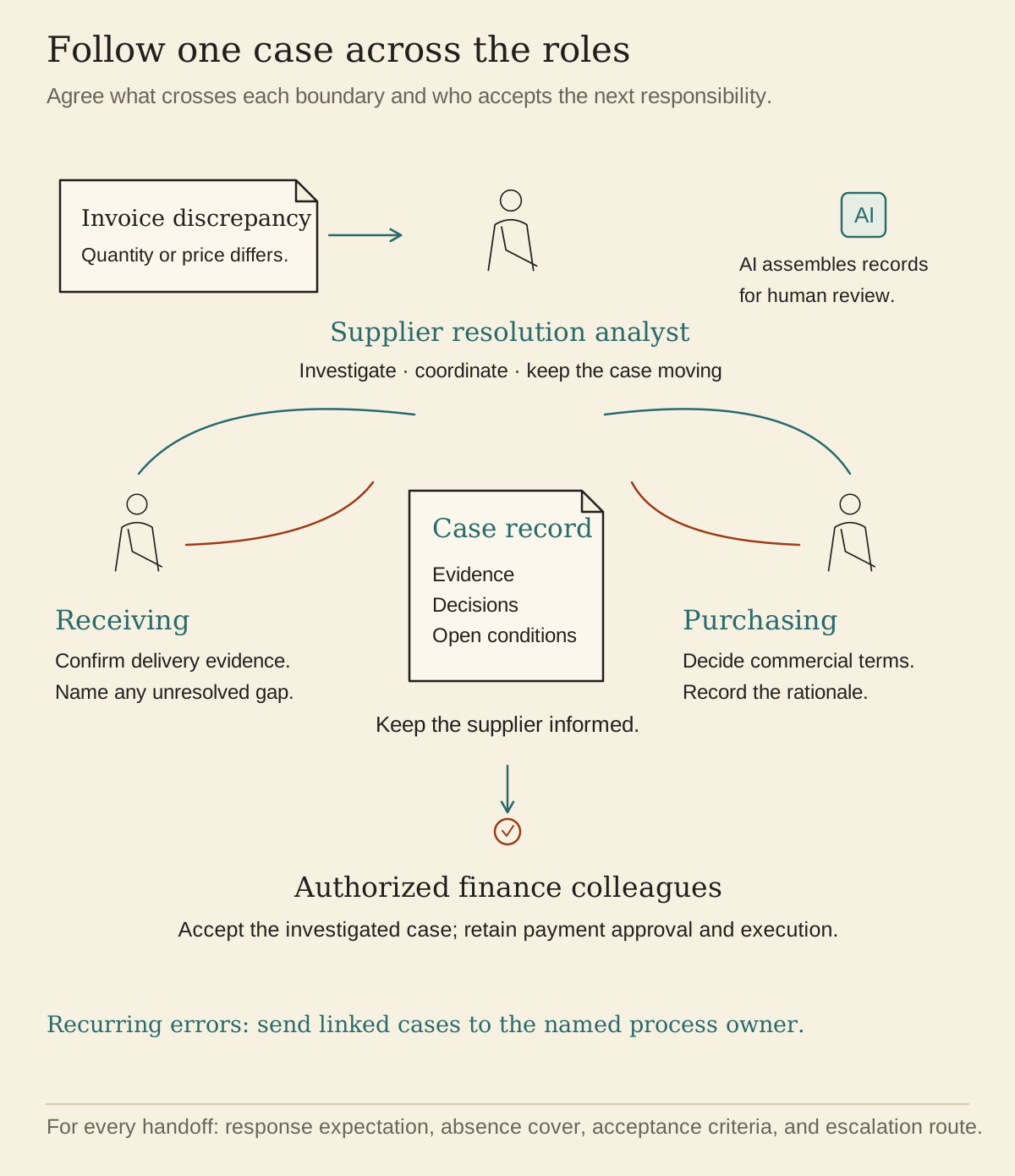
| Transfer | Information required | Acceptance |
|---|---|---|
| Analyst to receiving | Invoice, order, recorded receipt, disputed quantity, and the specific confirmation needed. | Receiving confirms the delivery evidence or identifies an unresolved gap and its owner. |
| Analyst to purchasing | Relevant terms, evidence of the discrepancy, and the commercial question requiring a decision. | Purchasing records its decision, rationale, and any supplier action it owns. |
| Analyst to authorized finance colleague | Completed investigation, supporting records, required approvals, and any open condition. | The receiving colleague confirms acceptance or specifies the missing requirement and responsible owner. |
| Analyst to process owner | Linked cases showing a recurring error, its effects, and the evidence available. | The process owner records ownership, the next investigation step, and when progress will be reviewed. |
For each transfer, agree a response expectation, absence cover, and a route for resolving delay. Test whether the receiving team has capacity to meet that commitment. An individual objective becomes achievable only when the surrounding roles can fulfill their parts.
The process owner may discover that the same mismatch keeps recurring. Investigating its cause then becomes a defined piece of improvement work, with an owner, time allocation, and evidence of completion. That work should appear in the relevant role agreement before it becomes a standing expectation.
Connect Responsibility to Evidence
Once routine invoice preparation moves to software, the employee's work changes. A remaining case may require several conversations, conflicting records, and a difficult explanation. Comparing the new role with the old count of invoices processed would obscure that change.
Begin with the role's purpose. For each responsibility, specify what a good result looks like and how the employee and manager will recognize it. Agree the evidence, review period, dependencies, and conditions needed to deliver the result.
The analyst's responsibilities need evidence of successful work.
| Responsibility | Intended result | Evidence and fair interpretation |
|---|---|---|
| Resolve discrepancies | An evidence-based case record supports a justified resolution or a clearly assigned next decision. | Review an agreed sample for accuracy, completeness, correct authority, and necessary rework. Set timing expectations from comparable cases and record dependencies. |
| Keep suppliers informed | The supplier receives an accurate update when promised. | Compare actual updates with the dates recorded in the case. Examine missed commitments and whether the employee had the required information and cover. |
| Identify a recurring problem | A documented pattern gives the responsible process owner enough evidence to investigate a cause. | Review the linked cases, explanation, remaining uncertainty, and owner's response. Agree the analyst's contribution and the shared follow-up before setting an improvement target. |
| Develop a new capability | The employee can investigate a selected unfamiliar case class and explain the reasoning. | Use the agreed learning criteria, coached practice, and review of comparable unfamiliar cases. Record support provided and remaining development needs. |
Before setting a target, examine representative cases under the proposed arrangement. Establish how much work arrives, how complex it is, how often records are missing, and how long each part takes. Use that evidence to agree a reasonable expectation. Record the case mix and AI support available when the expectation was set. Revisit it when a system change or a different mix of cases materially changes the work.
For familiar cases the employee is prepared and authorized to handle, an illustrative trial objective could read: "During the four-week trial, carry each assigned discrepancy to a justified resolution or obtain a decision from the person with authority to resolve it. Keep the supporting evidence and agreed next action in the case record. Agree a response date for each case and keep the supplier informed. Each week, review overdue cases, reopened cases, and corrections, including the reasons they occurred." Set response expectations with purchasing and receiving before the trial.
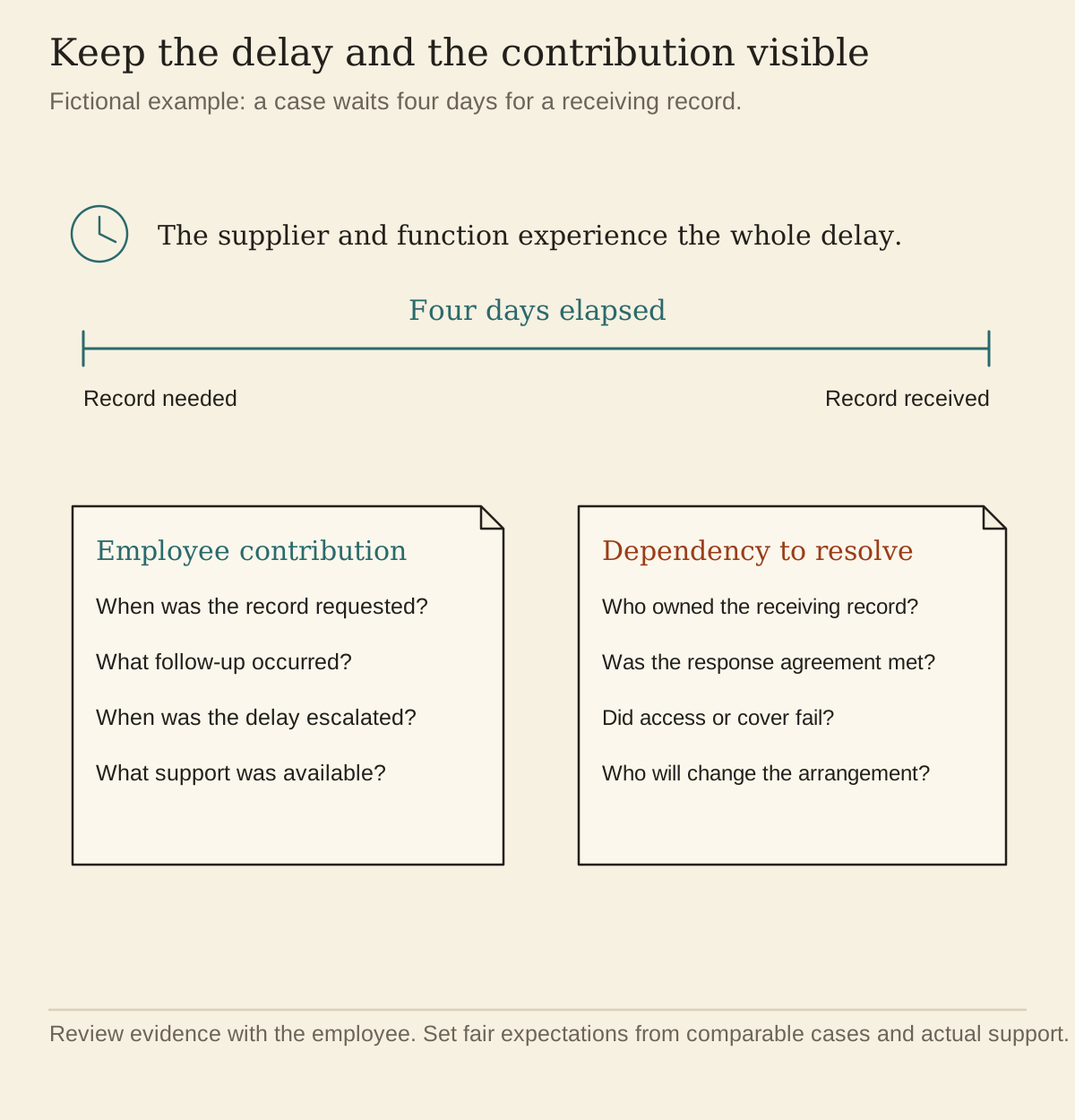
Keep both elapsed time and the reasons for delay visible. If a case waits four days for a receiving record, that delay matters to the supplier and the function. The employee's review should also show when they requested the record, followed up, and escalated the delay. Leadership can then address the dependency while the manager evaluates the contribution the employee could make.
Quality needs an explicit definition. For a discrepancy investigation, reviewers could examine whether the employee checked the relevant records, distinguished established facts from open questions, involved the right decision owner, and explained the resolution accurately. Walk through examples together before the review period begins. Where managers interpret the criteria differently, resolve those differences.
Give the employee access to the evidence used in their review and a way to explain unusual circumstances or challenge an interpretation.
Section 7.3 treats organizational measurement as a way to understand the health of working loops. Preserve that purpose. Agree evidence for an individual role separately and openly with its holder. Explain what will enter a performance review, who can see it, and how it will be interpreted.
When cases remain unresolved, the manager should examine access to records, response times from other departments, and the coaching and workload commitments made before the trial. Assign an owner and a date to any support the team still needs.
Give Development Its Own Objective
Alongside familiar cases, the employee can practice a new responsibility during the same trial. Give that assignment its own learning objective and support.
Seijts and Latham's work on goal setting supports using specific learning goals when people need to acquire new knowledge and strategies. [2]
The analyst's stretch assignment could be to investigate recurring price mismatches across suppliers. It requires comparing cases and testing possible causes with purchasing.
In the fictional trial, the employee finds three invoices with the same price difference. The AI suggests that the purchase order is outdated. The employee finds correspondence announcing a price change between two deliveries. They need purchasing to confirm which agreed price applies to each invoice. They are learning how to establish whether a pattern has one cause.
A coach asks the employee to explain which records support the proposed cause and what evidence is still missing. They prepare the question for purchasing together. The coach can now see whether the employee needs help comparing the records, interpreting the terms, or framing the question.
Their learning objective could read:
Example. During a four-week trial, investigate a recurring price mismatch with a named coach. Produce an explanation that links the invoice, order, and agreed terms; records remaining uncertainty; and identifies who can confirm the cause. At the end of the trial, explain the reasoning on a comparable case the employee has yet to encounter. The manager and coach review the work against those criteria before agreeing the next level of responsibility.
Adjust the trial period to the employee's experience and the cases available for practice. Review how they handle several unfamiliar cases before expanding their responsibility.
The manager must reduce current duties to make room for practice, reserve coaching time, and arrange access to the records and colleagues the employee needs. Agree which decisions require review during live work.
AI may help assemble records or suggest possible explanations. Ask the employee to examine those suggestions, check their sources, and explain why a conclusion is justified. Practice should include cases with missing or misleading information so the employee learns how uncertainty changes the next action.
At the review, ask which evidence could change the employee's conclusion and where specialist help is needed.
Keep early practice within a scope where errors can be caught and corrected before consequential action. Existing approval controls remain part of the work. Before assigning an expanded scope on an ongoing basis, agree the authority it requires and how the organization will review its effect on job level and pay. Tell the employee who will make that decision and when.
Find a Sustainable Degree of Challenge
The trial tests whether the new responsibility helps the employee develop. Review how their judgment changes with practice and where they still need help.
Agree which work the employee can perform independently and which work needs practice or review. In the trial, the analyst might continue resolving familiar quantity discrepancies while working through a recurring price problem with a coach. Protect time for that investigation and adjust the balance as both people see how much help it requires.
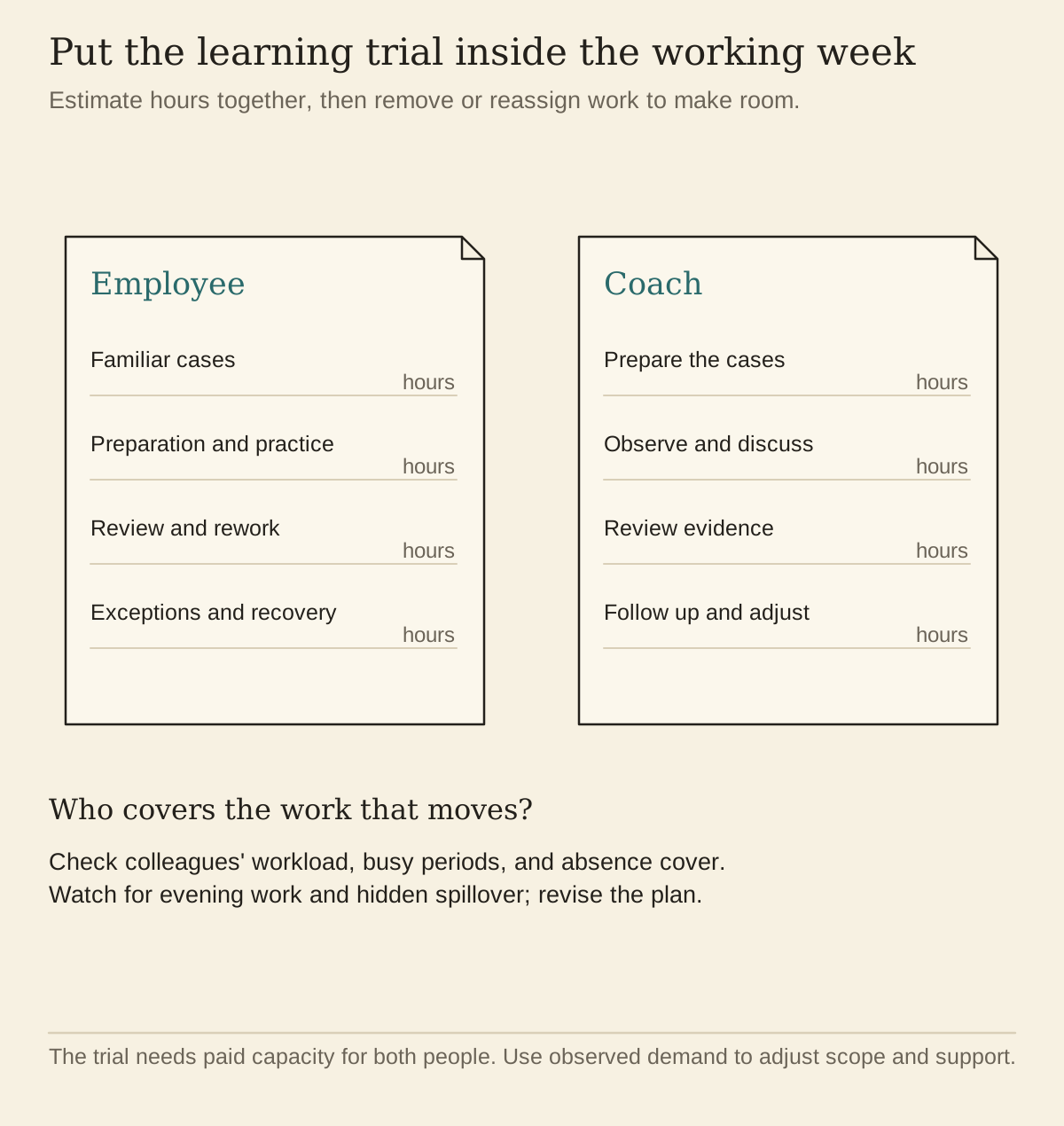
Check how much time the assignment actually takes, including preparation, coaching, and rework. Include the coach's workload when adjusting the plan.
Parker and Knight's SMART work design framework brings challenge into the same discussion as mastery, autonomy, relationships, and tolerable demands. Use those themes to examine the whole job as the trial develops. [3]
During the trial, ask what is becoming easier, where uncertainty remains, and whether the employee can recover between demanding tasks. Examine work that spills into evenings or shifts onto colleagues. Adjust the design when the learning commitment depends on that hidden effort.
If the employee continues to struggle, examine the cases together. Establish where the work broke down and whether the agreed support was available. The next step may be more practice, a smaller scope, or a different role to explore. Record that decision with the employee and explain how it affects the transition plan.
Discuss the kind and pace of development the employee wants. A sustainable role can include depth, continuity, and mastery of familiar work.
Test the Job in a Real Working Week
Run the trial through ordinary work and a busy period. Rehearse an absence and a case where the AI is wrong or unavailable. Agree beforehand who can pause the trial, what will trigger a review, and how the team will handle affected work.
At the agreed review, put the role charter, work evidence, learning record, and employee's account together. Check the function's results and the conditions under which people achieved them. Decide which responsibilities are ready to become part of the job, which need more supported practice, and which need redesign.
Carry the agreed changes into the job description, objectives, staffing plan, and transition arrangements. Name the person who can revise them as the work develops. Before expanding the role, agree with the employee what they will own next, what help will be available, and when the arrangement will be reviewed.
Intellectual lineage. The method draws on three sources. Singapore's guide to job redesign supplies practical steps for redesigning tasks and jobs, written before current generative AI. Seijts and Latham support setting specific learning goals when new knowledge and strategies are required. Parker and Knight's SMART model gives a general structure for good work design.
[1] IMDA, PDPC, and SUTD (2020). A Guide to Job Redesign in the Age of AI. / [2] Seijts, G. H., and Latham, G. P. (2005). Learning versus performance goals: When should each be used? Academy of Management Executive, 19(1), 124–131. / [3] Parker, S. K., and Knight, C. (2024). The SMART model of work design: A higher order structure to help see the wood from the trees. Human Resource Management, 63(2), 265–291.
Stage 5 has been the human work. The leader's own practice. The reckoning. What humans bring. The cognitive posture. Up-leveling. Passion. Hidden capability. Mattering, and the argument over ambition. What must be unlearned. The role of challenge. Workforce design, with humans retaining standing and accountability while agentic systems take bounded roles in the work. And now the design of the roles themselves, worked through with the people who will hold them. The next part addresses the practices that make this real day by day, regardless of what the chart looks like. Structure without practice will not function. Practice without supportive structure will struggle to scale. That is Stage 6.
Consider. If you keep three things from Stage 5: 1) Leadership practice is a powerful influence on workforce fluency, one source among several, and the workforce can rise past it. 2) The reckoning belongs beside the architecture: respectful treatment, worker participation, and an honored covenant make knowledge-sharing more credible, but never compulsory or automatic. 3) Use AI for thinking, and keep the human capability, authority, and responsibility the work still requires; test the difference, since it will not stay visible on its own.