What does it look like when an AI-Native transition goes wrong?
The earlier parts of this field guide have made a positive case. What AI-Native is. What it requires. What the leadership team has to do to produce it well. The argument has been about what the design should produce.
This section is the other half of the work. It is an accounting of what can go wrong when design work is skipped, delegated without the necessary authority, sequenced badly, or replaced by an announcement. Each case is anchored to a specific design decision and a plausible chain of consequences. The cases are composites built to illustrate patterns, with no claim about how common they are or that one decision alone caused every outcome. They combine patterns I have seen with patterns reported in research and industry surveys, whose methods and limits matter. None names a specific company. Some readers will recognize their own situation. That recognition should begin an inquiry.
When a company attributes a restructuring to AI, examine what work has actually changed. Ask which tasks the systems now perform, what happened to demand and staffing, and what evidence supports the announced savings. The cases below are about leadership design decisions and their consequences.
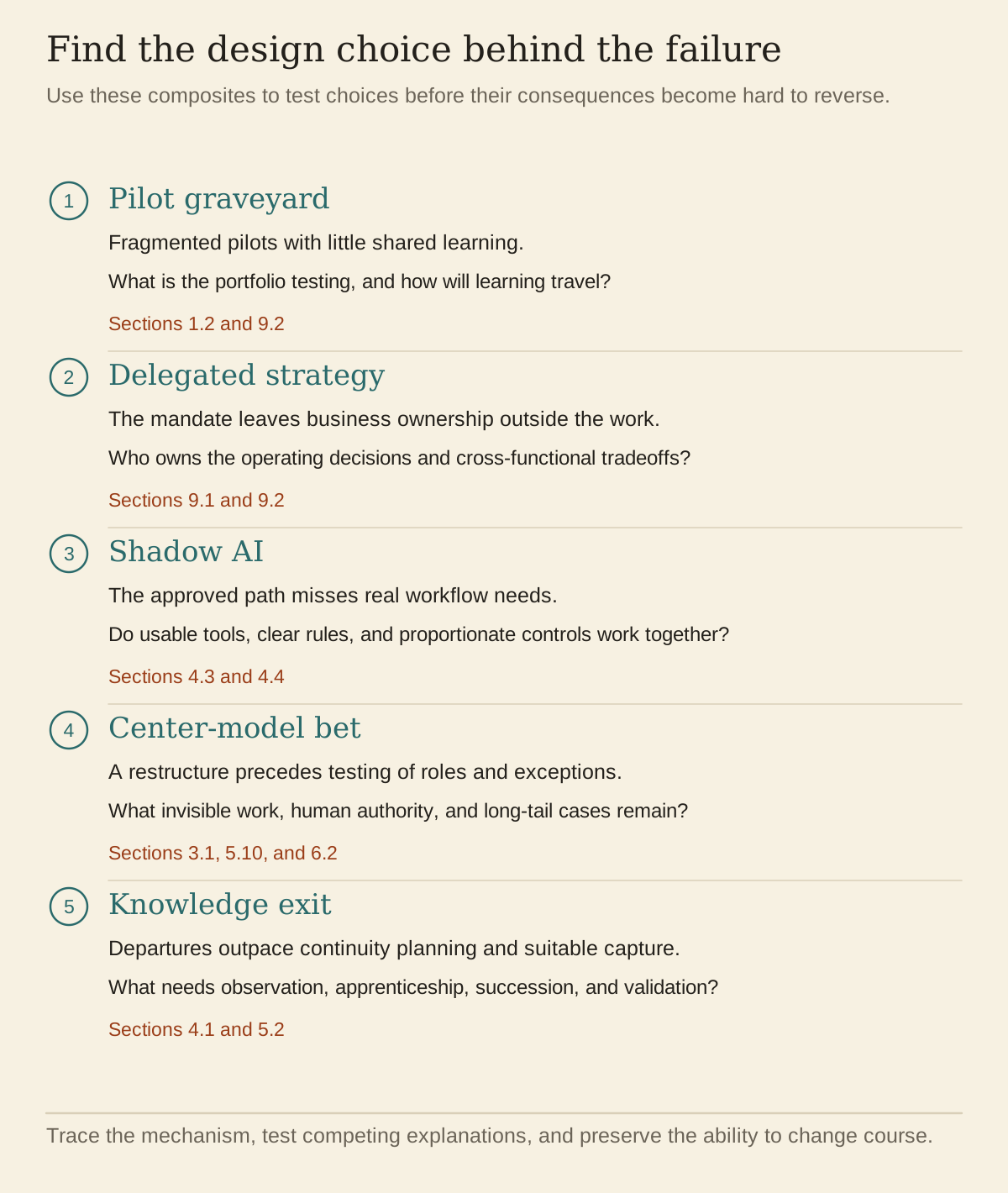
Five cases. Each names a design decision that helped create the conditions for failure, so a leadership team can recognize the choice and test its consequences before committing to it.
Case One. The Pilot Graveyard.
Section 1.2 sketched this composite in outline. Here is what four million dollars buys in the scenario. A diversified industrial company decides, in early 2024, to become AI-Native. The CEO announces the commitment at an all-hands meeting. The board approves the budget. Each function is asked to identify two or three AI pilots. The CFO funds procurement optimization. The CTO funds predictive maintenance. The CHRO funds recruiting AI. Marketing funds personalization. Operations funds quality inspection. Customer service funds a chatbot. Eighteen months later, the company has spent four million dollars across eleven pilots. Two demos work in controlled conditions but have not reached production. One system works technically but does not fit the operators' workflow, so it sits unused. The remaining eight are stalled for different combinations of data, integration, ownership, risk, economics, and adoption.
The pilot graveyard is a visible industry pattern, but no single failure rate describes it. The preliminary 2025 GenAI Divide report drew on interviews with representatives from 52 organizations, survey responses from 153 senior leaders, and a review of more than 300 publicly disclosed AI initiatives. It reported limited measurable financial returns across much of its sample. Its sampling, definitions, and non-peer-reviewed status limit generalization. McKinsey's 2025 global respondent survey found that 39 percent attributed any enterprise-level EBIT impact to AI; about 6 percent met McKinsey's stricter high-performer definition, which combined at least 5 percent EBIT impact with significant reported value. RAND's 2024 interview study did not independently measure an 80-percent failure rate; it cited external estimates and found organizational causes prominent in its interviews. S&P Global Market Intelligence's survey of 1,006 North American and European IT and business professionals found the share reporting that their companies abandoned most AI initiatives rose from 17 to 42 percent, with an average 46 percent of proofs of concept scrapped before broad adoption. These sources use different populations and outcomes. Together they support difficulty scaling; the 95-percent figure overstates what they show.
In the composite, the failure is not that the model worked and leadership did not. Some technologies fail too. The upstream design problem is that each pilot answers a different definition of AI-Native and has no shared architecture for learning. The CFO emphasizes cost reduction. The CTO emphasizes modernization. The CHRO emphasizes talent operations. None is necessarily wrong on its own terms. But the work does not compound, data and controls do not connect where they should, lessons do not travel, and eleven experiments do not become a coherent portfolio.
The design decision the leadership team should have made instead is described in Sections 1.2 and 9.2. Begin alignment and portfolio design before allocating the full budget. Produce a shared definition that records material disagreement. Choose an archetype as a working hypothesis, identify layer dependencies, set baselines and stop conditions, and define how learning will travel. This may lead to fewer pilots or to a deliberately varied portfolio. Variation can be valuable when it tests different assumptions deliberately; fragmentation is undesigned variation that produces no shared learning. Each experiment needs an owner, a reason to exist, a named user, a baseline, an evaluation method, a path to production or closure, and a way to inform the rest. Shared infrastructure should be reused where it truly is shared, while local requirements remain local. A stopped pilot can be a good result when it answers its question before absorbing more capital.
The lesson: the failure mode here was weak alignment, portfolio design, and learning architecture, compounded by project-specific problems. The remedy begins upstream of the technology, in the work the leadership team does before and during budget allocation, without requiring false consensus or assuming alignment can rescue a bad use case.
Case Two. The CTO-Delegated Strategy.
A professional services firm with two thousand employees decided in 2024 to develop an AI strategy. The CEO, recognizing that the technology was outside his domain of expertise, asked the CTO to lead the work. The CTO assembled a team, engaged a vendor, produced a multi-deck strategy document, and presented it to the executive team. The executive team approved it. The CTO began executing.
Eighteen months later, the engineering organization had sound infrastructure, faster code review, and higher developer productivity. Across the rest of the firm, partners had little involvement in the changes, teams were doing client work as before, and new business teams were pitching the same engagements. The firm's competitive position was unchanged. Its AI strategy had become a developer-productivity strategy.
Stanford Digital Economy Lab's April 2026 Enterprise AI Playbook studied 51 successful deployments across 41 organizations, so it is a selected set of successes rather than an estimate of enterprise success rates. Within it, the authors report eight cases where business-and-technology co-sponsorship made a difference. At one professional-services company, a CTO-led first attempt failed to gain traction; a second succeeded with the CEO and Head of Talent driving the mandate and incentives while the CTO owned implementation. IBM's vendor-produced 2025 survey of 2,000 CEOs found that 50 percent said the pace of recent investment had left disconnected, piecemeal technology. Those findings support cross-functional ownership. They do not support a stereotype that CEOs reimagine work while CTOs merely accelerate it; either role can think narrowly or systemically.
What went wrong in the composite was a category and governance confusion. AI-Native is an operating-model redesign that includes technology, data, security, workforce, customer, and business-model choices. A CTO may be capable of leading more than implementation, and a CEO cannot delegate accountability for enterprise design. The leadership model should follow competence and decision rights while giving business leaders, technologists, workers, risk functions, and affected customers a real role. A technology-only mandate predictably favors technical outcomes; a CEO slogan without technical ownership fails in the opposite direction.
The design decision the leadership team should have made instead is described in Sections 9.1 and 9.2. Engage more than one capability and make accountability explicit. Technology architecture needs qualified technical leadership. Operating-model choices require the CEO's sponsorship and the business leaders and workers whose work is being redesigned. Risk, legal, security, data, and customer perspectives enter according to consequence. This is not an argument for a committee so large that nobody decides. One accountable executive can own the enterprise outcome while named leaders own architecture, workflow, workforce, risk, and adoption decisions. The streams interlock through shared outcomes, decision rights, evidence, and escalation. Those links hold whether or not an executive is in the room. The CEO cannot outsource the tradeoffs, and the CTO should not be reduced to an order taker after strategy has already hardened.
The lesson: delegating enterprise AI strategy to a single function is itself a strategy decision and often leaves essential authority or knowledge outside the room. Treat AI-Native only as a technology problem and the company is likely to get a technology-shaped project. Treat it only as leadership transformation and it gets aspiration without a reliable system.
Case Three. The Shadow AI Explosion.
A professional services firm with eighteen hundred employees had a formal AI strategy. The strategy named a set of approved tools, a set of approved use cases, and a set of restrictions on data that could be processed by AI. The strategy was published in a portal, communicated through company-wide messaging, and reinforced in quarterly compliance training. Attendance at the training was excellent. The CIO believed the firm was managing AI adoption carefully.
Twelve months into the composite strategy, an internal audit estimates that the firm can account for approximately four percent of its AI usage. The estimate is uncertain, which is part of the finding. The rest includes personal accounts on consumer AI tools, unapproved browser extensions, and AI features inside SaaS applications bought for other purposes. Some employees have uploaded client documents, source code, or financial statements outside approved controls. The behavior varies from careless to well-intended workarounds, and executives are not presumed exempt. The firm has been governing the visible fraction while much of the actual use runs in the shadows.
The risk is documented, but the numbers need precision. IBM's vendor-produced 2025 Cost of a Data Breach research surveyed 600 breached organizations; 20 percent reported a security incident involving shadow AI. Organizations with high shadow-AI exposure had breach costs averaging $670,000 more than organizations with low or no exposure. That is not the same as shadow AI causing 20 percent of all breaches or $670,000 in every incident. Other industry studies report limited visibility and sensitive data entering unsanctioned tools, but estimates vary with product telemetry, definitions, geography, and sample.
What went wrong was that the policy did not address the work creating demand for AI, and the approved path did not meet enough of that demand. An employee facing a slow or unusable sanctioned tool has an incentive to route around it, although that does not excuse mishandling protected data. Test whether approved tools reduce unauthorized use by measuring both before and after rollout. The quality of the sanctioned experience matters alongside clear rules, training, access controls, data-loss prevention, procurement, monitoring with privacy limits, and enforcement.
The design decision the leadership team should have made instead is described in Sections 4.3 and 4.4. Give workers an approved path that supports real workflows, explain the boundaries, minimize unnecessary friction, and apply proportionate technical controls. A collaboration surface may be part of that design, one valid form among several. Governance both enables and restricts: it should enable safe work and restrict uses that violate law, contract, security, professional duty, or the rights of affected people. Discovery and data-loss-prevention controls can identify risky flows, but monitoring must be purpose-limited, disclosed, access-controlled, and separated from ordinary performance management. Procurement has to evaluate embedded AI features as well as products purchased under an AI label. Incident response has to cover prompts, outputs, agents, credentials, connected data, and downstream actions. A good experience does not make governance free; it makes compliance more practical.
The lesson: prohibition alone is brittle, while convenience alone is not governance. Leadership has to understand the workarounds, provide capable sanctioned options, enforce necessary boundaries, and keep updating both as tools and risks change.
Case Four. The Intelligence-at-the-Center Bet.
A company in a fast-moving sector decides that it will become AI-Native by reorganizing around AI rather than adding AI to its existing structure. The CEO announces the transformation publicly. The company will be lean and flat. Some roles will shift from doing work to supervising automated workflows or agents. Headcount and organizational layers will be reduced, and remaining employees will be expected to adopt new methods quickly. The market response is initially positive. This composite is a stress test of that design philosophy, invented for the purpose.
In the stress test, problems emerge twelve to fifteen months later. Complicated cases, angry customers, unusual situations, and moments requiring judgment and discretion are handled poorly. The system performs well on much of the routine volume, but value in the customer-facing function is concentrated partly in the long tail. Net Promoter Score declines and churn rises in previously stable segments. Removed middle managers had not been doing only visible coordination. Some translated context, detected weak signals, absorbed friction, developed people, and maintained relationships. Automation does not automatically replace those functions, so senior leaders inherit some and other work goes undone. This is a plausible causal chain to test before restructuring. Some flatter organizations will avoid it.
The philosophy has a real public example. On May 5, 2026, Coinbase CEO Brian Armstrong announced a roughly 14-percent workforce reduction and described the company as "rebuilding Coinbase as an intelligence, with humans around the edge aligning it." Because that announcement was only months ago, this book cannot claim its long-term outcome. It can examine the bet: AI at the operating core, fewer layers, player-coach leaders, smaller pods, and humans as an alignment layer. Forrester has predicted that half of AI-attributed layoffs will be quietly reversed, often through lower-paid or offshore roles; Gartner has predicted that by 2027 half of companies attributing headcount reduction to AI will rehire similar customer-service functions under different titles. Predictions are not observed reversals. A vendor survey by outplacement firm Careerminds asked 600 HR professionals involved in recent layoffs; 8.4 percent said their AI-driven restructure delivered on its promises and would be repeated unchanged, 32.9 percent reported losing critical skills, and 54.6 percent said AI required more human oversight than expected. Self-report, vendor interest, sample construction, and the wording of the questions limit the result. The evidence justifies testing the operating model before irreversible cuts. The bet is still open.
What goes wrong in the composite is a sequencing failure. The announcement becomes the design decision. The team has not yet mapped what each role does, which moments concentrate value and risk, what current systems can handle reliably, what invisible work each layer performs, or how exceptions will be detected and escalated. It commits to a structure modeled on the average case without testing the long tail or the distributional effects on customers and workers.
The design decision the leadership team should have made instead is described in Sections 3.1, 5.10, and 6.2. Do the operating-model work before an irreversible restructure. Map which moments in the customer journey concentrate value, risk, rights, and responsibility. Observe what each layer actually does, including invisible coordination and care. Test automation on routine and exceptional cases; measure quality and disparate effects; involve affected workers; design escalation and learning; and stage changes with rollback criteria. The resulting restructure might be smaller, different, or unnecessary. The announcement should follow evidence and required consultation rather than substitute for them.
The lesson: an AI-Native announcement is not an AI-Native operating model. Restructure announcements are easy. Operating-model redesign, testing, consultation, and accountable execution are the work. A leadership team that announces the structure before doing that work is making an irreversible public bet before it has enough evidence.
Case Five. The Institutional Knowledge Walked Out.
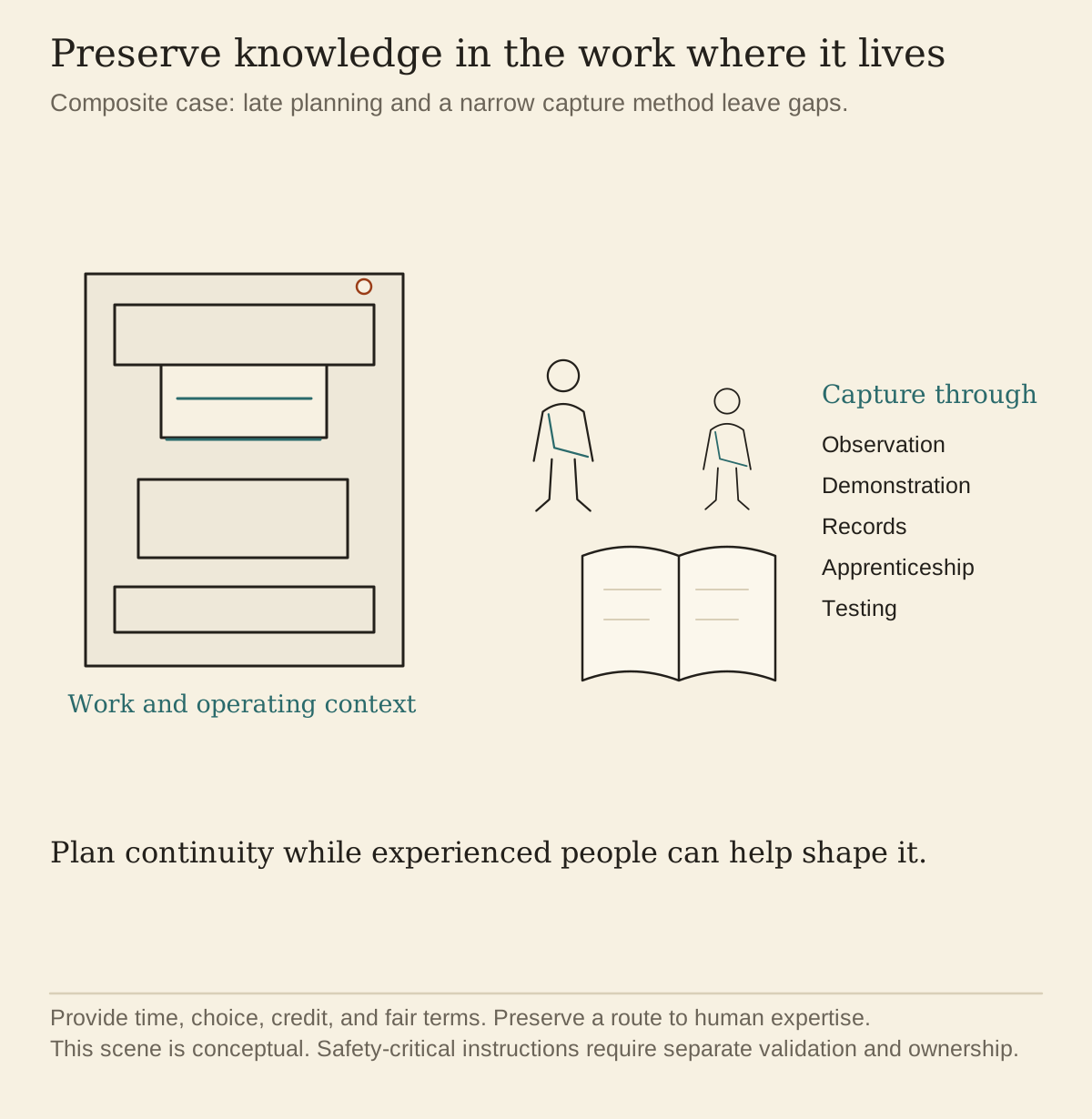
A manufacturing company, with operations going back four decades, had a workforce in its production facilities with deep operational expertise. The plant managers, the senior operators, the maintenance leads. They held knowledge of the equipment, the processes, the quirks of each line, the relationships with suppliers, the historical reasons things were done the way they were. Most of this knowledge was not documented anywhere. It existed in the heads of people who had been doing the work for fifteen, twenty, or thirty years.
The company decided in 2025 to invest heavily in AI for operations. The investment thesis assumed that much of the institutional knowledge could be represented in the systems being built. The CTO commissioned a knowledge project using interviews, observations, documents, operational data, and a graph for relationship-heavy knowledge. The vendor was engaged. The project began.
In parallel, the company was examining workforce demographics and cost. Senior operators were approaching retirement, and early-retirement incentives were taken up faster than expected. By the time the knowledge project entered its substantive phase eighteen months in, many intended contributors had left. The remaining workforce held different experience, just as valuable in its own terms, and still could not reconstruct every condition its predecessors had encountered. One of the last senior operators had run a 600-ton stamping press for thirty years. On cold mornings, he knew, the die ran a thousandth tight until the press warmed, so he fed the first hour slowly and inspected early parts. In March a modeler asked in a conference room how he decided when the press was ready. "You run it until it sounds right," he said. Fifty minutes produced four sentences because an interview detached from the machine was the wrong capture method. Observation, sensor data, demonstrations, and testing might have represented more; some embodied judgment would still resist codification. The system went into production and proved useful, but narrower than the investment thesis promised.
A 2025 Frontiers in Psychology study by researchers at Jilin Normal University surveyed 635 older employees across industries in China. Its overall result was not that AI adoption suppresses knowledge transfer: adoption was positively associated with intergenerational transfer. The study also found a smaller negative indirect pathway through identity threat and positive pathways through relational crafting, with digital self-efficacy moderating threat. The cross-sectional self-report design and specific population do not establish causation or describe every older worker. It supports a more useful point: adoption can produce competing pathways, and identity threat is one condition leaders should address without stereotyping older employees as defensive.
What goes wrong in the composite is sequencing joined to method and trust. The company begins late, after retirement incentives have accelerated departures and automation messaging has changed the employment bargain. Some people leave for retirement, care, health, or opportunity; some may share less because the project feels extractive; some participate fully. Meanwhile, the project relies too heavily on interviews and one representation. The technology can work as specified and still fail strategically because the specification assumed knowledge was complete, articulable, collectible, and stable.
The design decision the leadership team should have made instead is described in Sections 4.1 and 5.2. Capability continuity should begin before departures become urgent, but not as a covert prelude to workforce reduction. Experienced workers should help decide what is worth preserving, how it can be represented, who may use it, and how contributors receive time, credit, compensation, and the right to decline where appropriate. Capture should happen in the work where possible: observation beside the press, comparison of normal and anomalous runs, review of sensor traces, demonstration to apprentices, and explicit testing of the resulting rule. It should combine operational data, documents, mentoring, simulation, and the storage forms the use case requires. Safety-critical knowledge needs validation, versioning, ownership, and a process for correction; a vivid anecdote is not yet an operating instruction. The covenant makes commitments explicit; only conduct over time makes them credible.
The lesson: threatened people may reasonably withhold participation, but trust is not the only limit. Institutional knowledge is distributed, situated, changing, and only partly articulable. Honor the workforce because people have standing and because fair participation improves the work. Then design for what cannot be captured: apprenticeship, redundancy, succession, judgment, and continued access to experienced humans.
The five cases above share more than they differ. Each begins with a leadership team making a specific design decision, often without recognizing it as one, and encountering its consequences months or years later. The decision is not the only cause. It is the upstream choice the case makes visible.
Across all five composites, visible announcements and structural decisions interact with less visible assumptions, incentives, power, data, methods, and sequencing. Sections 7.1 and 7.2 provide hypotheses for tracing those interactions. A leadership team that intervenes only at the visible level increases its exposure to these failure patterns. The cases are diagnostics, and a team that reads them early can change the ending.
The composites begin with pressures a leadership team can recognize: cost, growth, risk, and the demand to show progress. Naming the patterns makes the design decisions legible, so a leadership team can recognize the choice before they make it, and choose the design that produces a different outcome.
The earlier intervention is the work this field guide has been describing. If the rest of the book has been an argument for what to design for, this section has been an argument for what happens when the design is skipped, delegated, sequenced badly, or replaced by an announcement.
Consider. If you keep three things from Stage 8: 1) Done well, the transition can change the texture of ordinary days, expanding some judgment work and shrinking some administrative work without assuming every role benefits equally. 2) Mixed workforce responses are normal; a uniform response is a reason to examine whether dissent is safe before suspecting manipulation or cynicism. 3) Every failure composite began with design choices whose consequences were not made legible; make the choices, evidence, affected groups, and reversibility visible before you commit.