What does AI-Native work look like on an ordinary day?
A reader can agree with every section of this book, follow every argument, and finish with no clear picture of what the company being described actually looks like on a Tuesday morning. The argument lands intellectually and stays abstract operationally.
Three constructed narratives close that gap. A day in the life of a senior knowledge worker. A week in the life of a leadership team. A month in the life of a workforce going through an AI-Native transition. These are fictional composites, built to illustrate the work, with no predictive claim. They are partial rather than exhaustive. Hold them in mind as design scenarios: concrete instances of how the operating model in the rest of the book might appear in practice.
They aim for honesty about friction, judgment calls, and moments where the company has to choose between competing goods. They are still selective. A narrative can make a designed future feel more proven and coherent than it is. The point is to make the work recognizable, invite critique, and expose decisions the abstract framework can hide. Real companies will unfold less neatly.
Methodological lineage. Henry Mintzberg's 1973 book The Nature of Managerial Work, based on structured observation of five chief executives, challenged a classical account of management associated with Henri Fayol. Mintzberg documented brief and varied activities, frequent interruption, verbal information, and ten managerial roles; his 1975 Harvard Business Review article The Manager's Job: Folklore and Fact received that year's McKinsey Award. His method sets a demanding standard precisely because these narratives do not meet it: I am constructing scenarios rather than reporting observation. The lineage informs the attention to ordinary time and actual activity. The evidentiary status is different, and a real company's work should be observed rather than assumed to match the story.
Mintzberg, Henry (1973). The Nature of Managerial Work. New York: Harper & Row. / Mintzberg, Henry (1975). "The Manager's Job: Folklore and Fact." Harvard Business Review, 53(4), 49-61.
A Day in the Life: Senior Analyst at an AI-Native Consulting Firm
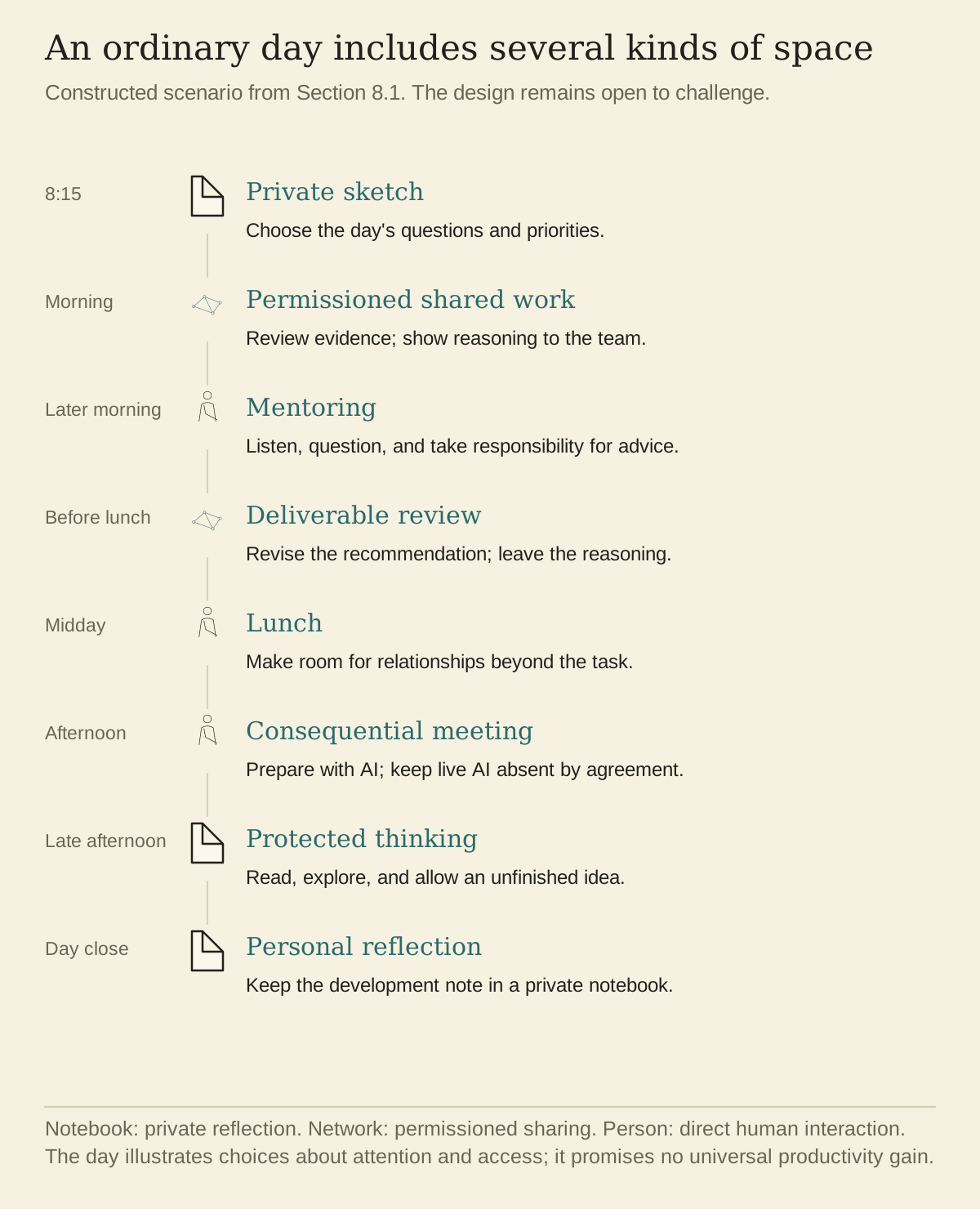
Elena Marsh is forty-six. She joined the fictional firm fourteen years ago as a research associate and worked her way up through the analytic ranks. The firm has been doing the AI-Native work seriously for about three years. In this scenario, the transition has changed her job, helped her develop new capacity, and altered the texture of her days in ways she could not have predicted when it started.
She arrives at her desk at 8:15 and does not check email. The firm's practices include a short ritual of beginning that she has come to value: fifteen minutes with the open questions on the engagement she is leading, a hand-drawn sketch of what today needs to accomplish, a note about the moments that will require her full attention. The engagement is Lakeshore Mutual, a regional property-and-casualty insurer deciding whether to keep writing homeowners coverage along the Gulf Coast or retreat to its inland book. The sketch happens on the notepad that sits on her desk. She has read enough about AI-for-thinking versus AI-as-thinking to know that the first sketch of the day belongs to her rather than to the AI.
Then she opens the firm's collaboration surface, the layer the firm built two years ago after recognizing that single-user chat tools were producing the thirty-islands problem from Section 4.3. The surface holds the team's shared context for the Lakeshore engagement, and overnight it has flagged something worth examining: two competing carriers have filed non-renewal notices in the same three coastal counties, three weeks apart, which changes what a Lakeshore retreat would look like to regulators and to the agents who sell its policies. Below the flag sits a question that Tomás posted from the Denver office last evening, and below that a draft section of the Lakeshore deliverable that a team member produced yesterday with AI support, awaiting her review.
She acts on none of it immediately. She reviews the items as inputs and decides which to engage with first. Being the one who decides what gets her attention, rather than letting the surface set the agenda, is a discipline she has had to learn deliberately. The surface is helpful, but it is designed to surface things, and not everything it surfaces deserves her attention.
She starts with Tomás's question. He has modeled Lakeshore's coastal book, and the numbers are ugly: the coastal counties lose money in seven of his ten scenarios. His question is about positioning. The analysis is ready for review and open to challenge. Lakeshore's CEO is the founder's grandson, and the founder built the company writing exactly these policies. Should the board presentation lead with the retreat scenario, or hold it as one path among three? Tomás has done the analytic work and used AI to support it. What remains includes validation, judgment, and communication, and he is asking for hers because she has walked clients through retrenchment before. She responds in the surface, visible to the authorized team, with her evidence and rationale laid out so he can challenge the thinking rather than merely receive the conclusion: lead with the numbers, but frame retreat as a question about what the company owes its agents, because that may be the frame through which this CEO can engage with the choice.
The response takes her twenty minutes. Before the transition, in this scenario, it often took an hour because she rebuilt more of the analysis before trusting it. The system and Tomás have done much of the preparation. She is reviewing the evidence and exercising judgment, and the firm values exactly that. The firm will need to check whether the time saved holds across other engagements.
Later in the morning she has her one-on-one with Priya, a junior analyst on her first independent engagement, a marine-parts wholesaler whose COO has championed a warehouse expansion the demand data does not support. They choose an in-person room without screens; the firm protects focused mentoring while providing remote and assistive alternatives when people need them. Priya gets to the real question quickly. "He announced the expansion at their holiday party. How do I tell him it doesn't pencil?" Elena listens, asks questions that help Priya find her own answer, and offers a framing that has worked for her: separate the decision from the person who made it, and give him a way to be the one who caught it. An AI system could generate advice or rehearse the conversation. Priya has chosen the accountable judgment and relational presence of someone who has delivered unwelcome numbers to proud executives for fourteen years.
Back at her desk, the morning has compounded. Tomás has thanked her in the surface, and a colleague in the insurance practice has built on her response with a consideration she had not weighed: Lakeshore's reinsurance renewal lands in January, which cuts the decision timeline in half. Three people have advanced the work through a shared, permissioned space. They might have done so through older channels; the surface made the context and timing easier to see.
She turns to the deliverable review. The AI-supported draft is competent, the framing right, the analysis sound. But the recommendation has converged on the obvious answer, full retreat from the coastal counties, when the engagement requires the less obvious one. Lakeshore is a mutual, and its coastal agents are the same agents who feed its profitable commercial lines; a full retreat would gut the network that makes the rest of the company work. The better answer is staged: tighter underwriting, a parametric reinsurance layer, and withdrawal only from the two counties where nothing closes the gap. The team member who wrote the draft did not see the divergence between the obvious answer and the right one. The AI did not see it either, because the AI was working from the prompt and the data, without the texture of the client relationship. She rewrites the section and leaves notes in the surface about what she changed and why. The notes are part of the team's learning practice; the next time an engagement turns on a distribution network the data cannot see, her reasoning will be there to consult. She is not certain she is right. She will find out this afternoon whether the staged answer survives contact with Lakeshore's CFO.
The original draft and her revision sit side by side in the surface, where the team member who produced the draft will see the difference and learn from it. The mentorship is happening through the work itself rather than through a separate training program.
At midday she has lunch with two colleagues. They talk about a wedding and a kitchen renovation. The firm protects this time, and she returns to her desk refreshed.
The afternoon holds the consequential meeting of the day. Lakeshore's executive team joins by video; her firm's engagement partner is in the room beside her. The team has used AI to help prepare materials and model scenarios, and its approved retrieval system has surfaced four permissioned, appropriately deidentified prior engagements from the firm's governed knowledge base. No AI system participates live in this meeting, a choice based on client consent, confidentiality, and the kind of conversation expected. The decision also depends on a relationship the firm has earned over years.
The meeting goes for ninety minutes and Elena speaks twice. Once when the CFO pushes on the parametric layer's basis risk and she has the answer because of the morning's preparation, and once when the CEO goes quiet at the retreat map and she offers the framing about the agents, the same one she gave Tomás that morning. Her interventions are short. They land. Lakeshore's CEO asks for the staged plan in writing, which is most of the way to yes. The partner thanks her on the way out. The work was preparation that took her hours and judgment that took her seconds, and the seconds were what mattered.
Late in the afternoon comes the part of the firm's operating rhythm that took her longest to accept: unstructured time, on her calendar, protected, for thinking, reading, working on problems that have not yet been named, sometimes for nothing in particular. Today she reads a long piece a colleague shared in the surface about Gulf Coast homebuilders adopting fortified roofing standards, adjacent to Lakeshore's world rather than inside it. The reading produces a half-formed idea about an insurer-funded discount program. She might use it in three months. She might never use it. The firm has decided that this hour is part of the work, and Elena, who fought it for the first year, now considers it indispensable.
At the end of the day she writes a brief reflection. What worked, what did not, what is on her mind for tomorrow, and today one more line, about whether she overrode the draft's retreat recommendation too quickly. The reflection is for her own development, and it goes in a notebook rather than the surface. Some things are private.
She leaves at 5:30. In the scenario, her workday is shorter than it used to be, reviewers judge the output stronger against the firm's quality criteria, and the texture of her hours has changed. By the welder's standard from Section 5.6, she describes herself as being in a better relationship with her own brain than she was three years ago. She also notices that the transition was not always comfortable, that there were stretches when she did not know what her role was becoming, and that she did not always appreciate leadership's choices. Some she challenged, and some changed because workers challenged them. She is grateful for parts of the support now. The disagreement was part of the transition, and it belonged to her.
A Week in the Life: Leadership Team at an AI-Native Manufacturer
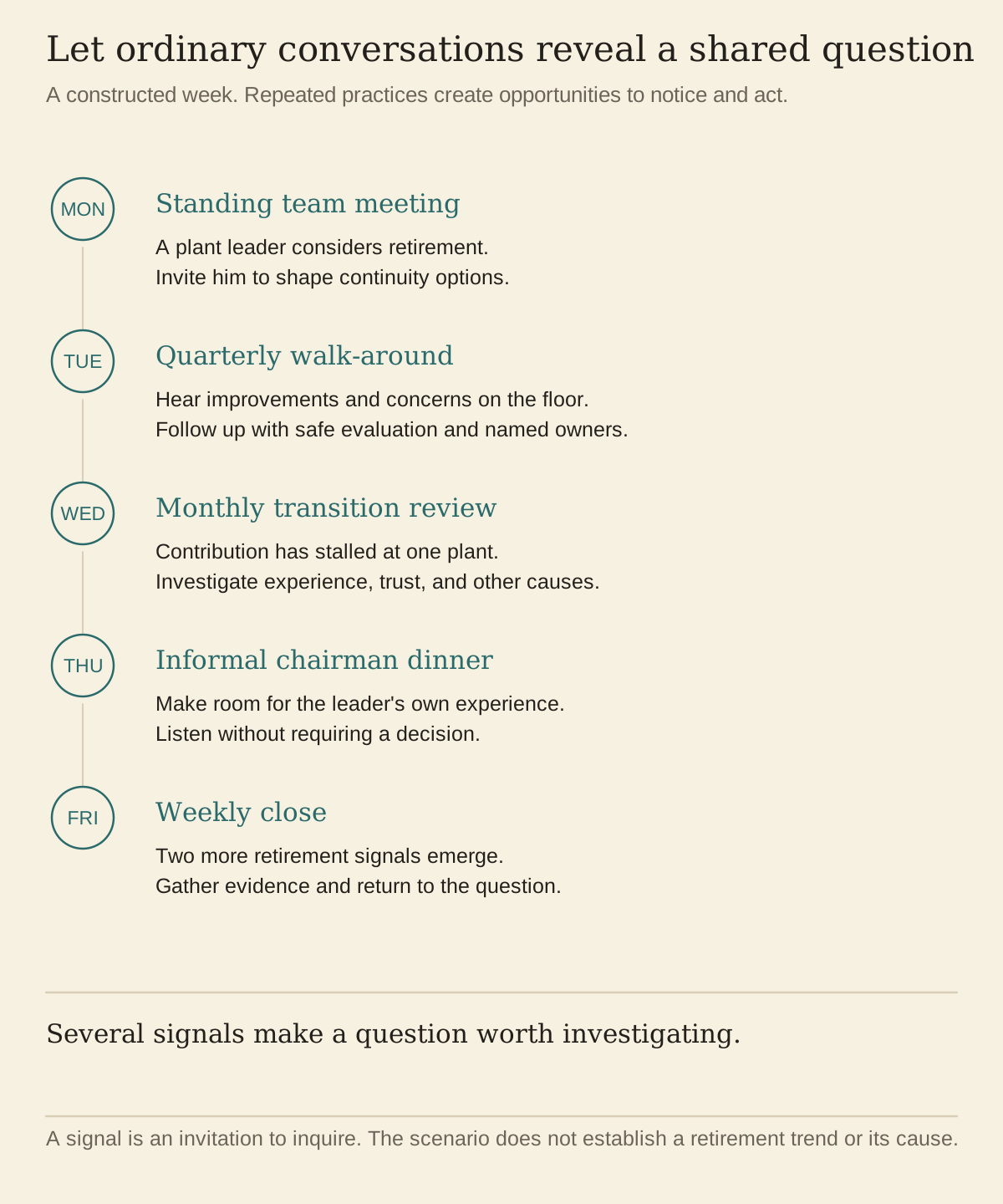
This fictional manufacturer machines hydraulic manifolds and valve assemblies for agricultural and construction equipment makers. It has been in business for sixty-three years. Carl Brandt has been CEO for nine of them. He inherited a strong company, and he has spent the past four years working to keep it strong through the transition at the center of this book.
The leadership team, eight people including Carl, meets every Monday morning, in person when possible. The meeting starts at 8:00 and runs until 10:30: an hour of operational review of the week ahead, an hour of substantive conversation about something the team needs to think about together, thirty minutes unstructured. The team has held to this format for two years.
This Monday's substantive conversation is about Gene Halvorsen. Gene has been with the company thirty-one years and runs the Rockford plant, the low-volume, high-mix operation where the hardest jobs go, and he has told Carl he is thinking about retirement. What Gene knows about that plant has never been written down: which spindle drifts when the humidity climbs, which supplier's certifications deserve a second look, why the pricing on the largest OEM contract is structured the way it is. The team understands that this knowledge is irreplaceable on any short horizon, and Gene's signal is the prompt for a conversation they have been deferring for two years.
The discussion runs into the unstructured half-hour and produces clarity about what the decision involves. The decision itself waits. What capability is at risk if Gene retires on the current trajectory. What should the company carry forward. What would honoring him look like while recognizing that he has earned the right to leave without turning his departure into an extraction project. Carl says plainly that he does not know the right path. The chief operating officer names the operational risk, the chief human resources officer the human dimensions, and the chief technology officer the limit that matters most: interviews, observation, records, and a knowledge graph may capture some of what Gene can articulate and demonstrate, but not all of his situated judgment. The team agrees to return in two weeks with options and to invite Gene to shape them, with protected time, choice over participation, credit, and compensation where the work exceeds his role.
On Tuesday morning Carl does his quarterly walk-around at Rockford, a practice he started three years ago: half a day on the floor, in conversation with workers, asking questions, listening more than talking, taking notes on what he hears. He comes back knowing things he did not know. The grinding cell has been running a coolant-filtration bypass the floor team rigged themselves, without a capital request, and scrap on that line is down because of it. A buyer at the company's second-largest customer is irritated about late inspection paperwork, an irritation that has not yet reached the account team through any official channel. And a second-shift machinist named Dana has been suggesting a fixture change that would cut changeover time on the long-run jobs, and her supervisor has been waving it off.
Carl follows up on all of it. The filtration rig gets recognized through the firm's practice of celebrating valuable worker-led improvement, while safety and engineering review determine whether the bypass should remain. The paperwork complaint goes to the account team with Carl's name on the escalation. With Dana's agreement, Carl brings her and her supervisor together, listens to the fixture idea, and asks them to define a fair, safe evaluation. The conversation is uncomfortable for the supervisor and clarifying for everyone else. It ends polite and unconvinced; whether the fixture change gets a fair evaluation is something Carl will have to check later without turning a CEO visit into a substitute for a functioning improvement process.
On Wednesday the leadership team holds its monthly review of the AI-Native transition, structured around the four diagnostic questions from Section 7.1. What loops appear to be running well. What loops may be running in the wrong direction. What goals, constraints, delays, or side effects are counteracting the interventions. What defeating structures may be present. Fourteen months of these reviews have worn away some of the early awkwardness without converting the maps into certainty.
This month's review surfaces a stall. Voluntary knowledge contribution and reuse appear healthy at three plants and are going nowhere at the fourth, in Owensboro. The first instinct in the room is pressure: set a target and hold the plant manager to it. The systems-thinking discipline makes the team investigate instead. The Owensboro manager lived through a documentation drive at a previous employer fifteen years ago that ended in layoffs six months after the binders were full. That history makes his concern rational, but it may not be the only cause. The chief operating officer and chief human resources officer will visit together next week, open by listening to workers and their representatives, restate what the covenant does and does not permit, and decide with the plant whether any capture should proceed.
On Thursday Carl has dinner with the chairman of the board. The dinner is informal and the conversation ranges, and then the chairman sets down his fork. "How are you doing, Carl? You, apart from the company." Carl answers honestly. He is tired. He is worried about getting Gene's transition right. He is energized by what the firm has built and uncertain whether it is moving fast enough. The chairman listens and asks two questions that help Carl see his situation more clearly. Nothing gets decided, and the dinner is one of the more important things that happens to him all week.
On Friday the leadership team gathers for the weekly close. The format is short, forty-five minutes, each member sharing one thing that went well, one that did not, and one thing they are carrying into next week. It produces a quality of conversation the team has come to need.
This Friday's close surfaces something the team did not know it was thinking. The chief human resources officer mentions that a maintenance lead in Owensboro has asked about pension bridge options. Two turns later, the chief operating officer mentions that his best quality engineer floated a phased-retirement question at a plant review. Set beside Gene, the two mentions become a recognition: the firm is at the front of a wave of retirement signals arriving earlier than it has historically seen. Carl commits to bringing this back as a substantive Monday conversation in three weeks, and the team agrees on what data to gather in the meantime. The Friday close has done what it exists to do. It surfaced a pattern no individual member would have seen alone.
The leadership team's week ends at 11:30 on Friday. Carl leaves at noon for a weekend with his family, and the firm protects disconnection because sustained availability carries health, family, and decision-quality costs. The team protects that time each week.
A Month in the Life: Workforce Going Through Transition
The third narrative is harder to write because the experience of being in a workforce going through an AI-Native transition is not as orderly as the two just described. The leadership team's week and the senior analyst's day were narratives of work that has been going on for years and has reached a steady state of practice. What follows is the experience of a workforce in the middle of the change, before the steady state has been reached.
The fictional company is a mid-sized employee-benefits consulting and brokerage firm, roughly fifteen hundred people. The CEO, Alan Reyes, announced the AI-Native transition fourteen months ago. The transition is real inside the scenario, it is incomplete, and the workforce is in the stretch where the shifts are visible and the destination is not yet clear.
The first week of the month is the all-hands meeting. It runs Thursday at nine, in the largest conference room the firm has, folding chairs added along the back wall, the regional offices patched in on a screen. Alan stands at the front and walks through what is going well, what is not, and a decision the leadership team has since concluded was wrong, the decision to pilot the new renewal-analysis tools in the firm's largest office first, where the senior consultants had the least slack to absorb a learning curve. He names what they are doing differently because of it. The address takes twenty minutes. The Q&A takes forty. The questions are real, and some of them are uncomfortable for him. He answers them anyway.
The workforce's response varies. Some people are reassured by the honesty. Others are alarmed that the leadership team admits in public to having been wrong, and a portion remain unconvinced. The facilitation partners expected mixed responses because people occupy different roles, histories, and levels of risk. A uniform response would be a reason to examine whether dissent feels safe or the question was framed too narrowly. Manipulation and cynicism come last on the list of explanations.
In the second week, the firm rolls out a new set of practices for its health-and-welfare renewal line, the result of nine months of work with senior practitioners, the chief technology officer, the engagement design team, and affected employees. An approved AI system drafts carrier-quote comparisons and renewal analytics for human validation. The intended redesign shifts more consultant time toward plan design and client conversation; whether it raises their contribution, workload, and development has to be measured. The rollout is staged. One team adopts first, its experience is observed, adjustments are made, and the next team follows if the evidence supports it.
The first team's adoption is awkward. The practices were designed around a steady work rhythm, and renewal season is not steady; the team vents its frustration in the weekly reviews. Leadership keeps the practices through the first discomfort and treats each objection on its merits. It checks workload, errors, client effects, and what the team says. By the end of the week, two practices have been revised and the rest are becoming more workable, though nobody would call them loved. The team that observed the pilot adopts with clearer expectations; its experience may still differ.
The third week brings the quarterly listening session, a practice the chief human resources officer instituted six months into the transition: two hours with a stratified but voluntary group across roles, levels, locations, tenure, and different experiences of the change. The process states how people are selected, how notes will be used, and what confidentiality can and cannot be promised. The leadership team listens for the first ninety minutes and responds for the last thirty; other channels remain open for people who will not speak candidly in front of executives.
This quarter's session produces genuine appreciation for the decision to give every consultant paid weekly hours for learning the new tools, and the leadership team receives it without inflating it. It produces a concern: the peer-review step in the new practices has, on some teams, become a rubber stamp, which the leadership team had believed was not happening. The chief human resources officer commits to looking at it directly. And it produces a question no one at the front of the room can answer. An eight-year consultant puts it plainly: "If the AI drafts the renewal analysis, what am I getting promoted for?" The leadership team does not pretend to have an answer. They commit to bringing one to the next session.
The week ends with the leadership team translating what it heard into actions, owners, timelines, and explicit explanations when a request will not be adopted. In the weeks ahead, the workforce should be able to trace what changed, what did not, and why. That closed loop is part of what makes listening credible over time.
In the fourth week, Corinne, a senior practitioner of nineteen years, gives notice, and no one saw it coming. Alan calls her directly. She chooses to share that her mother needs full-time care and says the transition played no part in her decision. He accepts this without probing and asks whether she wants to suggest anything that would make the transition better for the people who stay. She offers two ideas: move weekly practice reviews off Friday afternoons, when everyone is spent, and give consultants access to the carrier-comparison sources, assumptions, uncertainty, and reproducible checks rather than only a generated answer. The first becomes a change within the month. The second becomes a technical and workflow requirement the team will test, without pretending that a model's hidden internal reasoning can be made into reliable evidence.
Corinne's leaving is marked, simply and intentionally, the way the firm marks every departure. She is recognized publicly. Colleagues share moments from working together that they will carry forward, and she is invited to stay in touch.
The month closes with the leadership team reviewing where they are. Progress has come in some intended directions, and so have patterns they did not anticipate. Corinne's departure is recorded accurately as a caregiving departure rather than quietly relabeled as transition resistance. It also prompts a wider look at caregiver support and capability continuity, alongside the rubber-stamp reviews and the promotion question. The list is long. Calling it manageable would be premature; assigning owners, priorities, resources, and escalation rules is what makes it manageable. Not pretending the work is simpler than it is is part of what makes the transition real.
The workforce ends the month in a different place than it started. The change is incremental but visible to anyone who is paying attention. The firm is, in small ways, becoming what the leadership team committed to building. It is not finished.
What the Narratives Leave Out
The three narratives just told are narratives of work going well. They are not the only kinds of stories worth telling. The companies that learn from this work also study the failures, and the failures are abundant and instructive. The next section tells five of those stories, each traced back to the design decision that produced it.
Stage 9 then addresses the method that produced this work and that I use with leadership teams. The Arc5 method, the Nodalix architecture, and the way the two combine to support leadership teams in doing the work just described.