What kind of partner does this work require?
This section and the next describe what Arc5 and Nodalix offer and why I believe their combined capabilities fit this work. They also give you questions for assessing the support your team needs.
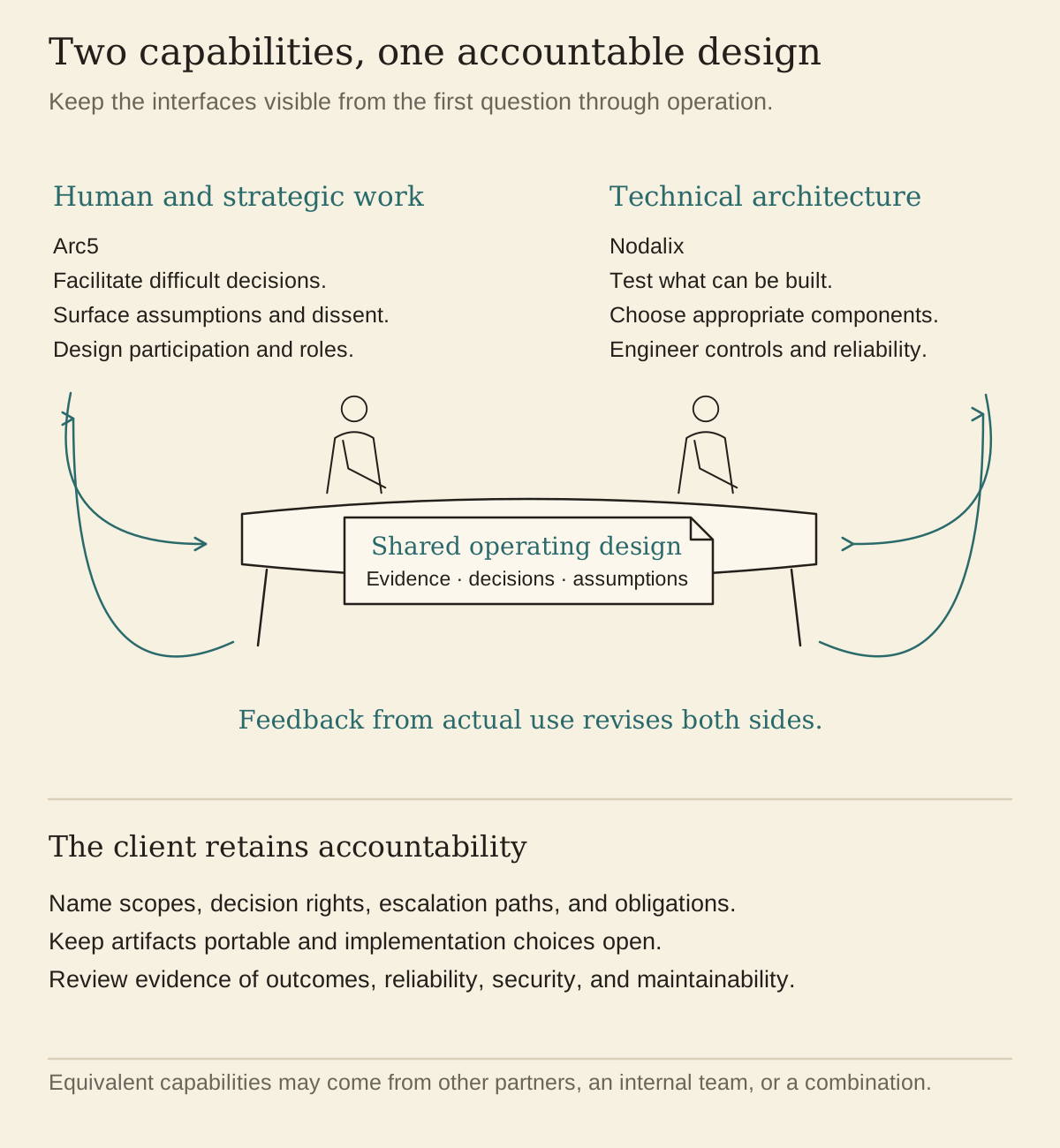
The Two Capabilities
Work of the kind this book recommends takes two distinct capabilities. One is designing and facilitating the human and strategic work at the leadership-team level. The other is building the technical architecture that makes the resulting operating model real.
That first capability is practiced by some management consultancies, organizational-design specialists, and facilitation firms. It involves understanding how leadership teams think, designing conversations that produce shared understanding without suppressing disagreement, holding difficult moments, surfacing assumptions, and helping a team construct and test new working models. It requires experience with senior teams, fluency in design thinking and systems thinking, structured collaborative design, and the capacity to read a room and adapt in real time. It is craft, in the specific sense used in Section 5.9, and prospective clients should ask for evidence of it rather than infer it from a firm's category or presentation quality.
The second is practiced by technology firms and strong internal engineering organizations. It involves understanding AI at the system level; choosing among graphs, relational data, documents, rules, models, and workflows; building automation or agents within governance constraints; and integrating with operational data and tools. It requires technical expertise, relevant domain knowledge, and the capacity to translate operating-model decisions into production systems. Evidence should include reliability, security, maintainability, user outcomes, and what happened after deployment. A successful demo is where that evidence starts.
The two capabilities can live in one firm, a partnership, or a strong client-led team, but they are often contracted and governed separately. One group writes recommendations; another interprets them and builds. If outcomes, assumptions, decision rights, and feedback are not shared, translation loss appears in the handoff. The client then has to reconcile outputs that were never designed to fit.
The reverse failure also occurs. A technical team builds exactly what it was asked to build while critical operating-model, workforce, customer, or governance assumptions remain untested. That is not always the technology firm's failure; the mandate, commercial model, or client governance may exclude the necessary work. A technically functional system can still be operationally misaligned, and a well-designed operating model can still be defeated by poor engineering.
I have watched versions of this failure mode repeatedly. The client ends up integrating outputs that were not designed together, and responsibility becomes ambiguous. The answer is not necessarily one vendor. It is one accountable design with explicit interfaces, shared evidence, and governance that follows the work across organizational boundaries.
What Arc5 Brings
Arc5 is a collaboration design firm. Its work is the design and facilitation of immersive engagements for senior leaders facing complex, high-stakes decisions, grounded in design thinking, systems thinking, and the discipline of structured co-creation.
Arc5's method has been refined over many years, across industries as different as defense and hospitality, and across decisions from strategy to large-scale transformation. That breadth informs its cross-domain pattern recognition. It does not mean a frame validated in one setting transfers automatically to another; the method has to be adapted and its assumptions tested in each organization. Prospective clients should examine relevant examples, references, facilitator fit, and how outcomes were assessed.
Four properties of the method matter for the AI-Native work.
First is the discipline of co-creation rather than answer delivery. Arc5 arrives without a predetermined answer and designs conditions in which the leadership team and affected participants can construct one. The discipline is harder than it sounds. A facilitator inevitably shapes the room through the agenda, questions, artifacts, participation rules, and moments of intervention. The obligation is to make that influence deliberate and contestable, surface dissent, and keep decision rights clear. Construction can increase understanding and ownership; whether the outcome survives execution depends on resources, incentives, authority, technical reality, and follow-through as well.
Second is the use of artifacts as carriers of meaning. Alongside any necessary decks or records, Arc5 produces physical and digital artifacts the leadership team works with during the engagement, designed to hold assumptions, choices, dissent, and rationale in a form that supports later decisions. Some teams have continued using such artifacts for years in my experience. Others will need them revised, integrated into an existing system, or retired. Continued use is evidence of utility only if the artifact remains accurate and changes decisions. Visibility alone proves little.
Third is the integration of human and strategic work. Arc5 does not treat people as an adoption layer applied after strategy. Conversations address what the company should do and how authority, capability, workload, rights, and leadership practice may need to change. That can begin the human reckoning and covenant work from Section 5.2. It cannot legitimately complete them in an executive room: workers, representatives, customers, and other affected people need channels that match their stake, and some decisions require bargaining, legal process, or specialist review.
Fourth is the grounding in systems thinking. Arc5 designs engagements that help participants formulate and test accounts of the systems they operate within, including the leadership team's own role. The loops from Section 7.1 and the iceberg from Section 7.2 become working hypotheses rather than decorative frameworks. A workshop can introduce and practice that discipline. The leadership team's capacity compounds only if it continues mapping, gathering contrary evidence, revising its models, and changing decisions after the facilitators leave.
These four properties are the strategic and human side of the work, and on their own they are not enough. The work the leadership team produces in the engagement needs to translate into technical architecture, and the translation is where the second capability becomes necessary.
What Nodalix Brings
Nodalix is an industrial AI company. Its work is the design and construction of AI systems for operations-heavy environments, grounded in knowledge graph architecture, virtual sensors, multi-agent systems, and the disciplines of governance, observability, and drift management described in Sections 4.3 and 4.4.
Nodalix is built around a specific premise: institutional knowledge is often a major constraint on useful AI in operations-heavy environments. The appropriate architecture may combine graphs, documents, databases, time-series data, rules, models, and human workflows. A graph is valuable when relationships and dependencies are central; it is overhead when a simpler representation answers the need. Structured knowledge can improve grounding and reuse, but competitive performance still depends on data quality, operations, adoption, maintenance, and the quality of the underlying business. The premise is load-bearing; graph-first dogma is not.
Four Nodalix capabilities matter for the AI-Native work.
First is knowledge architecture. Where a graph fits, Nodalix models operation-specific entities, relationships, dependencies, provenance, identity, time, and permissions rather than treating a generic ontology as the finished answer. It also connects the graph to other authoritative stores. No representation captures an operation completely, and soft knowledge does not become reliable merely because it is encoded. The foundation is a maintained evidence system matched to the use case.
Second is the virtual-sensor and inference layer. Nodalix combines available signals to estimate conditions that may not be measured directly and connects model-supported inference to operational context. A virtual sensor is an estimate inferred from other signals; it needs calibration, uncertainty bounds, drift detection, and fallback behavior. Software and models can traverse and infer from represented knowledge, while accountable people and institutions retain ownership of consequential decisions.
Third is the agent and orchestration layer. Nodalix builds delegated software that operates within defined permissions, approvals, budgets, and stop conditions, with logs and observability proportionate to risk and privacy. Audit trails do not make an agent trustworthy by themselves: evaluations, access control, change management, incident response, and accountable owners matter. Roles and limits should be explicit, and autonomy should rise only with evidence and reversibility.
Fourth is experience in operations-heavy contexts, including work described by Nodalix across defense, manufacturing, healthcare, and related settings. That experience can be relevant where failure has physical, clinical, security, or economic consequences. It should not be accepted as self-validating. A prospective client should verify which systems reached production, what claims can be referenced, which outcomes were independently measured, what security or regulatory obligations applied, what incidents occurred, and how the system is performing now. Confidential work may limit disclosure; it does not remove the need for proportionate due diligence.
These four capabilities are what Nodalix brings, and they are also not sufficient on their own. The architectures need to fit the operating model decisions the leadership team has made. If the leadership team has not done the strategic and human work, the architectures are built against assumptions that may not hold, and the system that emerges is technically functional and operationally misaligned.
The Combination
Both firms work together. The intended model is not a joint sale followed by an invisible handoff: the strategic and human work Arc5 leads and the technical architecture Nodalix leads are designed together from the beginning. The client should still see separate scopes, responsibilities, commercial interests, escalation paths, data access, and accountability. Continuity should reduce the client's integration burden while keeping clear where one firm's obligation ends and another's begins.
That integration can produce advantages a leadership team feels directly. It also creates a commercial risk the client should govern: the team helping define the need may benefit from being selected to build the answer. The firms should disclose that interest, separate discovery conclusions from predetermined product choices, make artifacts portable, and leave the client free to compete, pause, or internalize implementation. Integration is valuable when it improves the work, and it loses that value once it creates dependency.
Decisions emerging from the Arc5 work can be informed by technical reality: what appears buildable, on what assumptions, at what estimated cost and time, with what dependencies and tradeoffs. Early technical participation improves realism, but estimates remain uncertain and should be updated through prototypes, security review, user research, and operational testing.
Nodalix can then design against an explicitly chosen operating model rather than a brief stripped of its rationale. Strategic and human implications are not thereby “worked through” forever; new constraints and affected groups will appear during implementation. The architecture and operating model should co-evolve through controlled decisions rather than forcing either one to fit a frozen workshop output.
The handoff does not disappear. Every transition between facilitation, design, engineering, deployment, and operation is a handoff, including within one team. The combination aims to make those interfaces visible, staffed, and governed, with shared artifacts and people spanning them. Translation loss should be measured and corrected, on the assumption that some is always present.
Human work continues into technical implementation. The covenant from Section 5.2, practices from Section 6.1, and meaningful-involvement decisions from Section 6.2 can be carried into requirements, testing, rollout, and operations. The firms remain accountable for their own work; the client retains employer, operator, legal, and executive accountability that no adviser can assume.
Why Now
Timing matters here. The combination is not equally important for every project or moment. A bounded internal automation may need strong product, engineering, risk, and user participation without a full leadership engagement. An enterprise operating-model change needs a broader coalition. Earlier cloud migrations also carried major strategic, workforce, security, financial, and operating implications; describing them as substantially technical would repeat the mistake this chapter describes.
AI-Native work makes the interdependence unusually visible because probabilistic systems can mediate knowledge, decisions, communication, and delegated action. Strategic and human work cannot rescue unreliable technology, and technical competence cannot determine what the company should optimize or what it owes affected people. Failures can begin in either domain or at their interface.
That is why the combination matters now. Leadership teams need access to both sets of capabilities and a way to integrate them over time. They may find that in Arc5 and Nodalix, assemble it from other firms, build it internally, or use a hybrid. The relevant comparison is not one engagement versus separate firms in the abstract. It is which arrangement provides the competence, independence, continuity, domain evidence, accountability, and challenge the specific work requires.
This section reads as advocacy for the firms behind this book. It is. I have tried to state why I believe the combination is well-suited to the work while making the claims testable. A buyer should ask what is proprietary, what is transferable, what evidence supports past outcomes, how fees and incentives work, who owns the artifacts and data, what happens if the firms disagree, and how the client exits without losing its operating knowledge. The leadership team that chooses this combination and the team that does not can both be making reasonable decisions. A small, bounded project may not justify it. A client with strong internal capabilities may need targeted support rather than an integrated engagement. The book is useful either way: engage these firms, assemble equivalent capabilities elsewhere, or use the questions to test the capability already inside the company.
The next section describes the specific engagement that a leadership team can take to start the work: the Alignment Sprint.