How does a leadership team begin?
A leadership team that has read this far and is moved by the argument still has to decide what to do on Monday morning. The work I have been describing is substantial. The full transformation is the work of years. What a leadership team needs is a way to start that is concrete, bounded, and produces enough value on its own to justify the engagement before any commitment to the larger work is required.
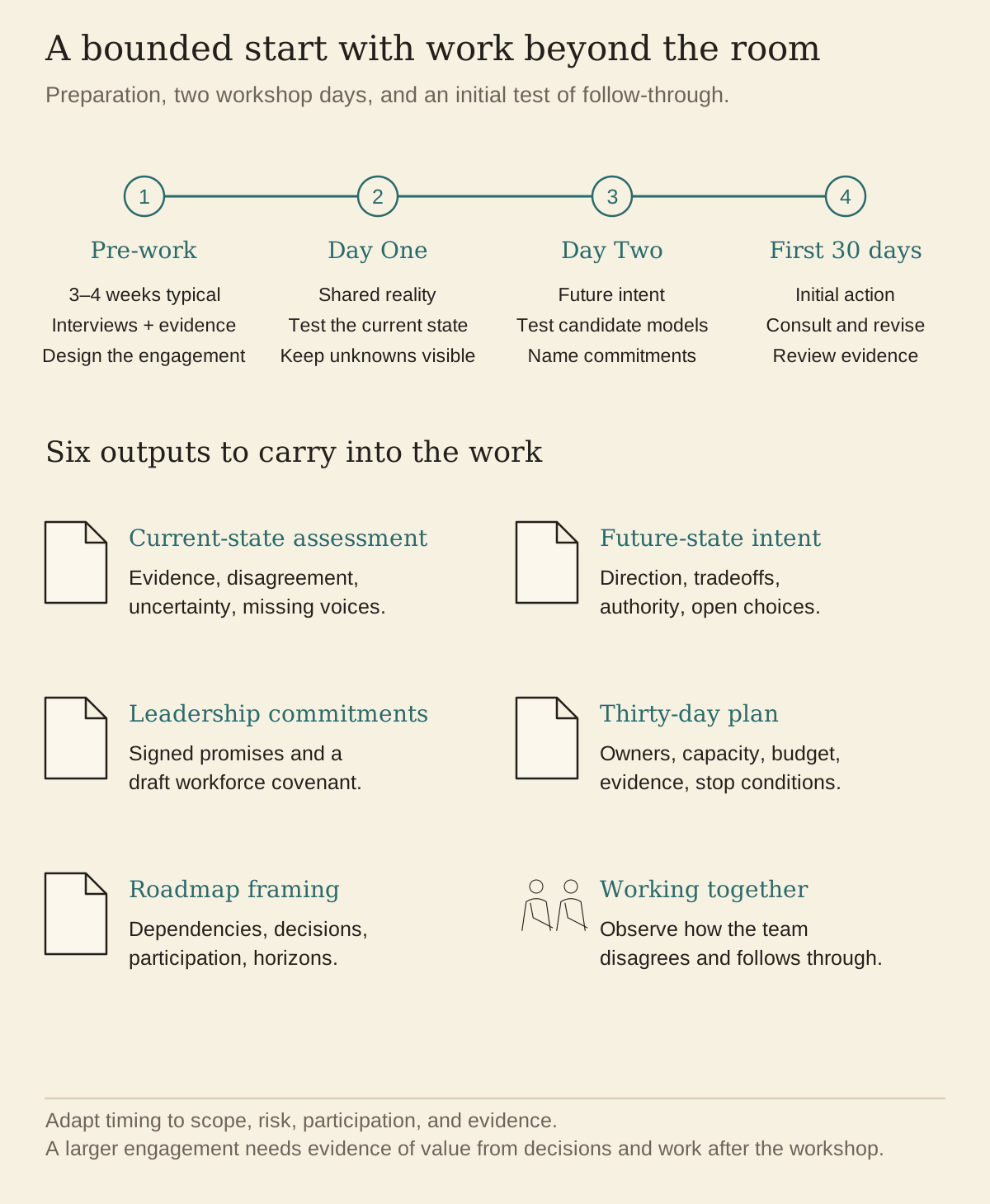
The Alignment Sprint is Arc5 and Nodalix's answer to that question. It is a designed engagement with a defined scope and specific outputs the leadership team can use to decide whether and how to proceed. It is an on-ramp rather than the transformation: a bounded engagement intended to improve alignment, expose disagreement, and frame the work. Whether it creates enough shared substrate has to be demonstrated after the room empties.
The Premise of the Sprint
My premise is that a leadership team beginning this work needs enough shared understanding to make coherent decisions. Analytic content, frameworks, and case studies are available. What is not available off the shelf is the team's own evidence-based view of where the company is, what it intends, where members disagree, and what authority they are prepared to exercise.
An Alignment Sprint is designed to produce a documented working view. It brings the leadership team into a structured engagement with preparation, artifacts, facilitation, and technical challenge. “Shared” does not mean unanimous or final. Material disagreement, uncertainty, missing voices, and decisions deferred for evidence should remain visible.
The central workshop is designed around two days because executive calendars are constrained. That is a commercial and practical design choice. Whether two days suffice depends on the team. Preparation and follow-through do require ongoing time from executives, the client design team, subject-matter experts, and affected participants. If the organization cannot provide that time, the sprint should be rescoped rather than sold as effort-free alignment.
The Pre-Work
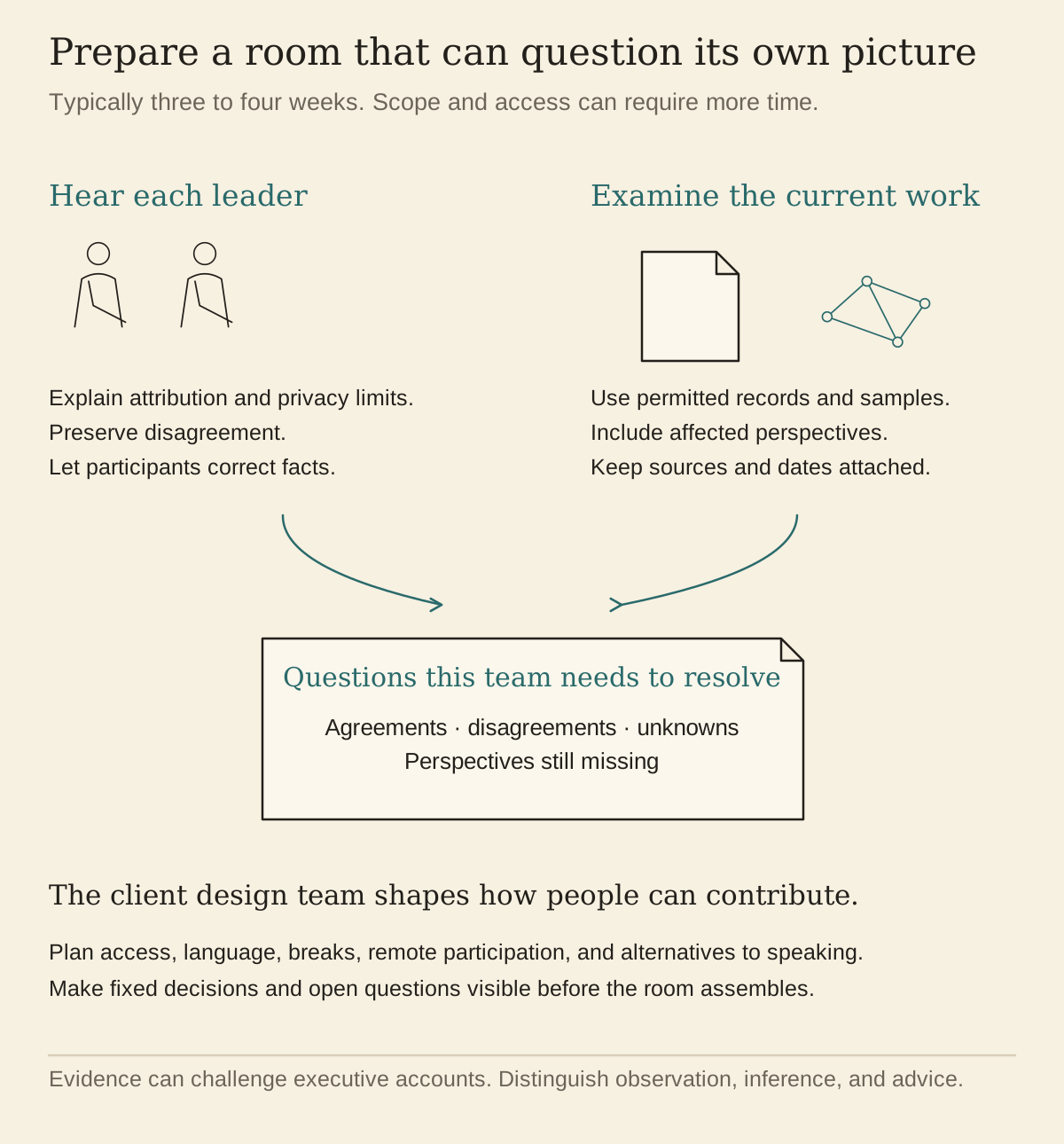
Work begins three to four weeks before the workshop, in several components.
First, the Arc5 facilitator interviews each leader for an hour about the company, AI-Native, hopes, fears, agreement, and disagreement. Before each interview, explain what will be attributed, how findings will be combined, who can see the notes, how long records will be kept, and the limits of confidentiality. The facilitator prepares a synthesis that removes identifying details where the group is large enough to permit it and preserves material disagreement. Participants can correct factual errors; the record should retain uncomfortable findings. Treat the interviews as accounts of people's views and questions to investigate. Claims about someone's underlying beliefs and any recommendations require further evidence.
Second, a review of the company's current state. This involves a structured assessment with technical, business, workforce, risk, legal, security, data, and customer perspectives proportionate to the scope. It examines the operating system, architectures, human work, practices, and systems view. Evidence may include policies, workflow maps, system inventories, incident history, employee and customer research, contracts, performance data, and samples of actual work, accessed under appropriate permissions. Evidence may contradict executive perception. The output is a working map of conditions, gaps, strengths, uncertainty, and claims requiring validation rather than a maturity score or consultant verdict. Sources and dates travel with the map so the workshop can distinguish a current fact from a remembered story.
Third, prepare the workshop materials from the interviews and current-state review: canvases for the team's decisions, relevant references and cases, and exercises designed to produce the agreed outputs.
Pre-work is typically planned for three to four weeks because customization matters, although availability, scope, regulated review, accessibility, and evidence collection may require a different schedule. A generic workshop risks generic outputs. Custom artifacts improve relevance only if they represent the evidence fairly and do not steer the team toward a predetermined answer.
The pre-work is also where the client's design team shapes the engagement. A typical design may involve about six meetings: objectives, inputs, outputs, constraints, flow, assignments, participation, breakout composition, accessibility, and a final walkthrough. The design must support remote participation, disability access, language needs, psychological safety, breaks, and alternatives to spontaneous speaking; otherwise the room will confuse ease of performance with quality of judgment. That participation can build understanding but does not transfer ownership automatically to everyone who will live with the results. The design team should document who was involved, who was absent, what was fixed before the workshop, what remains open to challenge, and which decisions cannot legally or ethically be made by this group alone.
The Two-Day Workshop
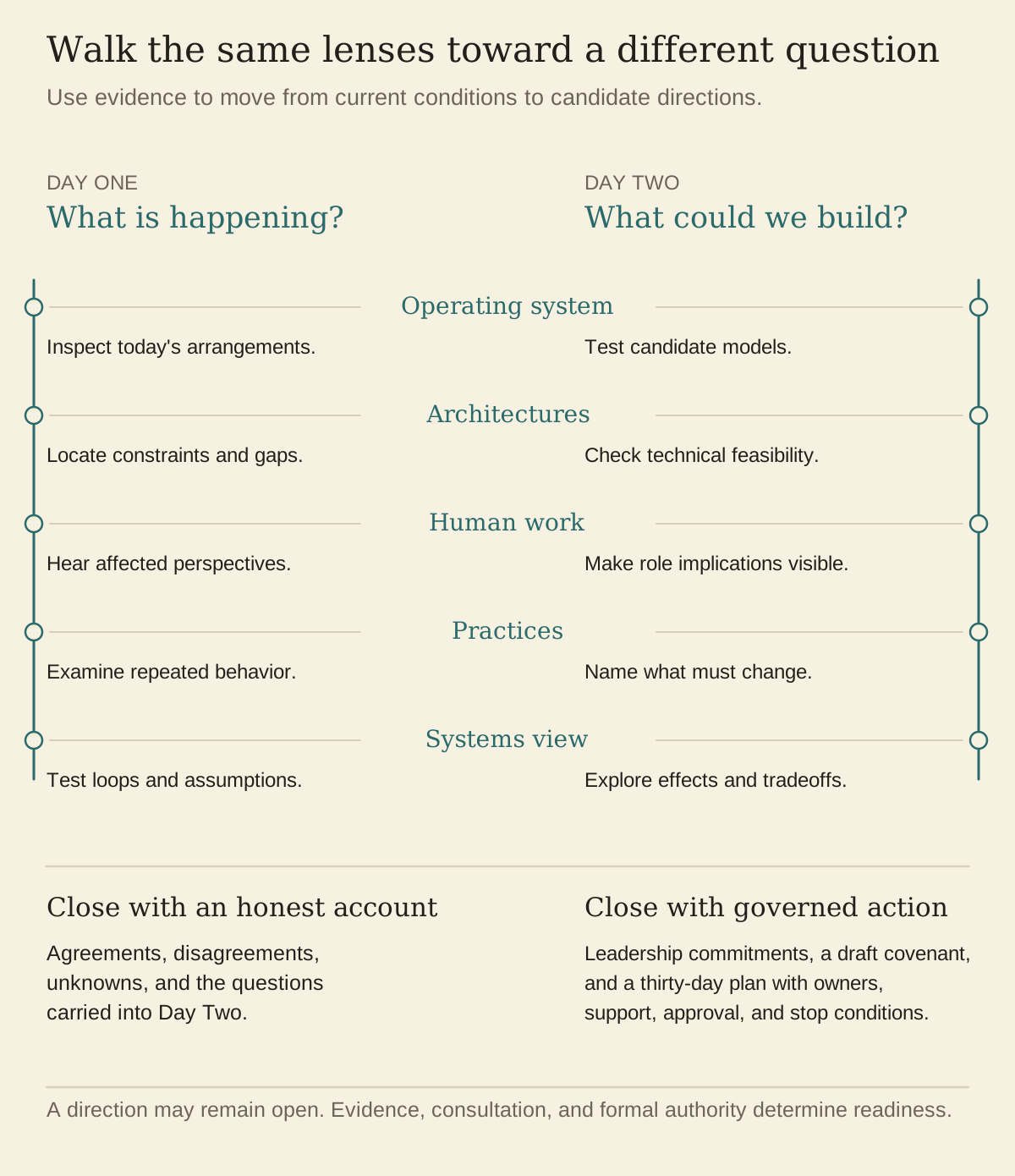
Two days, and each has a distinct purpose and structure. The structure is consistent across engagements, with the content customized to the specific leadership team.
Day One is shared reality, or as close to it as the available evidence and participants can get. Each member brings a view of what is working, what is not, and what is at risk. The morning surfaces those views and tests them against pre-work evidence. Good facilitation can reduce unnecessary defensiveness and make political dynamics discussable; it cannot remove power from the room. The output is a working account with agreements, disagreements, unknowns, and perspectives still missing.
The afternoon of Day One is the deeper diagnostic. The team examines the current state through the book's lenses: operating system, architectures, human work, practices, loops, constraints, and affected groups. The facilitator distinguishes observation from inference and prevents blame from substituting for a causal account. A working understanding can emerge, but any claim about workers, customers, systems, or legal obligations that has not been validated outside the room remains a hypothesis.
The day closes with the team's commitment to what they are bringing into Day Two. The commitment is short. It is the team naming what they are willing to take seriously, what they are not yet ready to address, and what they are committing to wrestle with the following day.
Day Two is shared future intent. The morning constructs candidate directions through the same lenses used for the current state. The team sketches two or three operating-model candidates from Section 4.2 and tests them against known constraints. In two days it may choose a direction, eliminate an option, or commission evidence needed before choosing. It should not manufacture certainty to satisfy the agenda. Timelines, investments, tradeoffs, reversibility, and affected groups become explicit, with formal approval reserved for the bodies that hold it.
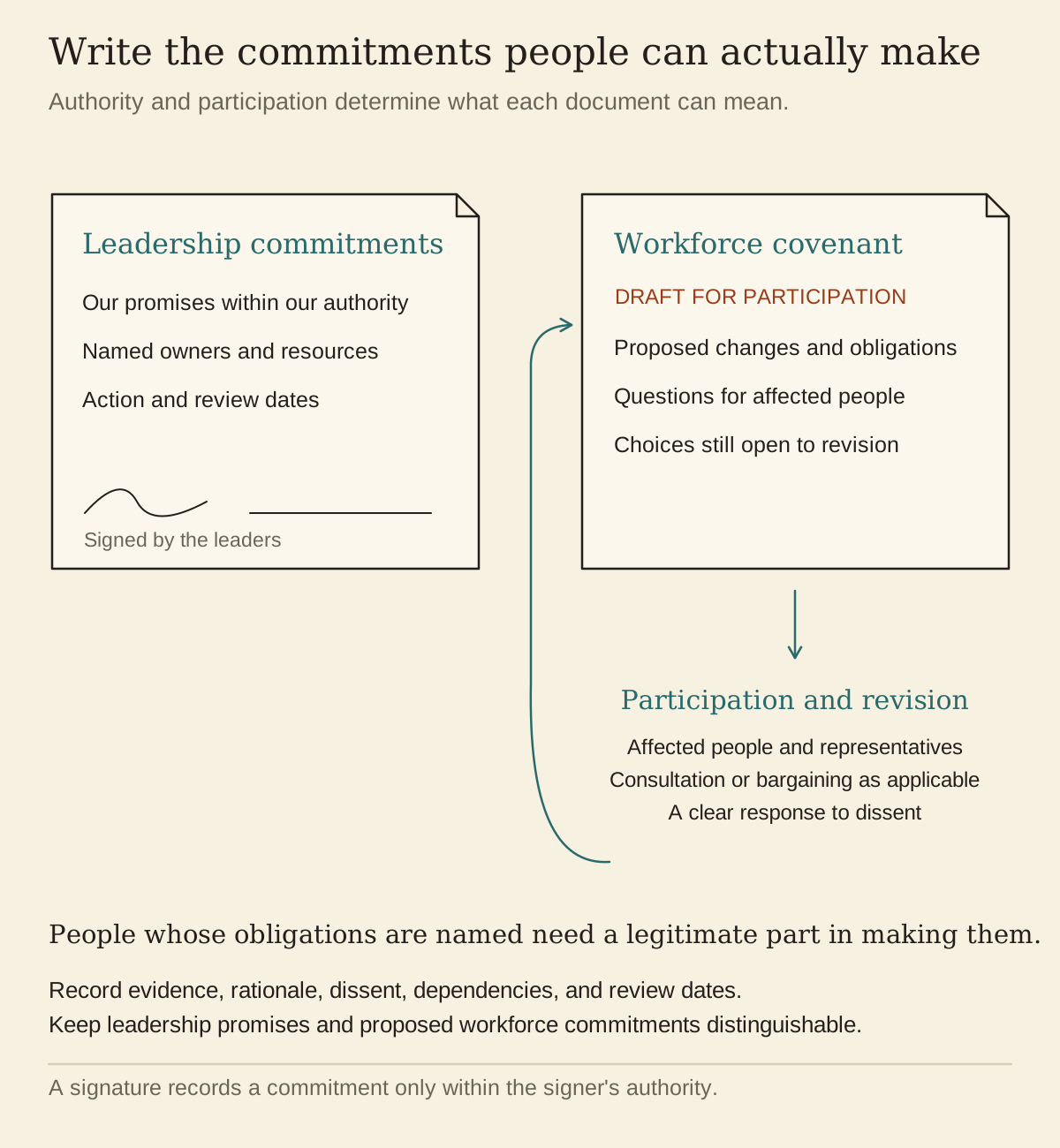
The afternoon begins the covenant work. The team writes the commitments it can make as leaders, the changes it proposes, what it hopes to ask of the workforce, what it would leave behind, and what it would carry forward. Leaders can sign their own commitments. They cannot sign for workers or convert consultation into consent. The draft then goes through workforce participation, legal or bargaining processes where applicable, revision, and a clear response to dissent. It becomes a covenant only when the parties whose obligations it names have had a legitimate role in making it.
The team closes Day Two by agreeing what it will do over the next thirty days. For each action, name an owner, required consultation or approval, and the support and budget needed. Set a baseline, identify evidence of progress or harm, and agree when to stop. Record each decision with its rationale, evidence, dissent, dependencies, review date, and whether it is reversible. Six months later, the log should let the team recover what it decided and why.
The Outputs
A sprint produces specific outputs, and any leadership team considering it deserves to know exactly what the sprint hands them.
First, the documented current-state assessment: the team's working account across the operating system, architectures, human work, practices, and systems view, including evidence, disagreement, uncertainty, and missing perspectives. It is versioned so later evidence can change it.
Second, the future-state intent: where the team proposes to take the company, with horizons, investments, tradeoffs, decision rights, affected groups, and unresolved choices explicit. It sits beside the current state so assumptions and changes remain traceable.
Third, signed leadership commitments and a draft covenant. The leaders own specific promises within their authority. Proposed asks of the workforce are labeled proposals, which leaves the commitment with the people who would make it. The artifact becomes the basis for participation and revision. People change it.
Fourth, the thirty-day plan. Who is doing what, by when, under whose authority, with whose participation, and with what evidence and stop conditions. The plan is short enough to use but includes capacity, budget, dependencies, communication, risk ownership, and the first review date. It is not a miniature transformation roadmap. Its purpose is to test whether the leadership team can convert workshop commitments into governed action and revise them when reality disagrees.
Fifth, the larger roadmap framing rather than the full roadmap: major phases, dependencies, decisions, evidence gates, participation, and possible horizons. Twelve to eighteen months may be a planning range for some companies. Each team should set its own from its own conditions. The framing helps the team decide what to commission next, whether with these firms, others, or internal teams.
Sixth, the experience itself. The team has spent two days working together in a way that, in my experience, many leadership teams find unusual. Afterward, look for changes in how members disagree, ask for help, explain decisions, and keep commitments. The experience is an output; durable collaboration is an outcome still to earn.
What Happens After the Sprint
A sprint starts the engagement rather than ending it. What happens after the sprint is what determines whether the work the team did in the room translates into the company they intended to build.
The first thirty days create an early credibility test, though they are not inherently more consequential than later implementation. Leadership commitments need owners and action. Proposed workforce commitments need listening, consultation, and revision before launch. The team communicates what it decided, what remains open, and how people can influence it. A weekly leadership review may fit; the cadence should match the work and include harms, dissent, and stop conditions as well as progress.
The firms typically offer light support during this period: a check-in, access for questions, and maintenance of agreed artifacts. The scope, decision rights, fees, data handling, and exit should be explicit. Facilitators cannot make sure momentum survives; they can surface drift, challenge rationalization, and help the team use the process it designed. The client remains responsible for execution and for creating channels where people can disagree without going through the advisers.
After the first thirty days, the team should have a clearer view of what the larger work involves. It has early execution evidence, feedback from affected people, and a record of which commitments held, changed, or failed. It should also review whether the sprint itself created value: which decision changed, which assumption was corrected, which risk surfaced earlier, and what burden the process imposed. If the answer is only that the workshop felt aligned, the evidence is too weak to justify a larger engagement.
The next phase varies. It may be additional discovery, workforce participation, a policy or bargaining process, a bounded workflow pilot, data remediation, capability development, or technical architecture. Where Nodalix is engaged, the design may use a graph and agents if the use case justifies them, or simpler components if it does not. Human and technical work often interleave, with evidence from each changing the other.
The Alignment Sprint is one possible on-ramp. The work after it is the transformation. The sprint may improve the odds by making assumptions, commitments, and interfaces visible. It is neither necessary for every company nor sufficient for any company, and its value should be judged by what the organization understands, decides, changes, and sustains afterward.
Why This Works as a Starting Point
Why might this work as a starting point? First, it offers a bounded commitment before a larger engagement. The team commits to interviews, evidence review, design participation, two workshop days, and thirty days of initial action. That is feasible for some teams and too compressed for others. The facilitation team carries much of the preparation, but executive and participant attention cannot be outsourced. The engagement should proceed only when the people needed for a credible start can participate.
Second, it is designed to connect analysis with decisions. Not every issue should be decided in the room: some require evidence, consultation, technical testing, legal review, or formal approval. The valuable output is a clean distinction among decisions made, hypotheses to test, questions to take to affected people, and choices not yet ripe. Ownership comes from authority and follow-through. A card moved on a canvas records a conversation.
Third, it works across levels of the iceberg rather than claiming one “right” depth. The team responds to immediate constraints, examines patterns, maps structures, and tests mental models. A two-day workshop may expose an assumption; it cannot prove that the assumption shifted or that durable change will follow. Decisions, incentives, resource flows, and observed outcomes provide that evidence later.
The first test comes when the team uses those outputs to make a decision after the workshop. The team also begins with unresolved questions and obligations to people who were not in the room. That is a more credible starting position than artificial certainty, provided the team follows through.
The sprint is the beginning. What happens across the years after it is the harder problem, and the next section takes it up.