What does sustained work on this look like over time?
The first month after a sprint can run on the energy of the workshop. The harder test comes as ordinary demands return. In week six the chief financial officer misses a check-in for board preparation. The reason is real, and everyone agrees to proceed without her. In week nine the first workflow redesign slips behind a client escalation, and two operator sessions dependent on it are rescheduled. Again, the reason is real. By week thirteen the signed leadership commitments and draft covenant may sit unopened while everyone remains busy doing work that mattered. No one announced an abandonment. No single decision killed the effort. The sequence reveals whether the sprint began an operating rhythm or created a good memory, because operating models are often lost through individually reasonable exceptions rather than open rejection.
This section uses three planning horizons: roughly the first ninety days, the rest of the first year, and year two and beyond. They are not laws of transformation. A regulated deployment, collective-bargaining process, acquisition, or urgent safety issue will require a different clock. The horizons organize questions about early evidence, system change, and longer-term maintenance. They also frame signals that working alignment is changing and ways the book can remain useful after the workshop. Everything here can be done internally, with these firms, or with others; the right arrangement depends on capability, independence, consequence, and trust.
Days 31 to 90: Proving the Motion
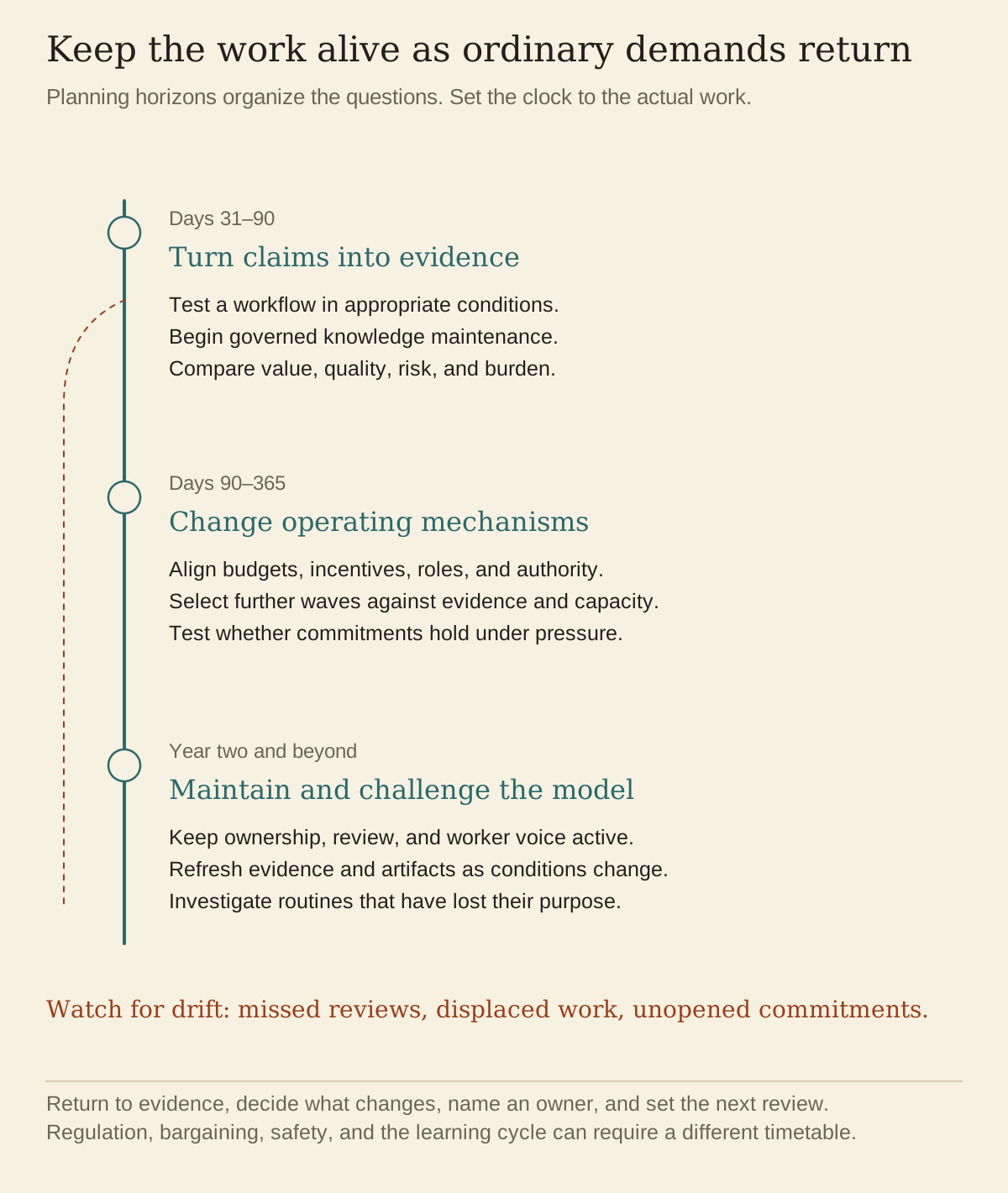
That first horizon has one job: convert the sprint's claims into evidence people can inspect. I would look for three forms while allowing the scope and risk to determine how far each can responsibly move. The point is not to perform momentum for the board. It is to discover whether the proposed model survives actual data, actual users, ordinary interruptions, and the controls the workshop could discuss only in theory. Early evidence should include who benefited, who carried new burden, what failed, and what the team chose not to do.
The first is a redesigned workflow tested in the real conditions of use with the people who do and are affected by the work. For a low-consequence, reversible workflow, that may mean production use within ninety days. For consequential work, it may mean a shadow run, simulation, controlled pilot, or a decision not to deploy. Case One in Section 8.2 described eleven pilots that did not become a coherent portfolio. The difference here is not that use is mandatory; it is that the experiment has a shared purpose, baseline, owner, evaluation, stop condition, and explicit route to scale, revise, or close.
The second is a knowledge-maintenance practice that has started where the use case requires it. It may feed a graph, document system, rules, training, or several forms. An experienced operator might work beside modelers to demonstrate, test, and document judgment, with protected time, credit, consent, and the right to contest the representation. This must not be capture rushed ahead of a workforce reduction so the company can extract knowledge first. Capability continuity and workforce planning should be transparent, participatory, and governed by the covenant's commitments.
The third is visible evidence of value and cost, described in terms the workforce recognizes. That may be safer work, less rework, faster access to evidence, a better customer outcome, or a burden that did not improve and caused the team to stop. Compare the result with a baseline, include quality and risk beside speed, and say what remains unknown. A worker may choose to describe the experience, but nobody should be recruited into testimonial theater or asked to speak for a whole role. Early evidence travels farther when peers trust the method, can inspect the limitations, and know that an inconvenient result will not be edited out of the story.
Through all of this, the leadership check-in from the sprint keeps running at the cadence the work needs. It is short when the evidence is routine and longer when a stop condition, workforce concern, security issue, or contested decision appears. The check-in is not a status recital. Its purpose is to remove a constraint, make a decision, revise an assumption, or stop work. At roughly day ninety it becomes a more deliberate checkpoint.
Bring this into the room. The ninety-day checkpoint. Reserve enough time for the leadership team and relevant participants to run five items in order. One: read the thirty-day plan and name what held, changed, or failed, distinguishing a justified revision from a euphemistic pivot. Put the original baseline beside the result. Two: test the loop hypotheses from Section 7.1 against evidence and competing explanations; redraw them where reality disagreed. Three: review the signed leadership commitments and the status of workforce participation in the draft covenant, including promises the company has already missed. Four: decide whether the next workflow should scale, pause, change, or close against the roadmap framing, with risk and capacity visible. Five: stop or deprioritize something so new work has room. Record the decisions, dissent, owners, and review dates. Scheduling the checkpoint early makes it less vulnerable to drift; whether half a day is enough depends on scope.
Days 90 to 365: Making It the Operating Model
The second horizon is where the future-state intent from Day Two stops being intent. Three kinds of work dominate it.
The first is letting operating-model decisions affect mechanisms. Quiet reversals appear when the team says measurement will change but leaves the old scorecard tied to pay, or approves a collaboration surface while the sanctioned experience remains unusable and necessary controls remain unexplained. A role may be announced as higher altitude while workload, compensation, and promotion criteria still reward the old task volume. A governance policy may promise bounded experimentation while the approval queue still treats every use case alike. The first year is an exercise in finding where the old model persists in metrics, meetings, approval paths, incentives, budgets, systems, procurement, job design, and decision rights. Announcements alone change none of these. Mechanisms matter, and so do the people who experience their effects and can reveal when the new mechanism is worse.
The second is a wave rhythm. Later workflow redesigns are selected against the roadmap, evidence, capacity, and risk rather than by whoever asks loudest. The number and cadence of waves should follow learning and operational ability, even if that means fewer waves than first announced. Measurement matures across this horizon too, with metric displacement as the standing caution: use quantitative and qualitative evidence honestly, and accept that some covenant commitments will not reduce to a number.
The third is the covenant being tested for real after legitimate participation has made it one. A budget squeeze, reorganization, automated task, safety incident, or dispute over the work will expose whether commitments constrain leadership when doing so costs something. This is where broad language needs operational meaning. What does investment in people require when a role changes? What process precedes a workforce reduction? Who may appeal an automated recommendation? What happens when a promised learning hour collides with a client deadline? Skepticism from a senior person may be obstruction or an important warning; evidence and conduct decide. The welder's standard from Section 5.6 remains a useful personal test, joined by formal tests of fairness, rights, process, and impact. One honored commitment can build credibility, and one breach can damage it, but trust is cumulative rather than switched by a single event. Repair requires acknowledgment, remedy, and changed conduct. Messaging comes after all three.
A quarterly cadence is a useful starting point to adjust. The team revisits loop hypotheses, practices, meaningful-human-involvement decisions, and covenant commitments often enough to affect action. High-consequence deployments may need continuous monitoring and faster review; slower capability change may need longer outcome horizons. Reuse the artifacts when they help and retire them when they become ceremony.
Through the First Year: Keeping the Work Running During the Change
As changes spread across functions, someone must keep today's work covered while people prepare for new responsibilities. In the accounts payable example from Section 5.11, invoices still arrive while employees learn the supplier resolution analyst role. Purchasing and receiving must answer current queries while adapting their own work. Leadership needs to fund the overlap, agree which demands can wait, and name who resolves conflicts between daily operations and the transition.
Put that temporary arrangement in the operating plan. Assign cover for learning time, budget for running both processes where necessary, and identify which instructions govern each kind of work. The process owner needs a current record of responsibilities and effective dates. When finance changes a procedure, purchasing and receiving need enough notice to prepare. A missed handoff can become a supplier's delayed payment.
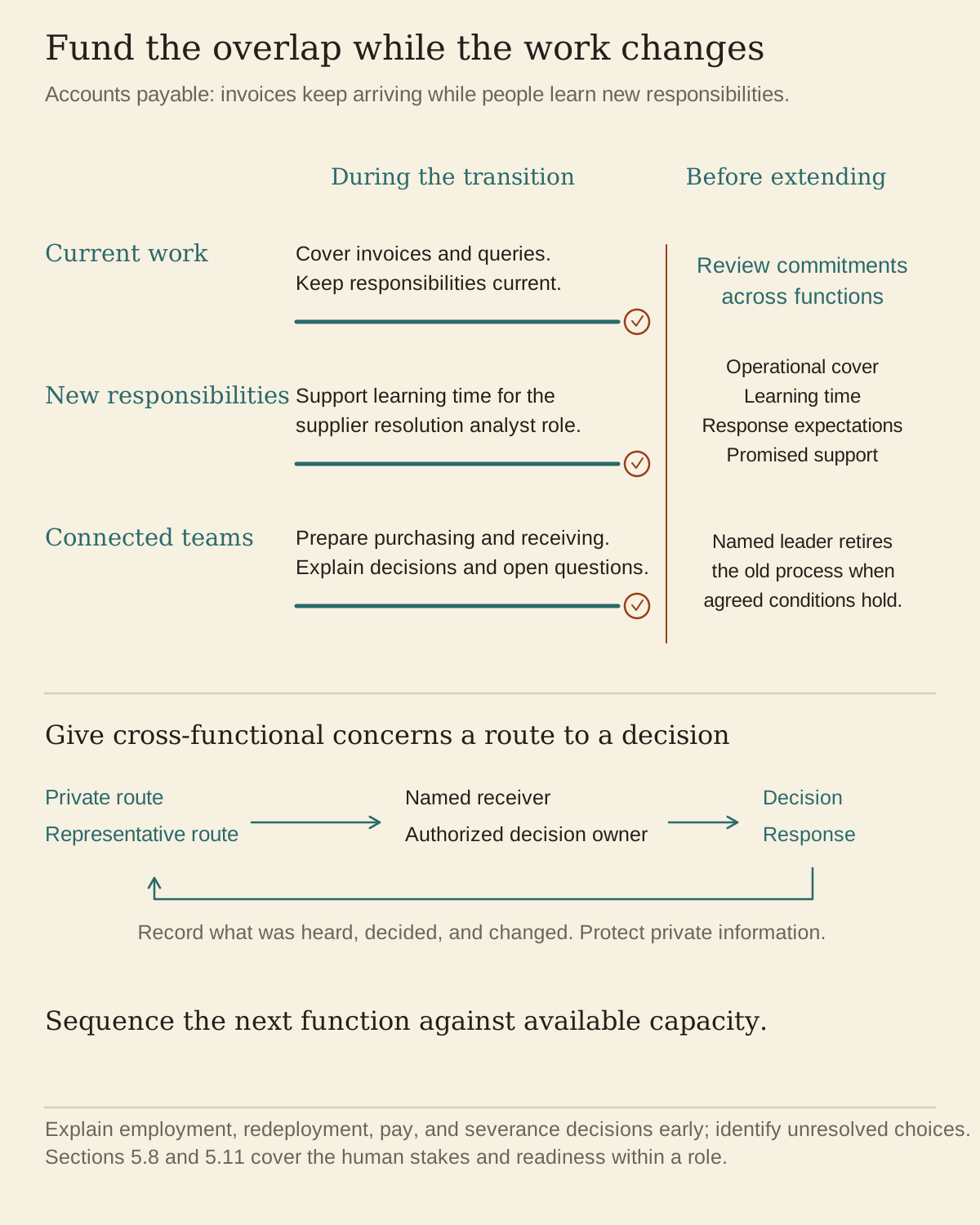
Prepare managers before asking them to explain the change. Give them the decisions already made, the questions still open, and a named person who can answer each question by an agreed date. Leadership must decide how employment, redeployment, pay, and severance will be handled and communicate those decisions early enough to inform people's choices. Where an answer remains open, explain the decision process and when an update will follow.
Section 5.8 explains the human stakes of these decisions. Put the information needed for consultation in employees' hands while their views can still influence the outcome, with time and access to appropriate representation. For a proposed placement, identify who decides, the criteria they will use, and how the employee can question the assessment. Include existing organizational knowledge in that assessment and provide supported opportunities to demonstrate relevant capability. Record the available next step if a proposed move proves unsuitable.
Maintain a route for concerns that cross departmental boundaries. Employees should be able to raise them privately or through their representatives. Name who receives those concerns and who has authority to resolve them. Keep a record of what was heard, the decision, and what changed, with access appropriate to the information. Report shared findings without identifying people who spoke privately. If purchasing repeatedly lacks capacity to support finance's new workflow, that issue belongs with the leaders responsible for both functions.
Section 5.11 provides the method for testing readiness within a role. Before extending the change, review whether commitments across functions were honored: operational cover, learning time, response expectations, and the support promised to affected employees. Resolve gaps that would be carried into the next function.
Give a named leader authority to retire the old process when the agreed conditions are met. Confirm that dependent teams are ready, superseded instructions are withdrawn, and responsibilities, access, and performance expectations reflect the new arrangement. Retain the records needed to explain the change and handle unresolved cases.
Use this review to sequence the next function. Check whether the people needed to support it are still carrying work from the previous transition. Agree what must finish, what can proceed together, and who will provide the necessary capacity before announcing the next wave.
Year Two and Beyond: Maintaining the Work
The test of year two is reduced dependence on executive attention, with some attention still in place. Ask which practices persist through leadership distraction or turnover: maintained knowledge because contributors see fair value, routines that survive a champion's departure, supported development opportunities that do not depend on favoritism, and governance that catches an unsafe shortcut even when the launch has executive sponsorship. Then ask what is merely hidden by habit. A practice can survive while losing its purpose; a knowledge base can grow while becoming stale; a mentoring count can rise while access remains unequal. No organizational loop is literally self-sustaining. Budgets, ownership, maintenance, governance, worker voice, and changing conditions remain. The transition is becoming part of the operating model when ordinary mechanisms carry it, exceptions are handled without improvising the values away, and people no longer need transformation rhetoric to explain routine work.
Two disciplines still need explicit ownership and a calendar, because compounding does not maintain itself.
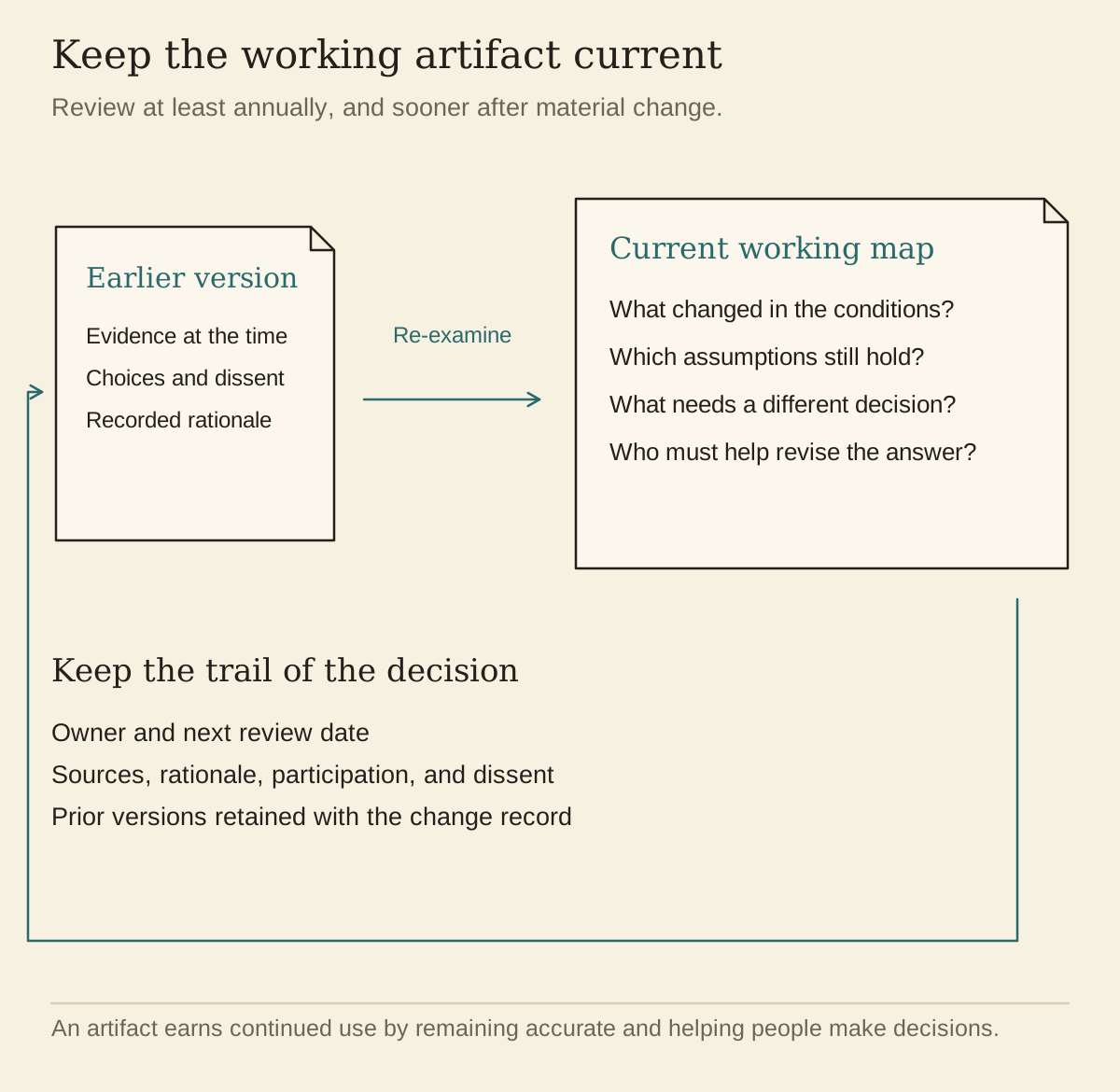
The first is the refresh cycle. Models, vendors, law, threats, prices, organizational strategy, and workforce capability change at different speeds. At least annually, and sooner after material change, the leadership team re-examines the archetype, layer investments, use cases, and boundaries of automated and human authority. Current-state evidence, future intent, covenant, and roadmap are revised with affected participants and version history rather than left as souvenirs. An artifact that is never revised is becoming scenery; an artifact revised without governance is becoming revisionist history.
The second is protection. Careless workforce or measurement decisions can damage trust and practice quickly, though no single action determines the system forever. Decision reviews should catch foreseeable conflicts before approval, while incident and appeal processes handle what gets through. The period of maximum risk may be when the work feels finished, because attention and challenge fade while technology and conditions keep moving.
When Alignment Decays
Working alignment is a produced state, and it changes. Nothing in the sprint makes a shared view permanent, nor should it: new evidence ought to create divergence before the team integrates it. People change roles, strategy moves, and private views develop. The problem is not disagreement returning. It is material divergence remaining hidden while coordinated decisions continue to assume agreement. In teams I have watched, that often appears through small reversions, each with a reasonable explanation, before anyone names the pattern.
Watch for this. Signs working alignment needs review. One: the same term drives incompatible decisions because leaders mean different things by it. Two: covenant commitments are absent when a relevant hard choice is made. Three: review rhythms repeatedly disappear without a better mechanism replacing them. Four: initiatives launch without portfolio rationale, evaluation, or learning paths. Five: leadership turnover changes decision assumptions or accountability. Six: an acquisition, new market, legal change, incident, or capability shift makes the future-state intent stale. None proves decay alone; each is a prompt to investigate.
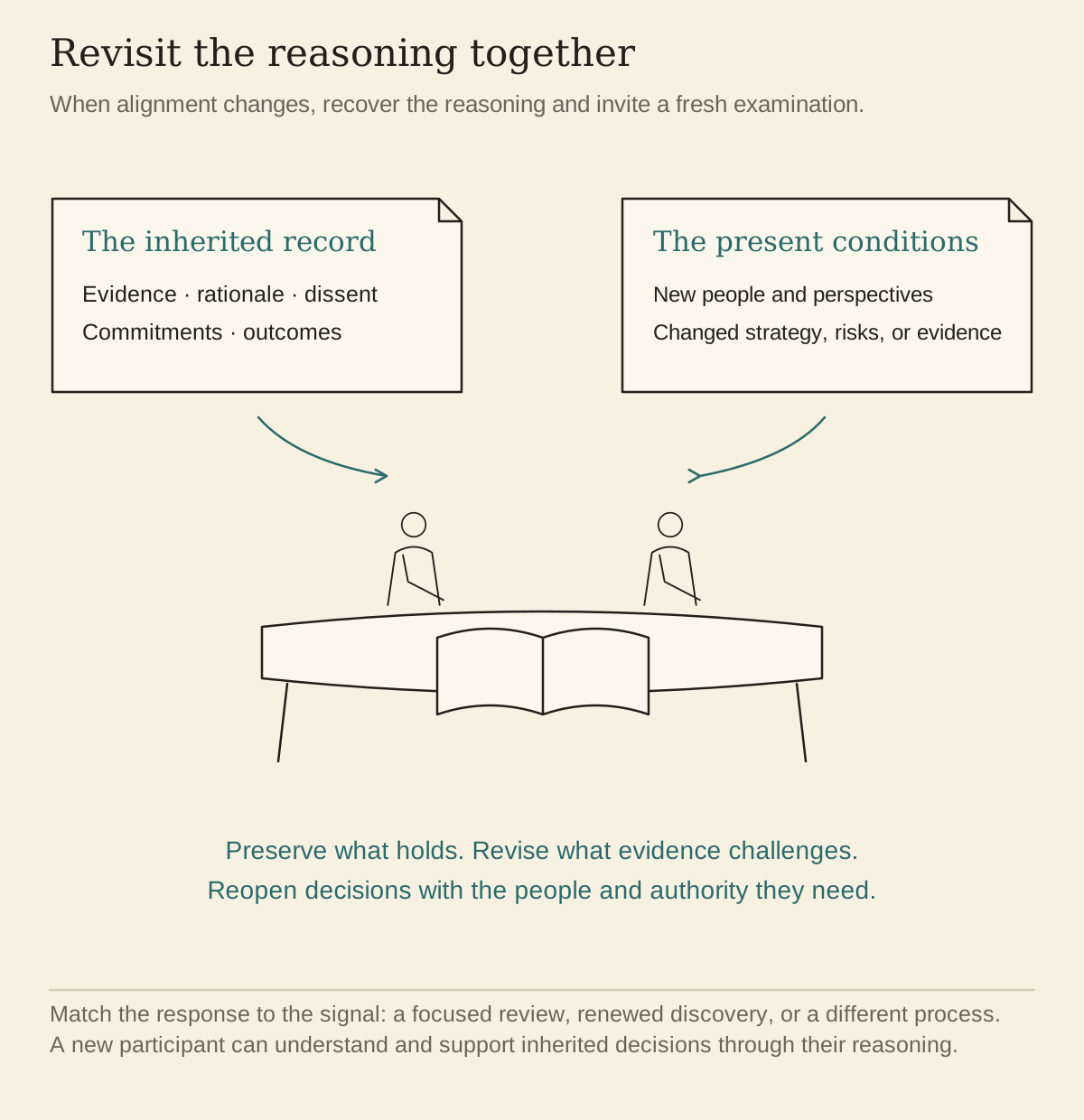
The response should match the signal. For limited drift without structural change, a focused realignment day may be enough: return to the evidence and artifacts, test the loop account, review commitments, name divergence, and revise intent. A capable internal facilitator may run it, provided power dynamics and conflicts do not require independence. The purpose is not to restore the old alignment automatically; new disagreement may be the correct response to new evidence. For structural change, such as a new chief executive, acquisition, material strategy shift, or major incident, repeat enough discovery to understand the new system. That may justify a full sprint, a different process, or no workshop at all. People often understand and support work they help shape, but a new executive does not automatically reject inherited decisions. Brief them on the rationale, evidence, dissent, commitments, and outcomes; invite challenge; include people affected by the new context; and redesign only what evidence warrants. External facilitation earns its keep when independence, skill, or capacity adds value, particularly when the sponsor is part of the conflict. It does not earn its keep simply because teams are categorically unable to examine themselves.
Working With This Book Between the Sessions
This field guide was structured so an agent can read it alongside you. The long middle is exactly when a team needs the book as a reference rather than as an argument.
The pattern I intend is simple. When a new situation arises, a team member can ask the book's companion agent what passages and exercises speak to it. At a checkpoint, the agent can guide the four-question diagnostic and organize answers, while citing the underlying sections, quoting accurately, and labeling inference. When a covenant commitment is under pressure, it can retrieve the actual language rather than an executive's memory of it. When the team plans a realignment day, it can draft an agenda and expose which affected voices are missing. The user should still verify that the response is grounded in the book and current company records. If the team connects its own artifacts, that must happen in an approved environment with purpose limitation, permissions, retention, provenance, versioning, and separation among personal notes, privileged material, workforce data, and shared records. Retrieval permissions should match the underlying source; the agent must not turn fragmented access into a new universal view. A graph is optional. Queryable and current does not mean universally accessible, automatically correct, or permanently retained.
The limit holds with full force. The agent can locate, connect, question, and translate, and it can participate in a mediated conversation if the people choose. It cannot confer consent, reconcile interests, assume accountability, or prove that a difficult exchange was honest. Use it to prepare and record within agreed boundaries. People with legitimate authority and standing still own the decision and its consequences.
The Work Is Yours Now
If you do one thing on finishing this section, schedule the first evidence review before attention disperses. Ninety days is a useful default for many low- and medium-consequence efforts; choose an earlier or later date when the risk, learning cycle, or required consultation demands it. Put the purpose, participants, evidence, and decisions on the invitation along with the date.
That is the shape of the work over time. The argument began with a phrase on a whiteboard and has ended with a calendar because durable change needs recurring attention. It also lives in budgets, systems, contracts, authority, habits, and what happens when someone challenges the plan. The frameworks are yours to use, the diagnostics are yours to test, and the agent can return you to the material. None substitutes for accountable decisions or legitimate participation.
One section remains in this stage, and it is the most practical thing in the book. Everything here has described the shape of the work. Section 9.4 describes how the sessions actually run, in the detail a person would need to run one.