What does it actually take to run one of these sessions?
Everything in Stage 9 so far has described the shape of the work. What it is for, what it produces, how it starts, what happens in the long middle after the room closes. That leaves out the part I get asked about most, which is how the sessions actually run. The mechanics. How many people in a breakout, how long a round goes, what is physically on the wall, what I say to launch the work, what I do when a group rejects the assignment.
These are the details a leadership team debates with me during design, and they are details clients often want to cut. I have strong defaults about them, and this section explains why. They come from practitioner experience across many rooms and industries. Read them as field notes. A default should carry accumulated learning without hardening into ritual. Accessibility, culture, power, safety, purpose, and the people in the room can all require a different design.
These field notes follow the choices sponsors most often question and explain the practical reasons behind my answers.
The Sponsor Conversation
I like to open by getting the sponsor talking about the challenge in front of them. In their own words. Then I get them to reframe it as what success looks like: what has to get accomplished, and separately, what would be nice to have. Sometimes I ask what they would want if they could wave a magic wand and the group went further than they expected.
I ask that last one deliberately. Most executives have learned to have low expectations of meetings and workshops, because most meetings and workshops are not designed very well. So I spend time early explaining how our methodology is different and why. Usually the sponsor is curious and starts asking questions, and that conversation matters as much as the answers.
What I often hear afterward is a version of this: I did not understand what you meant by different, but after going through it, now I do. That feedback is encouraging and may mean the experience made the method legible. It is not outcome evidence by itself. A session can feel distinctive and still fail to change a decision, include the right people, or improve what follows.
The thing sponsors most often ask for that they do not need is a smaller room. Leaders want to limit the stakeholders. Sometimes that is about controlling the message. More often it is that they do not want to pull people off their day jobs, or they believe a small group can do the work while everyone else stays focused on whatever they are doing.
My argument against shrinking reflexively is practical. The last thing you want is to discover in the room that a missing person holds essential knowledge or authority. So I push on four questions. Who holds the decision rights? Who knows how the work actually operates? Who bears the consequences? Who cannot safely or practically participate in this format but still needs a voice? The answer may expand the room, create interviews or parallel channels, or narrow what the room is authorized to decide.
There is also a legitimacy argument. Implementation benefits when relevant knowledge and affected perspectives shape the decision. That does not mean every stakeholder must attend one large session or leave aligned. Large rooms can reproduce hierarchy, exclude people who cannot attend, and create performance rather than candor. Participation should match the decision, and the process should show how input influenced it.
The last thing you want is to be in the middle of the session saying, I wish so-and-so were here to answer that.
What makes an executive anxious about the methodology is usually the open conversation. Not being able to control the agenda or the message. Loss of control. Some leaders worry that people will spend the day churning on something the leader has already decided.
I think controlling the conclusion too tightly is short-sighted. People process challenges differently, and structured discussion can help them surface knowledge and recommend options. It is not therapy, and participation does not guarantee anyone feels heard or trusts leadership. Trust depends on power, follow-through, candor about what is already decided, and an explanation of how recommendations will be used. Inviting input on a closed decision is worse than naming the boundary plainly.
The other thing that makes sponsors nervous is not knowing what I will do in a difficult moment. I explain the facilitation roles, escalation paths, design boundaries, and how I will check with the sponsor and client design team without letting the sponsor secretly rewrite participant input. The team keeps the work oriented to the stated purpose while protecting agreed participation rules.
I also tell them we can call audibles. We can notice that a group is going too deep, not deep enough, or in a more valuable direction and adjust mid-session. Adaptation is a capability. It improves the odds. Material changes should be explained when they affect purpose, time, or how outputs will be used, so flexibility does not become invisible manipulation.
I do turn work down. Usually when the leader will not follow the methodology, which normally means they want to control everything and do not really want people doing the work. Or they want the work done in principle, but they have no intention of using the output. Either one is a bad fit.
Why We Do Not Publish the Agenda
The design team keeps a detailed run-of-show. Participants receive a purpose, broad arc, start and end times, breaks, accessibility information, preparation, decision boundaries, and what will happen to the output. Whether they receive every exercise in advance depends on the work.
One reason to hold exercise-level detail loosely is that the design may change as evidence emerges. Small adjustments need no announcement. A change of course should be visible to the room. Participants deserve to know when the purpose, promised break, use of their input, or decision process changes.
A second reason is to preserve attention and discovery. Yet withholding information can increase anxiety, disadvantage people who need preparation, and undermine informed participation. The answer is progressive disclosure: give people enough structure to plan and consent, then introduce exercises as the day develops.
Plan for concentration and fatigue throughout the day. Use breaks, varied activities, and accessible ways to contribute so people can stay involved. Choose a group size and room layout that keep noise and social demands manageable.
Group Size and What Each Group Does
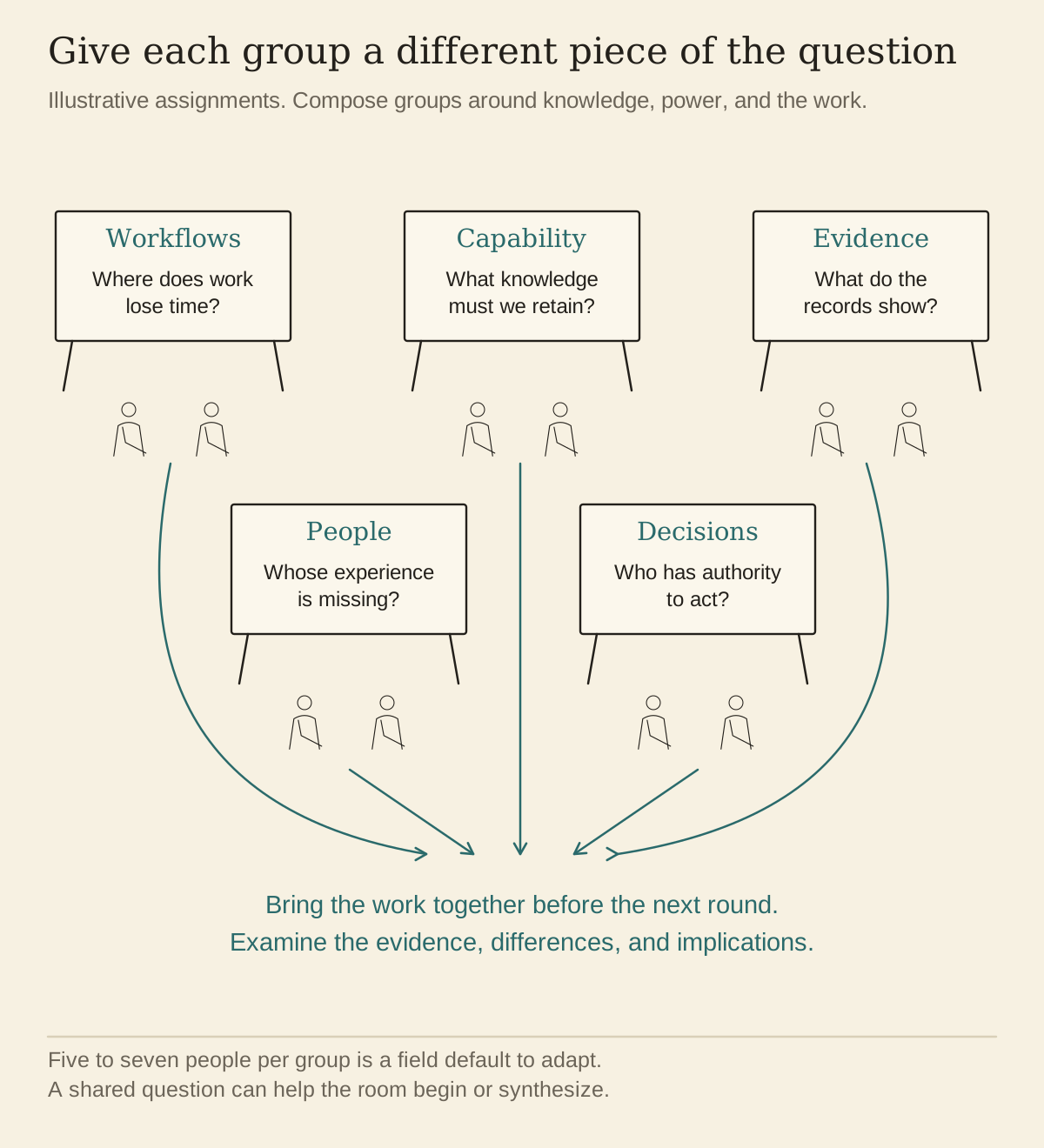
We want five to seven people per breakout. Eight is usually too big. With forty people I would probably run groups of six or seven, though it depends on the work. If there are eight distinct things that need focused attention, we will run eight groups of five instead, and sometimes one team gets eight people because its topic needs them.
Group size changes the work itself, beyond the logistics. What you get from a three-person team is different in kind from what you get from a seven-person team. So is the diversity of thinking. That is worth designing for rather than treating as a scheduling detail.
We assign groups rather than letting people pick most of the time, because role, knowledge, power, and cross-functional contact matter. We review rosters with people who know the participants while avoiding tokenism, retaliation risk, inaccessible movement, and combinations in which a reporting relationship will silence the conversation. Occasionally people choose a topic, with an accessible alternative to “voting with their feet.” Participants can flag a conflict or accommodation privately before the session.
On whether every group takes the same assignment: usually not. We run parallel processing, where each group works something slightly different, because that covers far more ground. Imagine thirty-five people all answering the same question every round. Your scope would have to be tiny.
Same-assignment rounds have their place. At the beginning, a visioning question everyone answers tells you where the room actually is. Sometimes I will have people work alone first, getting their own thoughts down before any group dynamic kicks in. And near the end of a day, a shared question can help synthesize what has been happening.
How many rounds depends on how much work there is and how long we have, and mostly on how many teams are in the room. Three teams means fewer report-outs, which buys me another activity or two. A large group with a lot of report-outs costs me one. In a one-day session you might get six. A lot of that math is decided by how long each team gets to share. Report-outs can run one minute per team or ten, and you can burn an afternoon on the difference.
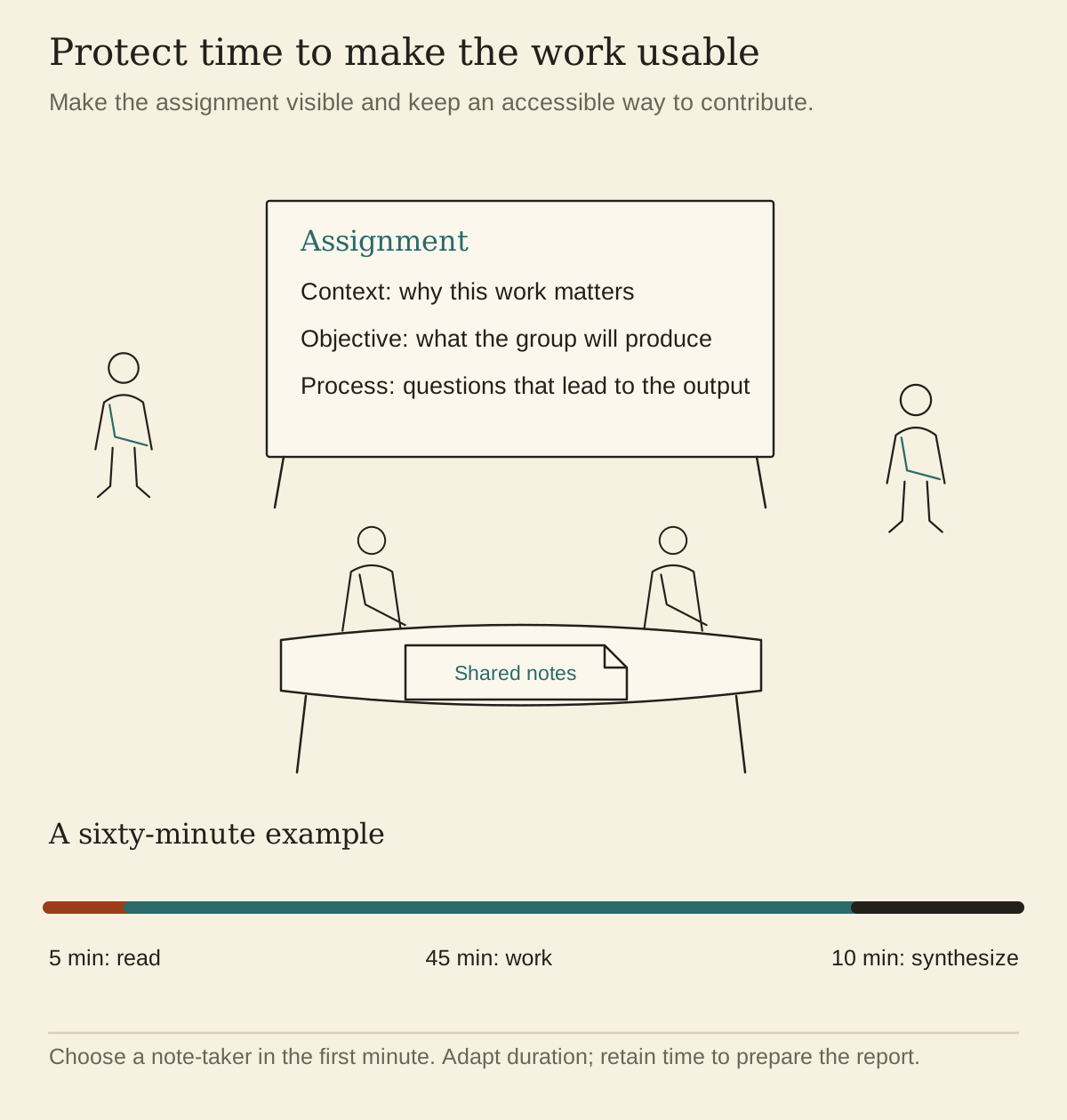
Every breakout needs a written assignment with three parts. The context explains why the work matters, names its inputs, and sets its scope. The objective states what the group will produce. The process gives an ordered set of questions that leads to the output the next round needs. Designing that connection is much of the preparation between the block diagram and the session. Aim for the front of one page, with type large enough for people around the table to read. During drafting, a page and a half gives the designer material to cut. Keep the context to a few lines; a very short round may need only the objective and process. Put the round's duration on the assignment. Keep the timing for individual steps on the facilitator's copy so the group can concentrate on the work. Match the task count to the time: a fifteen-minute round gets one or two tasks. A short page can still ask too much.
A round also has a rhythm inside it. For a sixty minute round we plan five minutes for the group to read the assignment, forty-five for the real work, and ten to synthesize, prioritize, and get the report ready. The group picks a note-taker in the first minute. Scale that shape for longer or shorter rounds, and always protect time at the end to synthesize, because a group that works to the buzzer walks to the front with nothing organized.
Timing, Breaks, and Energy
Most breakouts run thirty to forty-five minutes. Longer rounds need their own design, as the examples below show. Plan a report-out or shift-and-share so people can examine one another's work before continuing.
The morning is tighter than the afternoon. I keep morning rounds at an hour or under, and the first round of the day often runs forty-five minutes on purpose. It teaches the room how fast the work moves before anything harder gets asked of them. Longer rounds belong after lunch, once the groups know the form.
There is also a ceiling on how long the room stays apart. About an hour and forty-five minutes of work before everyone comes back together, and reaching that number takes a convergence inside the stretch. The shape that gets there is a forty-five minute round, a shift-and-share of twenty to thirty minutes, half an hour back home to finish, then the report out. Counting rounds is the wrong instrument. Two long ones back to back can breach the ceiling while three short ones with a shift-and-share between them stay under it.
Plan predictable breaks and enough time for people to return. People need predictable breaks for health, medication, prayer, caregiving, sensory regulation, private calls, and basic cognitive recovery. Publish them, start and end them clearly, and design the day so returning on time is realistic. A short overrun is a design cost. The group did what the design allowed.
Working lunches can be offered for a genuinely optional activity, but food should not become another compulsory work block. Provide an actual meal break and accommodate dietary, disability, religious, and medical needs. If the agenda cannot survive people eating without producing output, the agenda is overfilled.
Change posture regularly without requiring everyone to stand or move. Some people think better seated, use mobility devices, need captions, or cannot tolerate music and sensory stimulation. Offer snacks, quiet space, seating choices, accessible boards and digital equivalents, and advance notice of sound. Watch the late-afternoon dip as information about the design.
Hold contingency time. In a two-day session, part of the second afternoon may remain flexible based on Day One, but participants should know that in advance. Unallocated capacity also absorbs accessibility needs, conflict, technical failure, and work that deserves longer than the run-of-show predicted.
Coming Back Together
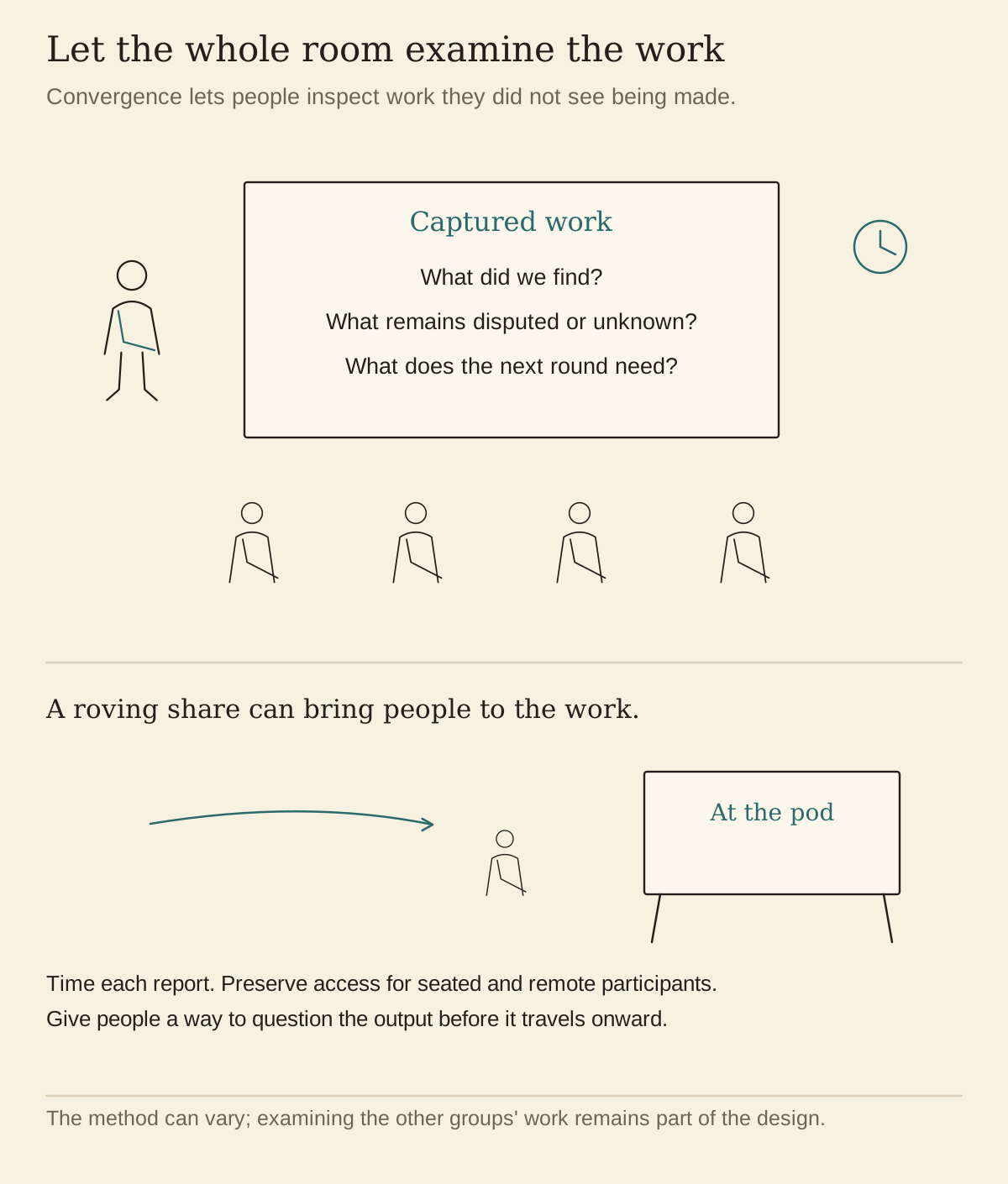
Every time the room goes out, something has to happen with what comes back before it goes out again. After the chatrooms, a plenary debrief before groups head to their first round. After a work round, a report-out or a shift-and-share before the next one starts. Skip it and the next round inherits raw material nobody has examined.
The deeper reason is what parallel processing costs. Every group works something different, which is what lets a session cover real ground, and it means most of the room did not see most of the work. People who never observed what the other groups did may feel disconnected from the output and have less basis for standing behind it. The convergence is where that gets repaired.
It carries a second job. While the room is together, the crew resets the breakout spaces, hangs the next assignment, and gets everything ready for the round that follows. Design the convergence and you have bought that time.
A commitment round has to be earned. On a one-day session that gets to the shape of the problem and no further, closing with commitments is ceremony, because nothing has been produced yet that anyone can sign. Action planning is itself a commitment round. People putting their names against specific items is the commitment, and it leaves the room as an artifact. A separate commitment block earns its time on a two-day session, after the work has gone somewhere.
The Room
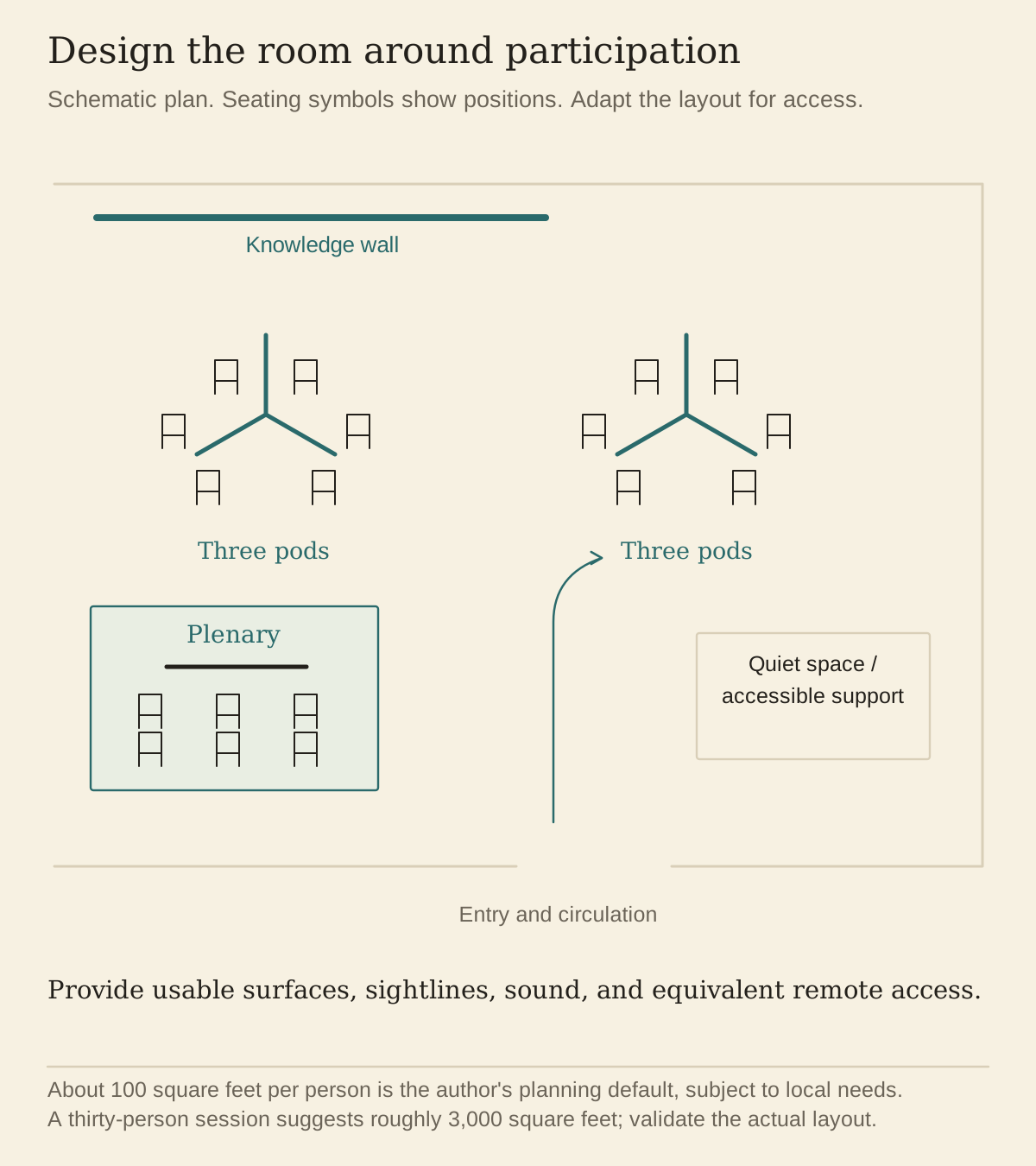
We need roughly one hundred square feet per person. A thirty-person session wants about three thousand square feet, and that also buys the wall space to post every round of output where people can walk back to it.
There is a plenary area where the sponsor opens and where teams share their work. Around it are breakout areas sectioned off by markerboards, each with chairs and boards, sometimes a screen.
My default has been no tables in breakouts because tables invite laptops and passive posture. That default must yield to access. Some participants need a writing surface, device, assistive technology, water, or physical support. Design for active shared work with tables, adjustable surfaces, boards, or digital tools as needed; do not equate comfort with disengagement.
When people walk in, we often have a walkabout waiting. Questions are already up on boards so participants can reflect on history, frustration, or prior failure without letting the past consume the day. This is facilitated reflection. A public wall is the wrong place for confidential, traumatic, or personally identifying material. Offer seated, digital, individual, and nonverbal ways to participate. The signal is that people are contributors from the first minute.
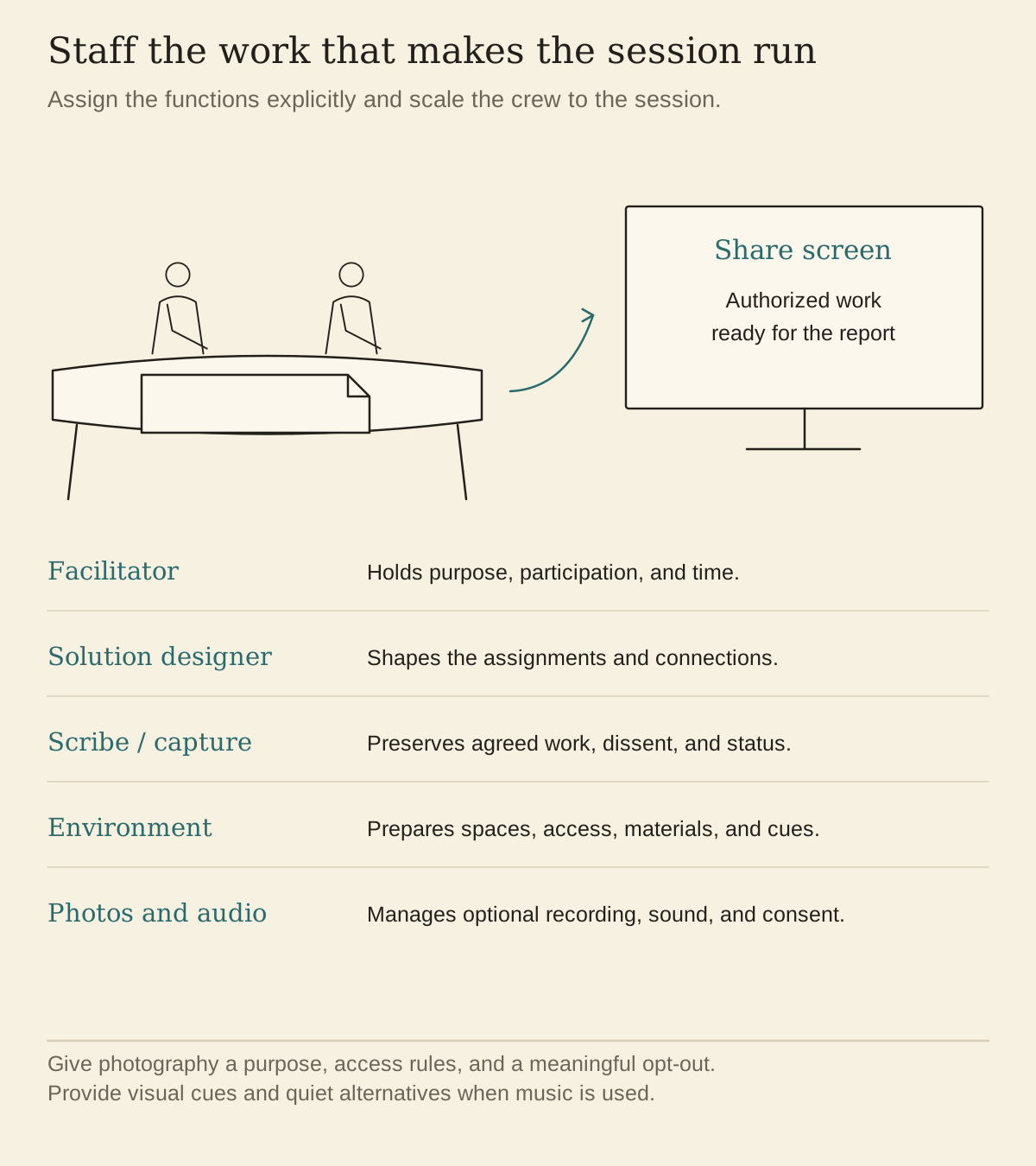
We also bring elements people may not expect: music, photography, or a visual artist. Each requires design and consent. Music needs volume limits and quiet alternatives. Photography needs clear purpose, storage, access, and meaningful opt-out without social penalty; never assume people love being photographed at work. Visual recording must avoid exposing confidential or attributed content unless participants agreed.
Virtual, hybrid, and distributed sessions require a design that gives remote participants a full part in the work: equivalent facilitation, accessible technology, deliberate turn-taking, digital artifacts, shorter blocks, and local support. If equivalent participation cannot be provided, name the limitation and create another legitimate channel rather than treating absence as consent.
Some sessions add a screen to each pod. The group still thinks on the marker boards, and the final output gets captured digitally before the share, which makes the report-outs instant and means the work leaves the room as files the team can open the next morning. The boards carry the thinking, and the screen carries it out the door.
Launching the Work
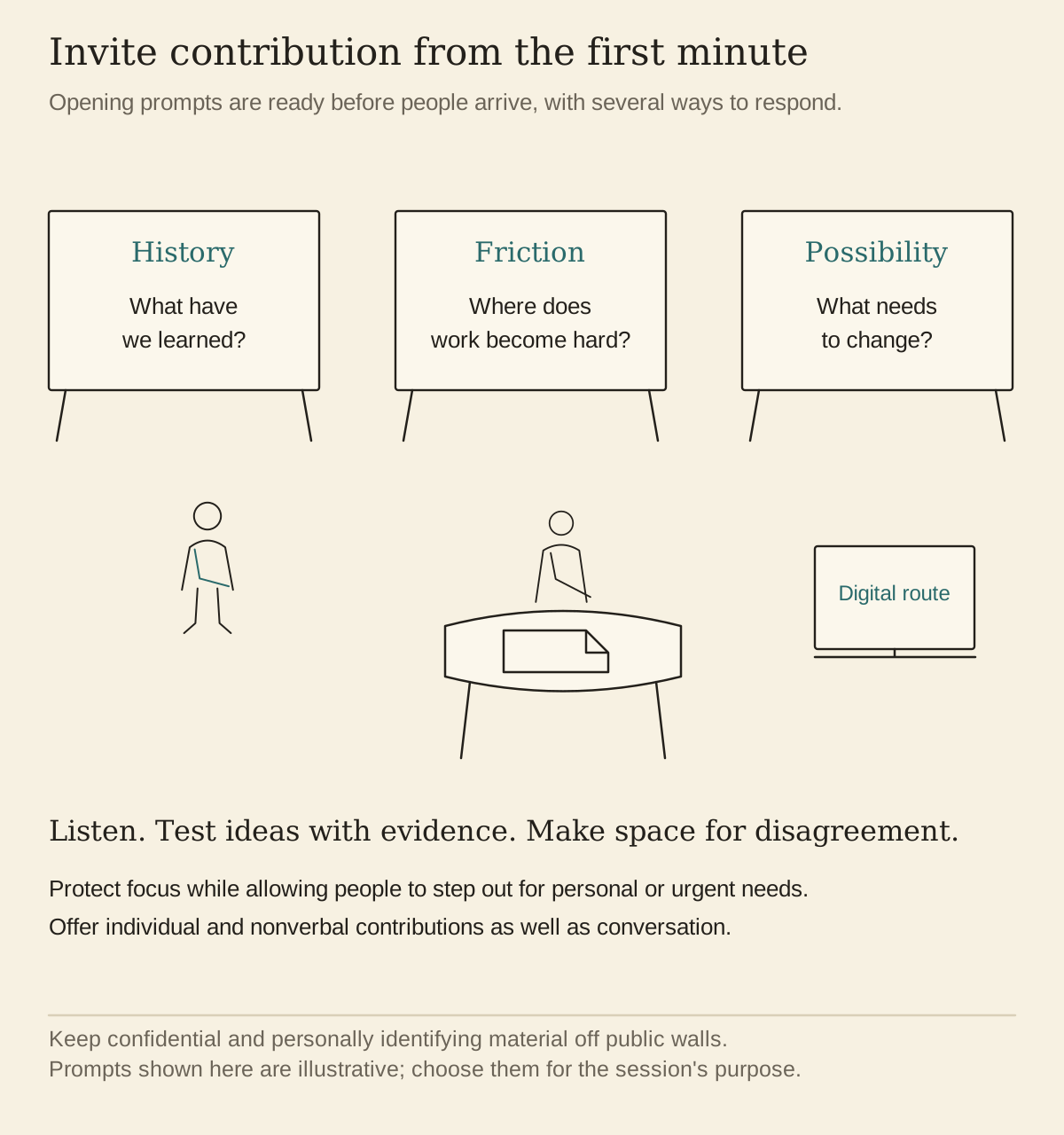
I open the day by talking about what it means to be a good participant in a session like this. Three things, and I say them plainly.
Single-tasking. Protect the session from avoidable calls, email, and divided attention. Also tell people explicitly that they may step out for health, caregiving, religious, accessibility, safety, or urgent work needs without explaining themselves publicly. Focus is a shared condition the design supports. The design earns it.
Listening. High-performing executives are trained to always have an answer, so our brains run ahead of the conversation because we want the best one. I ask people to actually listen to their teammates instead of sitting in their own heads composing what they will say next.
Debate. We want people bringing different ideas together, testing evidence, and sometimes preserving disagreement. Synthesis can produce something none arrived with; forced convergence can erase the person who was right. Critique the idea without requiring everyone to merge it.
The last thing I ask for is quality over quantity. I want five really good ideas from a team, thought through, rather than a list of fifty.
When a room needs shared knowledge before it can work, we may run chatrooms instead of one lecture. Three or four short talks run in parallel, followed by questions, and groups rotate. Provide the material in accessible form before or after, caption and amplify as needed, avoid requiring standing, and use visual as well as musical cues. Parallel delivery does not guarantee everyone heard the same thing; a common evidence packet and plenary clarification keep the level-setting from fragmenting.
Five really good ideas, thought through. Not a list of fifty.
Moving Work Between Rounds
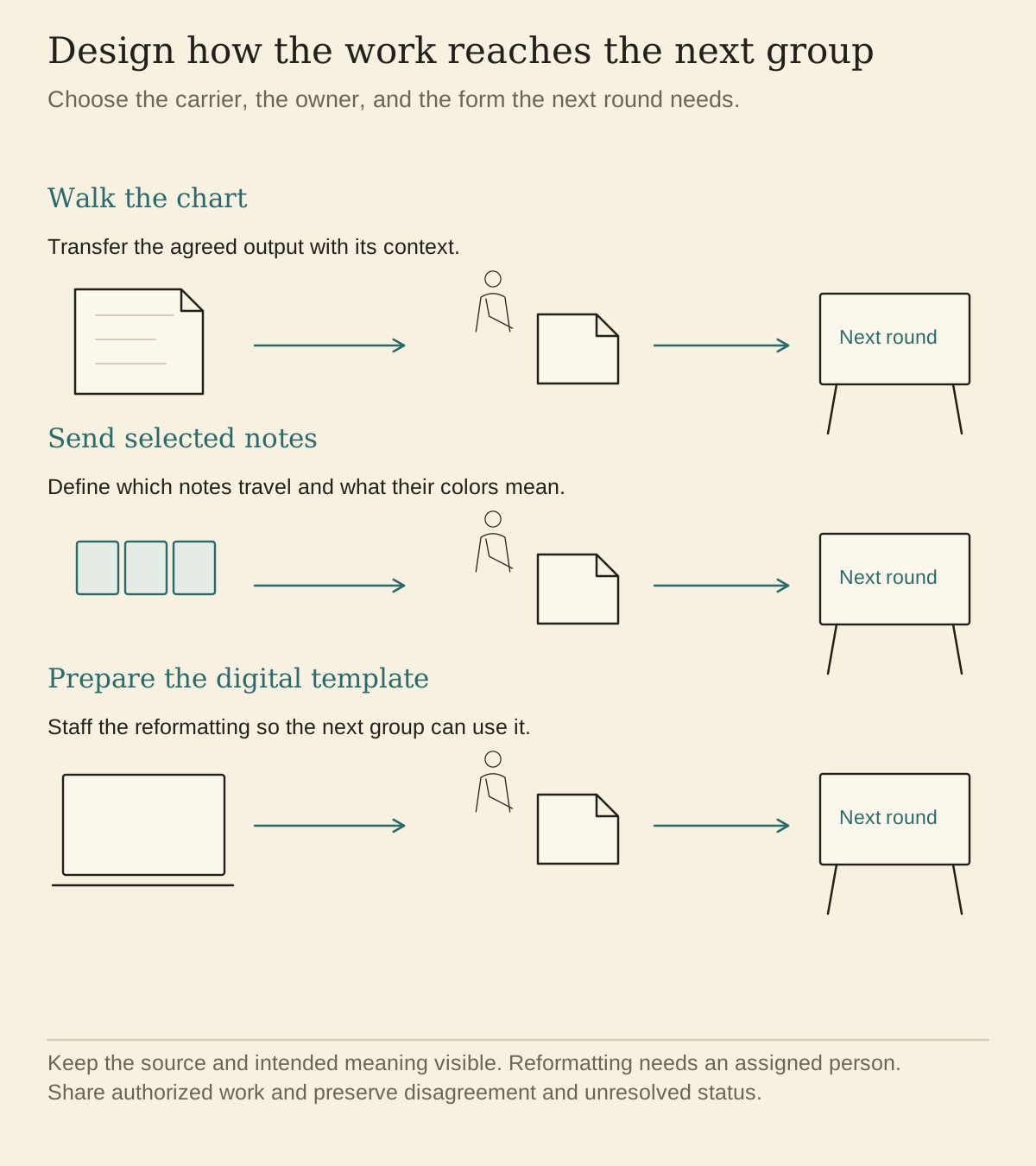
In a shift-and-share, sometimes the boards move and sometimes the people move. Sometimes one person stays behind while the rest of the team rotates. It depends on the space and on what we are trying to get. A common version is five-minute shifts, rotating three or four times, and then coming back home to where you started.
For carrying work forward, we use one of three mechanisms. Big flip-chart paper, where one round's output is written up and handed to the next team. Colored sticky notes, where the blue ones travel to the next round. Or digital templates in Google Slides or Docs, where a team types their output and our people reformat it into the shape the next round needs.
That reformatting between rounds is real work, and it is why the facilitation team matters. With forty or a hundred people you are producing a lot of output, and somebody has to manage it, template it, and make it reusable for the round that follows.
When Something Goes Sideways
If the room goes quiet, I do not assume disengagement. The question may be unclear, the stakes may feel unsafe, people may need processing time, or silence may be useful. I can restate the purpose, offer a minute to write, invite pairs, use an anonymous channel, or ask for volunteers. Direct invitation can work when the participant has agreed to that norm; surprise cold-calling can turn reflection into exposure.
If one person dominates, I reinforce the norm and change the structure: timed turns, writing first, a round-robin with a pass option, or a smaller group. A quiet conversation may be appropriate, led by the facilitator rather than using the sponsor's authority unless conduct or safety requires it. The goal is equitable airtime.
If a group finishes early, I check its evidence, detail, dissent, and whether the assignment was too easy or unclear. It may genuinely be done. I can offer an extension question or invite it to test the output from another perspective. Comparing it vaguely with “deeper” teams uses social pressure without giving useful feedback.
If a group rejects the premise, that happens, and it is fine. I walk the room making sure everyone understands the assignment. When a team pushes back, I give them the overarching goal and tell them that if they want to get there a different way, go for it. Letting them own the work is usually better than winning the argument.
What I watch when deciding whether to cut a round short or let it run is the evidence, detail, participation, and usefulness of the output for the next step. If needed, I enter a breakout, explain the gap, and ask a sharper question. A sponsor may observe only if the role was disclosed and will not suppress candor. Observation should assess one thing: whether the structure enables participation. It is not there to grade individuals, to judge whether an expert is “useful,” or ask whether teams should be pushed harder. Feedback belongs to the process unless conduct requires a separate response.
A person who appears not to engage may be choosing that. Behavior alone does not tell me why. They may be processing, excluded by the format, unconvinced of safety, dealing with a disability or private event, or signaling that the work is not legitimate. I can offer a private, nonintrusive check-in and an alternative channel. Participation may grow with the group, but conformity is not the measure of a successful room.
When an unanticipated tension surfaces, I assess consequence, consent, power, confidentiality, time, and whether the full group is the right place. Some tensions should be named in plenary. Others need a break, private support, formal grievance route, specialist help, or follow-up with people who were harmed. “Let us discuss the elephant” is not permission to expose someone. The session should make difficult issues addressable without pretending every issue can or should be resolved immediately in public.
Closing the Day
I like to close with a synthesis activity in which people reflect on what they produced. A commitment round belongs only after the group has earned it and only for actions within each person's authority. Passing must be allowed. People should not make public promises under social pressure that their manager later treats as consent or performance evidence.
It can be moving to hear people name what they are ready to do. Emotion is weak proof that a commitment is real, and tears make a poor design goal. Face-to-face contact may add weight for some people; remote commitments can also be sincere. What makes a commitment credible is specificity, choice, authority, resources, follow-through, and the ability to revise it when new evidence appears.
At the end I review where we got to, thank everyone, and invite reflection on what was useful, difficult, incomplete, or missing. The sponsor often closes by naming what happens next. The final word should not overwrite dissent or turn the day into endorsement; in some sessions a participant, worker representative, customer, or neutral facilitator is the more legitimate closing voice.
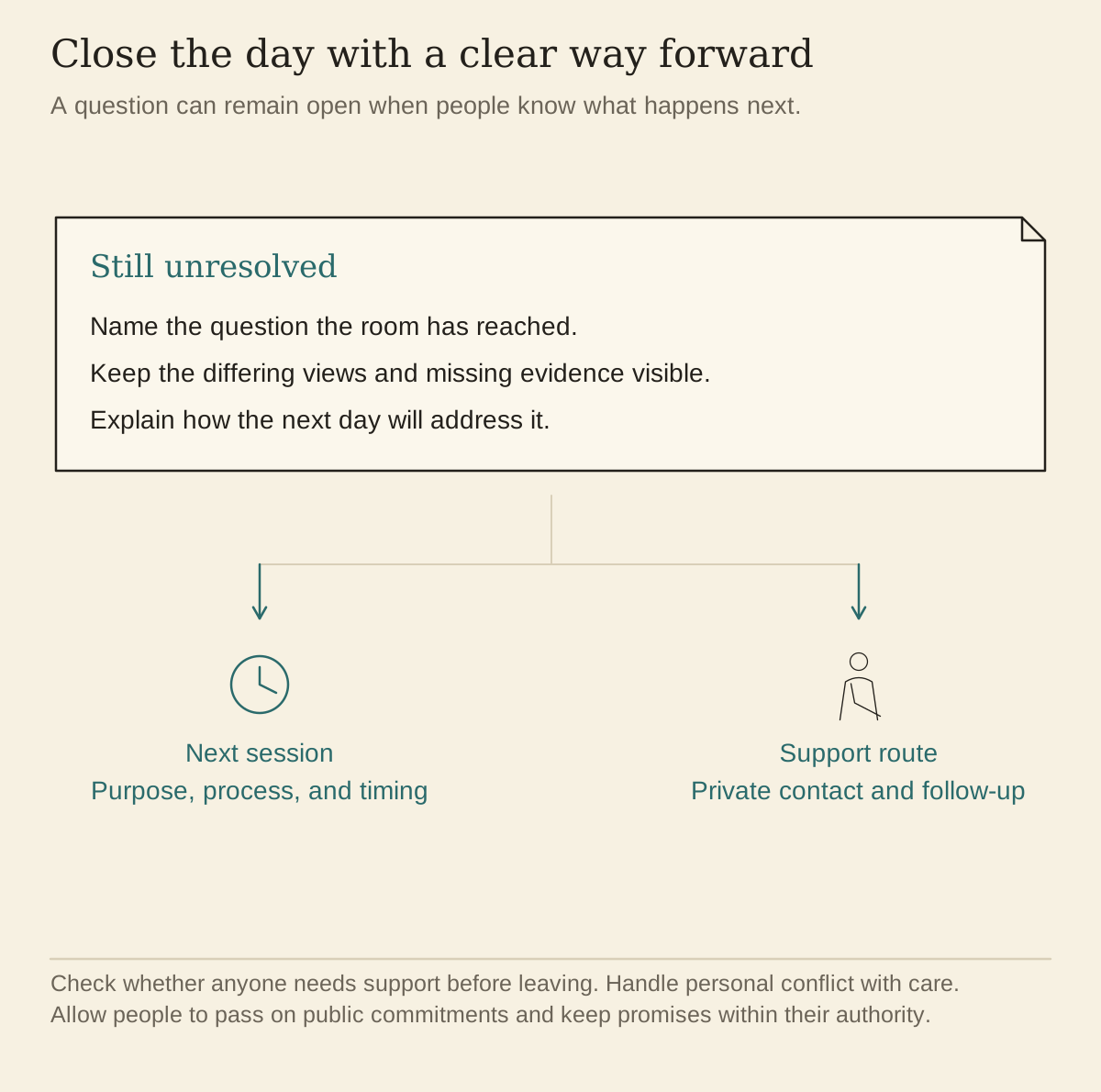
On a two-day session, we sometimes end Day One with an important question still open so people return ready to continue. Do not manufacture anxiety or leave a personal conflict raw for dramatic effect. Before people leave, name the open questions, explain how the next day will address them, and check whether anyone needs support.
Some participants have called a session the most productive of their career. I value that response while treating it as satisfaction evidence, vulnerable to selection, courtesy, recency, and the energy of the day. Photographs belong only to people who consented to them. The stronger test arrives later: what decision improved, what commitment held, what changed for people outside the room, and what the process cost.
The Shape of a Day
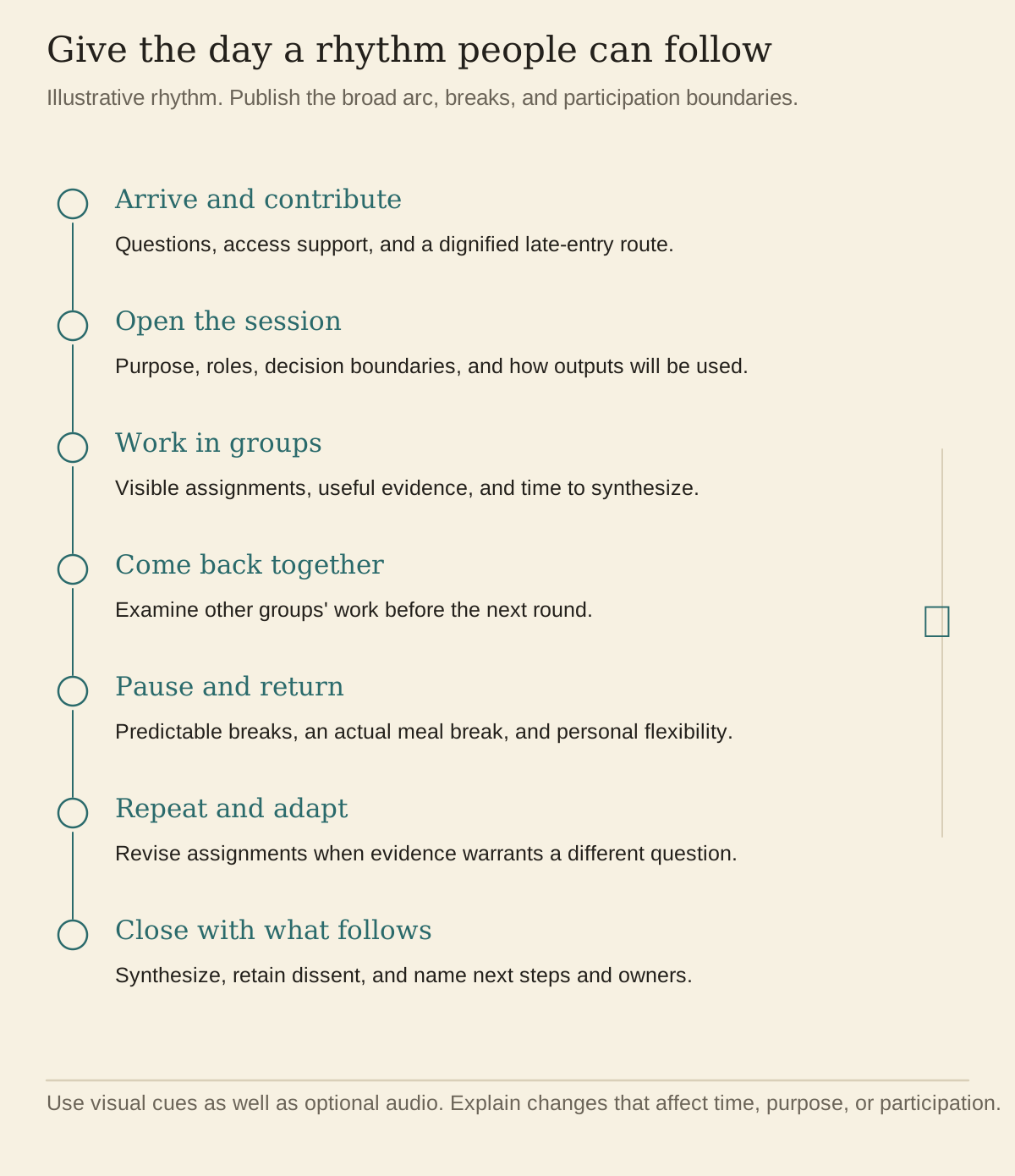
Sessions often start with breakfast and coffee. Partly hospitality, partly logistics. Food can support timely arrival, but travel, disability, caregiving, and transit disruption still happen. Publish a firm start and a dignified late-entry path so one delay does not derail the room or shame the person arriving.
When someone walks in, the default is to put away avoidable distractions while retaining devices and supports people need. Then they receive an opening assignment: pair up or work individually, get settled, and explore the questions around the space or in the digital equivalent. Depending on group size and access needs, that runs fifteen minutes to half an hour.
Once we have a quorum, we turn up the music. That is the signal to come sit down, and we use music the same way all day, as the cue that something is changing. I welcome everyone, set up my own role briefly, and hand over to the sponsor to welcome the room in their own words. Half an hour at most.
Then I come back and set up the first round. We describe the assignment, often put it on a screen so it stays visible, show how the teams are assigned, and send people out to their breakouts.
From there the day is a rhythm. Teams work. I am walking the room, stopping at every group to make sure they understand the assignment, watching for thirty or forty minutes while the work develops. I give a warning about five minutes out so they can wrap up and finish documenting. They bring their work to the front. Most rounds, most teams report out, and I time the report-outs to keep us honest. Then straight back out to the next round. Work, share, work again.
Through all of it I check with the sponsor and design team against the stated objectives. Satisfaction is a separate question. Participants know the scheduled breaks and may also step out as needed. The room pauses for lunch. Momentum matters, and humane participation is part of the momentum rather than its enemy.
I build the closing synthesis as the day develops, using the work people have put on the walls.
The Scene Change
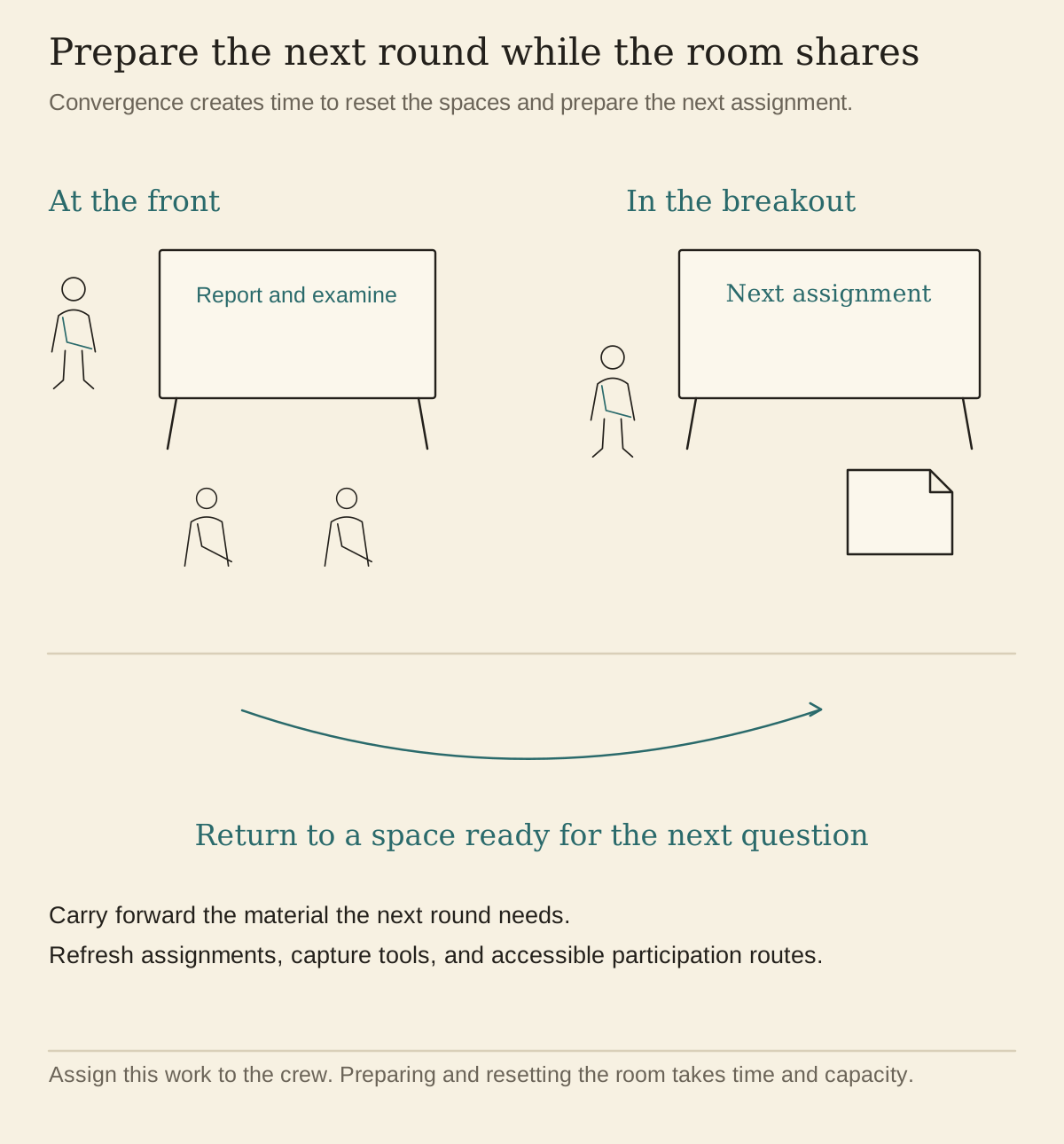
The part nobody sees is what the facilitation team does while the groups are working.
During a breakout they are preparing the next one. Organizing sticky notes. Getting flip charts ready. Then, when teams come to the front of the room to report out, the team goes into the empty breakout areas and resets them. I call it a scene change. By the time the report-outs finish, every breakout has been refreshed with the next activity, and people walk back into a space already staged for what comes next.
So while I am up front running the share-out, I am also watching my team in the background rebuilding the room. That orchestration is most of why the day feels all of one piece to the people inside it, and it is invisible by design.
By the time the report-outs finish, every breakout has been reset for the next activity. The room stays a step ahead of the people in it.
Changing the Design Live
I change things when the evidence in the room warrants it. Explain changes that affect the purpose, timing, or use of the work.
If I am moving between groups and I see a team struggling, I will hand them another question or two to test their work. If I see a team lit up about one particular area, I will tell them to stay there and go deeper rather than covering my original assignment end to end. Sometimes I wait until after a report-out, change the assignment entirely, and send them back with something different. I might just write it up at the front of the room.
I have run rounds where the exact assignment is held until groups arrive, allowing the design to respond to what the room needs. Participants should still know the purpose, time, decision boundary, and how their output will be used. Openness in design is not opacity about participation.
When the Room Turns
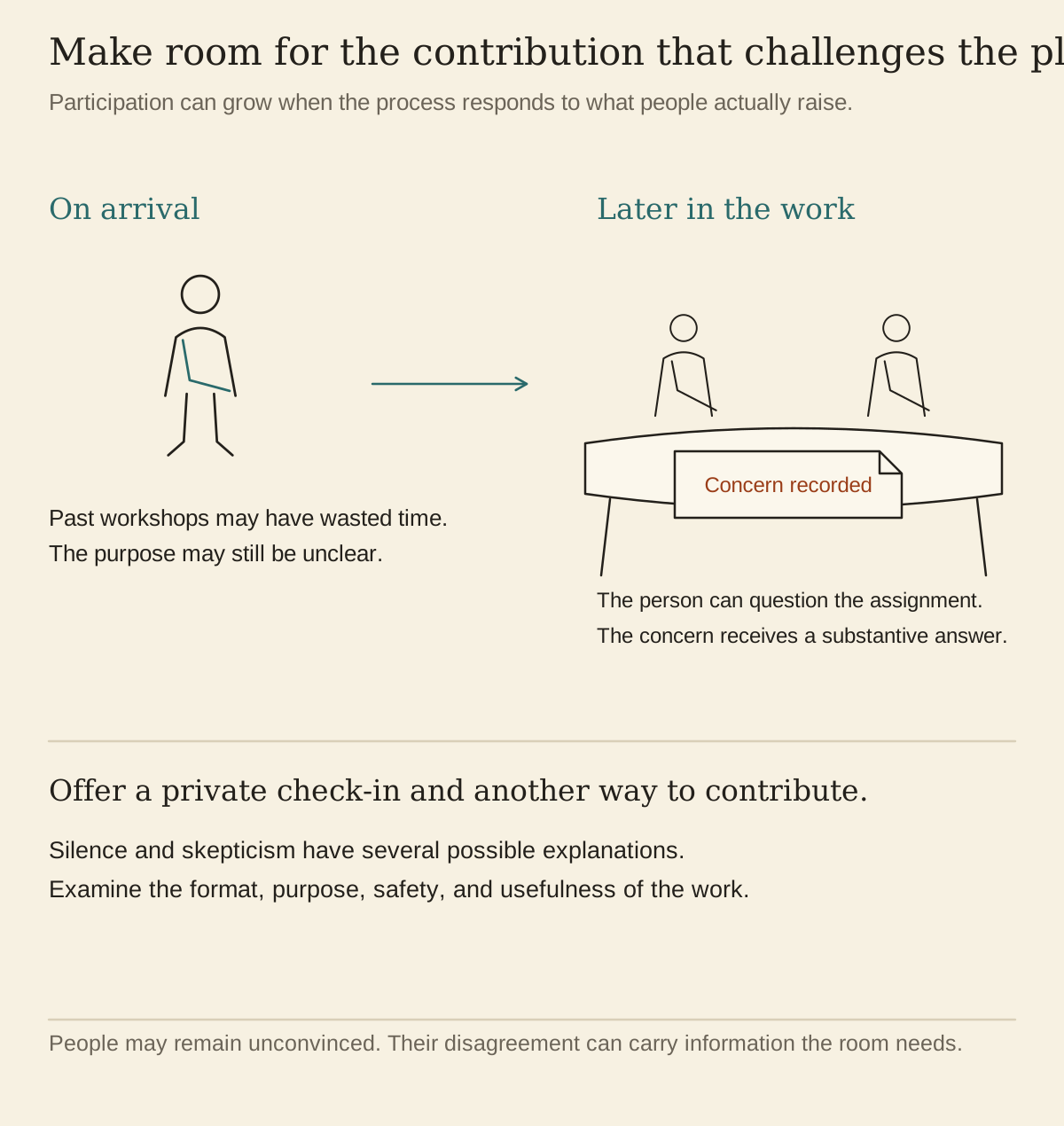
Almost every session has a few people who arrive in a bad mood, or who have never once been in a workshop worth their time and are expecting this to be the same. They have good reason to expect another wasted day.
The energy of the room can invite skeptical participants into the work. It can also pressure them to perform agreement. Some will engage later; some will remain unconvinced and may have good reason. My job is to make contribution possible and take dissent seriously.
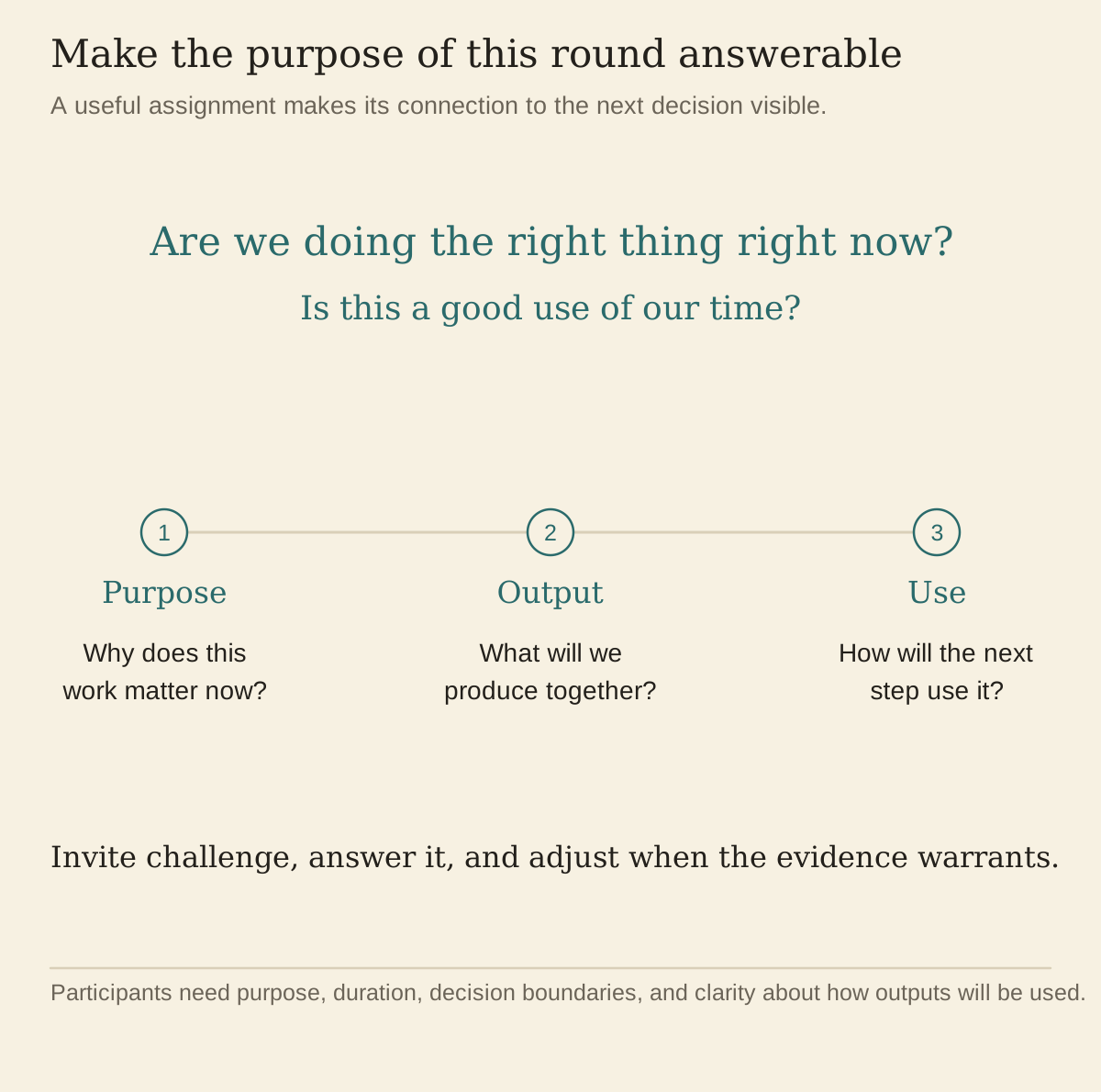
By the end, I want people to understand the process and judge it worthy of trust based on what it did. The question many participants carry is: are we doing the right thing right now, and is this a good use of our time? I answer with the purpose and the connection to what comes next. Participants should be able to challenge the assignment and receive a substantive answer.
Afterward
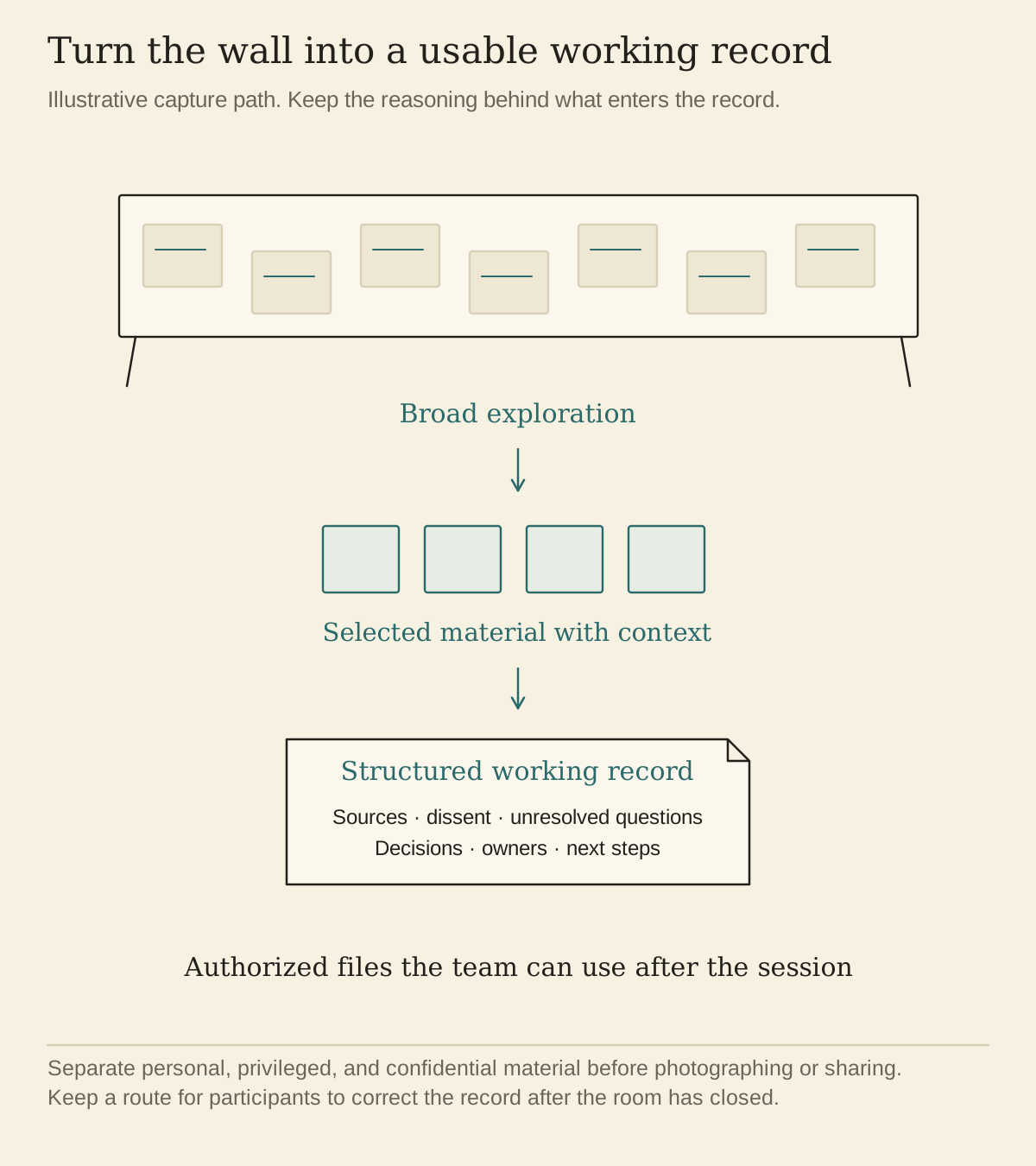
In the forty-eight hours after the room closes, our team aims to inventory and digitize agreed outputs and hand the authorized set to the client team. Before photographing boards, we separate shared work from personal, confidential, privileged, or sensitive material. The delivery preserves provenance, dissent, and unresolved status rather than polishing every note into agreement. Sponsor communication thanks participants, explains next steps, and gives each audience access only to what it is entitled to see.
What the harvest looks like depends on the session. We have delivered videos, e-books, and magazines. It depends on the purpose of the work.
Three months later, my facilitation team may not be involved unless follow-through was explicitly contracted. That makes client ownership, internal capability, and named responsibility essential. The session should establish review cadence, owners, decision rights, evidence, and escalation before people leave. It should also leave a route for participants to correct the record or raise a concern after the social pressure of the room has passed.
How do I know whether it worked? Satisfaction, readiness, and sponsor judgment matter, but they are not enough. I want participant feedback that can be candid, evidence of inclusion across groups, the quality and traceability of decisions, follow-through on commitments, and later operating outcomes appropriate to the session's purpose. Excitement is an immediate signal. Changed decisions and consequences are the test.
That is the craft, as plainly as I can set it down. It is the half of this work that does not fit in a framework, and it is the half that decides whether a room produces something real. Stage 10 closes the field guide with an account of who wrote this and why, and a statement of what we believe.
Consider. Look at the last working session your team ran. How many of these details were decided deliberately, and how many were inherited from how meetings usually go? The agenda, the breaks, the room, the group sizes, the way work moved between rounds. Most of the difference between a session that produces something and one that produces a nice conversation lives in those choices.
Consider. If you keep three things from Stage 9: 1) Strategy, operating design, workforce participation, governance, and architecture need explicit interfaces and shared evidence, whether one team provides them or several do. 2) A leadership team needs enough working alignment to decide coherently, while preserving dissent and commissioning analysis where evidence is missing. 3) The Alignment Sprint is one bounded on-ramp, built to distinguish decisions, commitments, hypotheses, and questions that require wider participation.