What is worth committing to as this transition unfolds?
Everything to this point speaks in my voice because the account is mine. This last section speaks as we, and the we is specific: the human partnership behind this field guide and the people who build and facilitate alongside me. AI systems helped us draft, test, retrieve, compare, and revise, as the preceding stages describe. They are tools and collaborators in the practical sense. Beliefs and accountability belong to the people who wrote this. The people named by the we own what follows.
These are the commitments we make and the ideas we continue to test. Their arguments, evidence, and limits appear throughout the book.
We believe that AI-Native is finally a question about human life. Operating models, architectures, practices, and technologies express a more foundational choice: what kind of place the company will be for the people who spend a significant part of their lives there and for the people affected by its products and decisions. A leadership team that excludes that question is solving an incomplete problem, however rigorous the optimization.
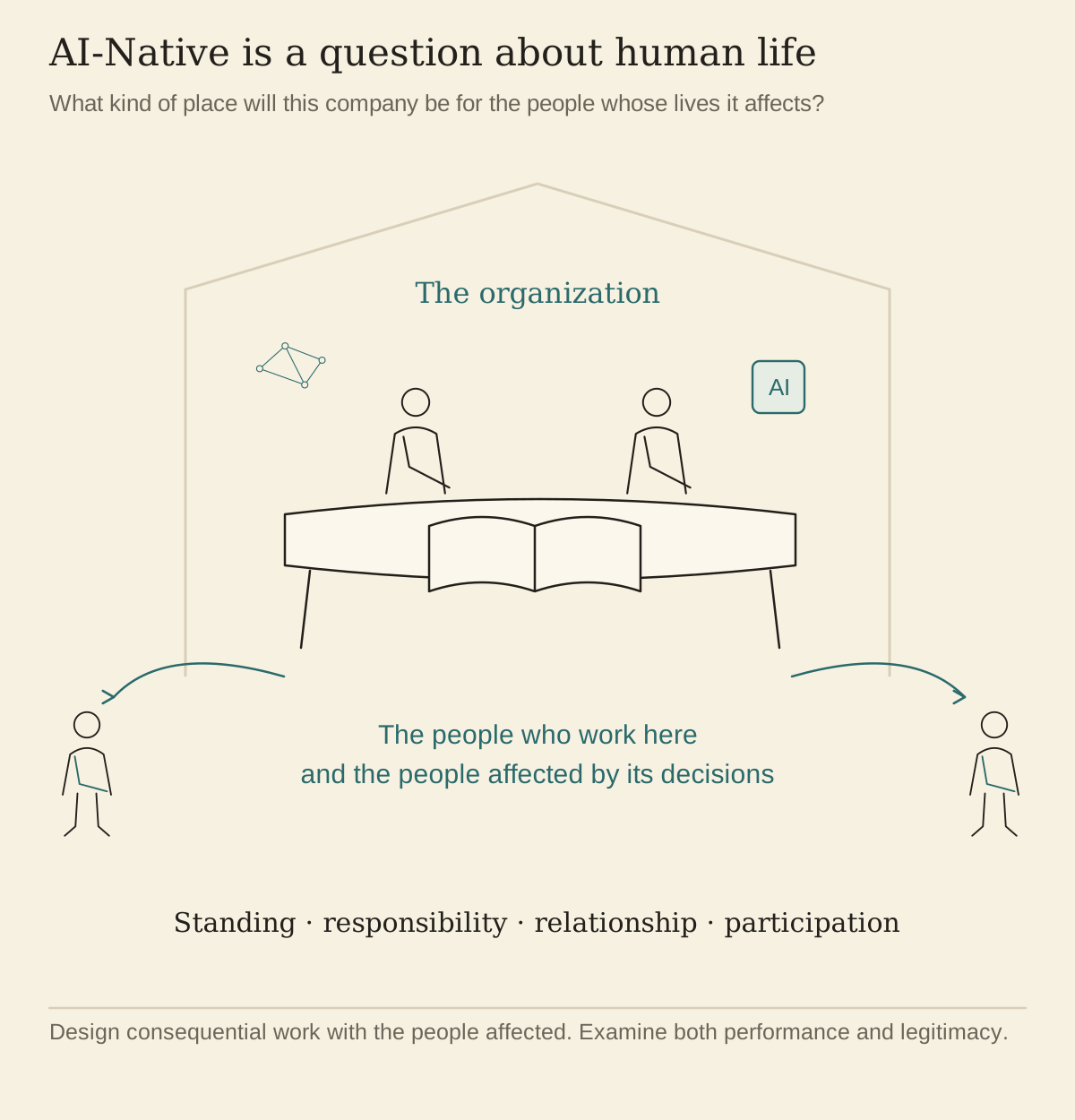
We believe that framing humans as the residual around automation is wrong. Human value is not secured by a permanent list of tasks machines cannot perform. It rests in standing, responsibility, relationship, participation, embodiment, lived stakes, and the authority to shape consequential work. A company that protects and develops those forms of value may build stronger performance and legitimacy; it should measure both rather than treat moral commitment as a guaranteed competitive return.
We believe that institutional knowledge can become strategic advantage in the AI-Native era. It lives across people, relationships, records, documents, graphs, databases, rules, tools, and practice. No single representation captures it, and structured knowledge does not reason by itself. Fair, willing participation improves what can be preserved, but willingness also depends on workload, consent, credit, compensation, privacy, professional duty, and whether leadership's conduct makes the covenant credible. The rest must be carried through apprenticeship, redundancy, succession, and continued human judgment.
We believe that the human reckoning is foundational. Grief over expertise, threats to status, fear of obsolescence, survivor guilt, shame at starting over, anger at broken promises, and complicated relief may all be present, alongside curiosity, indifference, and hope. Leaders should not assign emotions to people or demand disclosure. They should create honest channels, change the conditions producing avoidable harm, and accept that naming emotion is neither therapy nor a guarantee of transition success.
We believe that the distinction between using AI for thinking and allowing it to substitute for thinking a person or institution still needs is consequential. The right posture depends on the task, stakes, and capability the organization must retain. Offloading can be rational; unexamined dependence can weaken learning and verification. Companies should decide deliberately, test capability over time, and protect practice where judgment remains part of the job.
We believe that up-leveling is possible and uneven. Conditions such as supported challenge, feedback, time, access, mentorship, and meaningful work can be designed, but they do not produce identical results for every person. Demanding productivity without development may meet an immediate need while spending down capability. The workforce should help define what development matters and receive fair opportunity to pursue it.
We believe that the welder's standard is a question every AI-Native leadership team should be willing to hear: if a worker met you years from now, what might they say about the work they did here? Leaders cannot answer for workers, and confidence is not evidence. Ask people directly through safe channels, examine differences across groups, and treat hesitation as a prompt for inquiry rather than a diagnosis of hidden wrongdoing.
We believe that architecture shapes whether AI capability compounds or fragments. The nine-layer stack is an analytical model, and companies can build its layers in whatever order fits. Chat can be valuable and governable in a bounded use case; it becomes weak strategy when the company mistakes individual access for shared capability. Graphs fit relationship-heavy knowledge, collaboration surfaces fit shared work, and simpler stores or tools may fit other needs. The right default is deliberate, interoperable, permissioned architecture, with shared multiplayer surfaces where the work calls for them.
We believe that epistemic hygiene is a strategic discipline. Corroboration, monitoring, verification, provenance, evaluation, incident response, and the freedom to challenge an output improve the trustworthiness of AI-mediated work. They do not make it perfectly trustworthy at scale. Assurance remains bounded by the evidence, controls, people, and systems doing it.
We believe that practices help produce sustained change. Values without corresponding behavior, incentives, and accountability become slogans. Repeated practices can create conditions for learning, dignity, and human flourishing, but they can also become compulsory ritual. Teams should examine who benefits, who is burdened, and whether the practice still serves its value.
We believe that moments that matter are a useful level of analysis for meaningful human involvement. Consequence, rights, context, responsibility, preference, and relationship help identify where human participation deserves particular investment. Some moments can be automated responsibly; others require legitimate human authority. Design, protect, and review them with the people affected rather than assuming human presence alone creates a memorable experience.
We believe that an AI-Native transition is both a portfolio of projects and a changing system. Feedback structures can reinforce or balance change, and “defeating” names our managerial category for harmful combinations. Loop maps are hypotheses to test. Mental models can be powerful places to intervene, but structures, rules, information flows, power, and immediate events matter too, and causality runs in both directions. Skilled facilitation can help a team examine its assumptions; no process guarantees change will hold for eighteen to thirty-six months.
A leadership team that has read this book has arguments, frames, cautions, and references to which it can return. It has questions to test with its own workforce, customers, systems, and evidence. It has a possible beginning. If a bounded leadership engagement fits the need, the Alignment Sprint in Section 9.2 is one concrete move. It is not the only one.
The work itself is still ahead, and this field guide is preparation, and the evidence decides when to act. A reader may move, pause, investigate, reject a recommendation, or decide that a proposed AI use should not proceed. Bringing one leadership conversation to a more honest and consequential level, or stopping one badly designed intervention, would already produce value the field guide was written to enable.
We are available to support you if you would like the support. We would be honored to do this work with you if you choose us, and we would be glad to see you do this work well if you choose someone else, or if you do it on your own. The work matters more than who supports it. The work itself is what we advocate.
This is the end of this field guide. The beginning of the work is yours.
Consider. If you keep three things from Stage 10: 1) Legitimate participation changes people's relationship to the work, but it does not replace rights, authority, consent, or accountability. 2) These beliefs are a distillation; the arguments, evidence, and limits live in the stages behind you. Return to the one your situation requires. 3) The field guide prepares; the decisions and consequences are yours. Improve one consequential conversation or stop one badly designed intervention and it has done useful work.